No. 1 - Capital Stops Pretending Nature Is a Separate Ledger
The week capital stopped pretending that nature was a separate ledger

The Climate-Nature Nexus in Practice (Weekly Briefing to 26 May 2026)
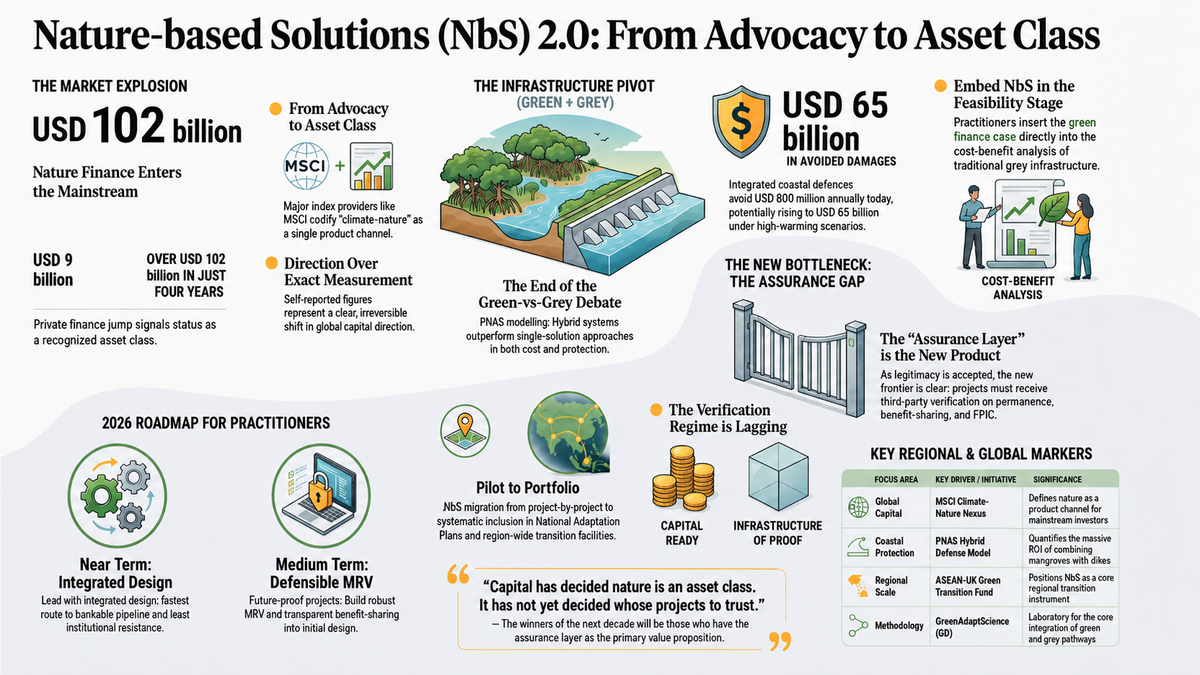
Bottom line: Nature finance has moved from an advocacy category to a recognized asset class, and the binding constraint has shifted with it, from legitimacy to assurance. The deals that close from here are the ones that can prove their claims. Stop spending scarce credibility arguing that ecosystems are infrastructure; spend it on the verification, safeguards, and consent that survive third-party scrutiny.
Here is the gateway into the field, and the briefing is the room you walk into (Podcast and Video, courtesy NotebookLM):
Link to Explainer Video
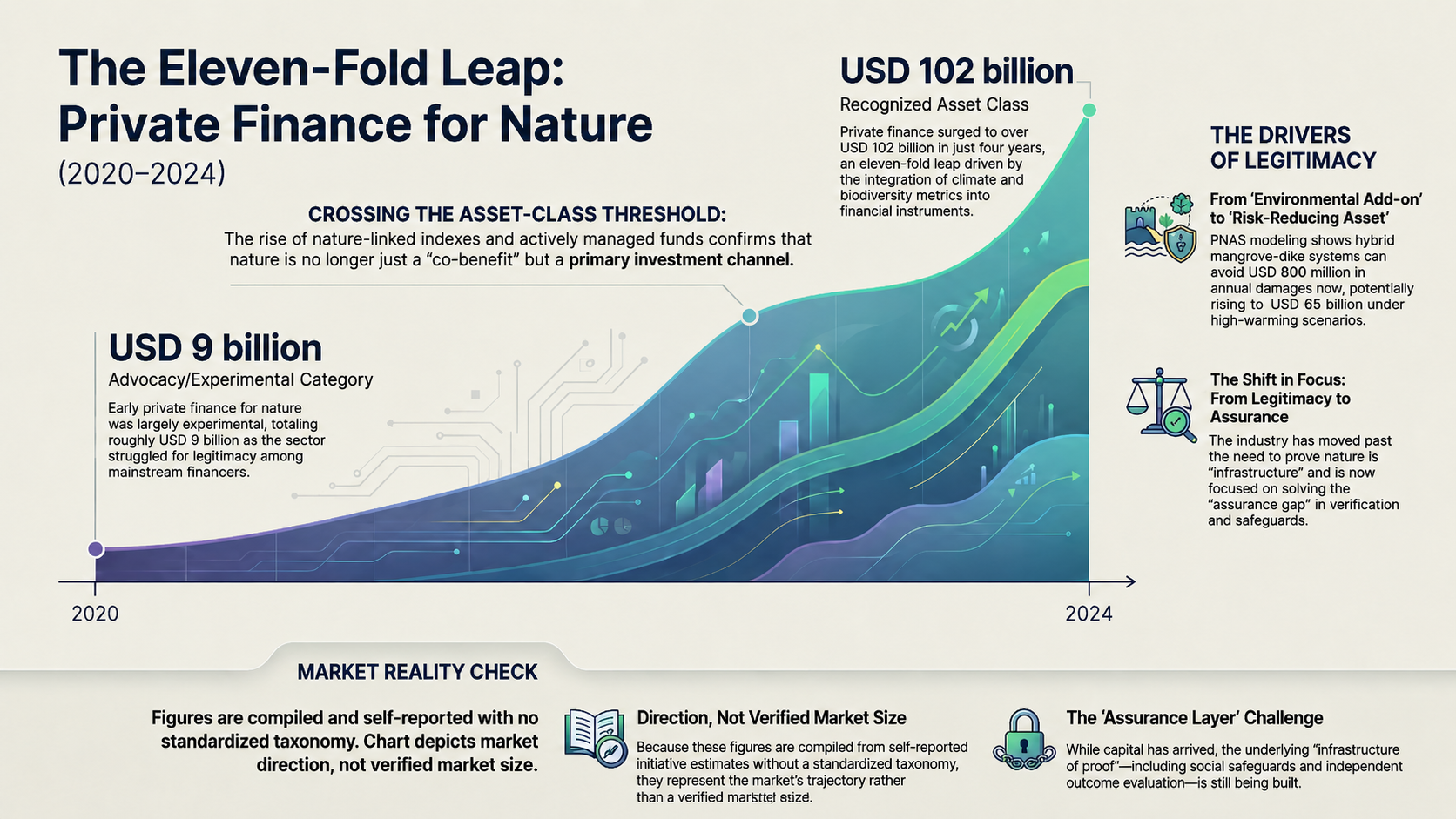
The sharpest signal in this week's evidence is not that nature finance is growing; everyone says that, but that it has quietly crossed a threshold. MSCI's nexus primer, recirculated this week as a market-framing reference, reports that private finance for nature has surpassed USD 102 billion, up from roughly USD 9 billion four years earlier, channeled through nature-linked indexes, ETFs, and debt conversions that integrate climate and biodiversity metrics into a single instrument.[1] The meaningful event is not the number, which is soft: compiled from self-reported estimates, with no standardized taxonomy and limited verification, it is a directional indicator rather than a market size. The meaningful event is that a major index provider has codified "climate–nature" as an identifiable product channel for mainstream investors. The framing has won even where the metrics have not.
That victory resolves the unsolved problem. For most of a decade, the binding constraint on NbS was legitimacy, specifically persuading ministries and financiers that ecosystems are infrastructure. That argument is effectively over. The Proceedings of the National Academy of Sciences' modeling of hybrid mangrove–dike defenses [2], reported by Mongabay and estimating roughly USD 800 million in avoided annual damages now and up to USD 65 billion under high-warming scenarios, is the kind of quantification that ends debates rather than starting them. The constraint has shifted downstream to verification, safeguards, and deal structure. Blue carbon reviews highlight significant methodological and governance challenges: carbon accounting often relies on short‑term or model‑based estimates rather than long‑term outcome monitoring, and robust baselines, attribution, and permanence assessments remain difficult to establish, underscoring the need for more rigorous monitoring, reporting, and verification and the cautious use of blue carbon credits.[3]
For senior practitioners, the implication is operational and immediate: redirect scarce credibility from defending the category to building the assurance layer. Deals that close will be those that withstand third-party scrutiny of permanence, benefit-sharing, and free, prior, and informed consent, precisely the questions June's NbS Symposium has organized around. The frontier is no longer whether mangroves are bankable. It is whether your mangrove project can prove what it claims.
Two clocks, Out of Phase
The structural story beneath the week is two movements running at different speeds: design convergence is largely settled, while the assurance architecture that should underwrite it is not. The gap between them will define the next two years of practitioner work.
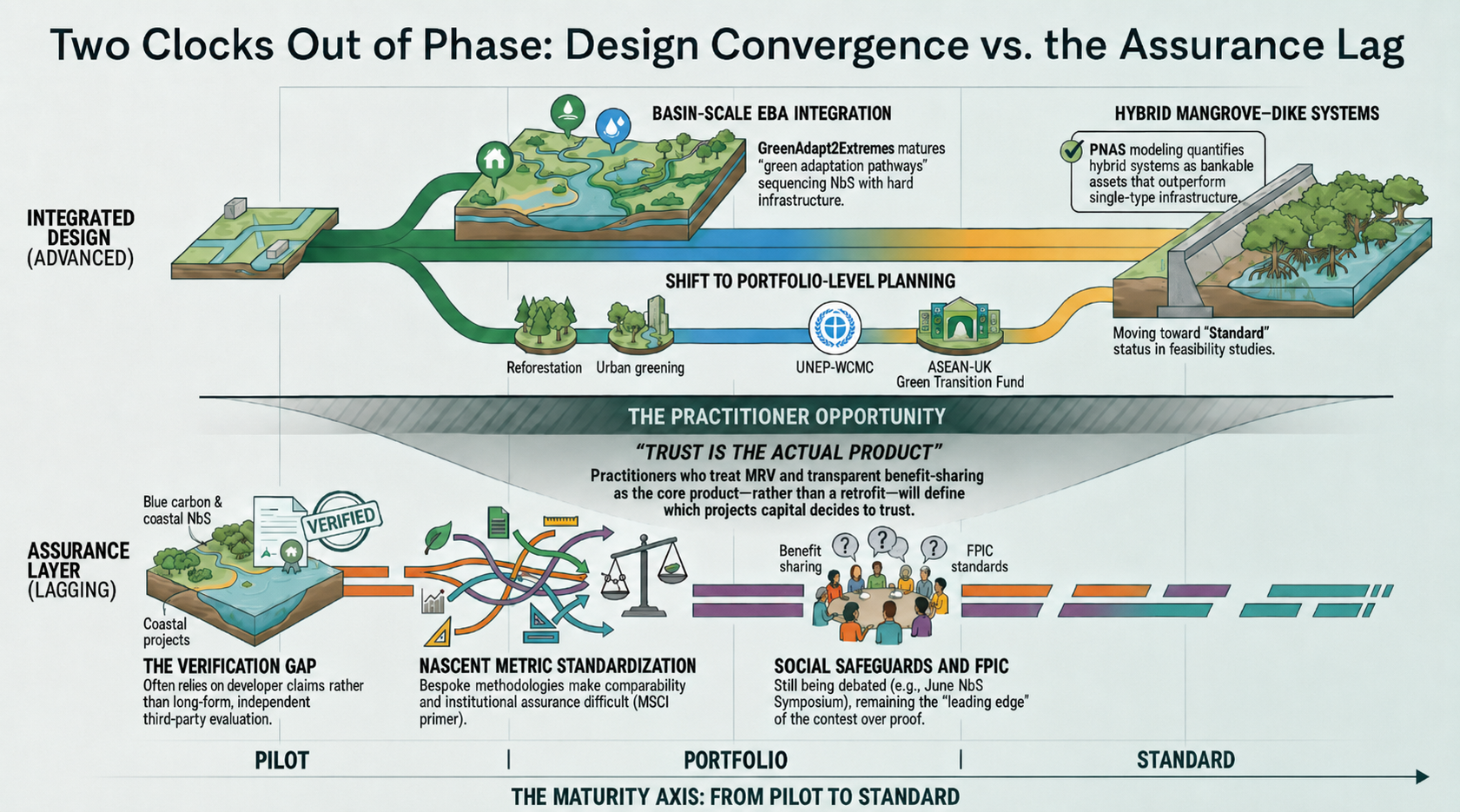
Design convergence is the more advanced of the two. The PNAS hybrid-defense modeling does what the field has wanted for a decade: it places mangrove restoration and engineered dikes within a single optimization rather than treating them as rival philosophies. It finds that combined systems outperform either alone, with benefits scaling steeply under high warming and falling hardest on lower-income coasts in South and Southeast Asia. That reframes mangroves as risk-reducing capital within an infrastructure feasibility study, not an environmental add-on appended after engineering. The practitioner move follows directly: insert NbS into the feasibility and cost–benefit stages of gray projects rather than proposing parallel green ones, and require that resilience metrics in infrastructure appraisal explicitly price ecosystem contributions. Europe's GreenAdapt2Extremes consortium, working in the Dora Baltea, Erft, and Geul basins, is the laboratory for exactly this integration at the river-basin scale, and its grant-funded methods are the kind that harden into de facto adaptation guidance.
The institutional counterpart is the shift from pilot to portfolio. UNEP-WCMC's May update [4] frames EbA as moving from project-by-project experimentation to systematic national adaptation planning, and the ASEAN–UK Green Transition Fund embodies the same logic at the financing level, positioning NbS as a core pipeline rather than a conservation annex. As a result, the unit of engagement is becoming the portfolio and the national plan rather than the single concept note. This sharpens the value of a theory of change that links an intervention to a country's NDC and NAP, because that document lets a project slot into a portfolio rather than compete as an orphan.
But the assurance clock lags, and that should worry senior practitioners most. Evidence from the same week shows the deal archetype, blended carbon revenue, grant-based technical assistance, and public co-funding outpacing the verification regime, while safeguards, consent standards, and independent verification still vary from program to program. MSCI itself acknowledges that metric standardization is nascent and comparability is poor. The next standards fight is not over whether nature counts, but over what counts as proof. So the discipline is sequencing: lead with integrated green–grey design, the fastest route to a bankable pipeline, but build from the outset around defensible monitoring, reporting, and verification, transparent benefit-sharing, and genuine consent, rather than retrofitting them when a verifier arrives. The practitioners who matter over the next decade will treat the assurance layer not as a compliance cost but as the product they sell. Capital has decided that nature is an asset class. It has not decided which nature projects to trust. That is the opening.
The Record
Capital arrived this week; the proof infrastructure beneath it remains thin. Each item is read for what it does to that gap.
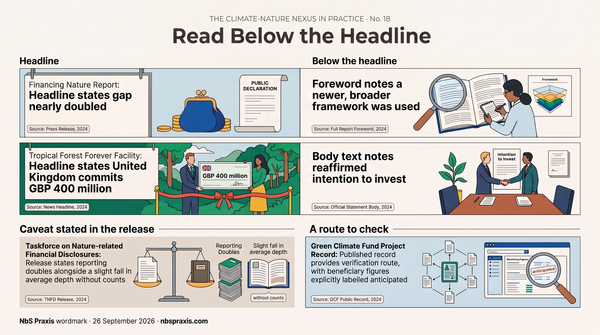
Private finance for nature passes USD 102 billion: a verdict, not a measurement. Mainstream capital now treats climate–nature as a single product channel; the roughly elevenfold rise over four years serves as a directional signal, since the figure itself is compiled, self-reported, and un-taxonomized. MSCI, The Climate–Nature Nexus: A Primer on the Way to Cali (16 October 2024, recirculated). Global. https://www.msci.com/research-and-insights/blog-post/the-climate-nature-nexus-a-primer-on-the-way-to-cali
Hybrid green–grey coastal modeling gives practitioners the number they wanted. Combined mangrove–dike systems could avoid roughly USD 800 million in annual damages now, rising to USD 65 billion under high warming, prospective value-at-risk, not committed capital, but enough to move the case into the cost–benefit language MDB infrastructure teams already use. Mongabay, 1 April 2026, reporting on a PNAS study. South/Southeast Asia salience. https://news.mongabay.com/2026/04/green-and-gray-mangroves-and-dikes-show-potential-in-protecting-shorelines-together/
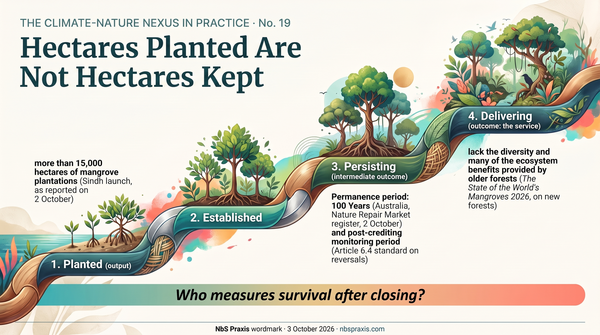
Blue carbon deals are outrunning their verification. Coastal NbS is increasingly structured as a multi-benefit investment rather than a conservation grant, but safeguards and verification diverge across programs, and many outcomes remain self-declared. This is the assurance gap, in concrete terms. Global Society Earth, 20 May 2026. https://www.globalsociety.earth/post/mangrove-restoration-and-blue-carbon-projects-are-reshaping-climate-finance-coastal-protect
The ASEAN–UK Green Transition Fund places NbS at a facility's core, not its annex. A structural signal more than an open funding window; with disbursement and impact data not yet public, the live work is pipeline conception aligned to GTF priorities rather than application. UK PACT. ASEAN region. https://www.ukpact.co.uk/regional-fund/asean-gtf
ASEAN in Focus
Southeast Asia is where this week’s two trends, integrated design and a lagging assurance layer, will collide most consequentially, because the region combines the highest physical exposure with the thinnest record of verified implementation. The opportunity is real; the governance gap is the binding constraint.
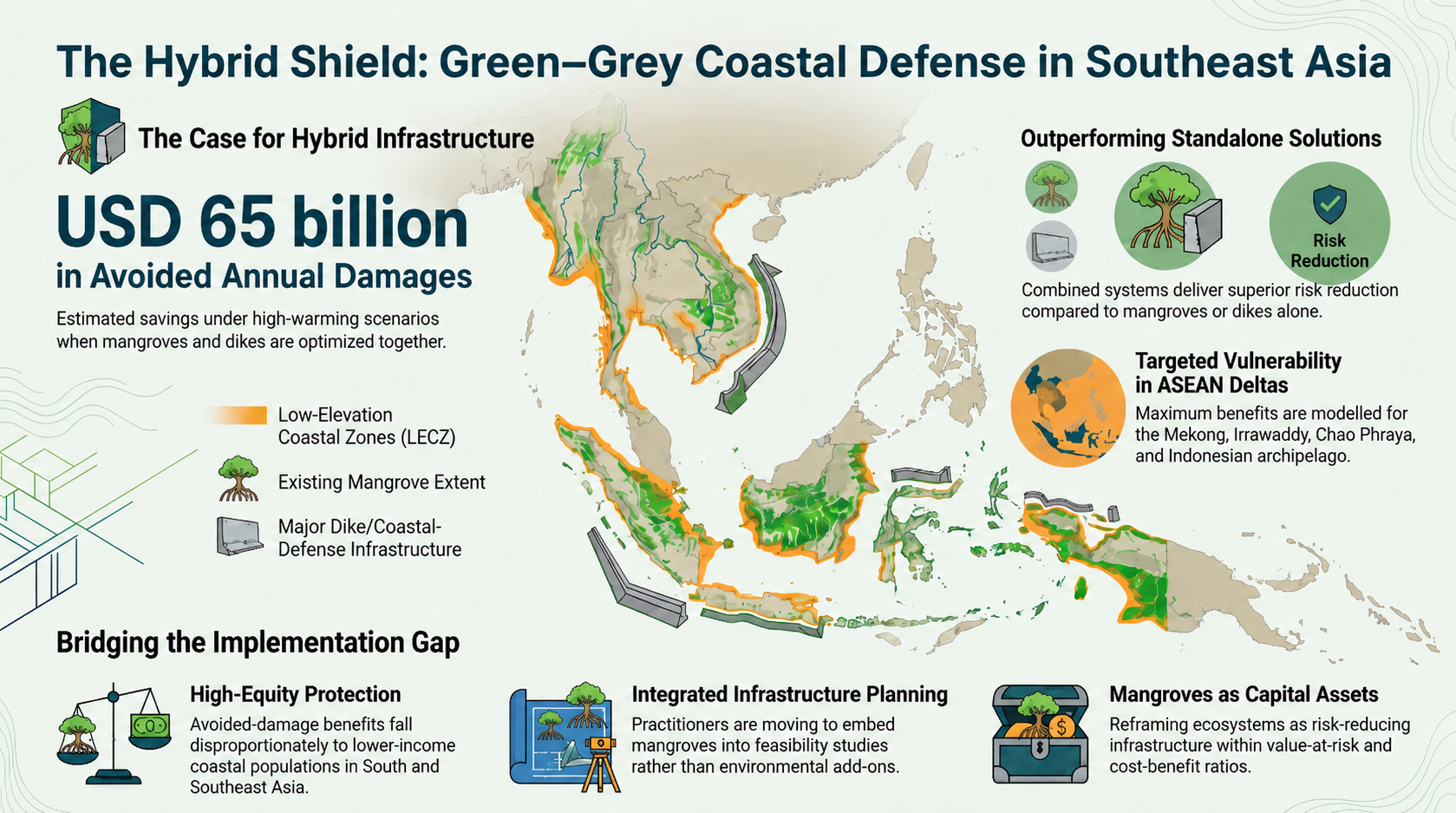
Southeast Asia is where the week's two clocks collide most sharply, because the region pairs the highest physical exposure with the thinnest record of verified implementation. The Green Transition Fund is the standout regional signal, treating ecosystem approaches as structural across energy, land use, and urban development, and is best read now as a forthcoming platform for project preparation that can crowd in MDB, domestic, and private capital, rather than as available funding. The European evidence transfers directly: basin-scale EbA methods to the region's transboundary rivers and deltas, and the hybrid mangrove–dike finding to its low-lying, dike-lined coasts, where the modeled equity-weighted benefits are largest. The honest qualifier is that fully realized ASEAN examples remain scarce, and local governance, tenure security, and implementation capacity, not the modeling, will determine whether the benefits materialize. The Yale ELTI/Blue Forests mangrove course in South Sulawesi is a direct, upstream response to that gap.
Worth Watching Through Year-End
The calendar is dominated by knowledge and governance events rather than pledging conferences, a sign that the field is still settling on how NbS should be done and proven. Attend to the standards being set, not the capital being moved.
NbS Symposium 2026, "Who benefits, who decides?" — June 2026. The leading edge of the assurance-and-safeguards debate; its emerging norms on benefit-sharing and consent will condition the bankability of nexus investments well beyond the room. Nature-based Solutions Initiative. https://www.naturebasedsolutionsinitiative.org/news/nbs-symposium-2026
Mangrove Ecology, Blue Carbon & Restoration Course — 1 June–25 July 2026, South Sulawesi. A practical, ASEAN-grounded capacity intervention — the upstream investment in assurance that the field currently underweights. Yale ELTI / Yayasan Hutan Biru (Blue Forests). https://elti.yale.edu/events/mangroves-2026
NbS International Congress 2026 — Paris, 2–6 November 2026. The year's principal knowledge exchange; expect advances in MRV, finance structuring, and Article 6 linkages, but no disbursements. Biodiversa+. https://www.biodiversa.eu/2026/05/05/nature-based-solutions-international-congress-2026/
NetworkNature Week — early November 2026. Continued institutionalization of NbS as an EU climate and resilience pillar, with an urban-NbS emphasis. NetworkNature. https://networknature.eu/networknature/community/nature-based-solutions-events
ENDNOTES:
[1] MSCI, The Climate–Nature Nexus: A Primer on the Way to Cali, (2024). Recirculated as a market-framing reference, week to 31 May 2026: Figures are compiled and self-reported with no standardized taxonomy; read as directional. https://www.msci.com/research-and-insights/blog-post/the-climate-nature-nexus-a-primer-on-the-way-to-cali
[2] Ward, P. J., Couasnon, A., Scussolini, P., Luo, T., Toimil, A., Vousdoukas, M. I., Salim, W., Aerts, J. C. J. H., & Bregman, N. (2026). Mangrove restoration and coastal flood adaptation: A global perspective on the potential for hybrid coastal defenses. Proceedings of the National Academy of Sciences, 123(4), e2510980123. https://doi.org/10.1073/pnas.2510980123
[3] Mengis, N., Paul, A. J., & Fernández‑Méndez, M. (2023). Counting (on) blue carbon—Challenges and ways forward for carbon accounting of ecosystem‑based carbon removal in marine environments. PLOS Climate. https://journals.plos.org/climate/article?id=10.1371/journal.pclm.0000148
[4] UNEP-WCMC. (2026, May 26). Ecosystem-based adaptation for climate resilience [Impact story]. UN Environment Programme World Conservation Monitoring Centre. https://www.unep-wcmc.org/en/news/ecosystem-based-adaptation-for-climate-resilience