Resilient Equity: What Medellín's Green Corridors Reveal About Financing Nature
What can cities, national authorities, accredited entities, practitioners, and the financiers behind them do in practice?

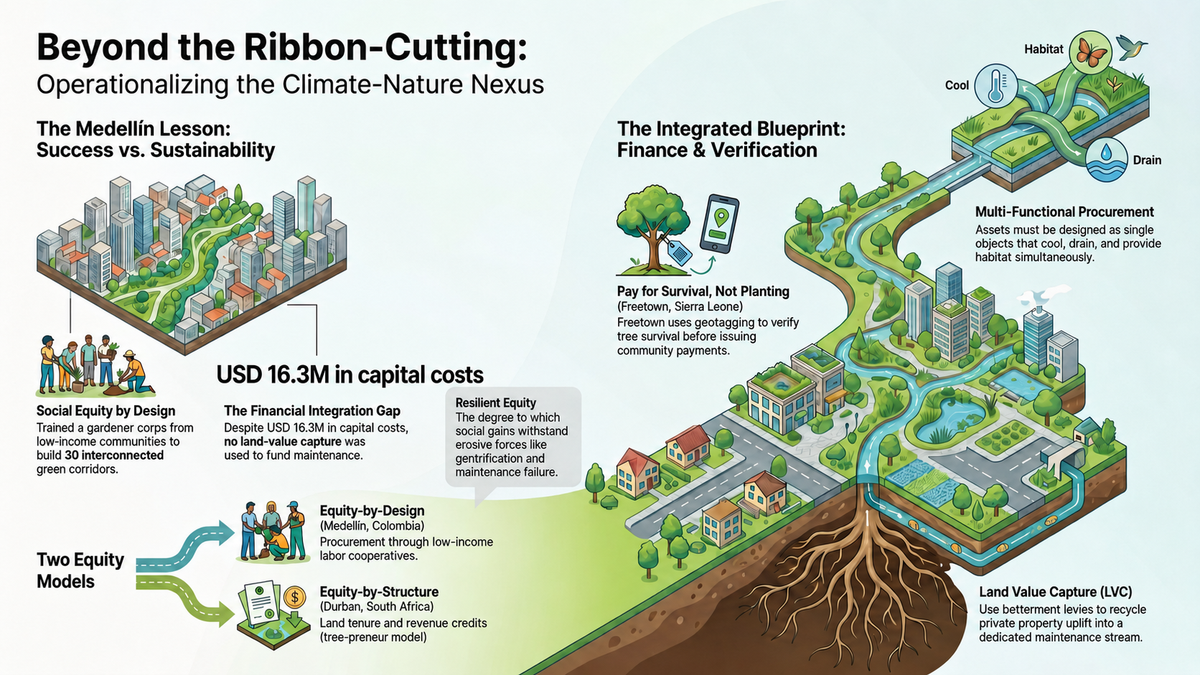
The Green Corridors of Medellín, Colombia, are among the most admired urban nature-based interventions of the past decade. They deserve that admiration. They also illustrate, with unusual clarity, the one thing such programs almost always leave undone: they are built, celebrated, and then left to compete each year for the budget that keeps them alive, while the rise in land value they help create is seldom captured to pay for them. The paper is not an attempt to diminish Medellín’s achievements but to learn what is transferable and what is not, to close that gap, and to engage with the discipline that integration demands.
The Nexus Is Not an Idea Problem
The climate–nature nexus has won the argument for integration. The Kunming–Montreal Global Biodiversity Framework and the Paris Agreement now share a common premise that climate mitigation, climate adaptation, and biodiversity conservation should be treated as a single system, jointly planned rather than as three separate agendas funded in silos. In cities, the principal operational expression of that premise is nature-based solutions (NbS) and ecosystem-based adaptation (EbA). NbS, as adopted by the UN Environment Assembly (UNEA) in March 2022, are actions to protect, conserve, restore, and sustainably use and manage ecosystems that address social, economic, and environmental challenges effectively and adaptively, while simultaneously providing human well-being, ecosystem services, resilience, and biodiversity benefits.[1] The UNEA definition draws on and now supersedes, in intergovernmental standing, the earlier International Union for Conservation of Nature (IUCN) formulation. EbA, as defined by the Convention on Biological Diversity (CBD), is the subset of those actions aimed specifically at helping people adapt to climate change through the conservation, sustainable management, and restoration of ecosystems.[2] The practitioner’s question is no longer whether NbS and EbA work; the evidence is now too consistent and too overwhelming. The question is how a city, with a given fiscal capacity and a privileged relationship with its financiers, moves from intention to operation and then keeps the asset alive once the ribbon is cut and the mayor has moved on.
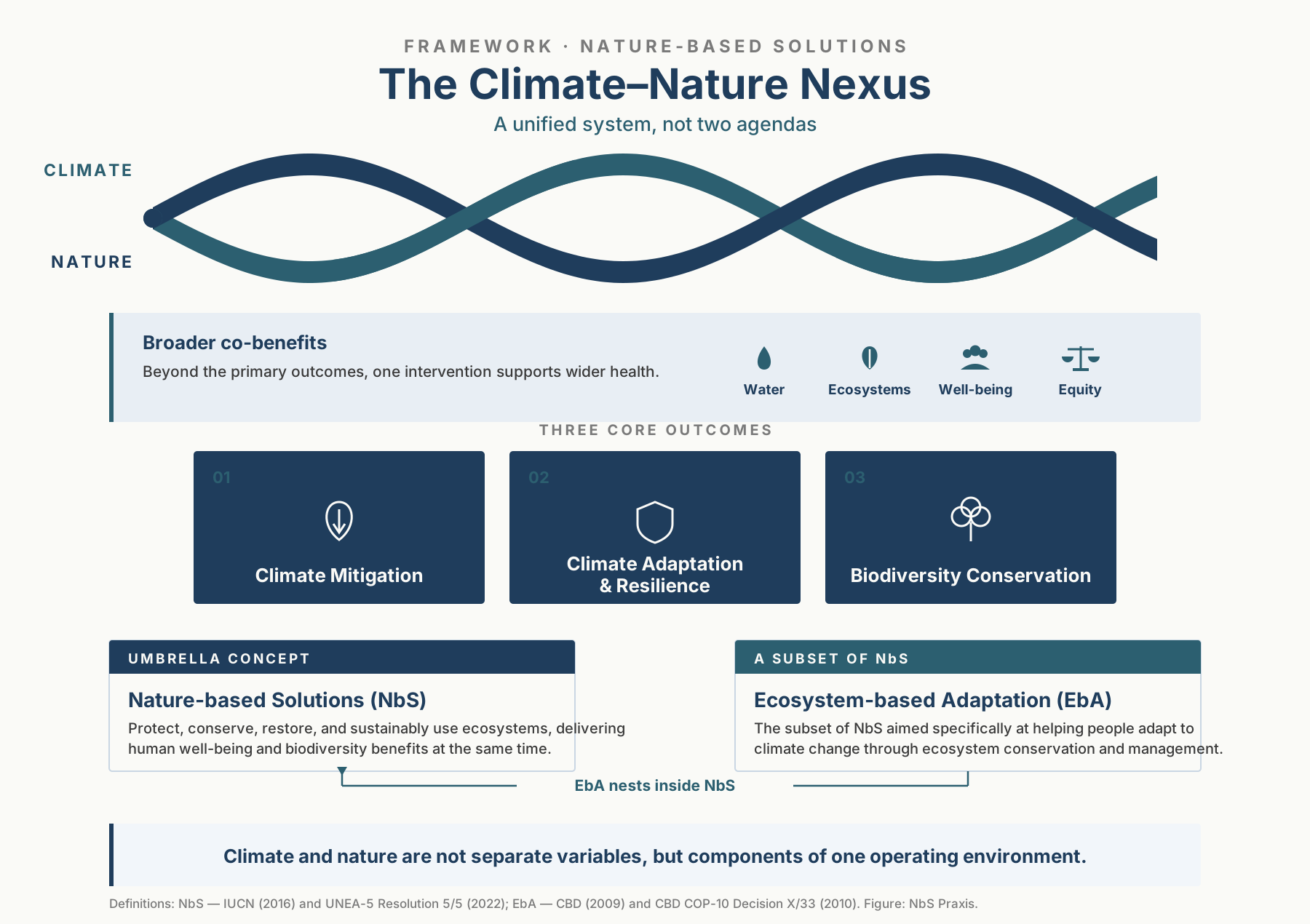
There is a conventional way to write this paper, following the project cycle from identification to preparation, financing, execution, operation and maintenance, and treating the nexus as a set of considerations to be addressed at each stage. I have chosen not to. The project-cycle structure implies that the dimensions of an integrated intervention can be sequenced as follows: diagnosing, designing, securing funding, appraising, building, and maintaining. The failure worth examining is precisely what happens when they are sequenced rather than integrated: when the financial architecture is treated as a downstream funding question rather than a design variable, when social equity is left to execution rather than built into the diagnosis, and when monitoring, reporting, and verification (MRV) is added after the fact rather than designed to be independent from inception. Medellín did not fall short for lack of a good project cycle, but integration was only partly achieved. Some stages remained separate, and the clearest example was in financing.
Medellín, on the Evidence
Between 2016 and 2019, Medellín built 30 interconnected green corridors, 18 along avenues and 12 along the city's streams, at reported costs of about USD 16.3 million in capital and roughly USD 625,000 a year in maintenance.[3] The program won the Ashden Award for Cooling by Nature in 2019. Medellín did something most greening programs do not: trained a corps of gardeners drawn from displaced and low-income communities to plant and maintain the corridors, putting the labor and a share of the benefit in their hands. For such schemes, the participatory approach the field aspires to is seldom achieved; most leave local communities as project beneficiaries rather than participants. On this point, Medellín delivered.[4] The green corridors are a serious undertaking. What follows does not diminish the program but takes its lessons seriously enough to identify how much more the corridors could have accomplished.
Begin with the numbers, because that is where the discipline starts. The municipality reports that the corridors lowered temperatures by about 2 degrees Celsius across the city, with local reductions of up to 10 degrees in surface temperature along the planted axes. The same source attributes a 34.6% rise in cycling and a decline in respiratory illness to the corridors.[5] These figures travel the world without qualification, carried by international outlets and city networks that have every reason to want an inspiring case and little reason to question it. The interrogation is not hostile; these are municipal monitoring figures, not independently measured. No published methodology specifies where the sensors were located, over what period, relative to what counterfactual, or whether the metric is air temperature, surface temperature, or thermal comfort. Without that, the figures cannot be checked.[6] The strongest independent anchor available, the modeling by Iungman and colleagues in The Lancet, estimates that raising tree cover to 30% across 93 European cities would lower temperatures by an average of 0.4 degrees and prevent roughly a third of urban-heat-island deaths.[7] A 2-degree citywide effect in a narrow Andean valley with strong heat-trapping is not physically absurd and may be real, but it sits at the upper edge of what credible models predict and should be treated as a municipal estimate awaiting verification rather than as a settled fact. The distinction between a self-reported number and an independently measured one is not a matter of pedantry: it is central to the case and the brand’s credibility.
The same discipline applies to the social claim, cutting in favor of the program. Medellín’s corridor design was visibly responsive to equity, as shown by the gardener corps and the decision to route green investment into the lower-income districts (the city’s ‘comunas’) rather than only the wealthier south. Whether that design prevented the displacement that green investment so often triggers, as rising amenities raise rents and price out the residents the investment was meant to serve, is a separate question, not answered by the evidence. No property-value time series or resident-turnover study isolates the corridor districts.[8] The most that can be said is that the design reduced the risk; whether this design eliminated that risk has not been measured. This is not a hedge but the heart of the argument. What makes an equity gain durable is precisely what Medellín, for all it did well, did not build, and that missing element deserves a name.
Resilient Equity
This paper proposes a term. Resilient Equity is the durability of the distributional, health, and public-good benefits of an NbS or EbA intervention, the degree to which an equity gain is built to withstand the erosive forces over the life of the asset. The term deliberately inverts the established academic concept of equitable resilience, which asks how the benefits of resilience can be shared fairly.[9] Resilient Equity asks the opposite and equally necessary question: "Once equity is achieved, how can it be made to last?" The opposing forces are predictable, chief among them displacement and green gentrification driven by uncaptured land-value uplift, alongside maintenance failures that allow a shared asset to decay and the gradual capture of its benefits by existing wealthier residents. Medellín is the instructive case of equity achieved at delivery, then left exposed because the value the corridors created was never structurally captured and recycled to the local communities.
What Transfers
The instinct in the development world is to treat Medellín as a template. What made the corridors work was a stack of preconditions that do not travel as easily as the photographs: a more than capable municipal botanical garden to run the horticulture and the gardener training; a recently completed metro and Metrocable system that gave the corridors a transport spine to follow; a city administration willing to direct procurement through low-income labor cooperatives; and a tropical mountain climate that lets things grow year-round. Strip any one of these out, and the same USD 16.3 million no longer buys the same outcome. The transferable lesson is not the corridor but the discipline of integrating the technical, social, financial, and MRV dimensions. The corridors partly achieved that integration, nowhere more so than in the gap between construction and financing.
The social dimension is where Medellín's effort was real and worth recalling in comparison. The corridors were built not through international procurement, but by a gardener corps drawn from displaced and low-income communities, and trained in partnership with the municipal botanical garden. Labor and corridor routing both doubled as equity instruments. That is genuine equity-by-design, more than most cities attempt. Durban, South Africa, shows what equity-by-structure looks like in the Buffelsdraai community reforestation program around its municipal landfill. The social benefit is built into tenure and the revenue model rather than into the procurement plan. Local communities, the tree-preneurs, grow and trade indigenous trees for credits redeemable against food, school fees, and other essentials. The land is municipally owned, not subject to the redevelopment displacement that erodes equity elsewhere.[10] The difference between the two cities is not effort or intent, which both cities had: Durban secured equity in tenure and structure, while Medellín secured equity in design, the form most exposed to erosion over the life of the asset. That contrast is Resilient Equity in practice: not a gain announced at the opening, but a gain engineered to last.
Capturing the Uplift
The financial dimension is where Medellín’s integration most visibly broke down, and where the most consequential lesson lies. Colombia is among the world's most sophisticated jurisdictions for land value capture, the practice of recovering for the public some of the increase in private land value created by public investment. Article 82 of the 1991 Constitution establishes the principle. Ley 388 of 1997 operationalizes the levy on land-value gains resulting from public action ('participación en plusvalía'). The betterment levy ('contribución de valorización') charges landowners directly for the increase in property values produced by a specific public work. The instrument has a long history in Colombian law. In Medellín, a dedicated fund, Fonvalmed, administers that levy. The fund financed about 80% of the city's arterial roads from the proceeds.[11] The corridors drew on none of these instruments. The city's own Comptroller, the Contraloría, which audits the use of public funds, reviewed the program in 2020. The audit traced every corridor contract to the ordinary municipal capital budget, with one 2019 contract drawing on the participatory budget ('Presupuesto Participativo'). The Contraloría found no plusvalía, no valorización, and no tax-increment instrument in the financing.[12] The instruments existed in the city’s own statute, but were not used to finance the green corridors.
The failure to use land value capture is the program's single largest missed opportunity, and the reason is worth stating because the logic extends well beyond Medellín. A corridor raises the value of adjacent land. In fiscal terms, that corridor is an asset that could help fund its own maintenance and extension. A betterment levy or a plusvalía charge captures that uplift and does two things at once. First, the charge creates a dedicated, ring-fenced revenue stream. That stream solves the permanence problem that kills most urban NbS: the slow death by deferred maintenance once the founding champions move on. Second, the charge recycles the value into the host district rather than to incumbent owners alone, beginning to solve the equity problem. Land value capture is thus the financial instrument for Resilient Equity. The two vulnerabilities Medellín risks, an unfunded maintenance liability and an unprotected community, share a single financial solution, which the figure below sets out as a loop.
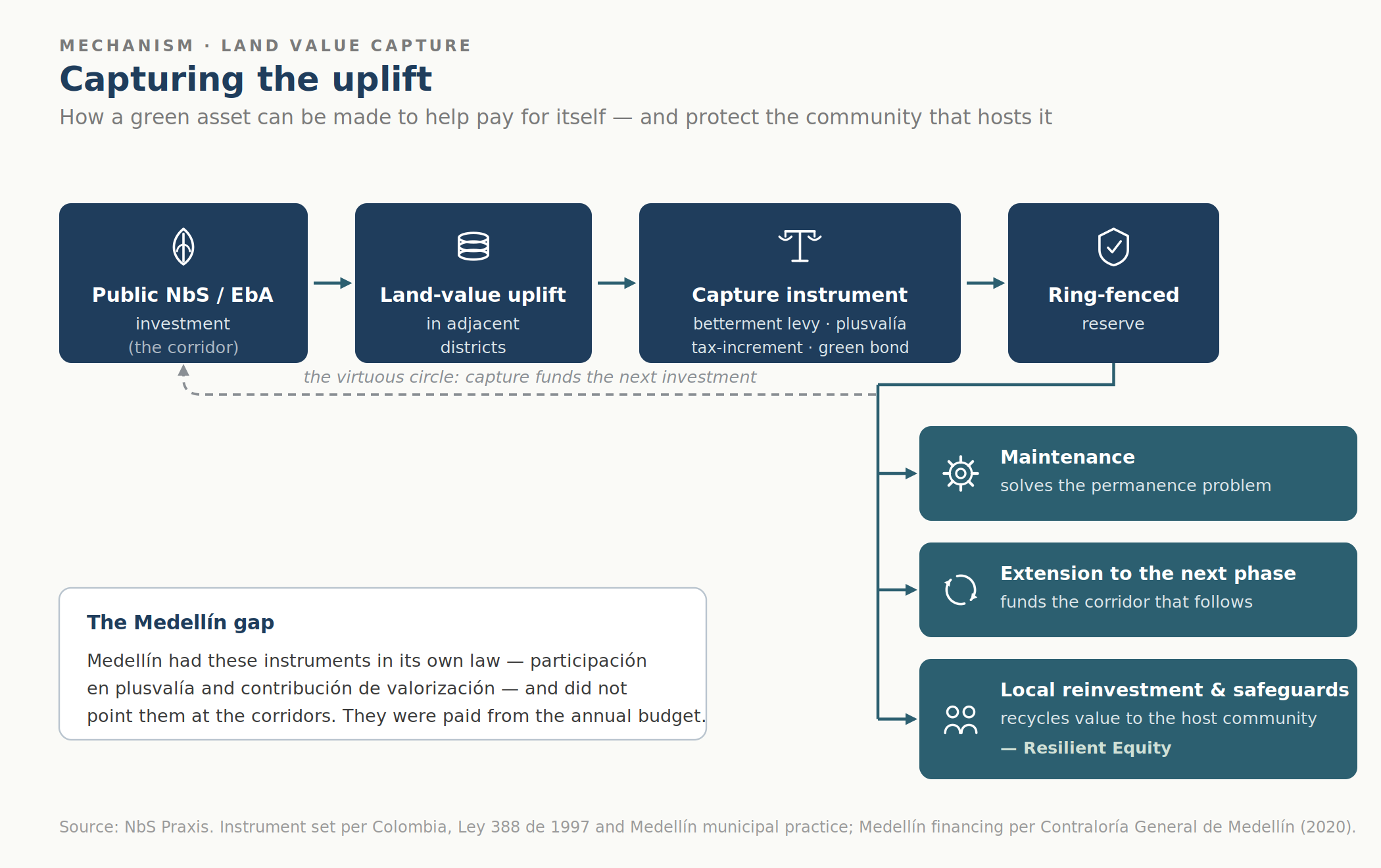
Published evidence that NbS generate the necessary uplift is now solid. Work by the Lincoln Institute of Land Policy finds residential price premiums of roughly 9% near green stormwater infrastructure in one United States city and up to 15% in another.[13] The mechanics of capturing such uplift are equally well established, but almost entirely in the transit sector, where land value capture has funded metro lines from Hong Kong onward, only in cities dense enough to make capture viable. The frontier this paper argues for is the transfer of that mature toolkit from transit to nature. A city that lacks fiscal space can route financing through a capable utility. In a non-sovereign operation I led at the Asian Development Bank, Shenzhen Water Group, a creditworthy utility in the People's Republic of China, borrowed in local currency to design, build, finance, and operate sponge-city projects in smaller cities that could not access capital on their own, under a public-private partnership model.[14] Where land value capture is not available, the dedicated-revenue principle still holds through other means. In Copenhagen, Denmark, the cloudburst-management program is funded through a dedicated tariff, so the resilience asset has its own revenue source rather than an annual budget allocation that may be revised.[15]
Measuring What We Claim
The MRV dimension is the one that the Medellín figures exposed at the outset. MRV is not a reporting afterthought but a design decision with financial consequences. Capital priced against unverifiable outcomes is capital exposed to hidden risks. A self-reported environmental result, however well-intentioned, is a weak foundation for a financing case. The instructive response is emerging not in a wealthy city but in Freetown, Sierra Leone.[16] The municipal tree-planting campaign tracks every tree through a digital register and pays community growers not for trees planted but for trees that survive. Each tree carries a geotagged, time-stamped photographic record, re-documented on repeat visits across the planting years. The distinction between planting and survival is the entire point, the difference between an output and a result. Planting numbers are easy to report and mean little. Survival is the hard, falsifiable outcome a reforestation program must deliver, and precisely the number that plant-and-walk-away schemes never publish. By paying for survival rather than planting, Freetown makes a documented per-tree record the basis of reward, and ties a results-based payment, or eventually a carbon credit, to a number a financier can interrogate rather than take on faith.
The approach also rewrites the economics of verification. Independent verification relies on a third-party audit, with validation and verification running to tens of thousands of dollars per cycle and more once international auditors and field visits are added. Those costs are largely fixed, and fixed costs fall hardest on the smallest projects. Peer-reviewed work finds transaction costs that can match or exceed a small project's entire income.[17] That arithmetic excludes community-scale reforestation from the carbon market before it starts. Inexpensive sensors, GPS-enabled phones, and the records they generate automatically promise to shift verification from fixed overhead to a marginal cost per credit, the structural shift that could make a program the size of Freetown's bankable. The further promise, still ahead of the practice, is a shared digital ledger that every party can read and no single party can quietly revise, and that is open in real time to financiers, national and local governments, and communities, of the kind that blockchains and tokenization aim to provide. Such a ledger would turn verification from trusting the reporter into reading a common record. Freetown has not built that; the live system is a conventional database, and the tamper-evident, distributed version remains an aspiration. The direction of travel matters all the same. A benefit that cannot be independently verified cannot be reliably financed. A benefit that cannot be financed will not be maintained.
Designing for More Than One Thing
The technical core of the nexus is the refusal to treat a green asset as doing only one thing. A corridor that only cools, or a drain that only drains, wastes the premise of integration. Procuring each function separately, with its own siting compromises, is also what makes integrated NbS look more expensive. The clearest counter-example is the Chulalongkorn Centenary Park in Bangkok, Thailand. The park covers about 4.5 hectares and is engineered as a single object that cools, holds, and cleans at once. The whole site tilts so that stormwater runs through constructed wetlands into a retention system holding on the order of 3,800 cubic meters, turning a flood liability in a sinking city into public space, habitat, and water storage.[18] The same logic, folding nature into the ordinary fabric of the city rather than being set aside in discrete parks, runs through the city of Bordeaux, France. The program treats roughly half of the metropolitan territory as working natural and agricultural infrastructure, carries the same seriousness as transport and housing, and serves as the green complement to a parallel densification strategy rather than an afterthought.[19] For any city, the design lesson is clear: specify each asset by the multiple functions it must perform (drainage, canopy, habitat, and public realm together), and procure each as one integrated object.
What a City Must Do
The prescription that follows is institutional rather than technical. The instruction is a single one, applied across the dimensions this paper has traced. A city serious about operationalizing the nexus needs one integrated plan that places drainage, green space, climate mitigation, resilience, and biodiversity conservation under a single accountable agency. That coordination shortfall led Medellín to build corridors, implement sustainable drainage, and develop a biodiversity strategy as three separate efforts. Planning must follow the catchment rather than the administrative boundary, because the cheapest interventions usually sit upstream in the wider basin and offer potential for payment for ecosystem services (more on that in a future paper on financing instruments and business models for the climate-nature nexus). The city needs a standardized catalog of asset designs procured under multi-year framework contracts, so delivery can scale rather than stall in project-by-project customization. A dedicated revenue stream must be secured at the design stage rather than sought after the fact. The national and city planning agencies, a development partner, and potential credible private investors should be engaged from the program's inception. Financing for operation and maintenance is an integral part of the sustainability financing plan and is therefore included in the capital structure. Operational responsibilities and regulations must be defined during project preparation. An urban NbS asset would fail in the long term, not because the project was not implemented, but because the asset was not properly maintained. Development partners cannot finance beyond project construction because the project must be closed. Most of the time, the asset management system and operation and maintenance arrangements agreed during loan negotiations fail to materialize and are not financed.
The symmetry for the multilateral and bilateral financiers who fund this work is exact. The bottleneck they face is not a shortage of capital but a shortage of structured, ready projects with credible benefit stacks, identified counterpart financing, and the institutional capacity to disburse. The single highest-return action available to a financier serious about the nexus is investment in project preparation at the city level: the unglamorous work of turning a good intention into a financeable structure. Another capital allocation to a window the pipeline cannot yet fill is the lesser intervention. I have spent enough years on both sides of that table, developing projects and structuring loans, to believe that the preparation gap is the real one.
The Work Ahead
Medellín built something great and showed the world that an integrated urban nature program can be delivered at scale in a middle-income city in a developing country. The fuller lesson, which this paper has tried to draw out, is that an intervention is only as durable as its financing and measurement, that equity is only secure when built into the structure rather than left to intent, and that the value a green asset creates can and should be captured to keep that asset alive. These are no reasons to admire Medellín less. They are the agenda for the cities that will build the next corridors, the institutions and financiers that will pay for them, and the communities that shift from beneficiaries to active participants supporting resilient equity. They are the questions I expect to keep working on in the pieces that follow this one.
Watch a six-minute overview of this paper on the NbS Praxis YouTube channel. The written analysis above is the definitive version.
Endnotes
[1] UN Environment Assembly, Resolution 5/5, “Nature-based solutions for supporting sustainable development,” adopted 2 March 2022 at the resumed fifth session of the Assembly (UNEA-5.2) in Nairobi. The definition reproduced in the body is the operative paragraph of the resolution: “actions to protect, conserve, restore, sustainably use and manage natural or modified terrestrial, freshwater, coastal and marine ecosystems which address social, economic and environmental challenges effectively and adaptively, while simultaneously providing human well-being, ecosystem services, resilience and biodiversity benefits.” The resolution was adopted by consensus of the 193 UN member states and supersedes, in intergovernmental standing, the earlier International Union for Conservation of Nature (IUCN) definition (Cohen-Shacham et al., 2016) on which it draws. https://wedocs.unep.org/handle/20.500.11822/39864
[2] Convention on Biological Diversity, “Voluntary guidelines for the design and effective implementation of ecosystem-based approaches to climate change adaptation and disaster risk reduction,” annexed to Decision 14/5 adopted by the Conference of the Parties at its fourteenth meeting, Sharm El-Sheikh, 30 November 2018. EbA is defined as “the use of biodiversity and ecosystem services as part of an overall adaptation strategy to help people to adapt to the adverse effects of climate change.” The definition derives from CBD Decision X/33 (Nagoya, 2010) and the report of the CBD Ad Hoc Technical Expert Group on Climate Change and Biodiversity (AHTEG). EbA is consistently characterized in the international policy literature, including by the IPCC Sixth Assessment Report (AR6) Working Group II (2022), as a subset of NbS. https://www.cbd.int/decisions/cop/14/5
[3] Alcaldía de Medellín, Secretaría de Medio Ambiente, "Corredores y muros verdes," and Ashden, "Urban Think Tank Next: tackling urban heat with green corridors," Fair Cooling Fund case study, https://ashden.org/fair-cooling-fund/urban-think-tank-next/. Capital and maintenance figures are municipal, reported via the Ashden case and the World Economic Forum. Two competing figures appear in the same body of reporting and are not adopted here. First, the Ashden Fair Cooling Fund case study states an overall cost of about USD 180 million, or USD 120 per square meter transformed. That figure is inconsistent with the footprint Ashden's own award citation records for the corridors, roughly 71 hectares (65 hectares along waterways and 6.2 hectares on roads): USD 120 per square meter across 71 hectares implies about USD 85 million, while USD 180 million implies about 150 hectares, roughly twice the corridor footprint. Second, Medellín's infrastructure secretary told the Thomson Reuters Foundation in July 2021 that maintaining the corridors costs about USD 1.50 per square meter every two to three months, with a workforce of 150 gardeners. Applied to 71 hectares, that unit cost implies annual maintenance of roughly USD 4.3 million to USD 6.4 million, seven to ten times the reported USD 625,000. The two reconcile only if the intensively maintained area is on the order of 7 to 10 hectares rather than 71, close to the 6.2 hectares of road planting Ashden records, which would leave the 65 hectares of stream-bank planting as extensive, lightly maintained ground. That reconciliation is plausible but was not established from the sources reviewed. The direction of the uncertainty is worth stating: if the higher figure is nearer the true cost, the unfunded maintenance liability this paper identifies is larger than the reported number suggests, not smaller.
[4] Ashden, “Alcaldía de Medellín,” Ashden Award 2019, https://ashden.org/awards/winners/alcaldia-de-medellin/
[5] Figures as reported by the Alcaldía de Medellín and repeated in C40 Cities, "Cities100: Medellín's interconnected green corridors," and World Economic Forum, "How cities from Medellín to Düsseldorf are using nature to tackle extreme heat," 2024, https://www.weforum.org/stories/2024/01/nature-positive-cities-tackle-extreme-heat/. All are municipal self-reported figures. The scope, metric, and baseline year of the temperature claim vary across the relays that carry it. The World Economic Forum reports a fall of about 2 degrees Celsius in the city's average temperature. Anastasia Moloney, reporting for the Thomson Reuters Foundation on 28 July 2021, records city hall as attributing to the project a 2-degree reduction in Medellín's urban heat island effect since 2018, and separately as saying the initiative has helped reduce average temperatures in parts of Medellín; syndicated in full by PreventionWeb, the knowledge platform of the United Nations Office for Disaster Risk Reduction, at https://www.preventionweb.net/news/colombias-medellin-plants-green-corridors-beat-rising-heat, with the original at news.trust.org, item 20210728130018-qufqy. Ashden, PreventionWeb, and Sustainable Energy for All report air temperatures at Green Corridors locations falling from 31.6 to 27.1 degrees between 2016 and 2019, a reduction of 4.5 degrees (https://www.preventionweb.net/news/colombia-green-corridors-help-reduce-heat-risk-medellin; https://www.seforall.org/stories-of-success/creating-a-greener-cooler-and-healthier-medellin). The Asia-Pacific Climate Change Adaptation Information Platform, operated by Japan's National Institute for Environmental Studies, reports the same three-year period and the same 31.6-degree baseline ending at 28.1 degrees, a reduction of 3.5 degrees, and describes it as a fall in the city's average temperature (https://ap-plat.nies.go.jp/inas/goodpractices/development/5.html). An identical baseline with endpoints differing by exactly 1 degree points to a transcription error in the chain rather than to a methodological disagreement. Which of these formulations the Alcaldía itself advanced, and which are artifacts of relay, could not be established from the sources reviewed for this paper.
[6] No published municipal or SIATA (Sistema de Alerta Temprana de Medellín y el Valle de Aburrá, the regional early-warning system) methodology note documenting station siting, observation period, counterfactual, or metric for the corridor temperature claims was identified in the review supporting this paper. The figures should be treated as municipal estimates pending such documentation. The relays cataloged at note 5 nonetheless locate the underlying readings at Green Corridors sites and describe them as air temperatures, which narrows the metric and the location further than the headline does without supplying the siting, period, or counterfactual that a methodology note would. The 31.6-degree baseline is consistent with a site-level reading along the planted axes and not with a city average, since Medellín sits on a valley floor at about 1,500 meters in the Aburrá Valley and its mean temperatures run in the low 20s Celsius year-round, the stability behind Medellín's long-standing description as the city of eternal spring. If the city-wide headline rests on those corridor-site readings, as the shared 2016 to 2019 window suggests, that is the step at which the claim acquires a scope the underlying data does not support.
[7] Tamara Iungman et al., “Cooling cities through urban green infrastructure: a health impact assessment of European cities,” The Lancet 401, no. 10376 (2023): 577–589, https://doi.org/10.1016/S0140-6736(22)02585-5
[8] No property-value time series or resident-turnover study isolating the Medellín corridor districts was identified in the review supporting this paper. On the general risk pattern of green gentrification, see Isabelle Anguelovski and the Barcelona Laboratory for Urban Environmental Justice and Sustainability (BCNUEJ); and Melissa García-Lamarca, Isabelle Anguelovski et al., “Challenging the financial capture of urban greening,” Nature Communications 13 (2022).
[9] Nilufar Matin, John Forrester, and Jonathan Ensor, “What is equitable resilience?” World Development 109 (2018): 197–205, https://doi.org/10.1016/j.worlddev.2018.04.020 See also Zachary B. Lamb and Lawrence J. Vale, The Equitably Resilient City: Solidarities and Struggles in the Face of Climate Crisis (Cambridge, MA: MIT Press, 2024).
[10] eThekwini Municipality (the metropolitan municipality of Durban, South Africa) / UNFCCC Momentum for Change, “Buffelsdraai Landfill Site Community Reforestation,” https://unfccc.int/climate-action/momentum-for-change/lighthouse-activities/buffelsdraii-landfill-site-community-reforestation Hectares restored and the tree-preneur model are as reported; tree-count totals vary across reporting cycles and are not relied on here.
[11] Constitución Política de Colombia (1991), art. 82; Ley 388 of 1997, arts. 73–90 (participación en plusvalía / participation in land-value gains); Fonvalmed (Fondo de Valorización del Municipio de Medellín / Medellín Municipal Valorization Fund), “Fondo de Valorización del Municipio de Medellín,” https://fonvalmed.gov.co/en-que-consiste/ The roughly 80% figure for arterial roads financed by valorización is reported by Fonvalmed.
[12] Contraloría General de Medellín (the city’s independent comptroller), Informe Final, Auditoría Especial Gestión Corredores Verdes – EDU, SIF y SMA, Vigencia 2017–2019 (December 2020), https://www.cgm.gov.co/cgm/Paginaweb/IP/Informes%20de%20Auditora%20PGA%202020/Informe%20Final%20AE%20Corredores%20Verdes.pdf The audit lodges the program under Plan de Desarrollo 2016–2019 (the city’s Development Plan) program 7.1.1, project 7.1.1.2, executed by the Secretaría de Infraestructura Física (Physical Infrastructure Secretariat, SIF) and the Secretaría de Medio Ambiente (Environment Secretariat, SMA) with the Empresa de Desarrollo Urbano (Urban Development Enterprise, EDU) as executing arm; one 2019 contract is drawn from Presupuesto Participativo (participatory budget). The tax-increment instrument referenced in the city’s territorial plan (FIRI, Financiación por Incremento en la Recaudación Inmobiliaria / financing through property-tax-increment recovery) was not nationally operational until late 2020 and was not a financing source for the corridors.
[13] Jason Cohen, Mark Dietz, and Shi-Ling Huang, “Green Infrastructure, Home Values, Land Value Capture, and Equitable Property Assessment,” Lincoln Institute of Land Policy working paper, 2023, https://www.lincolninst.edu/publications/working-papers/green-infrastructure-home-values-land-value-capture-equitable-property/ These are working-paper findings, cited as suggestive empirical anchors rather than settled effects.
[14] Asian Development Bank, Project 52090-001, Climate-Resilient and Smart Urban Water Infrastructure Project (Shenzhen Water Group), https://www.adb.org/projects/52090-001/main The author initiated the non-sovereign loan to Shenzhen Water Group.
[15] City of Copenhagen, Cloudburst Management Plan 2012, https://en.klimatilpasning.dk/
[16] Mayor's Delivery Unit, Freetown City Council, "#FreetownTheTreeTown," https://freetownthetreetown.sl/; C40 Cities, "Freetown's highly replicable way of self-financing urban reforestation," https://www.c40knowledgehub.org/s/article/Freetown-s-highly-replicable-way-of-self-financing-urban-reforestation; and World Bank, "#FreetownTheTreeTown campaign: Using digital tools to encourage tree cultivation in cities," https://blogs.worldbank.org/en/sustainablecities/freetownthetreetown-campaign-using-digital-tools-encourage-tree-cultivation. The survival target, geotagged tracking, and payment cadence are as reported by the program, C40, and the World Bank. The tracking and token system is built by the nonprofit Greenstand (TreeTracker app); the production ledger is a centralized relational database accessed via an API. The transparent, tamper-evident distributed-ledger design in Greenstand's 2022 white paper, a permissioned Ethereum side-chain with a "TRing" token, is a stated aspiration that the white paper notes "may not accurately represent the current workings," https://docs.greenstand.org/overview/introduction/the-model/white-paper. References to a digital "token" and "ledger" here describe this impact-accounting system, not a live public blockchain.
[17] Under Verra’s Verified Carbon Standard, project costs separate into Verra’s own administrative fees and the separate fees of third-party validation and verification bodies (VVBs). Verra publishes the former, including a USD 0.23-per-credit issuance levy and a USD 3,750 registration-review fee (Verra Program Fee Schedule v1.0, 2024, https://verra.org/wp-content/uploads/2024/10/Verra-Program-Fee-Schedule-v1.0.pdf), but states that it does not track the latter, which proponents negotiate directly with auditors (https://verra.org/programs/verified-carbon-standard/). Published third-party analysis places validation at roughly USD 25,000–50,000 and each verification at USD 5,000–30,000, with a further USD 5,000–20,000 in international auditor travel, higher for forestry projects requiring field visits (Offset8 Capital, drawing on Perspectives Climate Group, VCMI, and GIZ, 2026, https://offset8capital.com/articles/africa-carbon-market-vvb-capacity-gap-pathways-2030/). On the structural barrier these largely fixed costs create for small projects, see C.S. Galik, D.M. Cooley, and J.S. Baker, “Transaction costs for carbon sequestration projects in the tropical forest sector,” Mitigation and Adaptation Strategies for Global Change 18 (2013): 1267–1284, finding transaction costs that can reach or exceed total project income, in one sub-1,000-hectare case about 98% of revenue at a carbon price of USD 8 per ton; and O. Cacho and L. Lipper, “Abatement and Transaction Costs of Carbon-Sink Projects Involving Smallholders,” Fondazione Eni Enrico Mattei Working Paper 27.2007.
[18] Landprocess / Kotchakorn Voraakhom; see “Kotchakorn Voraakhom: the architect helping sinking cities fight flooding,” CNN Style, https://www.cnn.com/style/article/kotchakorn-voraakhom-landscape-architect-spc-intl Park area and storage capacity are as reported. The source gives storage in US gallons and area in rai; both are converted to metric in the text (about 4.5 hectares; roughly 3,800 cubic meters).
[19] Bordeaux Métropole / a’urba, “55 000 hectares pour la nature,” https://www.aurba.org/productions/55-000-hectares-pour-la-nature-synthese-des-propositions/