No. 4 - From Disclosed Risk to Underwritten Asset
Nature stopped being a risk to disclose and became a resilience asset to underwrite

The Climate-Nature Nexus in Practice (Weekly Briefing to 20 June 2026)
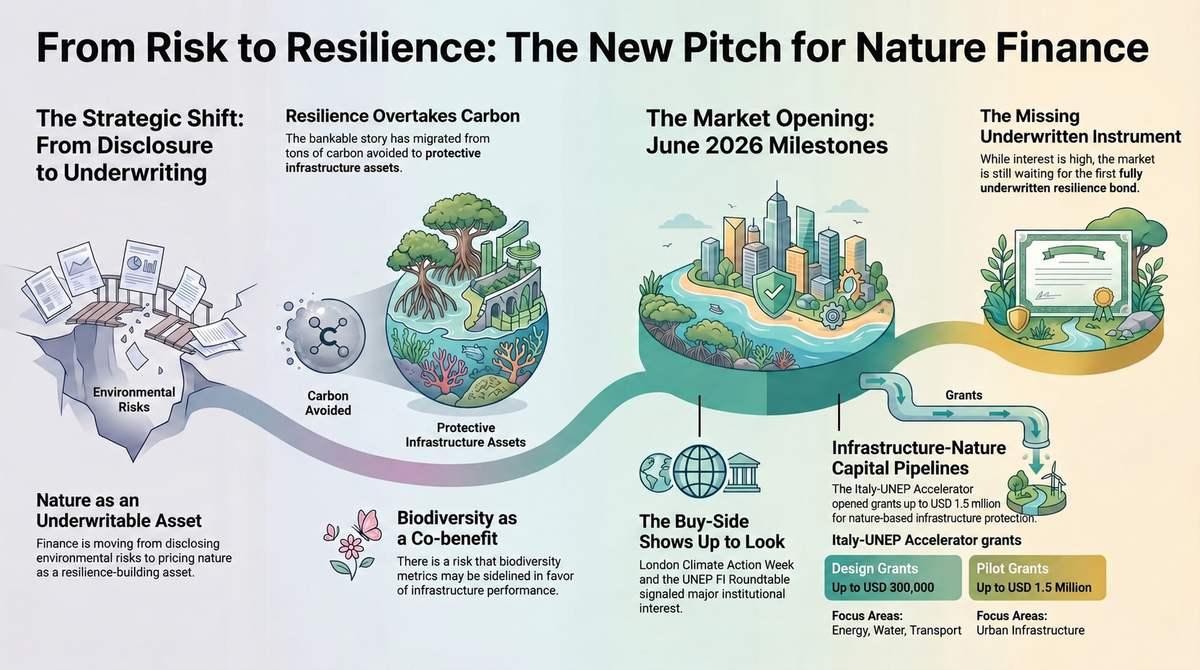
Bottom line: For three weeks, this briefing tracked nature finance building its plumbing. This week, the field is opening the doors and waiting to see who would walk in. London Climate Action Week and the UNEP FI Global Roundtable are convening the banks, insurers, and asset owners that the accounting layer was built for, under one banner: from risk to resilience. The reframing is the news. Nature is being sold not as a carbon story but as an insurable resilience asset. No one underwrote anything yet. The buy-side is showing up to look.
Here is the gateway into the field, and the briefing is the room you walk into: [Podcasts and Video — NotebookLM]
Link to Explainer Video
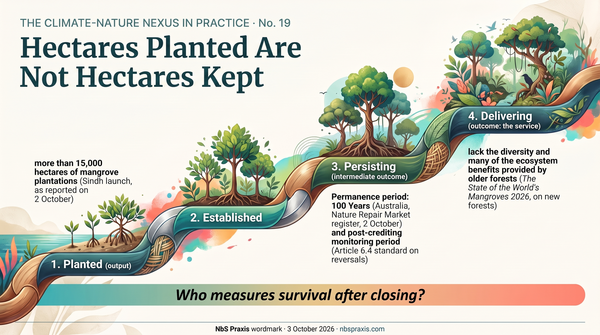
Last week, this briefing argued that the field had stopped pitching and started building the plumbing: the accounting in Bangkok, Thailand; the tracking in national plans; and the standards in Brussels, Belgium. This week posed the next question. With the rails going in, will anyone ride them? The answer will arrive in London, United Kingdom. London Climate Action Week opened on 20 June, and for the first time, biodiversity and nature are taking the main stage rather than a side room, with the finance sector as the intended audience.[1]
The UNEP FI Global Roundtable, opening on June 23 under the banner From Risk to Resilience: Financing the Future, brings together banks, insurers, and asset owners to view nature not as a risk to be disclosed but as a resilience asset to be underwritten.[2] Italy and the United Nations Environment Programme (UNEP) also opened a rare piece of concrete capital, the Nature-based Solutions Innovation Accelerator, a window for design and pilot grants for nature that protects infrastructure, closing on June 30.[3] Convenings and a grant call, not disbursements.
For practitioners, the implication sharpens last week's. The scarce skill is no longer rendering an ecosystem within a treasury's accounting categories; it is structuring that ecosystem for an insurer to price and a balance sheet to hold. Nature's bankable pitch this week is adaptation and resilience, not carbon. The buy-side is showing up to look. Whether it shows up to underwrite is the test for the next ten days.
Nature Goes Looking for a Buyer
The rails are being laid. This week, the field is convening the institutions meant to ride them and will find that the pitch that sells is resilience, not carbon.
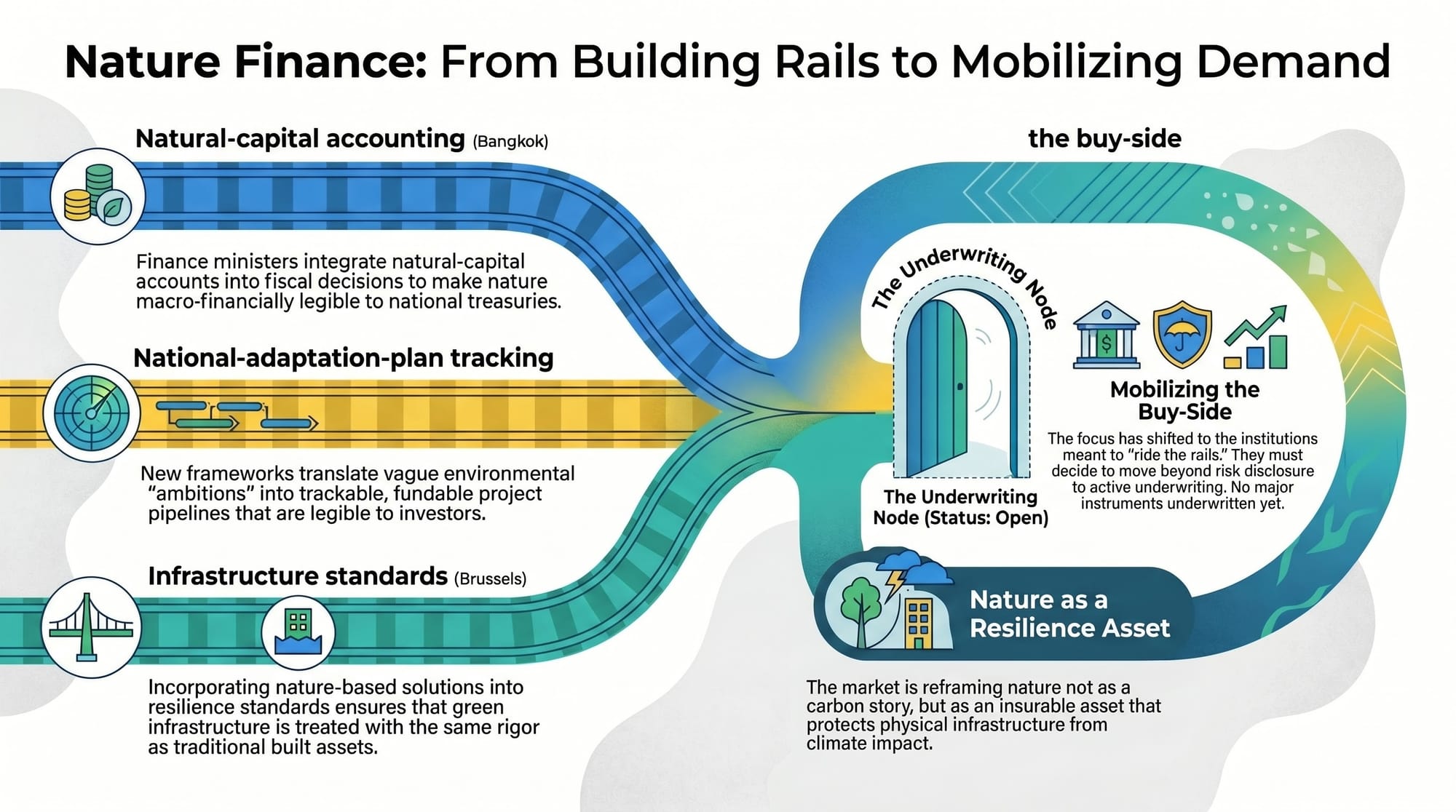
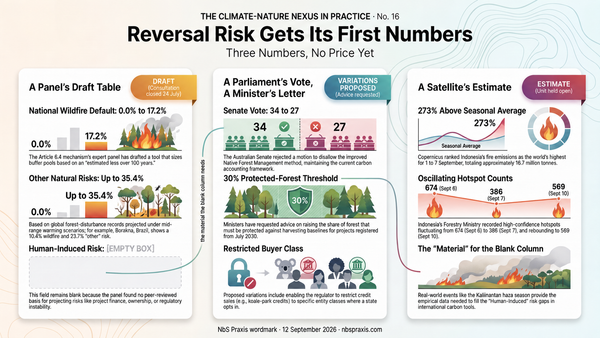
For three issues, the binding constraint moved down the stack last week, from legitimacy to measurement to the accounting-and-standards base layer. This week, the constraint moves sideways, to demand. The rails No. 3 described, natural-capital accounts, adaptation-plan tracking, and infrastructure standards, exist to make nature legible to a buyer, and London is where the buyer is supposed to appear. The Roundtable's 19th edition, held with the Green Finance Institute, frames the agenda as a move from risk to resilience, with sessions on financing nature and on insuring the climate-nature intersection.[2] The verb matters. Disclosure asks an institution to measure a danger; underwriting asks it to price and carry one. The week's wager is that nature is reaching the second.
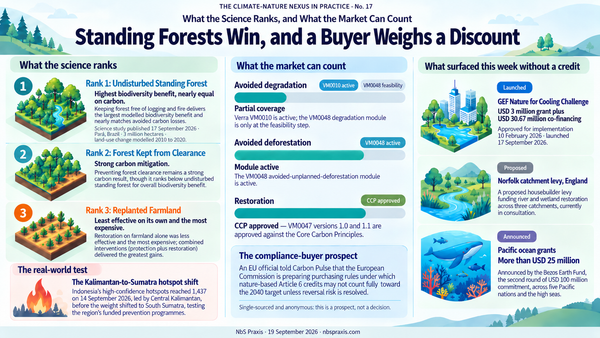
Resilience, not mitigation, is the frame doing the work. Last week, the United Nations Educational, Scientific and Cultural Organization (UNESCO) put nature into the language of critical-infrastructure standards; this week, the investment case follows, with the Finance for Biodiversity Foundation flagging a London program that uses nature-based solutions to protect built infrastructure1. Italy and UNEP carry the same logic into capital, offering design grants up to USD 300,000 and pilot grants up to USD 1.5 million for nature that defends energy, water, transport, and urban systems across five Central Asian and six African countries.[3] Nature as protective infrastructure is a frame that both an insurer and a public-works ministry understand, and that shared legibility, not a new carbon argument, opens the balance sheet. A Luxembourg dialogue earlier in the month folded the same vocabulary into development-finance mandates, framing climate, nature, and resilient infrastructure as one financing problem.[4]
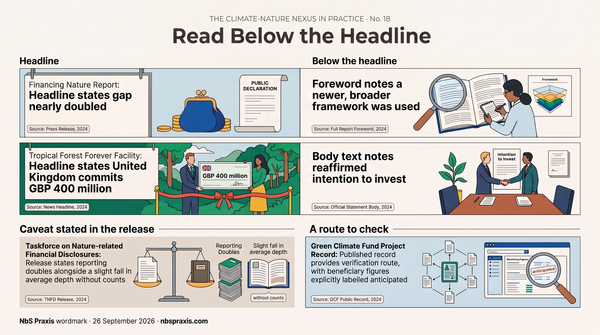
The tilt toward resilience carries a cost worth naming. Nature's mitigation pitch, carbon sequestered and credits issued, has spent two years under integrity scrutiny, and the week's silence on credits is telling. The bankable nature story has shifted from the tonne of carbon avoided to the asset protected. For a treasury weighing adaptation, the shift reads as progress. For the carbon-credit market, this reads as a quiet demotion. The mitigation case has not failed; the resilience case simply travels further with the institutions holding the money this week.
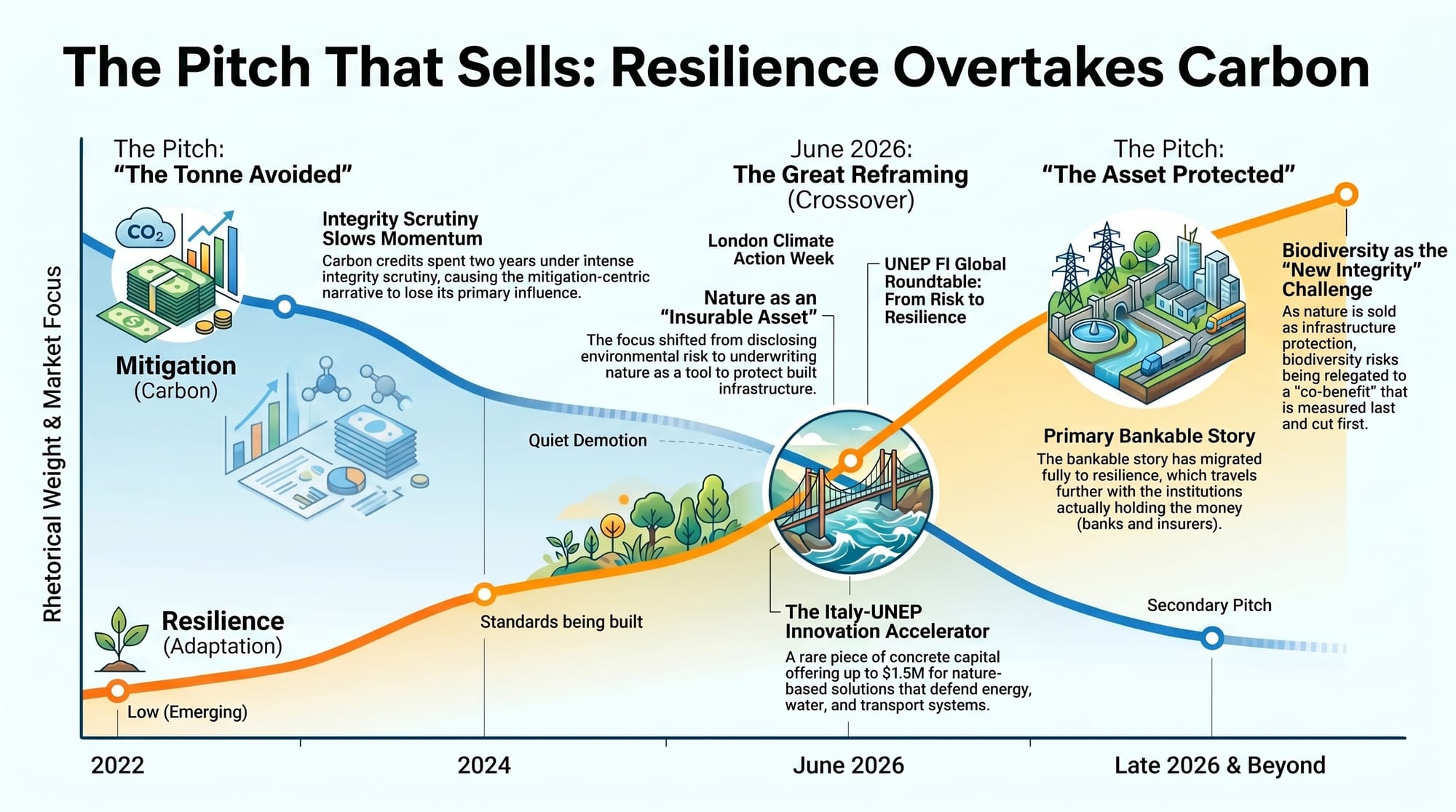
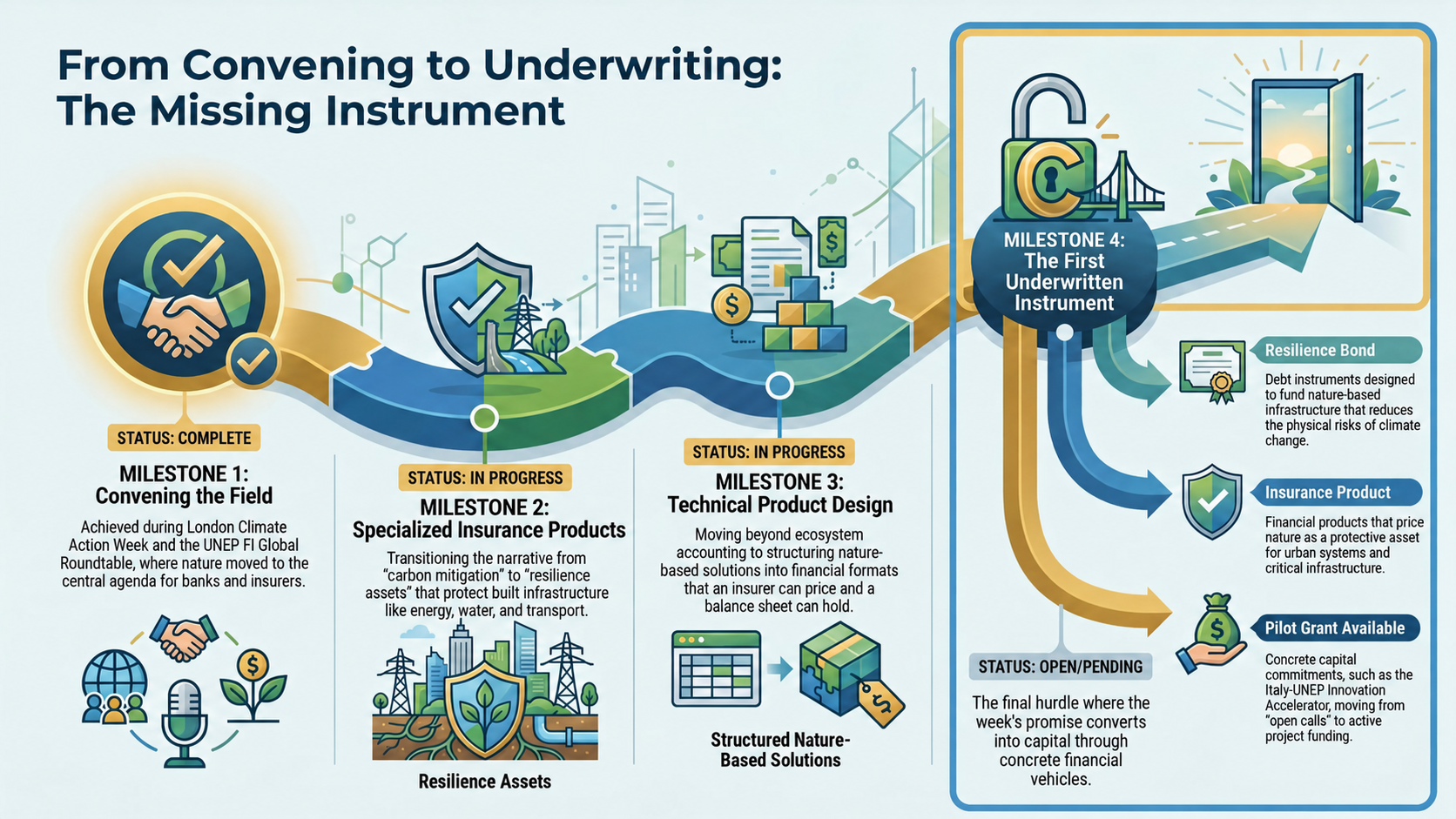
Biodiversity is in the most precarious position. The London program pairs the resilience case with a session on investing in nature with confidence, evidence-led, and biodiversity-claiming.[1] But confidence is what the outcome metrics cannot yet provide. The Italy-UNEP accelerator, the week's most concrete instrument, publishes performance expectations for infrastructure and finance, but not yet for the promised biodiversity.[3] The structural risk is plain. When nature is sold as infrastructure protection, biodiversity becomes the co-benefit measured last and cut first, the very fate the resilience framing was meant to spare. The integrity question that dogged carbon credits is migrating, intact, to resilience assets. The next move is not another convening but an underwritten instrument, an insurance product, a resilience bond, or a pilot grant disbursed, that prices nature as the asset the week says it has become.
The Record
Conviction arrived this week as a guest list and a grant call, not a disbursement. Each item is evaluated for its impact on the gap between a claim and a buyer.
London put nature on the main stage and aimed it at the finance sector. London Climate Action Week opened on 20 June and ran for nine days, with more than 750 events. The Finance for Biodiversity Foundation's pre-week briefing confirmed that nature has moved from a side room to the central agenda, positioning ecosystems as a strategic asset for banks, insurers, and investors rather than a risk to report. The convening mobilizes attention and intent; no capital attaches to the festival itself. Finance for Biodiversity Foundation, London, 17 June 2026. https://www.financeforbiodiversity.org/news/nature-on-the-agenda-at-london-climate-action-week-2026/
The UN's largest sustainable-finance roundtable reframed nature from risk to resilience. UNEP FI convenes the 19th Global Roundtable on Sustainable Finance in London, 23–25 June, with the Green Finance Institute, under the theme From Risk to Resilience: Financing the Future. The program features plenaries on financing nature and resilience, a thread on insuring the climate-nature intersection, and closing leadership dialogues from COP30 to COP31 on scaling finance and insurance. The Roundtable sets the buy-side agenda; product and commitment, if they come, follow the room. UNEP Finance Initiative, London, 23–25 June 2026. https://www.unepfi.org/events/unep-fi-global-roundtable-2026/
Italy and UNEP opened a rare infrastructure-nature capital pipeline. The Nature-based Solutions Innovation Accelerator, promoted by Italy's Ministry of the Environment and Energy Security with UNEP and the Organisation for Economic Co-operation and Development (OECD), keeps its first call open until 30 June, offering design grants of up to USD 300,000 and pilot grants of up to USD 1.5 million for nature-based solutions that strengthen energy, water, transport, and urban infrastructure across five Central Asian and six African countries. These figures are grant ceilings, not commitments, and biodiversity performance standards have not yet been published. Convention on Migratory Species Secretariat / UNEP, notice 2026/007. https://www.cms.int/news/2026007-funding-opportunity-nature-based-solutions-innovation-accelerator-nbs-ia
A Luxembourg dialogue folded nature into the language of nexus finance. At the inaugural Luxembourg International Climate Finance Days on 3–5 June, the Global Green Growth Institute hosted a high-level dialogue on aligning financial systems for climate, nature, and resilient infrastructure, framing the New Collective Quantified Goal of USD 300 billion a year by 2035 as the envelope within which nature finance must compete. The dialogue, concluded before this reporting week and cited as context, signals that nexus finance is entering development-bank and ministry mandates, though no nature-specific allocation was disclosed. Global Green Growth Institute, Luxembourg City, Luxembourg, 3–5 June 2026. https://gggi.org/event/luxembourg-international-climate-finance-days-2026/
ASEAN in Focus
The region with the world's densest coastal carbon sat outside the week's marquee pipeline, and the omission is the story.
Southeast Asia produced no nexus operation of its own this week, a quiet stretch, as regional evidence confirms. The sharper point lies in the week's one concrete instrument. The Italy-UNEP accelerator, the marquee infrastructure-nature window of the fortnight, restricts its first phase to Central Asia and Africa, leaving the members of the Association of Southeast Asian Nations (ASEAN) outside a pipeline built for exactly their assets.[3] Mangroves, peatlands, and blue-carbon coastlines are the textbook case of nature as protective infrastructure, the very framing London spent the week pricing,[1] yet the region's exposure to that capital this week was nil. For ASEAN practitioners, the lesson is not to wait for a global window but to build bankable, standards-compliant projects that enable the region to claim the next one. Governance, tenure, and the discipline to document biodiversity outcomes, not the ecology, will decide whether Southeast Asia sits inside or outside the resilience-asset market the week convened.
Worth Watching Through Year-End
The diary remains heavy with convenings that shape demand and standards, not disbursements. Watch which room issues the first underwritten instrument.
London Climate Action Week — through 28 June 2026, London. Europe's largest climate gathering, where the nature-finance and resilience rooms, including the UNEP FI Global Roundtable on 23–25 June, are the nearest venues to convert this week's reframing into commitment. E3G and partners. https://londonclimateactionweek.org/
Nature-based Solutions Symposium: “Who benefits, who decides, who pays, what's missing?” — 29–30 June 2026, York, United Kingdom. The leading edge of the equity-and-governance debate, whose norms on benefit-sharing and consent will condition the bankability of high-integrity nexus projects. British Ecological Society with the Nature-based Solutions Initiative, University of Oxford. https://www.naturebasedsolutionsinitiative.org/news/nbs-symposium-2026/
Climate Week NYC — 20–27 September 2026, New York. The year's largest corporate and government gathering, the bellwether for whether the resilience-asset and nature-positive turns are real or rhetorical. Climate Group. https://www.climateweeknyc.org/
Nature-based Solutions International Congress 2026 — 2–6 November 2026, Sorbonne University, Paris. The principal NbS knowledge exchange across more than 500 participants; expect advances in monitoring, accounting, and methods, not disbursements. SOLU-BIOD and NetworkNature, with Biodiversa+. https://www.biodiversa.eu/2026/06/10/nature-based-solutions-international-congress-2026/
Endnotes
[1] Finance for Biodiversity Foundation, “Nature on the agenda at London Climate Action Week 2026,” 17 June 2026; London Climate Action Week 2026, 20–28 June 2026. Primary (organizer and compiler); current-week convening and agenda, not capital committed; the specific session titles are as listed by the Foundation and not independently confirmed. https://www.financeforbiodiversity.org/news/nature-on-the-agenda-at-london-climate-action-week-2026/
[2] UNEP Finance Initiative, “Global Roundtable on Sustainable Finance 2026,” 19th edition, London, 23–25 June 2026, theme “From Risk to Resilience: Financing the Future,” in collaboration with the Green Finance Institute. Primary (organizer); upcoming convening, agenda rather than disbursement. https://www.unepfi.org/events/unep-fi-global-roundtable-2026/
[3] Convention on Migratory Species Secretariat, notice 2026/007, “Funding Opportunity for the Nature-based Solutions Innovation Accelerator (NBS-IA)”; initiative promoted by Italy's Ministry of the Environment and Energy Security with UNEP and the OECD; first call open through 30 June 2026; design grants up to USD 300,000 over 24 months and pilot grants up to USD 1.5 million over up to 48 months; Phase I eligibility covers Kazakhstan, Kyrgyzstan, Tajikistan, Turkmenistan, Uzbekistan, Algeria, Angola, Côte d'Ivoire, Kenya, Mozambique, and Tanzania. Primary (organizer); figures are grant ceilings available, not disbursements; biodiversity performance standards not yet published. https://www.cms.int/news/2026007-funding-opportunity-nature-based-solutions-innovation-accelerator-nbs-ia; https://www.unep.org/topics/climate-action/climate-finance/nature-based-solutions-innovation-accelerator-nbs-ia
[4] Global Green Growth Institute, “High-Level Dialogue on Climate Nexus Finance: Aligning Financial Systems for Climate, Nature and Resilient Infrastructure,” Luxembourg International Climate Finance Days, Luxembourg City, 3–5 June 2026. Self-reported by the organizer; concluded before this reporting week and cited as background; no nature-specific allocation disclosed. https://gggi.org/event/luxembourg-international-climate-finance-days-2026/