No. 3 - Building the Plumbing, Not the Pitch
Nature Finance spent the week building its plumbing, not its pitch

The Climate-Nature Nexus in Practice (Weekly Briefing to 13 June 2026)
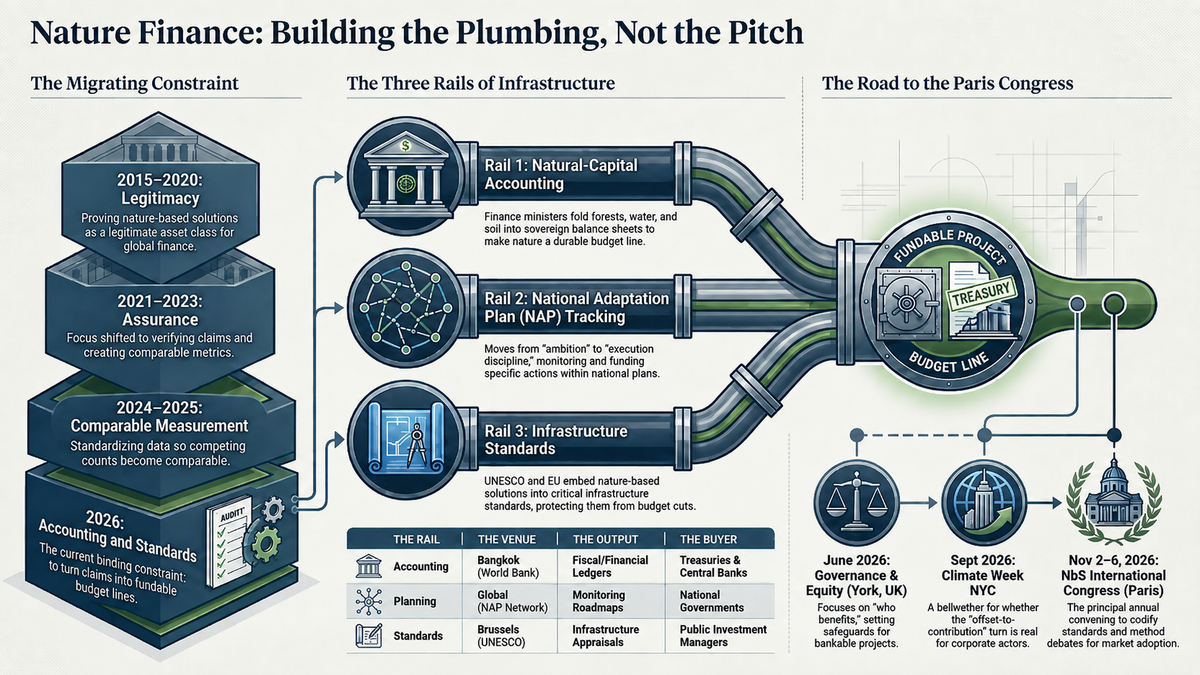
Bottom line: For two weeks, this briefing has argued that nature is an asset class whose size cannot yet be proven. This week, the field stopped arguing and started building the plumbing. Finance ministers met in Bangkok to push natural-capital accounting into fiscal decisions; adaptation planners gained tools to track nature within national plans; and the EU incorporated nature-based solutions into the language of critical-infrastructure standards. None of it moved capital. All of it builds the rails on which the capital will run. The unglamorous accounting layer, not the next headline number, is the market now.
Here is the gateway into the field, and the briefing is the room you walk into: [Podcasts and Video — NotebookLM]
Link to Explainer Video
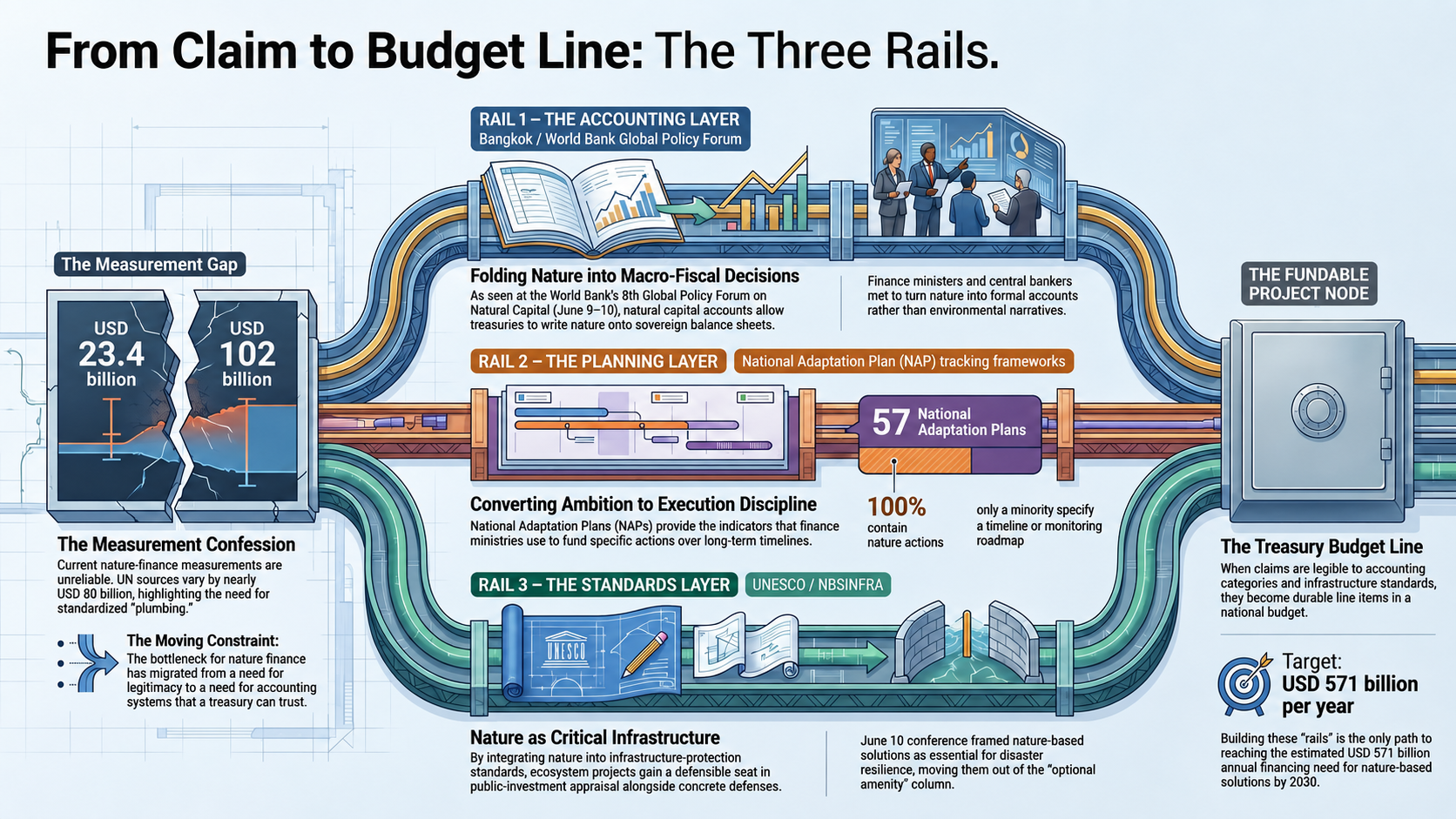
Last week, this briefing argued that nature finance cannot agree on its own size and that a figure swinging from USD 23 to 102 billion between two UN sources is a confession, not a measurement. This week answered the obvious next question: what does the field do when it cannot trust a number? It builds the infrastructure that makes a number meaningful. The week's three real events were not deals. They were an accounting forum,[1] a tracking framework,[2] and a standards conference.[3]
The throughline is that the binding constraint is shifting again. For a decade, the constraint was legitimacy, and no one argued that the fight was over. Then it was assurance, then comparable measurement. This week reveals the layer beneath all of them: the accounting systems, planning frameworks, and standards that turn a project's claim into a number a finance ministry can include in a budget. In Bangkok, the World Bank convened finance ministers and central bankers to integrate natural-capital accounting into macro-fiscal decision-making.[1] The buyer for nature is no longer an environment ministry; it is a treasury, and a treasury needs accounts, not narratives.
For senior practitioners, the implication is both uncomfortable and clarifying. The scarce skill this week was neither origination nor verification. It was the ability to map an ecosystem into the accounting categories that a ministry of finance already uses. The week was thin on capital precisely because the field was busy laying track. Capital decided nature is an asset class. This week started building the ledger on which the asset class will be priced. That ledger, not the pitch, is the opportunity.
The Plumbing Is the Product
The contest in nature finance has shifted from the deal to the accounting, planning, and standards layers that determine whether a claim becomes a number anyone will fund. Three shifts are visible this week, and each one relocates a practitioner's job.
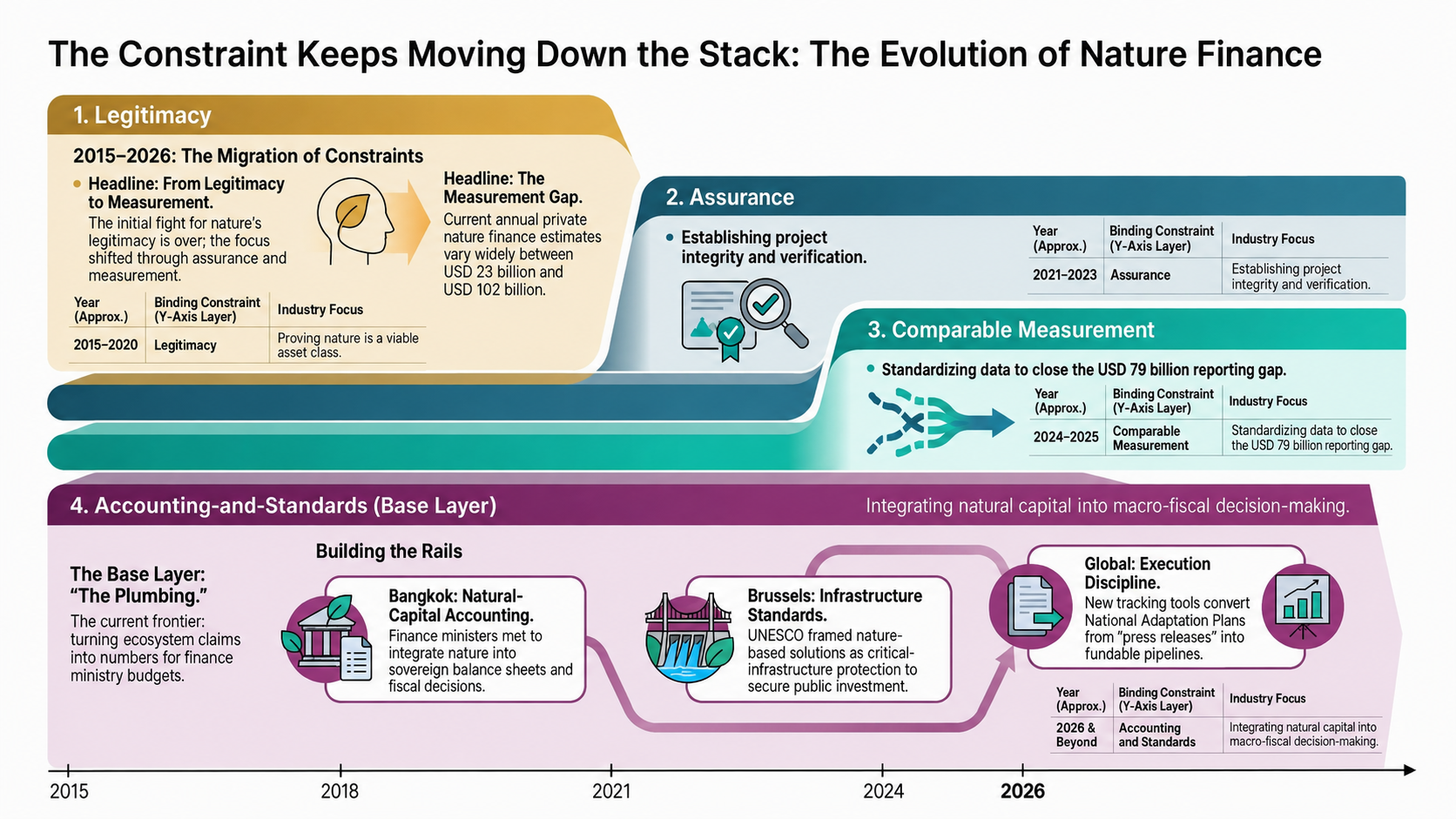
Start with the accounting layer, because the rest sits on top of it. The World Bank's 8th Global Policy Forum on Natural Capital, held in Bangkok on 9 and 10 June, was aimed squarely at finance ministers, central bankers, and investors, not conservationists, and focused on how natural-capital accounts inform fiscal and financial decisions.[1] This is the quiet center of the nexus. A treasury that keeps accounts for forests, water, and soil can write nature into a budget line and a sovereign balance sheet, which is the only durable way nature-based solutions and ecosystem-based adaptation reach scale. The forum disbursed nothing, and that is the point: accounting is infrastructure, and infrastructure is what the field has been missing. Held alongside a Thai commercial banking sustainability forum, it also positioned Bangkok as a bridge between global accounting standards and domestic financial practice.[4]
The second shift brings measurement into the plans that govern public adaptation spending. The evidence base for tracking nature-based solutions and ecosystem-based adaptation within national adaptation plans has matured into a set of usable tools. The NAP Global Network's review of 57 submitted plans found that every one now contains at least one such action, even as only a minority specifies a timeline or a monitoring roadmap to deliver it.[2] The gap is no longer ambition; it is execution discipline. A national adaptation plan that names a mangrove action but cannot track it is a press release, not a pipeline. The tracking frameworks now circulating are what convert the first into the second. The unit of engagement is the national plan, and the product is an indicator that a finance ministry will fund.
The third shift moves nature-based solutions out of the amenity column and into the standards that govern hard infrastructure. UNESCO's conference in Brussels on 10 June, held within the EU-funded NBSINFRA project, framed nature as a means of protecting critical infrastructure against climate and disaster risks, with a policy roundtable and an evidence-to-policy panel aimed at European institutions and member states.[3] When a flood-resilience standard or a public-investment appraisal can specify a restored wetland the way it specifies a concrete defense, nature stops being the line item cut first in a tight budget. This is slow, procedural work, and it is exactly where durable demand is built.
Follow the three together, and the logic closes. Accounting assigns a number to nature that a treasury recognizes; planning frameworks place that number in a national budget; standards give it a seat in infrastructure appraisal. The headline figures the field cannot agree on become less important once these rails exist, because a project will be priced using accounts and standards rather than a market-size estimate. The week's lesson for practitioners is to stop competing on the pitch and start competing on the plumbing. The portfolios that win the next decade will be those whose claims are already legible within the accounting categories these three forums are standardizing. November's Paris Congress will test whether the field can turn this procedural progress into a method the market adopts.[5]
The Record
Conviction showed up this week as institutional machinery rather than capital. An agreement on the basic arithmetic has still not been reached. Each item is evaluated for how it affects the gap between a claim and a fundable number.
Finance ministers met to turn nature into accounts, not speeches. The World Bank's Global Program on Sustainability convened the 8th Global Policy Forum on Natural Capital in Bangkok on June 9 and 10, drawing finance ministers, central bankers, and investors to discuss how natural capital accounting is entering fiscal and financial decision-making, followed by a peer-learning workshop for core implementing countries on June 11. The framing is the win that practitioners have wanted: nature as macro-fiscal infrastructure rather than an environmental annex. But this was policy dialogue, and no disbursement or funding window was attached. World Bank Global Program on Sustainability, Bangkok, 9–10 June 2026. https://www.worldbank.org/en/events/2026/06/09/global-policy-forum-on-natural-capital-2026
Nature entered the language of critical-infrastructure standards. UNESCO hosted an international conference on nature-based solutions for critical infrastructure resilience in Brussels on 10 June, as part of the EU-funded NBSINFRA project, convening UN agencies, the European Commission, and member states for a policy roundtable and an evidence-to-policy discussion. The significance is procedural: when NbS enters infrastructure-protection standards, it gains a defensible place in public investment management rather than competing as a green add-on. No financing was announced; the output is framing and evidence synthesis. UNESCO, within the NBSINFRA project, Brussels, 10 June 2026. https://indico.un.org/event/1023722/
Tracking tools matured for nature inside national adaptation plans. The NAP Global Network's synthesis of 57 submitted national adaptation plans confirms that every plan now includes at least one NbS or EbA action, while a related review finds that only a minority specify a timeline or a monitoring roadmap for implementation. The diagnosis is no longer absence but execution: the indicators and tracking frameworks now circulating are the bridge from a named action to a fundable one. Established evidence from 2024 and 2025, increasingly cited as donors weigh NbS-specific tracking requirements. NAP Global Network and IISD, reports 2024–2025. https://www.iisd.org/publications/report/tracking-progress-nature-adaptation-nap
A G7 donor signaled a continued integrated climate-nature window. Global Affairs Canada's consultation on its next climate-and-nature finance package, which builds on the existing CAD 5.3 billion commitment with a pillar for nature-based solutions and biodiversity, points to a likely continued integrated window for NbS and EbA pipelines. The signal matters for pipeline planning, but the CAD 5.3 billion is a commitment rather than a disbursement; the consultation has closed, and no new numerical target has been announced. Global Affairs Canada, consultation page; commitment figure self-reported, not independently verified. https://international.canada.ca/en/global-affairs/consultations/development/2024-05-10-climate-nature-finance
Registration opened for the field's principal annual convening. Biodiversa+ and NetworkNature confirmed the parameters and opened registration for the Nature-Based Solutions International Congress, 2 to 6 November 2026, at Sorbonne University in Paris, which will draw more than 500 researchers, practitioners, city representatives, and policymakers for a Scientific Conference and NetworkNature Week. The Congress consolidates NbS as a self-standing field with dedicated convening power and sets the runway for standards and method debates, though any codification depends on uptake by UNFCCC, CBD, or TNFD-aligned processes. Biodiversa+ and NetworkNature, Paris, 2–6 November 2026. https://www.biodiversa.eu/2026/06/10/nature-based-solutions-international-congress-2026/
ASEAN in Focus
Southeast Asia was the venue this week for the accounting debate, not the deal. The region that holds the world's most efficient carbon sinks hosted a forum on how to put nature on a treasury's books, a precondition for financing those sinks.
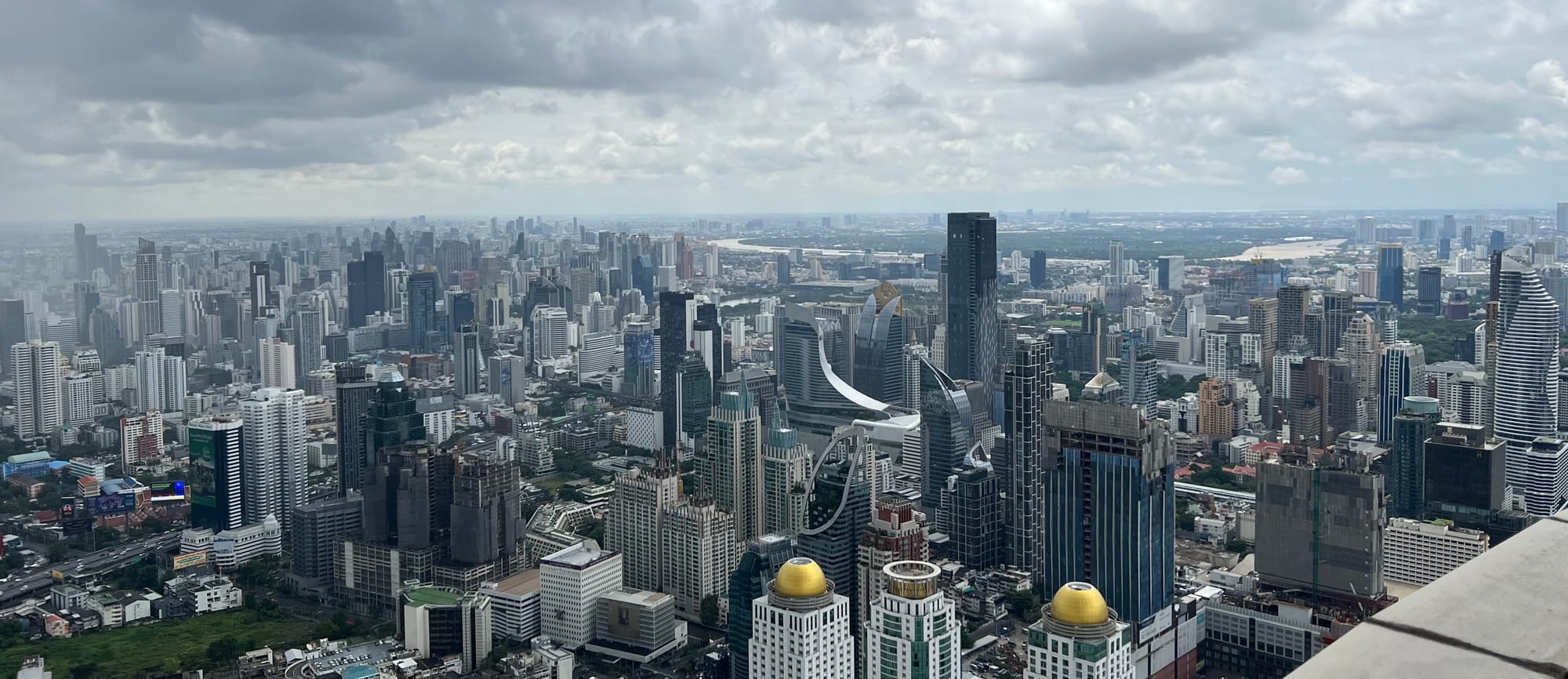
Southeast Asia sat at the center of the week's real story because the accounting forum that anchors this issue convened in Bangkok, Thailand. The World Bank's Global Policy Forum gathered finance ministers and central bankers, several from Asian implementing countries, to work through how natural-capital accounts enter national planning and fiscal systems, with a dedicated peer-learning workshop for core countries on 11 June.[1] For ASEAN practitioners, the opening is concrete: a treasury that keeps natural-capital accounts can align sovereign climate commitments, biodiversity strategy, and public-finance reform, thereby making the region's mangroves, peatlands, and marine ecosystems fundable rather than merely valued. The forum did not name any ASEAN-specific funding envelope, so follow-through will show up in subsequent country-level reform and pipelines, not in a pledge this week. The reading of the seven days is that ASEAN produced no new NbS or EbA operations; the regional news was the accounting venue itself, and accounting is the unglamorous precondition that the region's permanence problem has been waiting on. Governance, tenure, and the discipline to keep accounts once the forum ends, not the science, will decide whether the opening is taken.
Worth Watching Through Year-End
The diary through December remains full of convenings that set standards and shape pipelines, not conferences that move capital. That is the tell of a field still building its measurement and accounting rails. Watch the standards, not the headlines.
Nature-Based Solutions Symposium: “Who benefits, who decides?” — 29–30 June 2026, York, United Kingdom. The leading edge of the equity-and-governance debate, organized around who gains and who bears the risk when ecosystems are leveraged to advance climate goals, will shape norms around safeguards, benefit-sharing, and consent, which will condition the bankability of high-integrity nexus projects. Nature-based Solutions Initiative, University of Oxford. https://www.naturebasedsolutionsinitiative.org/news/nbs-symposium-2026
World Climate Investment Summit — 25 June 2026, in partnership with the London Stock Exchange Group. A returning investor-and-issuer venue whose past editions have featured nature-based solutions and biodiversity-credit sessions, making it a place to watch for blended climate-nature instruments, though the 2026 agenda and any NbS-specific sessions are not yet publicly confirmed. World Climate Investment Summit with LSEG; the agenda is provisional and announced only via social media. https://www.instagram.com/p/DXd-f9Ajgfi/
London Climate Action Week — 20–28 June 2026, London. Europe's largest climate festival, including the UNEP FI Global Roundtable, where the nature-finance and resilience rooms are the nearest venues to turn this week's accounting and measurement arguments into commitments. E3G; UNEP FI. https://londonclimateactionweek.org/
Climate Week NYC — 20–27 September 2026, New York. The year's largest corporate-and-government gathering, alongside the UN General Assembly, the bellwether for whether the offset-to-contribution turn and the integration agenda are real or rhetorical. Climate Group. https://www.climateweeknyc.org/
NbS International Congress 2026 — 2–6 November 2026, Sorbonne University, Paris. The principal NbS knowledge exchange, with a Scientific Conference and NetworkNature Week across more than 500 participants; expect advances in monitoring, accounting, and methods, not disbursements. SOLU-BIOD and NetworkNature, with Biodiversa+. https://www.biodiversa.eu/2026/06/10/nature-based-solutions-international-congress-2026/
Endnotes
[1] World Bank Global Program on Sustainability, “8th Global Policy Forum on Natural Capital 2026,” Bangkok, Thailand, 9–10 June 2026, with a peer-learning workshop for core implementing countries on 11 June, co-hosted with the Government of Thailand. Primary (event organizer); current-week convening, policy dialogue rather than a finance commitment; no disbursement or funding window announced. https://www.worldbank.org/en/events/2026/06/09/global-policy-forum-on-natural-capital-2026
[2] NAP Global Network and International Institute for Sustainable Development (IISD), “Tracking Progress on the Integration of Nature-Based Solutions and Ecosystem-Based Adaptation in National Adaptation Plan Processes,” synthesis report, 8 November 2024, with an accompanying infographic, 17 June 2025; finding that all 57 reviewed multi-sector NAP documents contain at least one NbS or EbA action. A related NAP Global Network review of monitoring, evaluation, and learning, 24 September 2025, finds only 39% of NAPs specify an implementation timeline or roadmap. Institutional analysis; established 2024–2025 evidence, cited here as background, not current-week news. https://www.iisd.org/publications/report/tracking-progress-nature-adaptation-nap
[3] UNESCO, “International Conference on Nature-Based Solutions for Critical Infrastructure Resilience,” Palais des Académies, Brussels, 10 June 2026, organized within the EU-funded NBSINFRA project (2023–2026); a policy roundtable and an evidence-to-policy discussion convening UN agencies, the European Commission, and EU member states. Primary (event organizer); current-week convening, framing, and evidence synthesis rather than capital commitment. https://indico.un.org/event/1023722/
[4] KASIKORNBANK, “EARTH JUMP 2026: A Bridge to Empowered Actions,” Bangkok, June 2026, held in partnership with the World Bank Group alongside the Global Policy Forum on Natural Capital, framing Thailand as a bridge between global policy frameworks and domestic business practice. Compiled from corporate and press reporting; commercial-banking forum, contextual to the World Bank event. https://www.thestorythailand.com/en/kbank-earth-jump-2026/
[5] Nature-Based Solutions International Congress 2026, organized by the French National Research Program on Nature-based Solutions (SOLU-BIOD) and NetworkNature in collaboration with Urban Nature Plans+, Biodiversa+, Sorbonne University, and the City of Paris; full Congress 2–6 November 2026 at Sorbonne University, Paris, with the Scientific Conference on 4–6 November and NetworkNature Week 2–5 November; call for abstracts and posters closed 5 June 2026. Primary (organizer); upcoming convening, knowledge exchange rather than disbursement. https://www.biodiversa.eu/2026/06/10/nature-based-solutions-international-congress-2026/