No. 6 - Who Benefits, Who Decides, Who Pays
After London’s marquee week, the field’s question turned from whether nature is investable to who benefits, who decides, and who pays.
The Climate-Nature Nexus in Practice (Weekly Briefing to 4 July 2026)
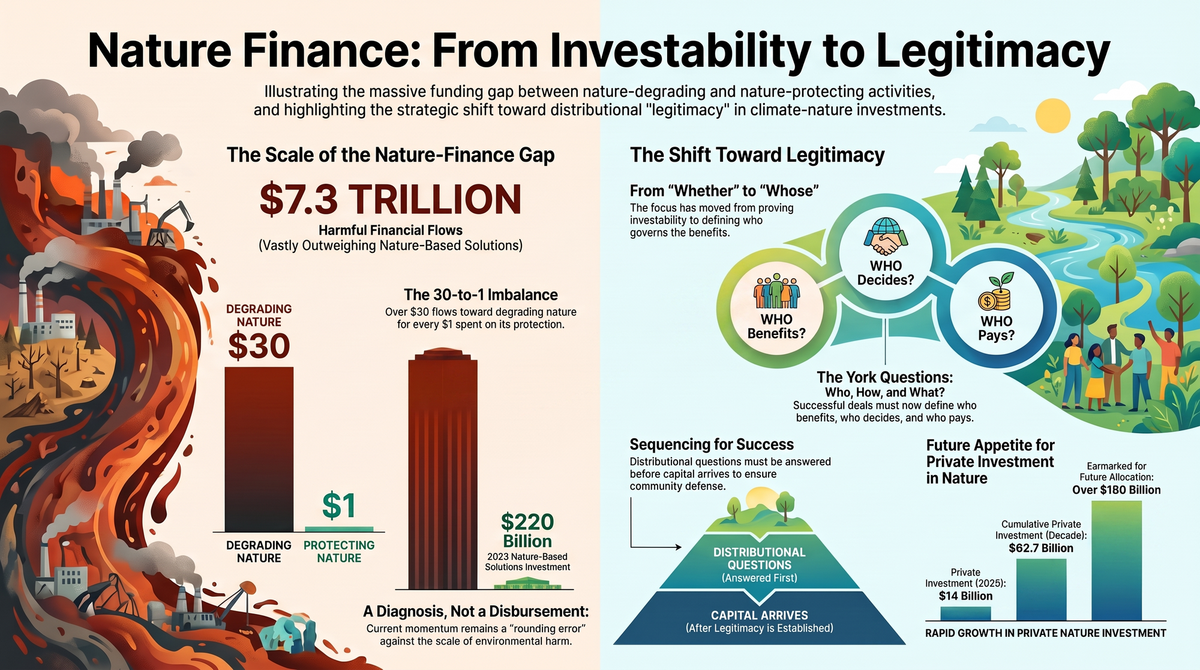
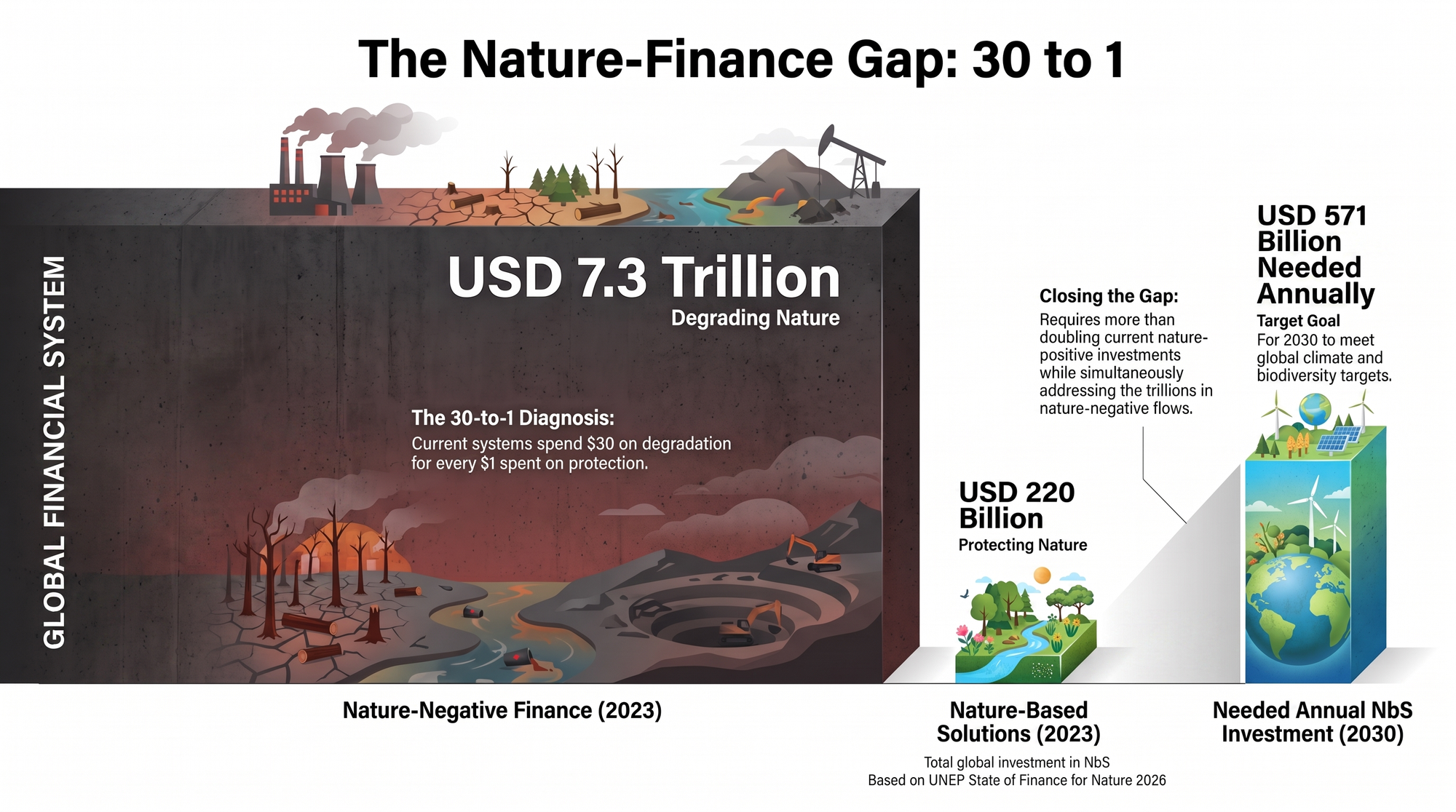
Bottom line: Over the past few weeks, this briefing has watched climate and nature converge in language, tooling, and now in the diagnosis of the gap. This week, the marquee finance fortnight in London closed, the field decamped to York, United Kingdom, and the question changed. It is no longer a question of whether nature is investable or integrated. It is who benefits, who decides, and who pays. That turn rests on the scale of the imbalance: by the latest United Nations Environment Programme count, over USD 30 flows toward degrading nature for every USD 1 toward protecting nature.[1] Integration’s next binding constraint is legitimacy, not proof.
Here is the gateway into the field, and the briefing is the room you walk into: [Podcasts and Video — NotebookLM]
Explainer Video Link
Last week, London spoke the sentence. Climate and nature became a single agenda item on the United Nations podium and in finance rooms, and the open question was whether the method would become an instrument. This week, the marquee fortnight closed, and the field did not wait by the ledger. It moved to York, where the Nature-based Solutions Initiative and the British Ecological Society convened a symposium around four questions that determine whether integrated nature finance holds: who benefits, who decides, who pays, and what is missing. [2] The question shifted from whether to whom.
The timing is well chosen because the week’s hardest evidence was the size of the gap, not a new flow. The United Nations Environment Programme’s latest stocktake finds roughly USD 30 spent on activities that degrade nature for every USD 1 spent to protect it, with nature-based solutions drawing about USD 220 billion in 2023, against USD 7.3 trillion moving the other way. [1] A second flagship, from Forest Trends and The Nature Conservancy, shows private investment in nature rising fivefold over a decade to a cumulative USD 62.7 billion, real momentum that remains a rounding error against the harm. [3] Both documents are diagnoses, not disbursements.
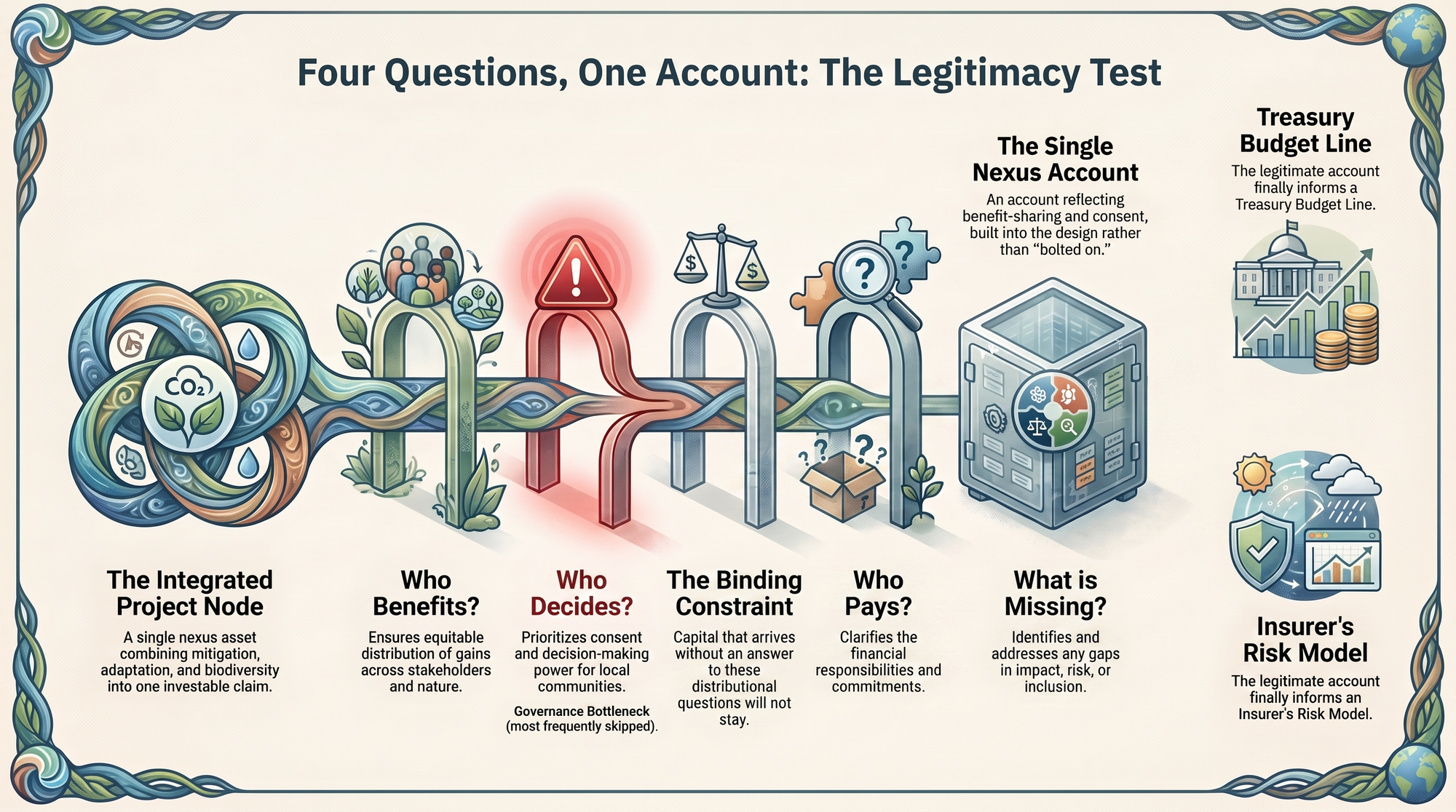
For senior practitioners, the instruction sharpens. The scarce skill is no longer structuring the integrated asset. The scarce skill is answering the distributional questions before the capital arrives, so the instrument that ultimately prices nature is also one that a community will defend.
From Whether to Whose
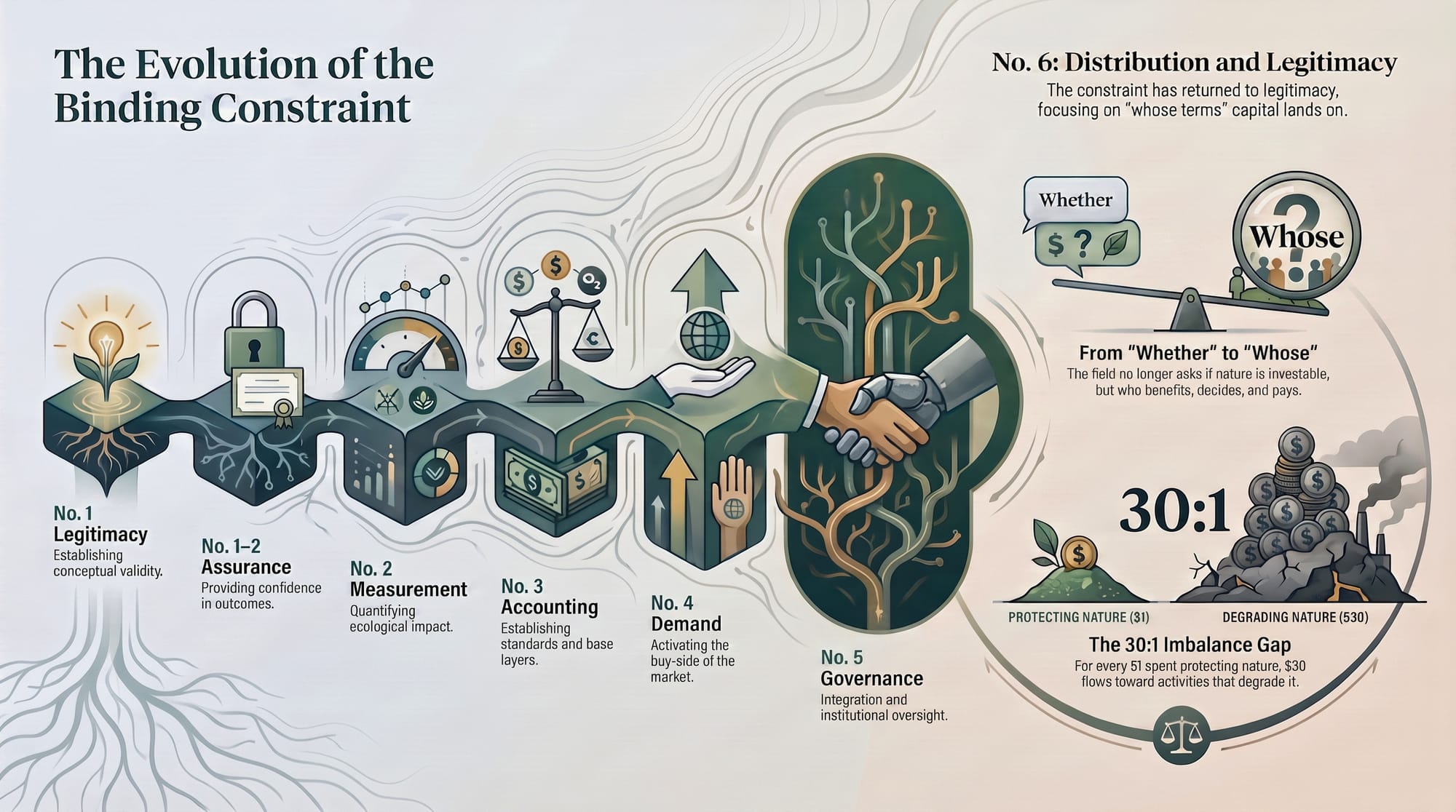
The week shifted the binding constraint again, from whether climate and nature integrate to whether that integration is legitimate. Mitigation and adaptation have their methods; distribution now gates both.
Over five issues, the binding constraint has migrated down and across the nexus stack: from legitimacy to assurance to measurement to the accounting base layer to demand, and last week to governance and integration. This week, the constraint moves once more, back up to legitimacy, but a legitimacy of distribution rather than of concept. The field no longer argues that nature is investable. York’s four questions concede the point and ask the sequel: when integrated capital arrives, on whose terms does it land? [2]
Mitigation shows the pattern first. The science anchoring nature’s mitigation case keeps hardening. A group of 287 scientists, convening in mid-June at the Bonn climate session in Germany, issued a first joint statement that animal-mediated processes, from seed dispersal to grazing, belong in climate accounting, widening the frontier of what integration must eventually be priced. [4] A wider frontier without a wider ledger is the two-speeds problem in another form. The mitigation asset grows more legible each week; the capital to protect it does not keep pace.
Adaptation is where the week’s one institutional gear actually turned. The Global Environment Facility’s ninth funding cycle opens on 1 July 2026, and its adaptation programming strategy for the Least Developed Countries Fund and the Special Climate Change Fund centers on ecosystem-based approaches, integrated land and water management, coastal protection, and resilient livelihoods as the spine of the 2026–2030 period. [5] The cycle turning over is architecture, not a disbursement dated to this week, and the distinction matters. But the strategy places ecosystem-based adaptation at the core of the largest dedicated adaptation windows, just as York asks who will govern the benefits.
Biodiversity remains the most exposed strand, and the week’s two counts explain why. Forest Trends reports that annual private investment in nature reached more than USD 14 billion in 2025, and that over USD 180 billion is earmarked for future allocation, based on a survey of institutions holding USD 207 trillion in assets. [3] The appetite is real and rising. What determines whether it becomes just and durable capital is the York agenda: benefit-sharing, consent, and who holds the account. Last week’s two speeds, fast language and a slow ledger, acquire a third variable this week, namely the terms. Capital that arrives without an answer to the question of "who benefits?" does not stay.
The Record
The week’s developments were convenings and counts, not commitments. Each item is weighed by how far integration moves from method toward a legitimate, priced instrument.
The field’s governance edge convened. The Nature-based Solutions Initiative at the University of Oxford and the British Ecological Society held a two-day symposium in York, built on four questions (who benefits, who decides, who pays, and what is missing), with Natural England, the National Trust, the Royal Society for the Protection of Birds, WWF, and the UK Centre for Ecology and Hydrology among the conveners. The meeting produced norms and arguments, not capital, but York is where the terms that make integrated nexus deals legitimate are set. British Ecological Society with the Nature-based Solutions Initiative, University of Oxford — York, United Kingdom, 29–30 June 2026. https://www.britishecologicalsociety.org/content/bes-symposium-2026/
London’s marquee fortnight closed with a focus on the nature-finance gap. The Nature Hub at London Climate Action Week gathered more than 350 finance, business, and government leaders, and its closing remarks were blunt: the missing ingredient is not ambition or frameworks but the acceleration of capital at scale, with nature reframed as a strategic economic asset rather than an environmental line item. Nature4Climate, Nature Hub retrospective — London, week ending 28 June 2026. https://nature4climate.org/13-lessons-from-nature-hub-london-climate-action-week-2026/
The largest dedicated adaptation windows opened with nature at the center. The Global Environment Facility’s ninth period opens on 1 July 2026, and the programming strategy for its Least Developed Countries Fund and Special Climate Change Fund makes ecosystem-based adaptation a pillar of 2026–2030, spanning coastal protection to integrated land-and-water management. The strategy provides programming direction; specific project approvals and disbursements follow through the cycle. Global Environment Facility — GEF-9 LDCF/SCCF adaptation programming strategy, period 1 July 2026–30 June 2030. https://www.thegef.org/council-meeting-documents/gef-ldcf-sccf-02-sm3-01
ASEAN in Focus
Southeast Asia holds the physical asset discussed in the abstract, and again watched the governance conversation unfold elsewhere. Peer-reviewed work led by the National University of Singapore finds that conserving and restoring the region’s peat swamp forests and mangroves could mitigate roughly 770 million metric tons of carbon dioxide equivalent per year, more than half of Southeast Asia’s land-use emissions, from ecosystems covering about 5% of its land. [6] That is the integrated asset in one sentence: mitigation, coastal adaptation, and biodiversity in the same hectare.
The York questions bear directly on it. A mangrove that stores carbon, buffers a coast, and feeds a fishery is governed by whoever holds its tenure, and blue-carbon deals fail the legitimacy test when benefit-sharing and consent are an afterthought. The region’s live proposals show the ambition and the gap at once: an ecosystem-based adaptation concept for the Gulf of Thailand, submitted by the United Nations Development Programme at about USD 10 million, sits in the Adaptation Fund pipeline as a concept under review, not as approved capital. [7] For ASEAN practitioners, the instruction is to build the distributional answer into the design and anchor it in national Nationally Determined Contributions (NDCs) and National Adaptation Plans (NAPs), so the region can claim integrated finance on terms its communities defend.
What This Means
The week’s signal lands hardest on the practitioners who design and govern nexus deals: program designers, the development institutions that fund them, and the community intermediaries who hold consent. The instruction from York is sequencing. Answer the distributional questions before the capital arrives, not after. Name who benefits, document who decides, and price who pays, with free, prior, and informed consent (FPIC) and benefit-sharing built into the account rather than bolted on. Last week’s discipline was to construct one integrated claim that a treasury and an insurer could both read; this week adds that the same claim must satisfy a community and a rights regime, or the capital it attracts will not stay. The gap the flagship counts describe does not close through more appetite. It closes through instruments legitimate enough to survive scrutiny where the project actually sits.
Worth Watching Through Year-End
The diary now turns to the governance and resource-mobilization meetings that will set the terms for this week’s field.
Climate Week NYC, 20–27 September 2026, New York. The year’s largest climate gathering and a bellwether for whether corporate and government nature commitments translate from language to capital. Climate Group — New York, 20–27 September 2026. https://www.climateweeknyc.org/
CBD COP17, 19–30 October 2026, Yerevan, Armenia. The biodiversity COP, where resource mobilization and the Kunming-Montreal review put the question of who pays on the treaty agenda, is the multilateral form of York’s question. Convention on Biological Diversity, seventeenth Conference of the Parties — Yerevan, Armenia, 19–30 October 2026. https://armenia.un.org/en/289877-conference-parties-convention-biological-diversity-cop17
Nature-based Solutions International Congress 2026, 2–6 November 2026, Paris. The principal NbS knowledge exchange, expected to advance monitoring, accounting, and the equity methods York proposed. NetworkNature and SOLU-BIOD, Sorbonne University — Paris, 2–6 November 2026. https://nbscongress.sciencesconf.org
Endnotes
[1] United Nations Environment Programme, State of Finance for Nature 2026: Nature in the Red — Powering the Trillion-Dollar Nature Transition Economy, 2026. (press release: "Harmful investments outpace nature protection by 30 to 1"). [Provenance: primary source, UNEP flagship report. The underlying flows are 2023 data reported in the 2026 edition.] https://www.unep.org/resources/state-finance-nature-2026
[2] British Ecological Society with the Nature-based Solutions Initiative, University of Oxford, “Nature-based Solutions Symposium: Who benefits, who decides, who pays, what’s missing?” York, 29–30 June 2026. Primary (organizers); current-week convening producing norms and argument, not capital. https://www.naturebasedsolutionsinitiative.org/news/nbs-symposium-2026/
[3] Forest Trends and The Nature Conservancy, Gaining Ground: State of Private Investment in Nature 2026, released around May 2026. Figures (cumulative USD 62.7 billion across 1,918 investments; fivefold rise 2016–2025; more than USD 14 billion in 2025; over USD 180 billion earmarked; survey of 70 institutions holding USD 207 trillion in assets) are self-reported and compiled from transaction and survey data; background, not current week. https://www.forest-trends.org/publications/gaining-ground-state-of-private-investment-in-nature-2026/
[4] International Fund for Animal Welfare and partners, “Scientific Consensus on Wildlife and Climate,” announced at the UNFCCC Subsidiary Bodies session (SB64), Bonn, 11 June 2026, with 287 signatory scientists. Primary and advocacy; mid-June background cited for the widening mitigation frontier, not current week. https://www.ifaw.org/au/press-releases/280-global-scientists-unite-urgent-need-wildlife-protection-climate
[5] Global Environment Facility, GEF-9 Programming Strategy on Adaptation to Climate Change for the LDCF and SCCF, period 1 July 2026–30 June 2030. Primary: programming direction with the cycle opening within the reporting window, not a disbursement dated to the week. https://www.thegef.org/council-meeting-documents/gef-ldcf-sccf-02-sm3-01
[6] Sasmito, S.D., Taillardat, P., Adinugroho, W.C. et al., "Half of land use carbon emissions in Southeast Asia can be mitigated through peat swamp forest and mangrove conservation and restoration," Nature Communications, volume 16, article 740, published 28 January 2025. Peer-reviewed model, with Massimo Lupascu as senior author. The paper reports avoided emissions of about 691.8 ± 97.2 TgCO2e per year (about 48% of the region's land-use emissions) plus a restoration potential of about 94.4 ± 7.4 TgCO2e per year; the widely quoted "approximately 770" is the rounded sum of the two, and the ± 97 band belongs to the avoided-emissions figure. Peatlands and mangroves occupy about 5.4% of Southeast Asia's land area. The figure shows modeled potential, not measured flux. https://www.nature.com/articles/s41467-025-55892-0
[7] Adaptation Fund, “Proposals and Concepts Under Review,” including an ecosystem-based adaptation concept for the Gulf of Thailand submitted by the United Nations Development Programme (about USD 10 million). Self-reported pipeline: a proposed figure under review, not approved or disbursed. https://www.adaptation-fund.org/projects-programmes/proposals-concepts-under-review/