No. 5 - One Agenda in Language, Not Yet on the Ledger
Climate and nature became one agenda this week: in the language, not yet on the ledger

The Climate-Nature Nexus in Practice (Weekly Briefing to 27 June 2026)
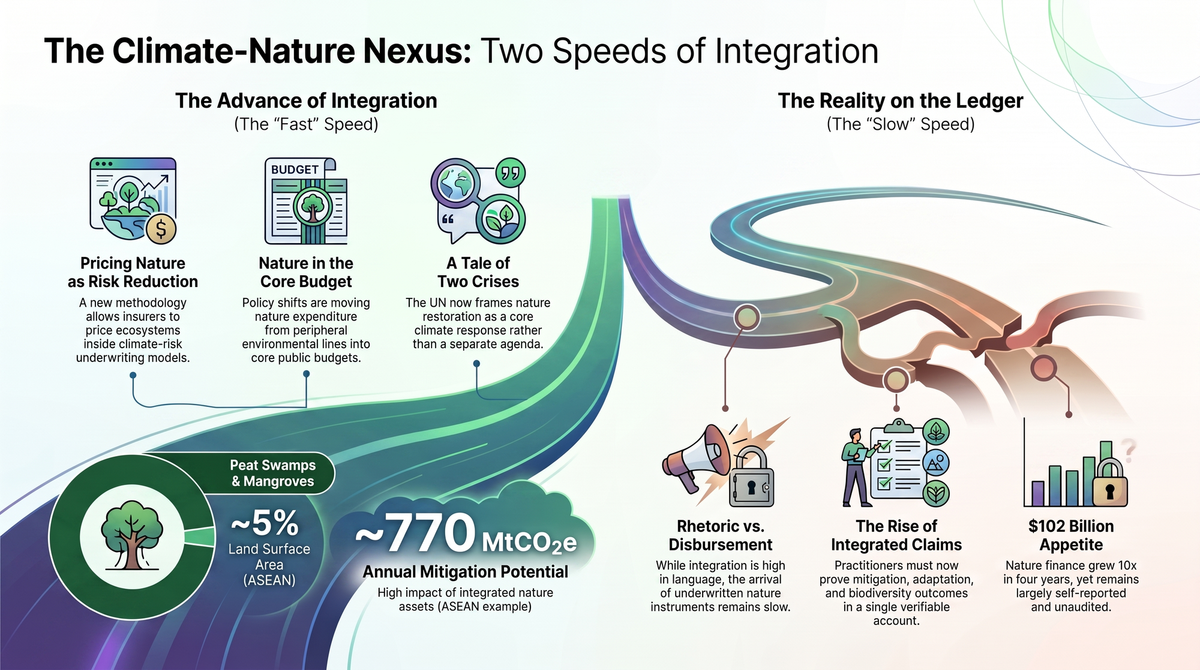
Bottom line: For four weeks, this briefing watched nature finance build its accounting rails and then convene its buyers. This week, the buyers filled the rooms in London, and the United Nations Secretary-General placed the restoration of nature at the center of the climate response. The week produced a shared frame and a new method for pricing nature within climate-risk underwriting, not a disbursed instrument. Integration is winning the language and the tooling, but lagging on the ledger. The question is no longer whether nature is investable, but whether climate and nature will be governed and financed as one system.
Here is the gateway into the field, and the briefing is the room you walk into: [Podcasts and Video — NotebookLM]
Explainer Video Link
Last week, this briefing left the field at a threshold. The buy-side had shown up to look, and the open test was whether any room would issue the first underwritten nature instrument. This week, the rooms convened in London, United Kingdom, and the answer came with a twist: the instrument did not appear, but the integration did.
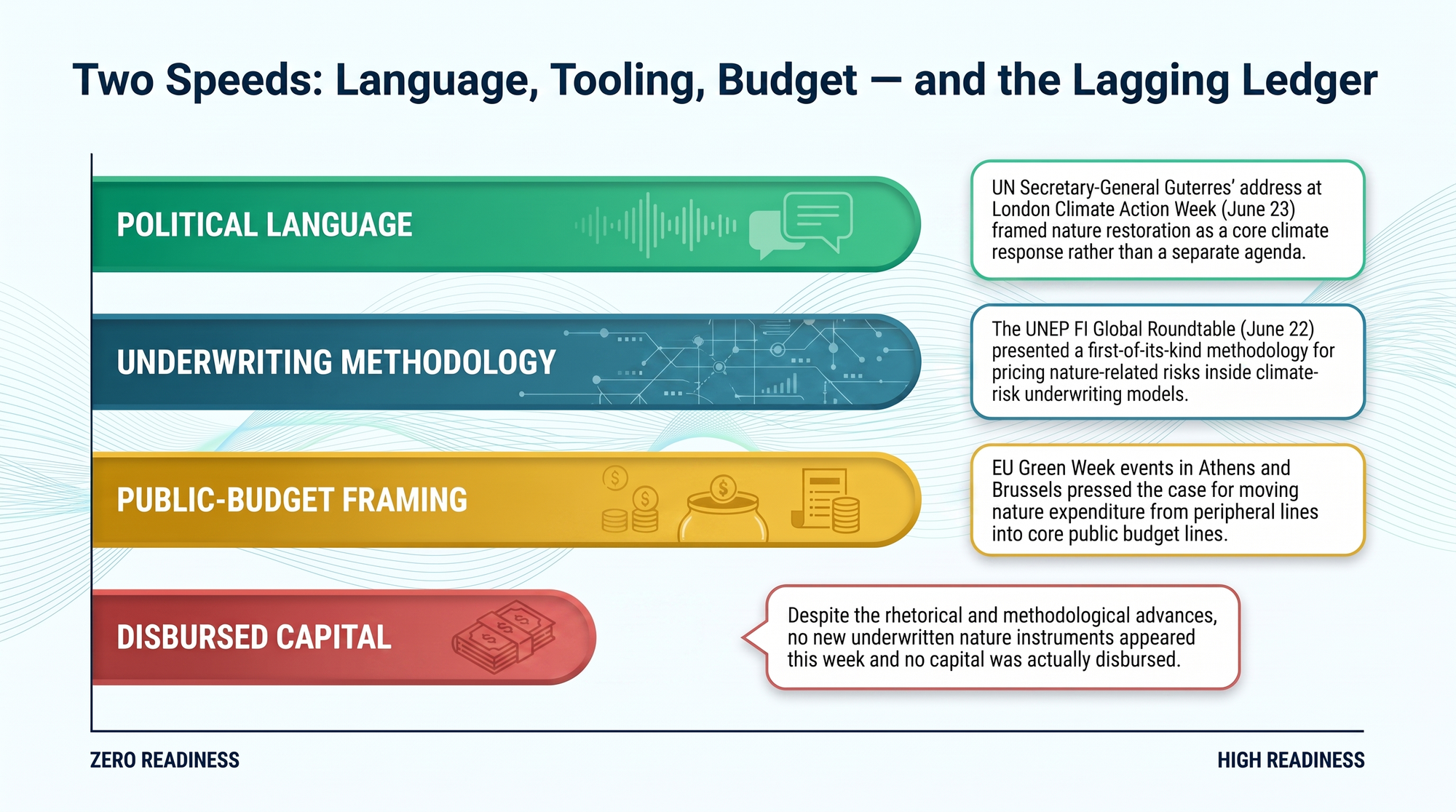
The week’s loudest signal came from the top. In a special address to London Climate Action Week on 23 June, the United Nations Secretary-General framed the world as facing a tale of two crises, climate and energy, and named restoring nature and halting deforestation as core climate responses rather than a separate environmental agenda.[1] The same fusion ran through the finance rooms. The UNEP FI Global Roundtable, the 19th edition of the United Nations Environment Programme Finance Initiative’s flagship gathering, convened under the banner From Risk to Resilience and, in a 22 June insurance session, presented a first-of-its-kind methodology for pricing nature within climate-risk underwriting.[2] In Athens, Greece, an EU Green Week event pressed the case for financing nature across public budget lines and through nature-based entrepreneurship.[3]
None of this moved capital. A speech, a methodology, and a financing dialogue are not a disbursement. The reframing is the news, and it sharpens last week’s lesson for senior practitioners. The scarce skill is no longer structuring a single bankable asset. The scarce skill is positioning a project so that one account carries both its climate and nature values, legible to a treasury’s budget line and an insurer’s risk model at once.
One Agenda, Two Speeds
The week fused climate and nature across language, tooling, and public budgeting. The underwritten instrument that would price the fusion did not arrive, and the gap between the two speeds is the story.
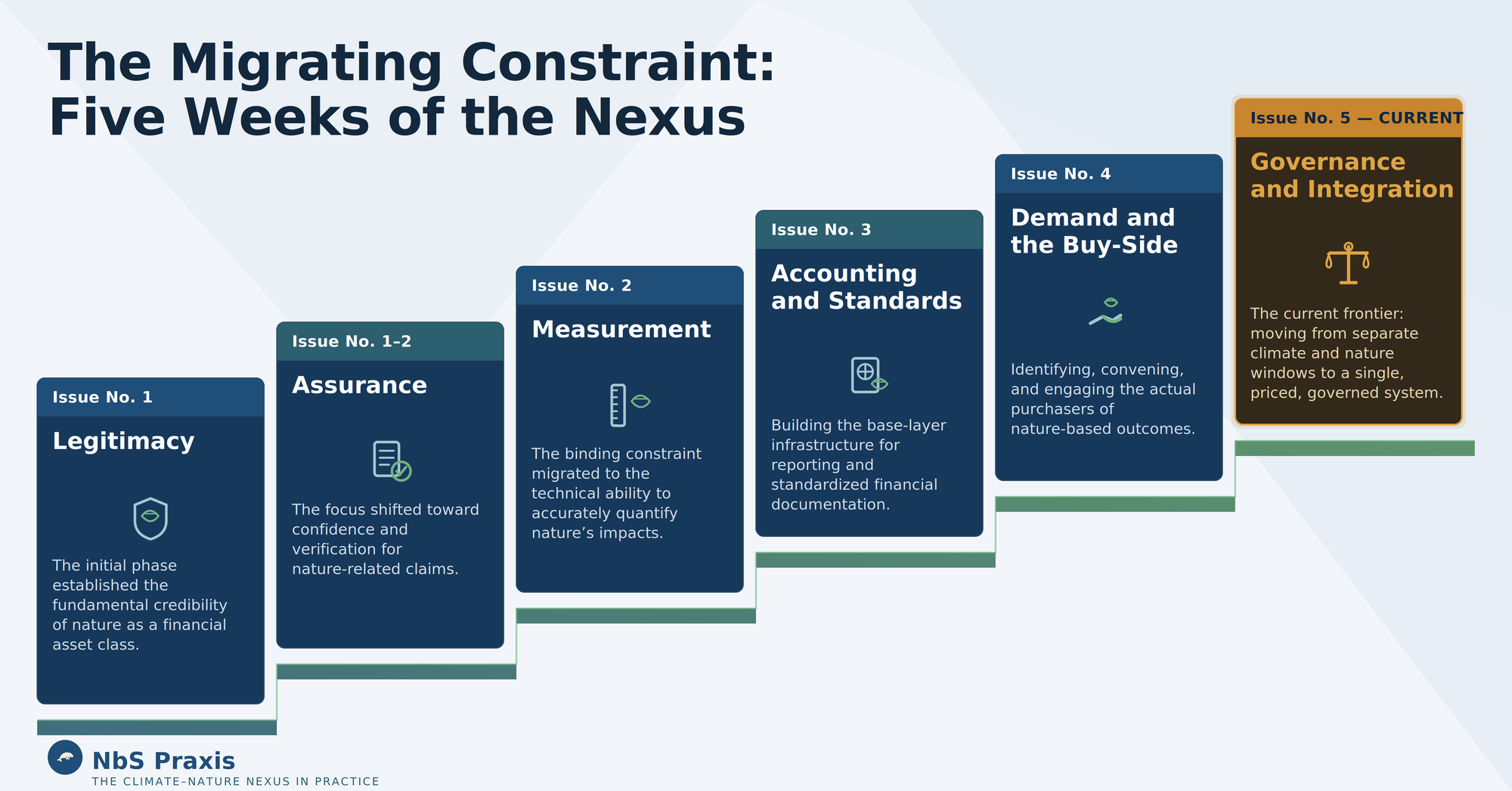
Over four issues, the binding constraint shifted down and then across the stack: from legitimacy to assurance to measurement to the accounting-and-standards base layer to demand. This week, the constraint moves up to governance and integration. The question is no longer whether a buyer exists for nature, as posed in Question No. 4, but whether climate and nature will be governed, budgeted, priced, and financed as a single system or kept in two separate windows. London answered in the affirmative, in words.
Start with mitigation because the week’s highest voice put nature there. The Secretary-General’s address placed forest protection and ecosystem restoration within the climate response, not beside it.[1] The rhetorical framing matters; a head-of-system speech sets the frame that ministries borrow. Yet the address reserved its concrete mechanisms for other targets, including an initiative on the environmental footprint of artificial intelligence and a call to action on methane, while nature received the language of priority without an accompanying instrument.[1] Nature won the sentence; methane won the mechanism. The pattern repeats the week in miniature.
Adaptation and resilience mark the point at which integration becomes operational. The Roundtable’s theme, From Risk to Resilience, reflects the verb shift this briefing has tracked since No. 3, and the week provided a tool: a method for incorporating nature into the underwriting of climate risk, developed with the insurance sector and presented alongside new disclosure guidance from the Taskforce on Nature-related Financial Disclosures (TNFD).[2] A methodology is infrastructure, not capital. But a methodology is what lets an insurer price a mangrove or a floodplain as risk reduction rather than charity, and pricing is the precondition for the instrument No. 4 (https://www.nbspraxis.com/the-climate-nature-nexus-in-practice-weekly-briefing-to-20-june-2026-no-4/) that is still waiting for.
Biodiversity remains in the most exposed position, as it has been all month. The Athens event brought biodiversity restoration into the language of public budgets and entrepreneurship, treating ecosystems as an expenditure to mainstream rather than a cause to fund.[3] The framing is right, but the money is notional; the event trafficked in pathways and pipelines, not disbursement. The integration case also has institutional champions beyond the convenings. The Elders, a group of senior global figures founded by Nelson Mandela, press governments to treat climate action and the protection of nature as a single transition rather than two regimes.[4] The advocacy is real; the binding governance reform is not yet on any negotiating table.
The two speeds are the point. Integration is fast in language, tooling, and budget framing, and slow in capital. The risk is familiar from the carbon market: a single agenda can become a rhetorical umbrella under which money still flows through separate climate and biodiversity channels, each with its own metrics, with nature credited last. Private finance for nature has grown from roughly USD 9 billion to over USD 102 billion in four years, on the broadest count, a figure compiled from self-reported and heterogeneous instruments and not independently audited.[5] The number measures appetite, not integration. Whether that appetite resolves into one priced, governed system or stays as two windows wearing one banner is the test the next quarter will set.
The Record
Conviction arrived this week as a speech, a methodology, and a financing dialogue, not a disbursement. Each item is weighed by how far it advances the integration of climate and nature toward a priced instrument.
The United Nations put nature at the center of the climate response from the highest podium. In a special address to London Climate Action Week, the Secretary-General described a tale of two crises, climate and energy, and named halting deforestation and restoring nature as central climate solutions, while reserving new mechanisms for artificial-intelligence transparency and methane. The speech sets the frame; no capital attaches to it. United Nations, Secretary-General’s special address, London, 23 June 2026. https://www.un.org/sg/en/content/sg/statements/2026-06-23/secretary-generals-special-address-london-climate-action-week-delivered
The UN’s largest sustainable-finance roundtable turned integration into an underwriting tool. The UNEP FI Global Roundtable on Sustainable Finance, 19th edition, convened in London on 23–25 June with the Green Finance Institute under the theme "From Risk to Resilience". A 22 June insurance session presented a first-of-its-kind methodology for integrating nature into climate-risk underwriting and risk models, and the Taskforce on Nature-related Financial Disclosures contributed sector guidance and tools. The methodology is infrastructure for pricing, not committed capital. United Nations Environment Programme Finance Initiative, London, 23–25 June 2026. https://www.unepfi.org/grt2026/
EU Green Week brought nature financing into public budgets. A NATURANCE-led EU Green Week event in Athens on 23 June, “Financing nature-based solutions: pathways to scalable biodiversity restoration and nature-based entrepreneurship,” followed a 2 June session in Brussels, Belgium, on unlocking nature across the budget lines. Both argued that nature expenditure belongs in core public budgets rather than a peripheral environment line. The events shape the method and narrative; the figures discussed are prospective, not disbursed. NATURANCE / EU Green Week 2026, Athens, 23 June 2026. https://www.naturanceproject.eu/nature-based-solutions-naturance-eu-green-week-2026/
ASEAN in Focus
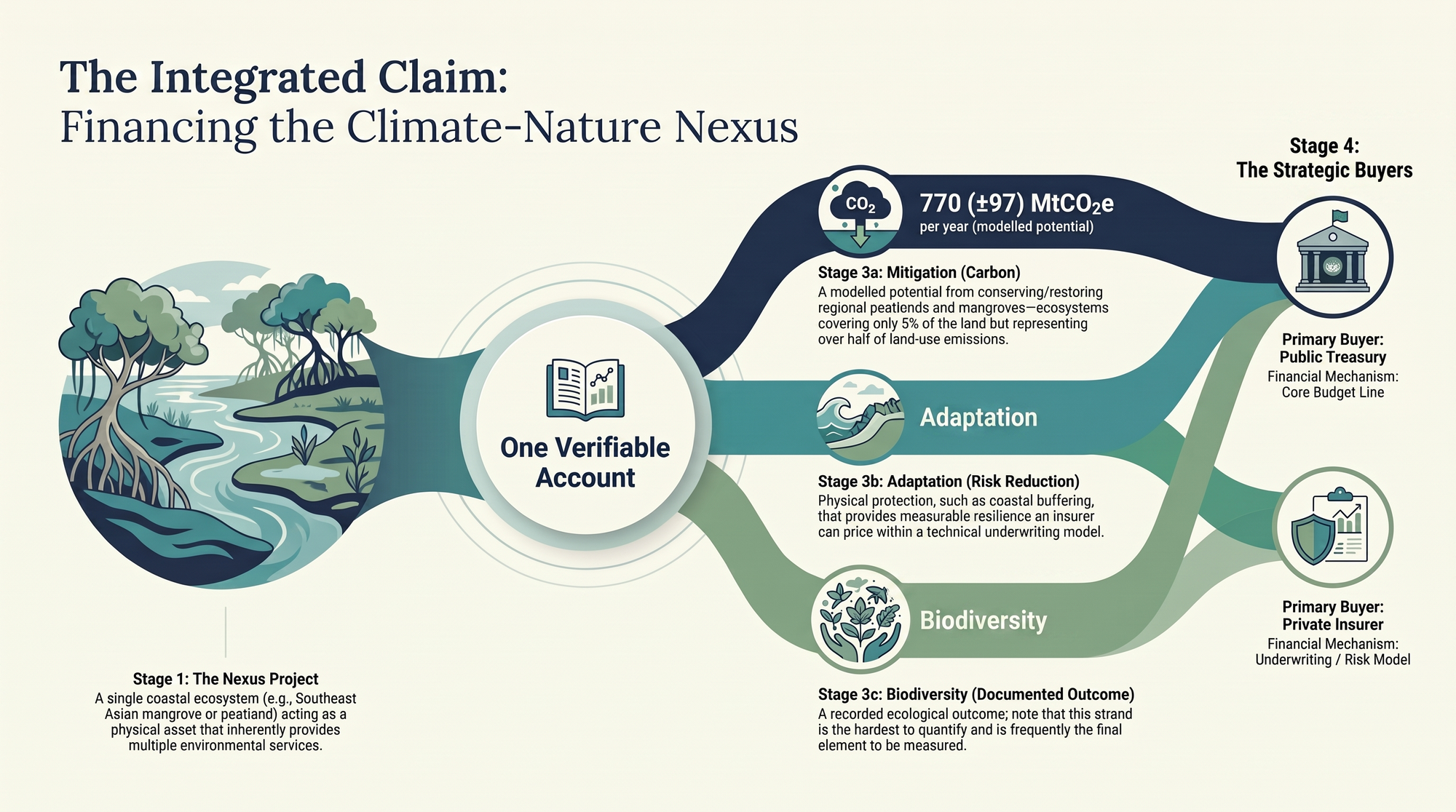
Southeast Asia is where the integration debated in London is already a physical reality, yet the region again sat outside the marquee rooms. The proof is in the carbon. A 2025 study in Nature Communications, led by the National University of Singapore with Nanyang Technological University, Singapore, and James Cook University, Australia, finds that conserving and restoring the region’s peat swamp forests and mangroves could mitigate roughly 770 MtCO2e a year, more than half of Southeast Asia’s land-use carbon emissions, from ecosystems covering only about 5% of its land surface.[6] These systems deliver mitigation, coastal adaptation, and biodiversity at once; they are the integrated asset that the week’s rhetoric described. Yet the convenings, the underwriting methodology, and the budget-line financing were European and global, and ASEAN’s coastal carbon drew none of the week’s marquee attention. For practitioners, the lesson compounds last week’s. The task is governance and documentation that allow a single mangrove or peatland project to claim mitigation, adaptation, and biodiversity outcomes in a single verifiable account, anchored in the region’s Nationally Determined Contributions (NDCs) and National Adaptation Plans (NAPs), so Southeast Asia can claim the integrated capital when it arrives.
What This Means
The week’s signal lands hardest on the practitioners who structure nexus deals: program designers and the development institutions and financiers behind them. The instruction is to stop presenting a project as either a carbon asset or a biodiversity asset and to build it as a single integrated claim. The UNEP FI underwriting methodology and the EU “across the budget lines” framing are the working templates: a treasury that budgets for nature on a core line and an insurer that prices nature in a risk model are the two buyer integrations intended to be reached. The discipline that makes the claim hold is documentation, with one account in which mitigation, adaptation, and biodiversity outcomes are measured together and withstand third-party scrutiny. The field has the sentence and now the method. The instrument follows whoever writes that account first.
Worth Watching Through Year-End
The diary still favors convenings that shape governance and standards over disbursements. Watch which room moves integration from method to instrument.
Nature-based Solutions Symposium: “Who benefits, who decides, who pays, what’s missing?” — 29–30 June 2026, York, United Kingdom. The equity-and-governance edge of the field, where norms on benefit-sharing and consent will decide whether integrated nexus projects are both bankable and just.
British Ecological Society with the Nature-based Solutions Initiative, University of Oxford. https://www.naturebasedsolutionsinitiative.org/news/nbs-symposium-2026/
London Climate Action Week closing days — through 28 June 2026, London. The last window for the week’s reframing to produce a committed nature-finance instrument rather than another agenda.
E3G and partners. https://londonclimateactionweek.org/
Climate Week NYC — 20–27 September 2026, New York. The year’s largest corporate and government gathering is the bellwether for whether the integration turn is real or rhetorical.
Climate Group. https://www.climateweeknyc.org/
Nature-based Solutions International Congress 2026 — 2–6 November 2026, Paris. The principal NbS knowledge exchange is expected to advance monitoring, accounting, and methods across more than 500 participants.
SOLU-BIOD and NetworkNature, with Biodiversa+. https://networknature.eu/networknature/event/nature-based-solutions-international-congress-2026-shaping-resilient-future-people-and-nature
Endnotes
[1] United Nations, “Secretary-General’s special address at London Climate Action Week [as delivered],” 23 June 2026. Primary (speaker’s office); current-week address, rhetorical framing rather than committed finance; nature named as a climate priority while new mechanisms were announced for artificial intelligence and methane. https://www.un.org/sg/en/content/sg/statements/2026-06-23/secretary-generals-special-address-london-climate-action-week-delivered
[2] United Nations Environment Programme Finance Initiative, “Global Roundtable on Sustainable Finance 2026,” 19th edition, London, 23–25 June 2026, theme “From Risk to Resilience: Financing the Future,” with the Green Finance Institute. Primary (organizer); current-week convening; the nature-into-climate-risk-underwriting methodology is organizer-described and presented as a method, not committed capital; TNFD contributed sector guidance. https://www.unepfi.org/grt2026/
[3] NATURANCE project / EU Green Week 2026, “Financing nature-based solutions: pathways to scalable biodiversity restoration and nature-based entrepreneurship,” Athens, 23 June 2026, following “Unlocking nature’s potential across the budget lines,” Brussels, 2 June 2026. Primary (organizer); convening and dialogue, with figures prospective and self-reported rather than disbursed. https://www.naturanceproject.eu/nature-based-solutions-naturance-eu-green-week-2026/
[4] The Elders, “The Climate and Nature Crisis: Proposals for Action.” Primary (organization); standing advocacy for integrating climate action and nature protection, cited here as background rather than a current-week event. A separately circulated item dated 18 June 2026, attributing to The Elders a specific “UN Planetary Council” proposal, could not be independently verified against a primary source as of writing and is not relied upon here. https://theelders.org/ClimateNaturePolicy
[5] MSCI, “The Climate-Nature Nexus: A Primer on the Way to Cali,” 16 October 2024. Compiled estimate; the USD 9 billion to over USD 102 billion growth figure is self-reported, aggregates heterogeneous instruments, and is not independently audited; cited as background, not current-week. https://www.msci.com/research-and-insights/blog-post/the-climate-nature-nexus-a-primer-on-the-way-to-cali
[6] National University of Singapore, with Nanyang Technological University and James Cook University, “Half of land use carbon emissions in Southeast Asia can be mitigated through peat swamp forest and mangrove conservation and restoration,” Nature Communications, 2025. Peer-reviewed; modeled mitigation potential of roughly 770 ± 97 MtCO2e per year; 2025 study cited as background, not current week; the value is a modeled estimate, not a measured flux. https://www.nature.com/articles/s41467-025-55892-0