No. 17 — Standing Forests Win, and a Buyer Weighs a Discount
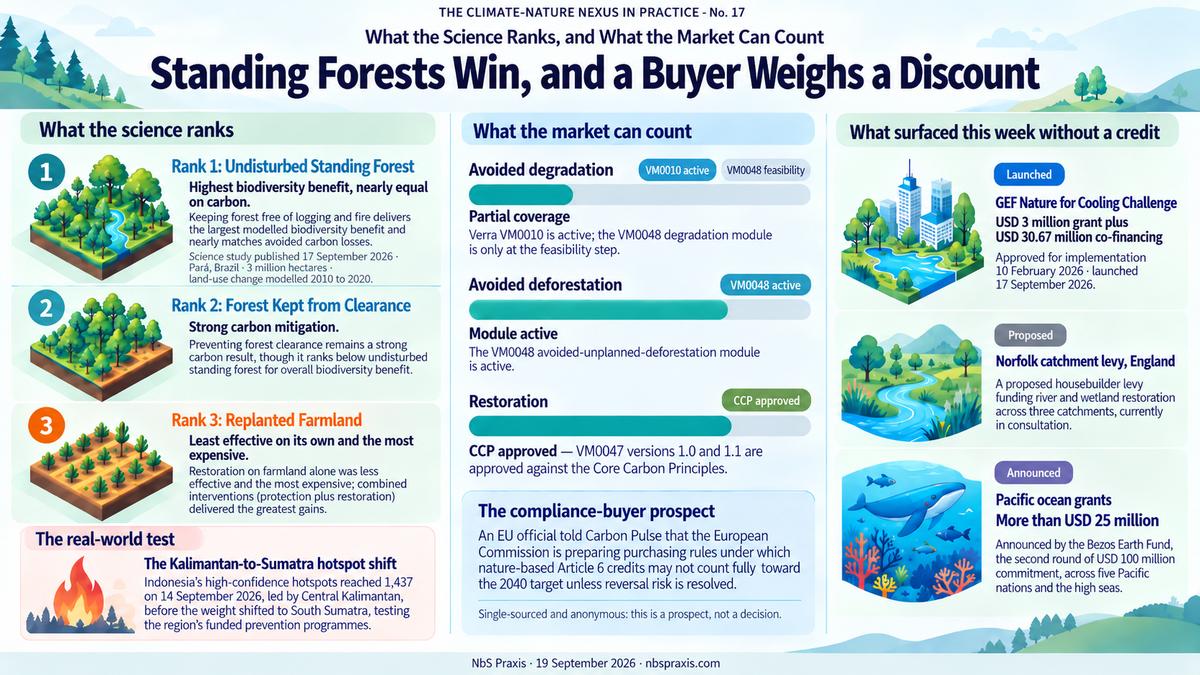
A Science study across 3 million hectares in Pará found that keeping forests free of logging and fire protects more biodiversity and carbon than planting new forests, and at a lower cost. The week’s finance arrived as a launch, a proposal, and a grant round, none of which was a credit.

The Climate-Nature Nexus in Practice (Weekly Briefing to 19 September 2026)
Bottom line: A Science study across 3 million hectares in Pará, Brazil, found that keeping standing forest free of logging and fire delivers the largest modeled biodiversity benefit and nearly matches avoided deforestation for carbon; restoration on farmland alone was less effective and the most expensive. Market groups proposed crediting caps for Pará’s nested projects, and an EU official told Carbon Pulse that Brussels is preparing rules to discount nature-based Article 6 credits unless reversal risk is resolved. The week’s finance came without a credit: a Global Environment Facility cooling challenge launched, a catchment levy proposed, and Pacific grants announced.
Here is the gateway into the field, and the briefing is the room you walk into: [Podcasts and Videos — Gemini Notebook: www.youtube.com/@nbspraxis]
Link to Explainer Video (Playlist of 1 Podcast and 3 Videos for Week 17, available at https://www.youtube.com/playlist?list=PLN6YQ7aUa6_U
Last week’s briefing left three provisional reversal-risk numbers on the table and asked who must answer them. [1] A team led by Lancaster University, publishing in Science on 17 September, modeled a decade of land-use change across Pará, Brazil, and found that keeping standing forest free of logging and fire delivered the largest biodiversity benefit and nearly matched avoided deforestation for carbon. [2] An EU official told Carbon Pulse that Brussels is preparing rules under which nature-based Article 6 credits would not count in full toward its 2040 target. [3] The outcome the study ranks first, forest kept from degradation, is the one the market’s accounting covers least completely, and the week’s finance signals came through channels that need no credit, each at its stage. [4] [5] [6] [7] Pipeline design should start with the avoided-degradation outcome and the instrument able to pay for it, with restoration alongside, not ahead.
Paying for the Forest That Stayed Standing
Avoiding degradation outperforms planting, and the accounting that would pay for avoidance is the least developed part of the market.
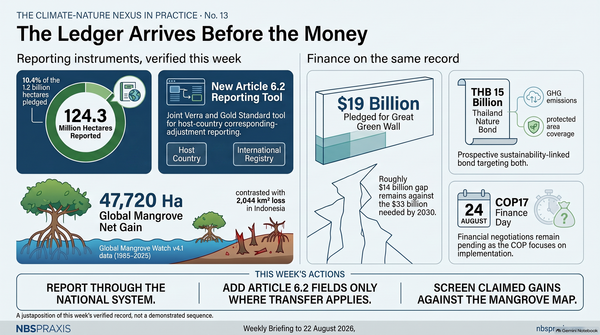
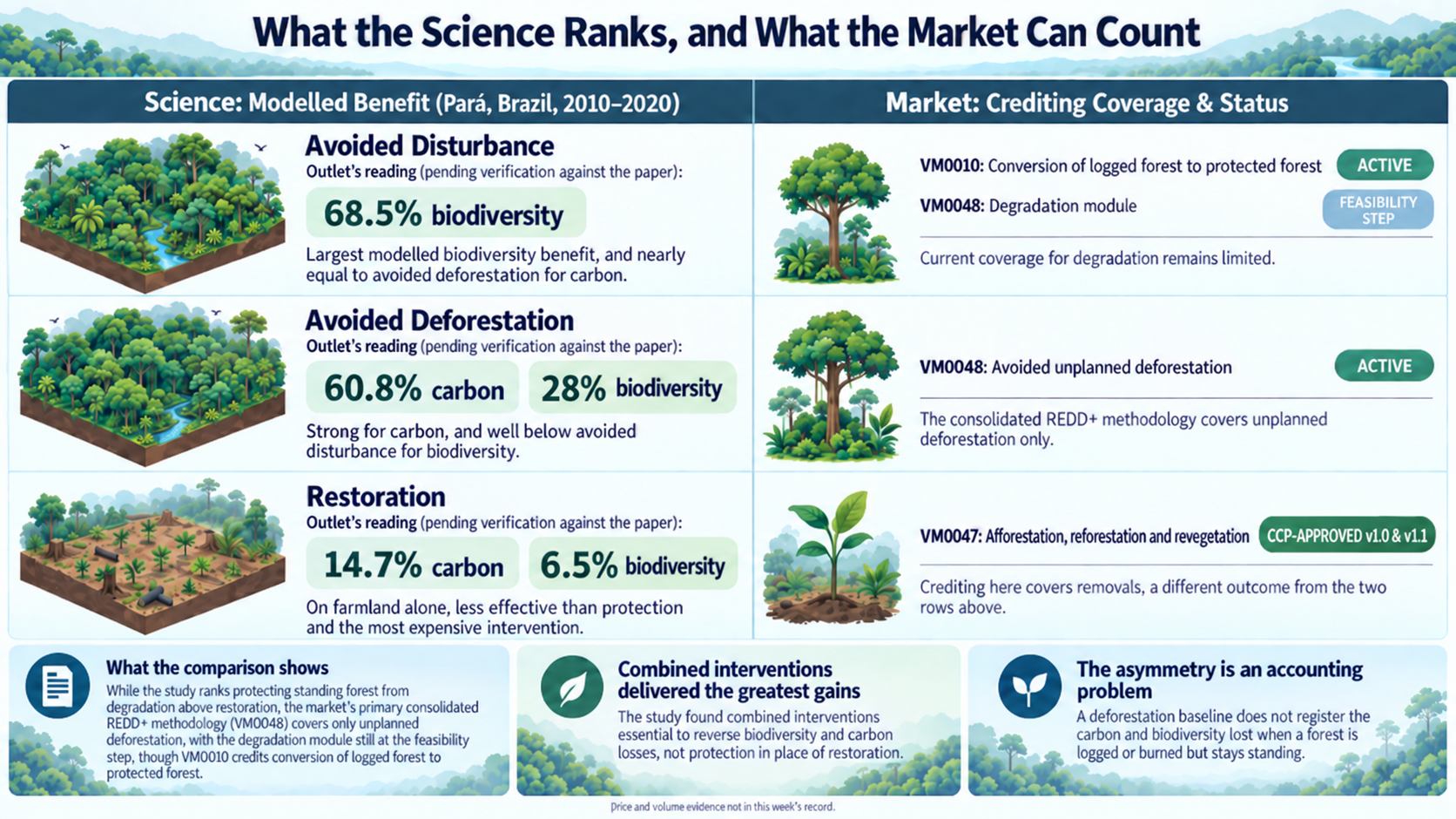
The study’s asymmetry is an accounting problem before a conservation one. Logging and fire strip biodiversity and carbon from a forest that remains a forest on every map, and a deforestation baseline does not register the loss. Instruments exist but cover the outcome unevenly: Verra’s VM0010 credits converting logged forest to protected forest, while its consolidated REDD+ methodology VM0048 still covers only avoided unplanned deforestation, with a degradation module at the feasibility step. [8] [4] Price and volume evidence is not in this week’s record; coverage is. The removal supply VM0047 provides is a different outcome, and Verra’s vetting of four more data providers is expected to cut that pipeline’s cost without touching the degradation gap. [9]
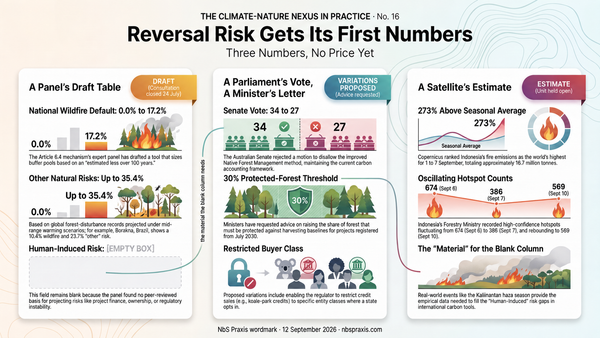
A buyer is weighing conditions. An EU official told Carbon Pulse this week that the Commission is preparing purchasing rules under which nature-based Article 6 credits would not fully count toward the 2040 target if standard-setters fail to resolve reversal risk; the rule is single-sourced and anonymous, a prospect. [3] A week earlier, Australia’s ministers said the regulator would be enabled to restrict who may hold credits from one native-forest method where a state opts in, framed as support for a state commitment, not as a durability rule; the parallel this briefing draws, eligibility written at the point of purchase in both, is editorial. [1] Verra’s Scope 3 program opened a different door, value-chain units rather than offsets, which still carry reversal risk, so the channel changes the claim, not the physics. [10]
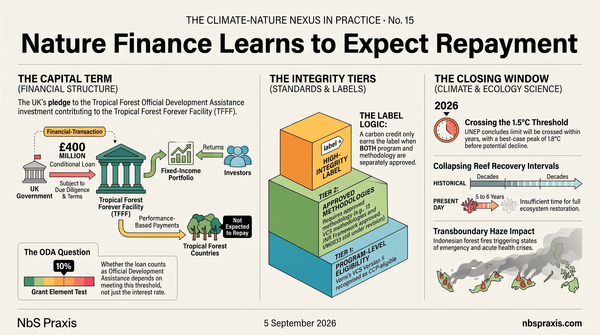
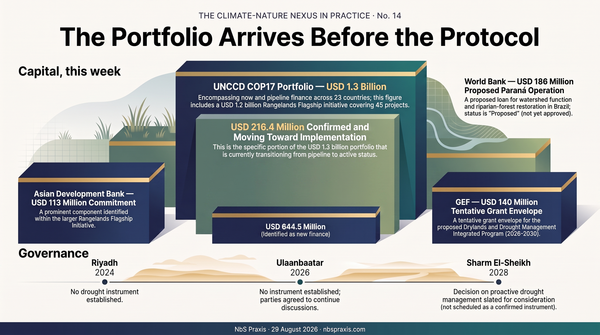
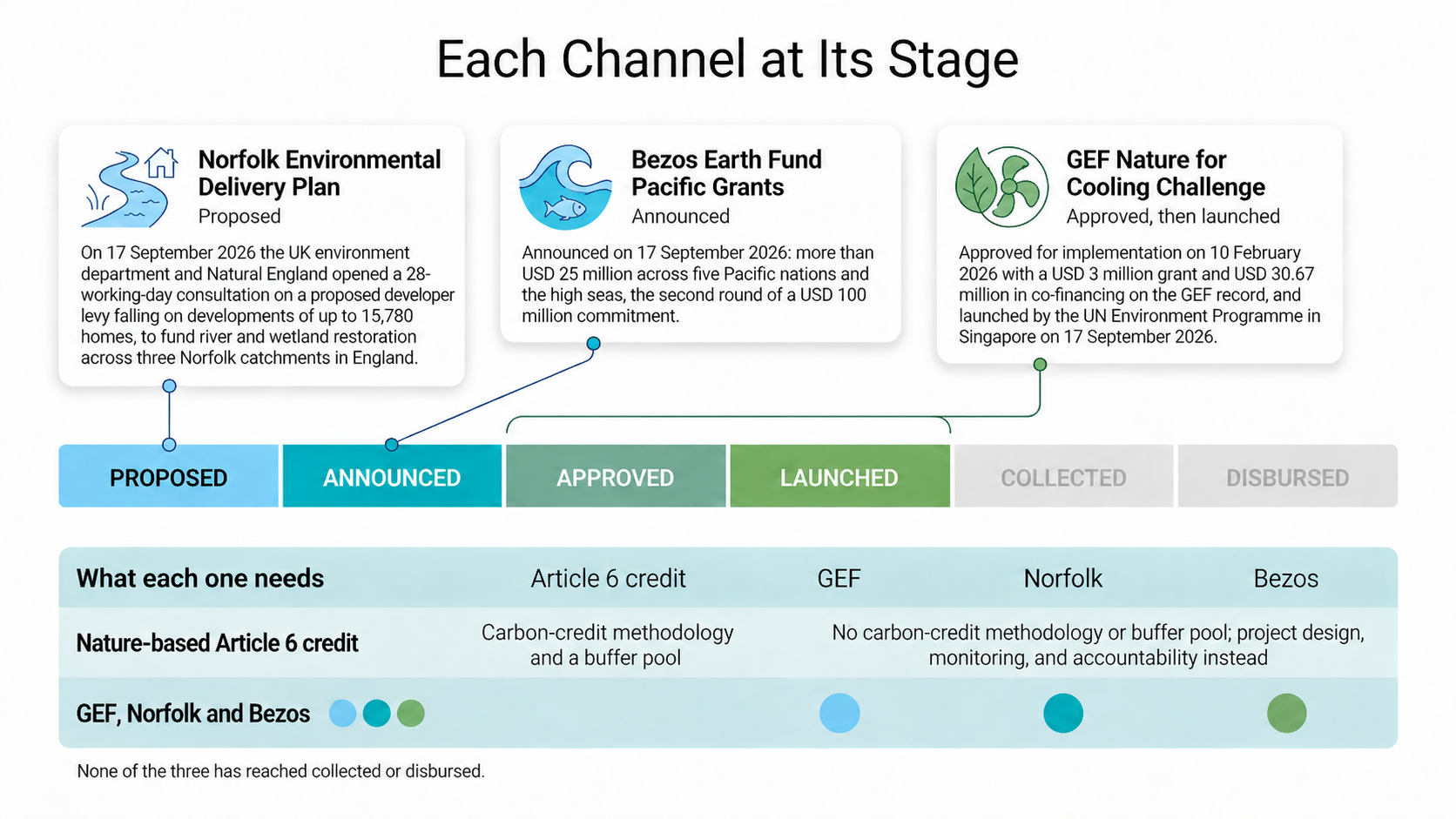
The week’s money moved through plumbing, each piece at its stage. The Global Environment Facility (GEF) approved a mitigation-window grant for urban nature-based cooling in February, and the challenge launched on 17 September. Natural England proposes a housebuilder levy to fund restoration across three Norfolk catchments, now in consultation. The Bezos Earth Fund announced a second round of Pacific Ocean grants. [5] [6] [7] None needs a carbon-credit methodology or a buffer pool, though each needs its own design, monitoring, and accountability. Southeast Asia provided the counter-example: a fire season that spiked in Kalimantan and moved to South Sumatra, the disturbance the Pará study priced; ASEAN in Focus has the figures.
The Record
A Science study across 3 million hectares in Pará ranks avoided disturbance above restoration.
Researchers from Lancaster University modeled land-use change from 2010 to 2020 in the Santarém and Paragominas regions using satellite imagery, 381 survey transects, and 499 rural properties. Avoiding disturbance (logging and wildfire) produced the largest modeled biodiversity benefit and nearly matched preventing deforestation for carbon; restoration on farmland alone was less effective and the most expensive; combined interventions delivered the greatest gains. Carbon Pulse’s analysis puts avoided disturbance at 68.5% of biodiversity losses mitigated, against 28% for avoided deforestation and 6.5% for restoration, and avoided deforestation at 60.8% of projected carbon losses, against 14.7% for restoration.
This week: published 17 September. (Science; Lancaster University; Carbon Pulse, 18 September 2026.) Source | Source
Verra opened two supply-side channels: a Scope 3 Standard and four additional data providers for its afforestation methodology.
Version 1 of the Scope 3 Standard Program, released on 15 September, will issue Scope 3 Units representing one tonne of carbon dioxide equivalent reduced or removed within a corporate value chain, on the Verra Registry, with reversal risk as a unit attribute. Launch methodologies cover agricultural land management and low-carbon concrete, and Version 1 permits only listing, so no units exist. On 17 September, Verra vetted Treefera, CYCLOPS, Lobelia Earth, and TransparenC as suppliers of stocking-index data under VM0047; the Integrity Council for the Voluntary Carbon Market lists versions 1.0 and 1.1 as approved against the Core Carbon Principles.
This week: primary Verra releases; vetting is a data decision, not a project approval, and any cost saving is expected, not measured. (Verra, 15 and 17 September 2026; Integrity Council register.) Source | Source
Three non-credit channels surfaced on one day, each at its stage: a GEF-funded challenge launched, an English levy proposed, and Pacific grants announced.
At the Global Cooling Pledge Assembly in Singapore on 17 September, the UN Environment Programme launched the Nature for Cooling Challenge under GEF project 11960, approved for implementation on 10 February 2026 with a USD 3 million grant and USD 30.67 million in co-financing on the GEF record; the release says “33 million in co-financing”. The same day, the UK environment department and Natural England opened a 28-working-day consultation on the first Environmental Delivery Plan under the Nature Restoration Fund, covering three catchments in Norfolk, England, where a flat levy on developers of up to 15,780 homes would fund river and wetland restoration; and the Bezos Earth Fund announced more than USD 25 million in grants across five Pacific nations and the high seas, the second round of a USD 100 million commitment.
This week: primary releases of 17 September; the GEF grant dates from February and the co-financing figures conflict; the Norfolk plan is a draft with no climate language; grants announced, not disbursed. (UNEP; GEF; Defra; Bezos Earth Fund.) Source | Source | Source | Source
ASEAN in Focus
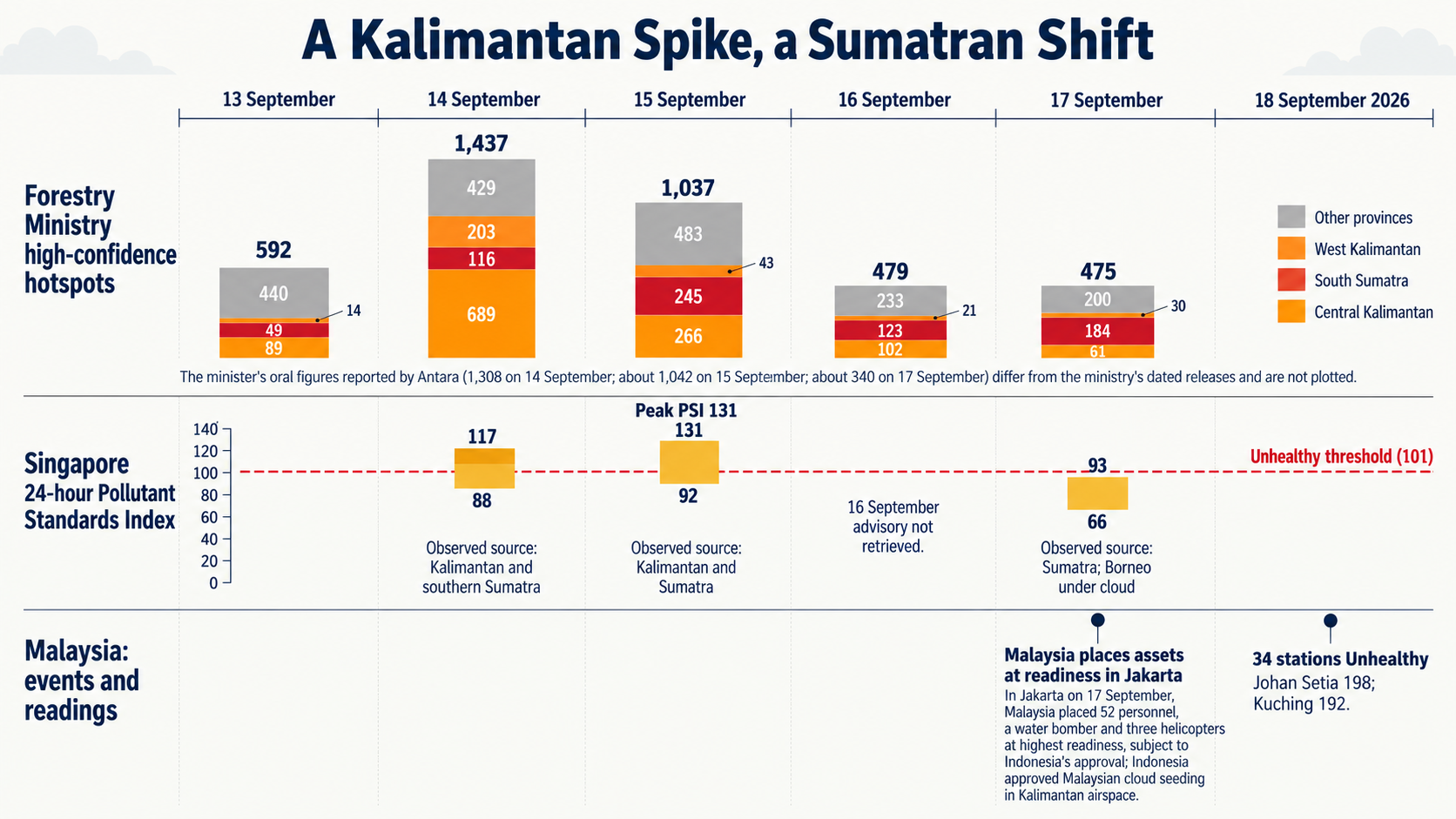
The fire season peaked in Kalimantan and then shifted to Sumatra. According to the Forestry Ministry’s high-confidence series, hotspots rose from 592 on 13 September to 1,437 on 14 September, led by Central Kalimantan at 689. They then fell to 1,037, 479, and 475 through 17 September, as South Sumatra rose to 245 and led the last two days with 123 and 184, against Central Kalimantan’s 102 and 61; the minister’s oral figures reported by Antara differ and are in the endnote. [11] [12]
Singapore’s National Environment Agency traced its haze to Kalimantan and southern Sumatra on 14 September, when the 24-hour Pollutant Standards Index read 88 to 117, and to both on 15 September at 92 to 131, before readings eased to 66 to 93 by 17 September, with Sumatra the observed source. [13]
Malaysia then bore the brunt, with 34 stations Unhealthy on 18 September, led by Johan Setia in Selangor at 198 and Kuching in Sarawak at 192. [14] In Jakarta, Indonesia, on 17 September, Malaysian Deputy Prime Minister Ahmad Zahid Hamidi placed 52 personnel, a Bombardier CL-415MP water bomber, and three helicopters at the highest readiness, subject to Indonesia’s approval and requirements; Indonesia approved Malaysian cloud seeding in Kalimantan airspace. [15]
The region has prevention instruments, including the EU- and German-funded peatland program SUPA, the International Fund for Agricultural Development’s MAHFSA program, and the ASEAN Investment Framework’s USD 1.5 billion mobilization target for 2030. This season is their test; the gap the Pará study points to is scale and implementation, not absence. [16]
What This Means
For developers and standard-setters with land-based credits, the Article 6.4 Supervisory Body’s October meeting becomes a demand-side event if the reported EU rule materializes. A submission quantifying human-induced risk, as No. 16 argued, is the one most likely to protect eligibility. [3] [1]
For program designers and finance officers, the Pará study is the reason to write avoided degradation into results frameworks and baselines before restoration targets, and the week’s non-credit channels are the instruments to study, each at its stage. [2] [4] [5] [6] [7]
For ASEAN institutions, the Malaysian package and the airspace approval test the haze arrangement’s assistance provisions, and the funded prevention programs are the ones to scale. [15] [16]
Worth Watching Through Year-End
Climate Week NYC runs in New York from 20 to 27 September 2026; the Taskforce on Nature-related Financial Disclosures releases its 2026 status report in New York and online on 21 September; the UN General Assembly holds a climate event on 23 September and a sea-level-rise meeting on 24 September.
(Climate Week NYC; TNFD; UN.) Source | Source | Source
The Article 6.4 Supervisory Body holds SBM 023 in Bonn from 5 to 9 October 2026; the Pre-COP31, hosted by Fiji with a leaders’ event in Tuvalu, runs from 5 to 8 October; the Global Tipping Points Conference meets in Kuala Lumpur, Malaysia, from 12 to 15 October.
(UNFCCC; Australian co-host site; Sunway Centre.) Source | Source | Source
The IMF and World Bank Group Annual Meetings run in Bangkok, Thailand, on 12 to 18 October 2026; the Adaptation Fund Board meets in Bonn from 19 to 23 October; the Convention on Biological Diversity’s COP17 convenes in Yerevan, Armenia, from 19 to 30 October; and the Green Climate Fund Board meets on 26 to 29 October.
(IMF; Adaptation Fund; CBD; GCF, dates without venue.) Source | Source | Source | Source
The Nature-based Solutions International Congress convenes in Paris, France, from 2 to 6 November 2026; UNFCCC COP31 follows in Antalya, Türkiye, from 9 to 20 November.
(NbS International Congress organizers; UNFCCC.) Source | Source
Endnotes
[1] NbS Praxis. (2026, September 12). Reversal risk gets its first numbers (The Climate-Nature Nexus in Practice, Weekly Briefing to 12 September 2026, No. 16). Prior issue, cited for series continuity and for the Australian ministerial statement of 10 September as carried there, which framed the buyer-class restriction as support for New South Wales’ commitment on the sale of Great Koala National Park units where a state opts in; the peer review of this issue reads the DCCEEW method page (updated 14 September 2026) the same way, and this pass could not open that page. Not an external primary source. https://www.nbspraxis.com/no-16-reversal-risk-gets-its-first-number/
[2] Miranda, L. S., Thomson, J. R., Ferreira, J., Gardner, T. A., Berenguer, E., Lees, A. C., Mac Nally, R., Aragão, L. E. O. C., Brancalion, P. H. S., Ferraz, S. F. B., Garrett, R. D., Molin, P. G., Moura, N. G., Nunes, S. S., Parry, L., Silveira, J. M., Vieira, I. C. G., Viana, C., and Barlow, J. (2026, September 17). Protecting tropical forests is more cost-effective for biodiversity and climate than restoration. Science, 393(6817), 1221–1225. https://doi.org/10.1126/science.adx9928. Primary peer-reviewed study; the Science page returned an access error to this pass, so the findings are carried from the Lancaster University release of 17 September 2026 as mirrored on EurekAlert (https://www.eurekalert.org/news-releases/1143895) and from the Stockholm Environment Institute publication record dated 18 September 2026 (https://www.sei.org/publications/protecting-tropical-forests-restoration/), which states that “avoidance interventions delivered the greatest benefits and were more cost-effective than restoration” and that “combined interventions delivered the greatest gains and were essential to reverse biodiversity and carbon losses.” Modelled outcomes from observed land-use change, 2010–2020, across more than 3 million hectares in the Santarém and Paragominas regions of Pará, Brazil, with 381 transects, 38 catchments, and 499 rural properties. Neither institutional record carries percentages.
[3] Carbon Pulse (Simon, F.). (2026, September 18). EU weighs safeguards for nature-based Article 6 credits counted towards its climate goals. https://carbon-pulse.com/552205/. Trade reporting: the visible text states that the European Commission “is preparing purchasing rules that would stop nature-based Article 6 credits from counting fully towards the bloc’s 2040 climate target, should international standard-setters fail to resolve reversal risks, an EU official said this week.
[4] Verra. (2026). VM0048 and VMD0055 frequently asked questions [Web page], https://verra.org/methodologies-main/vm0048-vmd0055-faqs/, and Proposed REDD module for degradation [Methodology development page, modified 10 June 2026], https://verra.org/methodologies/proposed-redd-module-for-degradation/. Primary program pages: VMD0055 “is the only currently available module and it covers only the Avoiding Unplanned Deforestation component of REDD,” with a planned-deforestation module under development and a degradation module “being explored”; the proposed degradation module, covering unplanned logging, fuel-wood and charcoal extraction, and anthropogenic forest fire, sits at “Step 1.7: Verra conducts a feasibility assessment.” No completion date is stated.
[5] United Nations Environment Programme. (2026, September 17). Cool Leaders, roadmap and nature for cooling: Global Cooling Pledge acts [Press release, Singapore]. https://www.unep.org/news-and-stories/press-release/cool-leaders-roadmap-and-nature-cooling-global-cooling-pledge-acts. Primary launch release: the Nature for Cooling Challenge, led by UNEP and Sustainable Energy for All and joined by Brazil, Cambodia, and Côte d’Ivoire, with a USD 3 million Global Environment Facility grant and, in the release’s words, “33 million in co-financing”, and a claim of up to 5°C peak-temperature reduction. The GEF project record for project 11960 (https://www.thegef.org/projects-operations/projects/11960) gives approval for implementation on 10 February 2026, a USD 3,000,000 grant, USD 30,670,000 in co-financing, a medium-size project under GEF-8, climate change focal area, UNEP as agency; the UNEP GEF project page (https://www.unep.org/gef/projects/nature-cooling-challenge-ncc) gives the same grant and co-financing and a total of USD 33,670,000. The release’s “33 million in co-financing” conflicts with both records and is carried as the release’s wording; the in-window event is the launch, not the approval. The Cool Coalition project page (https://coolcoalition.org/projects/nature-cooling-challenge) describes a three-year mitigation-window project with technical assistance and monitoring, reporting, and verification.
[6] Department for Environment, Food and Rural Affairs, and Natural England. (2026, September 17). Government unveils plans to unlock over 15,000 new homes [Press release]. https://www.gov.uk/government/news/government-unveils-plans-to-unlock-over-15000-new-homes. Primary release: the first Environmental Delivery Plan under the Nature Restoration Fund established by the Planning and Infrastructure Act, covering the River Wensum, Bure Broads and Marshes, and Yare Broads and Marshes catchments in Norfolk, England; up to 15,780 homes; a proposed flat developer levy ringfenced for river restoration, wetland creation, and fen and reedbed management; a 28-working-day consultation. A draft plan under consultation, not an operational levy, receipts, or disbursements; the release contains no reference to climate, flooding, resilience, or carbon, so the ecosystem-based-adaptation reading in this issue is the briefing’s inference.
[7] Bezos Earth Fund. (2026, September 17). Bezos Earth Fund expands its Pacific Ocean conservation to five more nations [Press release]. https://www.bezosearthfund.org/news-and-insights/bezos-earth-fund-blue-pacific-continent-ocean-conservation-expands. Primary release, paraphrased: the fund is granting more than USD 25 million to partners in the Cook Islands, Kiribati, Papua New Guinea, Tonga, and Vanuatu, and to Rare for the Pacific high seas, spanning more than 625,000 square miles of ocean; the fund announced seven grants totaling USD 37.5 million in 2025; and with this round the fund has made USD 63.3 million in grants toward the USD 100 million commitment to Unlocking Blue Pacific Prosperity. The release does not itemize this round; the cumulative implies about USD 25.8 million. Grants announced, not disbursed; all figures are the fund’s own.
[8] Verra. (2026). VM0010 Methodology for Improved Forest Management: Conversion from Logged to Protected Forest, v1.4 [Methodology page]. https://verra.org/methodologies/vm0010-methodology-for-improved-forest-management-conversion-from-logged-to-protected-forest-v1-4/. Primary methodology record, active since 24 October 2024, with corrections of 4 September 2026: the methodology addresses “preventing the selective logging of forests that would have been logged in the absence of carbon finance,” with project-scenario forest use limited to activities that do not result in commercial harvest or degradation. The volume of credits issued is not established here.
[9] Verra. (2026, September 17). Verra announces additional vetted data service providers for ARR methodology [Announcement]. https://verra.org/verra-announces-additional-vetted-data-service-providers-for-arr-methodology/. Primary announcement: Treefera, CYCLOPS, Lobelia Earth, and TransparenC join Sylvera, Kanop, and Chloris Geospatial as vetted suppliers of stocking-index data for VM0047 versions 1.0 and 1.1; Treefera and Sylvera connected to the Verra Project Hub by API. Version 1.1 covers Verra’s minor-revision notice of 14 May 2025 (https://verra.org/verra-publishes-minor-revision-of-arr-methodology-vm0047/), which allows assisted natural regeneration on lands with existing forest not managed for wood products and the enhancement of carbon stocks in existing forest. Core Carbon Principles status from the Integrity Council for the Voluntary Carbon Market assessment-status register (https://icvcm.org/assessment-status/, table updated 12 August 2026), which records v1.0 approved in December 2024 and v1.1 in September 2025, and from the Council’s announcement of 1 October 2025 (https://icvcm.org/integrity-council-approves-six-carbon-dioxide-removal-methodologies/). A data-vetting decision, not a project approval; any transaction-cost saving is an expected effect, not a measured one.
[10] Verra. (2026, September 15). Verra launches Scope 3 Standard Program, a comprehensive framework for verifying value chain climate action projects [Press release, Washington]. https://verra.org/verra-launches-scope-3-standard-program-a-comprehensive-framework-for-verifying-value-chain-climate-action-projects/. Primary release: Version 1; Scope 3 Units of one tonne of CO2 equivalent reduced or removed within a corporate value chain; launch methodologies for improved agricultural land management and low-carbon concrete adapted from the Verified Carbon Standard; forestry, industrial fuels, super-pollutants, and refrigeration named for later; Version 1 permits listing only, with registration, validation, verification, and issuance to follow, and reportable units under Version 2. The program details page (https://verra.org/programs/scope-3-standard-program/s3s-program-details/, checked 19 September 2026) states that “S3Us are issued by Verra to project proponents on the Verra Registry” and lists reversal risk among the unit attributes. Self-reported; no units issued.
[11] Kementerian Kehutanan, Republic of Indonesia. (2026, September 14, 15, 16, 17, and 18). Daily hotspot releases: Data terbaru Kemenhut: hotspot karhutla di Kalteng, Kalbar turun tajam (SP.523/HKLN/09/2026, 14 September; observations for 12 and 13 September), https://www.kehutanan.go.id/news/data-terbaru-kemenhut-hotspot-karhutla-di-kalteng-kalbar-turun-tajam; Hotspot nasional meningkat, Kemenhut perkuat respons cepat dan operasi darat udara (SP.527/HKLN/09/2026, 15 September; observations for 14 September at 21:05 WIB), https://www.kehutanan.go.id/pers/hotspot-nasional-meningkat-kemenhut-perkuat-respons-cepat-dan-operasi-darat-udara; Hotspot nasional turun 400 titik (numbered SP.430/HKLN/09/2026 as printed, 16 September; observations for 15 September at 21:05 WIB), https://www.kehutanan.go.id/news/hotspot-nasional-turun-400-titik-operasi-darat-udara-terus-diperkuat; Hotspot nasional turun 558 titik (SP.532/HKLN/09/2026, 17 September; observations for 16 September at 21:00 WIB), https://www.kehutanan.go.id/news/hotspot-nasional-turun-558-titik-kemenhut-perkuat-pengendalian-dan-penyelamatan-satwa-terdampak-karhutla; Hotspot nasional turun, Riau nihil, pengendalian Sumsel diperkuat (SP.536/HKLN/09/2026, 18 September; observations for 17 September at 21:05 WIB), https://www.kehutanan.go.id/pers/hotspot-nasional-turun-riau-nihil-pengendalian-sumsel-diperkuat Primary ministry series of high-confidence hotspots from NASA Terra/Aqua, SNPP, and NOAA-20 via SiPongi: national 567 (12 September), 592 (13 September), 1,437 (14 September), 1,037 (15 September), 479 (16 September), 475 (17 September); Central Kalimantan 89, 689, 266, 102, 61 and South Sumatra 49, 116, 245, 123, 184 for 13 to 17 September; West Kalimantan 14, 203, 43, 21, 30. Official satellite counts, not burned-area measurements.
[12] Antara. (2026, September 18). Menhut dampingi Menko Polkam di Sumsel, laporkan tren hotspot karhutla. https://www.antaranews.com/berita/5747809/ State news agency report, 19:03 WIB, of Forestry Minister Raja Juli Antoni’s briefing in South Sumatra: 1,308 hotspots on 14 September, about 1,042 on 15 September, and about 340 on 17 September nationally, and South Sumatra counts of 239, 245, 249, and 216 for 14 to 17 September. These figures diverge from the ministry’s dated releases in the preceding endnote on every day but 15 September; the definition, observation time, or revision behind the difference is not stated, so the ministry series is carried in the body, and this series is recorded here only.
[13] National Environment Agency, Singapore. (2026, September 14, 15, and 17). Haze situation updates. https://www.nea.gov.sg/media/news/advisories/index/haze-situation-update-14-september-2026; https://www.nea.gov.sg/media/news/advisories/index/haze-situation-update-15-september-2026; https://www.nea.gov.sg/media/news/advisories/index/haze-situation-update-17-september-2026. Primary advisories: on 14 September at 6 pm, 24-hour PSI 88–117 (Moderate to Unhealthy), “moderate to dense smoke plumes from fires in Kalimantan drifted towards Singapore” and “some smoke haze was also observed to drift from southern Sumatra”; on 15 September at 6 pm, PSI 92–131, with “some smoke haze … transported from Kalimantan and Sumatra to Singapore”; on 17 September at 5 pm, PSI 66–93 (Moderate), smoke drifting from southern and central Sumatra and the situation over Borneo undetermined under cloud.
[14] Malay Mail. (2026, September 18). Sarawak and Selangor bear the brunt as 34 stations log unhealthy API levels in Malaysia. https://www.malaymail.com/news/malaysia/2026/09/18/sarawak-and-selangor-bear-the-brunt-as-34-stations-log-unhealthy-api-levels-in-malaysia/235578 National press report of Department of Environment readings at 8:30 am: 34 stations Unhealthy, Johan Setia 198, Kuching 192, Samarahan 184, Serian 180; no station Very Unhealthy or Hazardous. Station readings as reported, not an archived APIMS snapshot, and not an emergency declaration.
[15] Radio Televisyen Malaysia. (2026, September 17, 6:57 pm). Malaysia sedia bantu Indonesia tangani kebakaran hutan. https://berita.rtm.gov.my/nasional/senarai-berita-nasional/senarai-artikel/malaysia-sedia-bantu-indonesia-tangani-kebakaran-hutan/ National broadcaster’s report of Deputy Prime Minister Ahmad Zahid Hamidi’s statement in Jakarta: 52 personnel, one Bombardier CL-415MP amphibious aircraft, and three helicopters “at the highest state of readiness, subject to the approval and requirements of the Indonesian government”; Indonesia’s approval of Malaysian use of Kalimantan airspace for cloud seeding; agreement to update the 1997 memorandum of understanding on disaster cooperation. Malay Mail (2026, September 17, https://www.malaymail.com/news/malaysia/2026/09/17/malaysia-offers-indonesia-aircraft-helicopters-to-fight-forest-fires-amid-haze-concerns-says-zahid/235565) corroborates this, reporting that the matter was referred to President Prabowo Subianto. An offer at readiness; no acceptance, deployment order, or approval pathway beyond the stated condition was verified, and no ASEAN-level haze meeting was found in the window.
[16] ASEAN Haze Portal. Sustainable Use of Peatlands and Haze Mitigation in ASEAN (SUPA) [Programme page, checked 19 September 2026], https://hazeportal.asean.org/programmes/supa/ (funded by the European Union and Germany, EUR 24,556,000 over 60 months from 2017, with objectives that include managing wildfire risk and reducing transboundary haze); ASEAN Haze Portal. (2024, September 13). ASEAN reaffirms commitment to tackle transboundary haze with financial framework, https://hazeportal.asean.org/2024/09/13/asean-reaffirms-commitment-to-tackle-transboundary-haze-with-financial-framework/ (the ASEAN Investment Framework for Haze-Free Sustainable Land Management, endorsed August 2023, “aims to mobilise an estimated USD 1.5 billion by 2030,” with USD 1.231 billion identified across 39 active and 23 pipeline projects at that date); ASEAN Secretariat. (2019, November 29). IFAD together with ASEAN invests in reducing transboundary haze pollution in Southeast Asia, https://asean.org/ifad-together-with-asean-invests-in-reducing-transboundary-haze-pollution-in-southeast-asia/ (the MAHFSA programme, a USD 3.5 million IFAD grant). Background anchors: programme pages and a 2024 release, not evidence of current-year disbursement or of adequacy; the mobilization target is a target, not committed capital.