No. 13 — The Ledger Arrives Before the Money
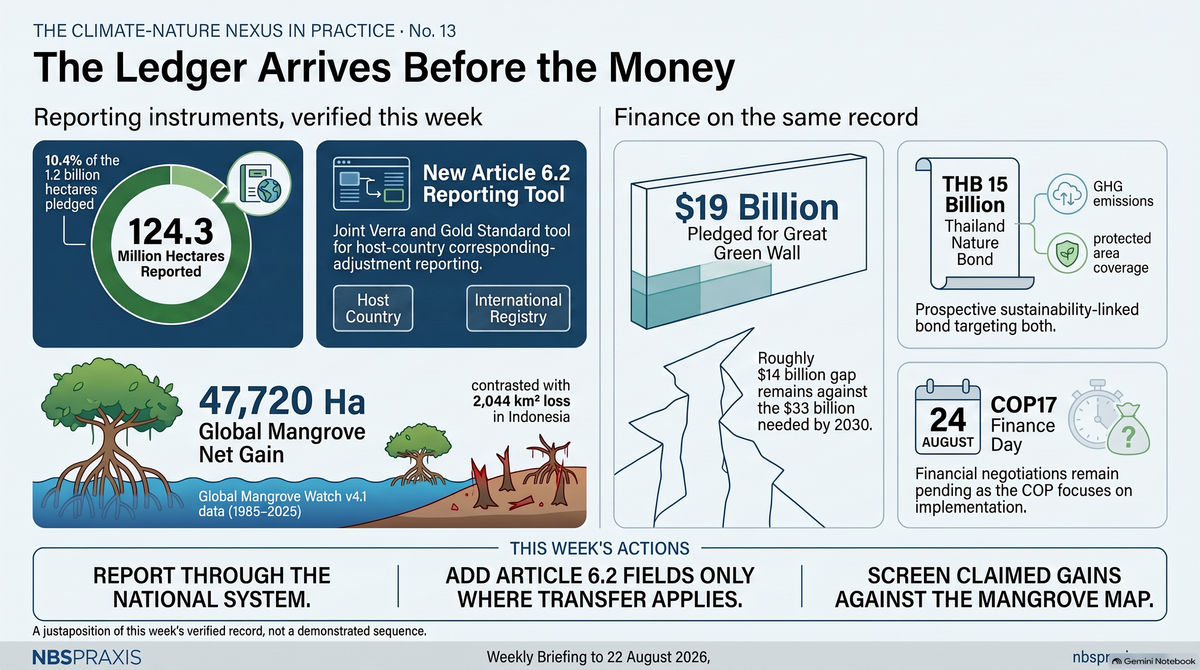
IUCN’s first pledge-to-reporting ledger for land restoration and a joint Verra and Gold Standard corresponding-adjustment tool were released the week the UNCCD COP17 opened, calling for a COP of implementation, while every finance item on the record remained pledged, prospective, or unverified.

The Climate-Nature Nexus in Practice (Weekly Briefing to 22 August 2026)
Bottom line: This week’s verified record favored reporting infrastructure over finance. The International Union for Conservation of Nature launched a ledger counting 124.3 million hectares of government-reported restoration, 10.4% of pledges, and a floor; Verra and Gold Standard released a joint Article 6.2 corresponding-adjustment tool; and UNCCD COP17 opened in Ulaanbaatar, Mongolia, with its secretariat calling for a COP of implementation, while every finance item on the same record remained pledged, prospective, or unverified.
Practitioners should match each instrument to its function: report through national systems, add Article 6.2 fields only where transfer applies, and treat mangrove maps as external screens. "What This Means" Section below sets out the actions.
Here is the gateway into the field, and the briefing is the room you walk into: [Podcasts and Video — Gemini Notebook: www.youtube.com/@nbspraxis]
Link to Explainer Video (Playlist of Podcast and Video for Week 13, available at https://www.youtube.com/playlist?list=PLEqULaNNsMGI)
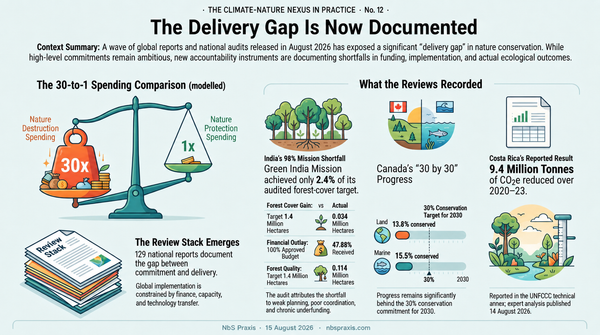
Last week’s briefing argued that audits, progress reports, and technical verification were widening the gap between commitment and delivery faster than finance was closing it. [1] This week, two reporting instruments arrived, a third received its public figures, and the convention that most needs money opened with implementation as its test.
- The International Union for Conservation of Nature (IUCN) launched its Global Restoration Achievements Database report at the seventeenth Conference of the Parties to the United Nations Convention to Combat Desertification (UNCCD COP17) in Ulaanbaatar, Mongolia, on 21 August, the first standardized ledger of restoration reported against restoration pledged. [2]
- Verra and Gold Standard released a tool on 20 August that compiles corresponding adjustments across both registries into the table-host-countries file in their 2026 Biennial Transparency Reports. [3]
- Aberystwyth University’s 20 August release gave Global Mangrove Watch version 4.1, a July dataset, its headline figures for 1985 to 2025. [4]
COP17 opened on 17 August with UNCCD Executive Secretary Yasmine Fouad calling for “a COP of implementation,” the drought framework unresolved, and the finance sessions scheduled for the second week. [5] [6] The reading offered here is bounded by the week’s verified record: the instruments that make delivery legible advanced while finance stood still, and the closing section turns that into actions.
Ledgers Before Liquidity
Three measurement instruments reached practitioners in one week, each with a different actor, purpose, and evidentiary status; the convention that needed the money opened with the gap unfunded.
The week’s defining feature was the arrival of counting systems, not capital:
IUCN’s database synthesizes official national reporting against pledges under the UN Decade on Ecosystem Restoration, the Kunming-Montreal Global Biodiversity Framework (KMGBF), UNCCD land degradation neutrality targets, and Nationally Determined Contributions (NDCs). The 124.3 million hectare total, 10.4% of roughly 1.2 billion hectares pledged, is conservatively constructed yet double-edged: the highest of IUCN’s four estimates and still a floor, because restoration that is never reported cannot be counted. [2] East Asia’s reported 38.8 million hectares equal 35% of its pledges; South Asia’s 37.8 million, 40%; and Sub-Saharan Africa’s 23.3 million, 5%. [2] The African Development Bank (AfDB) set out a separate measure the same day: at least USD 33 billion needed for the Great Green Wall by 2030, more than USD 19 billion committed, a gap of roughly USD 14 billion; the committed figure is an aggregate of pledges rather than disbursements. [7] Reported hectares against pledges and committed dollars against need are different measures; they belong side by side, not as a single gap.
The second instrument is the carbon-market one. The Verra and Gold Standard tool consolidates corresponding-adjustment records for authorized units across the two registries and populates the host-country table required under Article 6.2 of the Paris Agreement. [3] The boundary matters as much as the function: the tool applies only where host authorization and international transfer apply, and it is neither a restoration reporting channel nor a test of financeability. On a separate track, the Integrity Council for the Voluntary Carbon Market (ICVCM) closed its program application platform on 18 August until April 2027, with programs already in assessment unaffected; the two tracks are not two ends of one pipeline. [8]
The third instrument is ecological observation. Global Mangrove Watch version 4.1 maps extent and change using remote sensing, and the Aberystwyth release reports a net global gain of 47,720 hectares between 1985 and 2025, alongside a loss of 2,044 square kilometers (204,400 hectares) in Indonesia; lead researcher Pete Bunting cautions that the gains reflect both restoration and natural processes. [4] A map attributes no cause and establishes neither additionality nor permanence nor financial performance; its value is as external screening, a baseline against which a claimed gain can be checked, not a destination for reporting.
Thailand supplied the week’s sole sovereign instrument, pricing a nature indicator alongside a climate one: the Public Debt Management Office announced on 19 August a second sustainability-linked bond of THB 15 billion over roughly 15 years, with its coupon stepping up if either target is missed: net greenhouse-gas emissions of 152 million tonnes of carbon dioxide equivalent by 2035, and protected areas plus other effective area-based conservation measures covering at least 30% of national territory by 2030. [9] The bond is prospective until priced on 10 September, and the second target measures area coverage, not ecological condition.
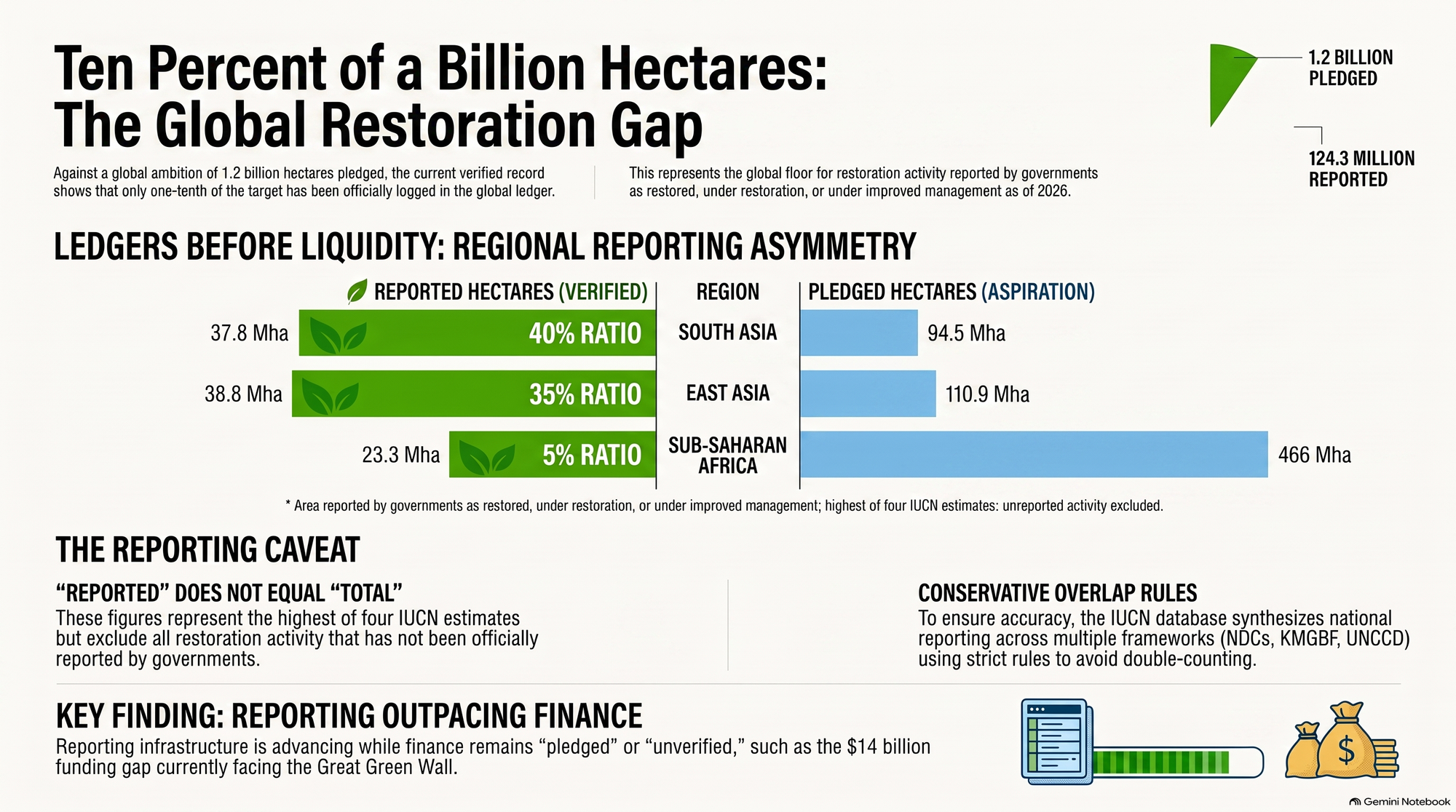
Taken together, the week suggests a juxtaposition, not a sequence. Reporting infrastructure advanced while the finance side remained pledged (the Great Green Wall), prospective (Thailand’s bond, COP17’s finance day on 24 August), or unverified. Nothing in the week’s evidence shows capital responding to the new instruments. The risk the week exposes is a reporting gap masquerading as a delivery gap, and the method cannot tell the two apart.
The Record
IUCN reported that government-reported restoration equals 10.4% of land-restoration pledges.
The Global Restoration Achievements Database 2026 report records 124.3 million hectares as restored, under restoration, or under improved management, compared with roughly 1.2 billion pledged; Sub-Saharan Africa’s reported area equals 5% of its pledges.
This week — in-window launch on 21 August; official government-reported data, compiled by IUCN using conservative overlap rules, not independently measured. (IUCN, Ulaanbaatar, Mongolia, 21 August 2026.) Source
Verra and Gold Standard launched a joint corresponding-adjustment reporting tool for Article 6.2.
The tool compiles a single record of adjustments applied to authorized credits across the two registries and populates the summary table that host countries submit with their 2026 Biennial Transparency Reports.
This week — in-window joint announcement on 20 August; primary registry releases, self-described benefits. (Verra and Gold Standard, 20 August 2026.) Source
UNCCD COP17 opened in Ulaanbaatar, with implementation as the secretariat’s stated test.
The secretariat’s opening release set implementation, measurable results, and increased investment as priorities; drought negotiations continued, with views divided between a binding protocol and a framework; The Nature Conservancy and the secretariat released an innovative financing playbook.
This week — in-window opening of a UN negotiating session; no decisions are final until the closing plenary, and the drought outcome remains pending. (UNCCD press release, 17 August 2026; Earth Negotiations Bulletin, 17–18 August 2026.) Source
Aberystwyth University published headline figures for Global Mangrove Watch version 4.1.
The 20 August release reports a net global gain of 47,720 hectares from 1985 to 2025 and a loss of 2,044 square kilometers in Indonesia; the dataset itself was published on 13 July, and the release is the first primary statement of the figures.
Current signal — in-window university release of a July dataset; satellite classification, not a peer-reviewed paper. (Aberystwyth University, 20 August 2026.) Source
The Integrity Council closed its program application platform until April 2027.
The Council suspended new program applications for platform upgrades. Programs already in assessment remain unaffected, and a revised Assessment Procedure is due in September 2026. The closure is administrative, not a rule change.
Current signal — in-window administrative notice dated 18 August; primary ICVCM statement. (Integrity Council for the Voluntary Carbon Market, 18 August 2026.) Source
ASEAN in Focus
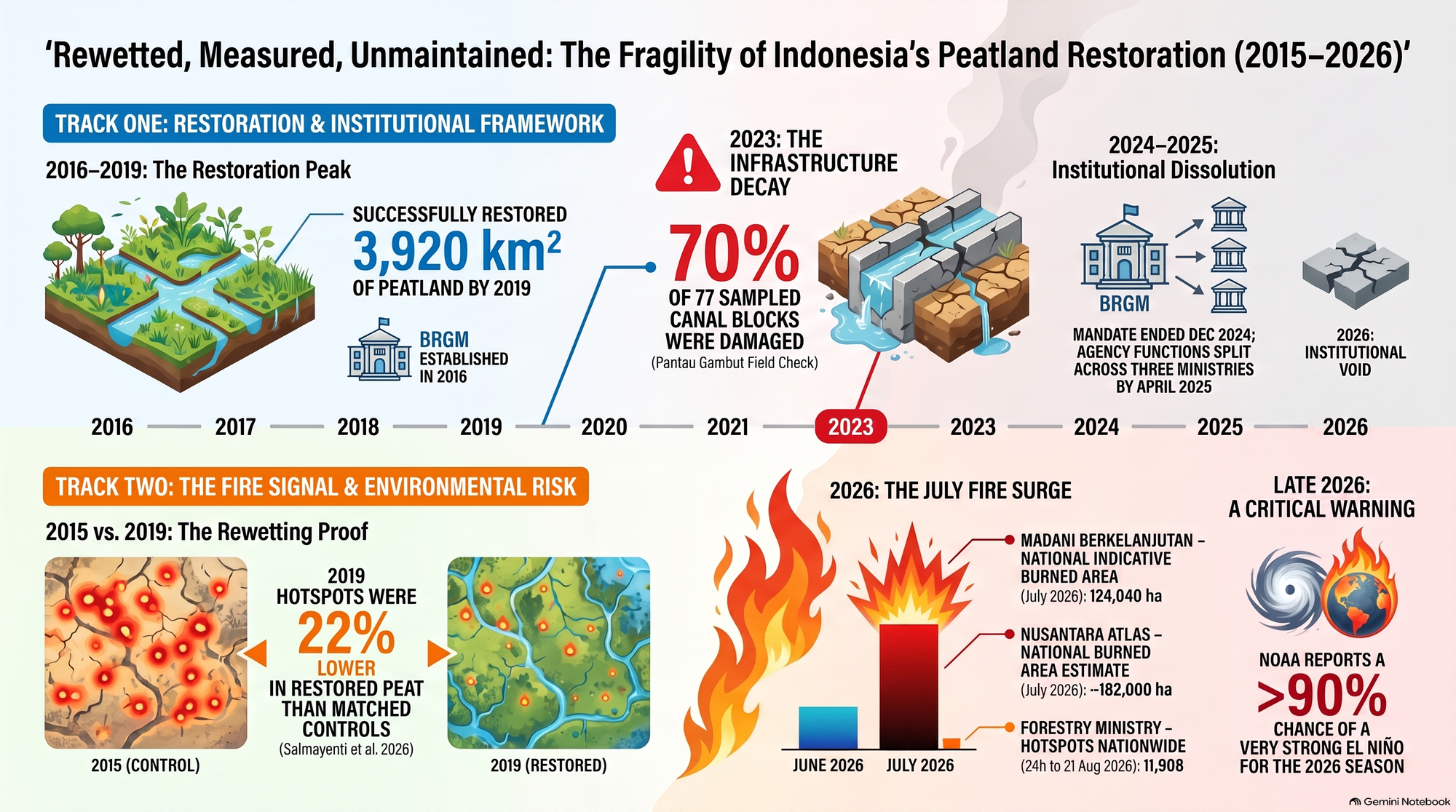
Indonesia’s fire season turned the peat-permanence question into a live test this week. The Forestry Ministry detected 11,908 hotspots nationwide in the 24 hours to 21 August, up from 6,352 a day earlier, and Sarawak, Malaysia, closed nearly 600 schools as haze crossed the border. [10] Three series underlie the spike and must not be merged:
- Nusantara Atlas estimates about 182,000 hectares burned nationally in July;
- Madani Berkelanjutan’s national indicative burned area rose from 15,474 hectares in June to 124,040 in July; and
- The National Disaster Management Agency (BNPB) reported 48,889 hectares in its six priority provinces as of 9 August, fighting with 35 aircraft on its lowest budget in 15 years. [10] [11]
The US National Oceanic and Atmospheric Administration’s 13 August outlook puts the chance of a very strong El Niño above 90%. [12] The counterfactual is older than the season: University of Leeds and IPB University researchers, in a Geophysical Research Letters paper published online on 28 May, find, from a matched comparison, that Peatland Restoration Agency rewetting cut fire hotspots in 2019 by 22% across 3,920 square kilometers, with no comparable effect in the low-fire year 2023. [13] Maintenance is the exposed flank: Pantau Gambut’s 2023 field check found 70% of 77 sampled canal blocks damaged, a sample rather than a census, and the agency’s mandate ended on 31 December 2024, with its dissolution formalized in April 2025 and its functions split across three ministries. [14] [15]
Vietnam’s government announced Resolution 235/NQ-CP on 14 August, approving the Article 6 implementation agreement with Singapore signed in September 2025; the methodology list is still to be published. [16] The regional reading: area-based indicators record hectares rewetted, and the infrastructure behind Indonesia’s 2019 result is a maintenance liability that those indicators may not see.
What This Means
The week’s operational shift is that visibility of delivery, not delivery alone, now determines how a program is read; the consequence is conditional interoperability, not universal reporting.
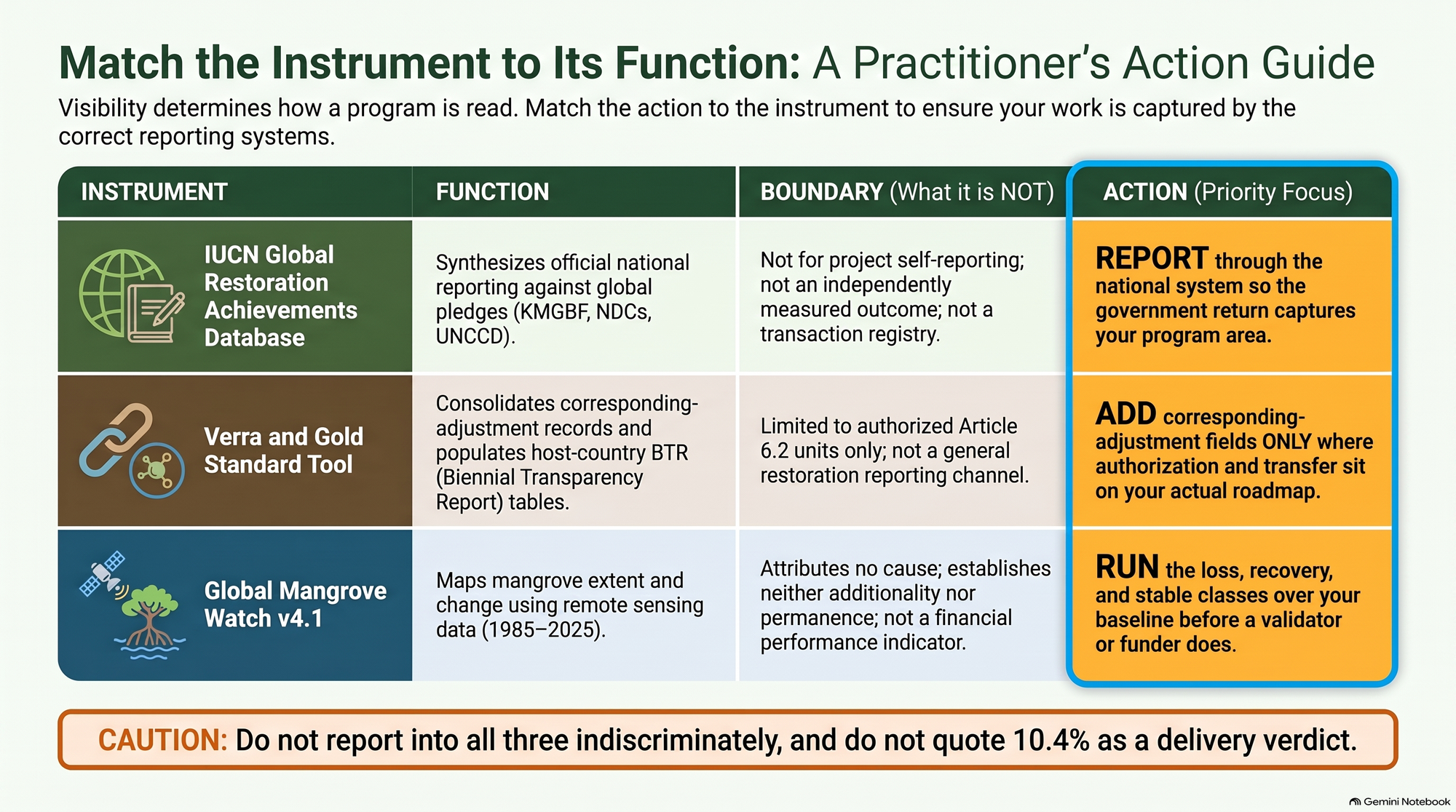
For program designers, three actions follow:
- Check whether the host country’s national restoration reporting would capture your program area, because a hectare absent from the government return is absent from the IUCN ledger, however real the work; if the answer is no, write the data flow to the national focal point into the program design.
- Add Article 6.2 corresponding-adjustment fields only where host authorization and international transfer sit on the program’s actual roadmap; the Verra and Gold Standard tool serves that case, and no other, and fields added on spec are dead weight at validation.
- Run the Global Mangrove Watch loss, recovery, and stable classes over your baseline before a validator or a skeptical funder does, because the map is now the cheapest external screen on a claimed gain.
For finance officers, a low reported ratio is a question, not a verdict: Sub-Saharan Africa’s 5% may mean under-delivery, which calls for implementation support, or under-reporting, which calls for monitoring finance, and the instrument should not be chosen until the diagnosis is made; pledged aggregates such as the Great Green Wall’s USD 19 billion price nothing until a disbursement schedule exists.
For governments in Ulaanbaatar this week and Yerevan, Armenia, in October, Indonesia’s peat record argues for a maintenance indicator and a maintenance budget line beside every area target, because an area ledger records gains that an unmaintained canal block quietly reverses. And two things not to do: do not report into all three instruments indiscriminately, and do not quote the 10.4% as a delivery verdict, because the method cannot separate what was not done from what was not counted.
Worth Watching Through Year-End
UNCCD COP17 continues in Ulaanbaatar, Mongolia, to 28 August 2026, with the finance day on 24 August and the drought policy framework decision pending.
(United Nations Convention to Combat Desertification; Global Environment Facility event listing.) Source
Climate Week NYC runs from 20 to 27 September 2026, when the Taskforce on Nature-related Financial Disclosures releases its second global status report on nature-related assessment and reporting.
(Climate Week NYC; TNFD status-report page.) Source | Source
CBD COP17 convenes in Yerevan, Armenia, from 19 to 30 October 2026 for the first global review under the Kunming-Montreal framework.
(Convention on Biological Diversity.) Source
The Green Climate Fund Board holds its 46th meeting in Songdo, Republic of Korea, from 26 to 29 October 2026.
(Green Climate Fund, Board decision B.43/15.) Source
The Nature-based Solutions International Congress gathers in Paris from 2 to 6 November 2026 (scientific conference 3 to 6 November); UNFCCC COP31 follows in Antalya, Türkiye, from 9 to 20 November 2026.
(NbS International Congress organizers; UNFCCC COP31 page.) Source | Source
Endnotes
[1] NbS Praxis. (2026, August 15). The delivery gap is now documented (The Climate-Nature Nexus in Practice, Weekly Briefing No. 12). Prior issue, cited for series continuity; not an external primary source.
[2] International Union for Conservation of Nature. (2026, August 21). Global land restoration gains ground but delivers only 10% of national pledges – IUCN [Press release]. https://iucn.org/press-release/202608/global-land-restoration-gains-ground-delivers-only-10-national-pledges-iucn ; and Mariappan, M., & Lau, C. (2026). Global Restoration Achievements Database: 2026 Report. International Union for Conservation of Nature. https://iucn.org/sites/default/files/2026-08/Restoration%20Achivements%20Database%202026.pdf Primary institutional release and report: the numerator is area reported by governments as restored, under restoration, or under improved management; only non-overlapping official figures are summed; the 124.3 million hectare headline is the highest of four estimation approaches; the database was last updated on 20 March 2026 and covers information publicly available to January 2026; IUCN describes the result as a lower-bound indicator because unreported activity is excluded. Not independently measured. The report itself carries an unresolved internal discrepancy, citing approximately 122.1 million hectares in section 4.4 against the 124.3 million hectare headline, and its title varies across the press release, the document heading, and the filename; the figure used here is the report’s own stated headline.
[3] Verra & Gold Standard. (2026, August 20). Gold Standard and Verra launch tool to support Article 6.2 reporting [Press release]. https://verra.org/gold-standard-and-verra-launch-tool-to-support-article-6-2-reporting/ Primary joint registry announcement; stated benefits are the developers’ own, no pilot countries are named, and the tool is a reporting aid for authorized units rather than a UNFCCC-endorsed accounting standard.
[4] Aberystwyth University. (2026, August 20). Net gain in global mangrove cover over 40 years [Press release]. https://www.aber.ac.uk/en/news/archive/2026/08/title-288760-en.html ; Global Mangrove Watch. (2026, July 13). Timeseries of mangrove extent (Version 4.1.12) [Data set]. Zenodo. https://zenodo.org/records/21346457; and Global Mangrove Alliance. (2026, July 27). Global Mangrove Watch 4.1 launch. https://www.mangrovealliance.org/news/global-mangrove-watch-4-launch The university release is the primary statement of the 47,720 hectare net gain (1985–2025) and the 2,044 square kilometer Indonesian loss; the dataset predates the reporting window and is a satellite classification, not a peer-reviewed paper; several 27 July launch-coverage sources consistently cited 47,707 hectares, a cross-source discrepancy with the university’s 47,720.
[5] United Nations Convention to Combat Desertification. (2026, August 17). UN land conference opens in Mongolia to accelerate global action on restoration and resilience [Press release]. https://unric.org/en/un-land-conference-opens-in-mongolia-to-accelerate-global-action-on-restoration-and-resilience/ Primary secretariat release, read via the UN Regional Information Centre mirror; the quoted phrases are the Executive Secretary’s and the Prime Minister’s as given in the release, which speaks of implementation, measurable results, and investment, not of declarations.
[6] International Institute for Sustainable Development. (2026, August 17–18). Earth Negotiations Bulletin: UNCCD COP17 daily reports. https://enb.iisd.org/convention-combat-desertification-unccd-cop17-17aug2026 Independent negotiation summary; views on a legally binding drought protocol versus a framework remained divided, and a decision is pending rather than scheduled.
[7] Soumaré, A. (2026, August 17). Restoring land, rebuilding hope. African Development Bank. https://www.afdb.org/en/news-and-events/restoring-land-rebuilding-hope-96202 Primary institutional commentary: at least USD 33 billion needed by 2030 for the Great Green Wall, more than USD 19 billion committed, a gap of roughly USD 14 billion; the committed figure is AfDB’s dated aggregate of pledges, whose original pledge schedule and disbursement status could not be traced in this pass.
[8] Integrity Council for the Voluntary Carbon Market. (2026, August 18). Program application platform update – August 2026. https://icvcm.org/program-application-platform-update-august-2026/ Primary administrative notice under Governing Board Decision GB 36; the closure concerns the program application platform, programs already in assessment continue, and the revised Assessment Procedure is expected in September 2026.
[9] The Standard. (2026, August 19). PDMO to issue second sustainability-linked bond [in Thai]. https://thestandard.co/pdmo-issue-slb/ Thai press report of the Public Debt Management Office announcement by Director-General Jindarat Viriyataveekul, corroborated by Bangkok Today, Bangkokbiznews, and Carbon Pulse, all 19 August 2026; the 2026 bond framework document and any second-party opinion were not located; the step-up size is not disclosed, and the issue is prospective until book-building on 10 September.
[10] Karmini, N. (2026, August 21). Indonesia warns against starting open blazes as haze from wildfires spreads to Malaysia. Associated Press. https://abcnews.com/International/wireStory/indonesia-warns-starting-open-blazes-haze-wildfires-spreads-135831582 Wire report citing the Forestry Ministry’s 24-hour hotspot count (11,908, up from 6,352), Nusantara Atlas’s estimate of about 182,000 hectares burned in July, and the Sarawak government’s closure of nearly 600 schools affecting about 200,000 students; the cumulative figure of about 285,000 hectares appears in the article text without a named source and is not used here; no apnews.com canonical page was located, so the syndicated copy is cited.
[11] Jong, H. N. (2026, August 13). Indonesia’s wildfire season surges as haze spreads into Malaysia. Mongabay. https://news.mongabay.com/2026/08/indonesias-wildfire-season-surges-as-haze-spreads-into-malaysia/ Republished by Eco-Business on 19 August 2026; cites Madani Berkelanjutan’s national indicative burned-area analysis (15,474 hectares in June to 124,040 in July, per Madani’s 6–7 August release), BNPB’s six-province total of 48,889 hectares as of 9 August, and BNPB’s 35 aircraft; the IDR 491 billion 2026 BNPB budget as the lowest in 15 years is per CNBC Indonesia, 29 November 2025. Secondary coverage of three agencies’ figures with different methods and scopes; BNPB’s provincial values match Forestry Ministry January–June figures, so the 9 August currency is uncertain.
[12] National Oceanic and Atmospheric Administration, Climate Prediction Center. (2026, August 13). ENSO diagnostic discussion. https://www.cpc.ncep.noaa.gov/products/analysis_monitoring/enso_advisory/ensodisc.shtml Primary forecast: “a greater than 90% chance of a very strong event during the Northern Hemisphere fall and winter 2026-27”; background anchor issued three days before the window, superseding the 81% figure in the 9 July discussion.
[13] Salmayenti, R., Spracklen, D. V., & Holden, J. (2026). Tropical peatland restoration reduces fire occurrence. Geophysical Research Letters, 53(11), e2025GL121564. https://doi.org/10.1029/2025GL121564 (Repository record: https://eprints.whiterose.ac.uk/id/eprint/243839/ ) Peer-reviewed study, published online 28 May 2026 and in issue 16 June 2026; the 22% figure is a matched-control estimate for 2019 across 3,920 square kilometers, the 38% share refers to the total hotspot reduction between the 2015 and 2019 El Niño years, and the authors report no strong effect in 2023; the authors’ public account appeared in The Conversation on 12 August 2026 and The Jakarta Post on 19 August 2026. Background anchor with current-week coverage.
[14] Pantau Gambut. (2026, July 2). A decade of peatland restoration in Indonesia. https://en.pantaugambut.id/publications/a-decade-of-peatland-restoration-in-indonesia Civil-society monitoring report: field checks in 2023 on 77 canal blocks listed on BRGM’s PRIMS platform found 70% damaged, and 52% of the observed blocks recorded water tables deeper than the 40-centimeter threshold; the sample’s provincial frame is not stated and the figures are not a national census.
[15] Mongabay Indonesia. (2025, May 9). BRGM bubar, restorasi gambut dan mangrove makin gelap? [BRGM dissolved: A darker outlook for peat and mangrove restoration?]. https://mongabay.co.id/2025/05/09/brgm-bubar-restorasi-gambut-dan-mangrove-makin-gelap/ Secondary reporting, corroborated by Liputan6 and Indonesian parliamentary research coverage, of the agency’s closure: the mandate under Presidential Regulation 120 of 2020 (signed 22 December 2020, per Indonesia’s official legal databases) expired on 31 December 2024, operations ended, and an April 2025 State Secretariat letter formalized the dissolution, with functions transferred to the Ministry of Forestry, the Ministry of Environment, and the Ministry of Marine Affairs and Fisheries.
[16] Báo Chính phủ. (2026, August 14). Chính phủ phê duyệt Thỏa thuận thực hiện theo Điều 6 Thỏa thuận Paris [Government approves the implementation agreement under Article 6 of the Paris Agreement]. https://baochinhphu.vn/chinh-phu-phe-duyet-thoa-thuan-thuc-hien-theo-dieu-6-thoa-thuan-paris-ve-bien-doi-khi-hau-102260814185442077.htm Official government portal announcement of Resolution 235/NQ-CP approving the Implementation Agreement with Singapore, which Singapore’s Ministry of Trade and Industry confirms was signed virtually on 16 September 2025 by Minister for Sustainability and the Environment Grace Fu and Acting Minister of Agriculture and Environment Tran Duc Thang; the resolution’s own signature date is not stated in the coverage, the resolution text was not located, and eligible sectors are not specified. Background anchor two days before the window.