No. 24 — Agreements, a Label, and Haze Fines Move Separate Lines
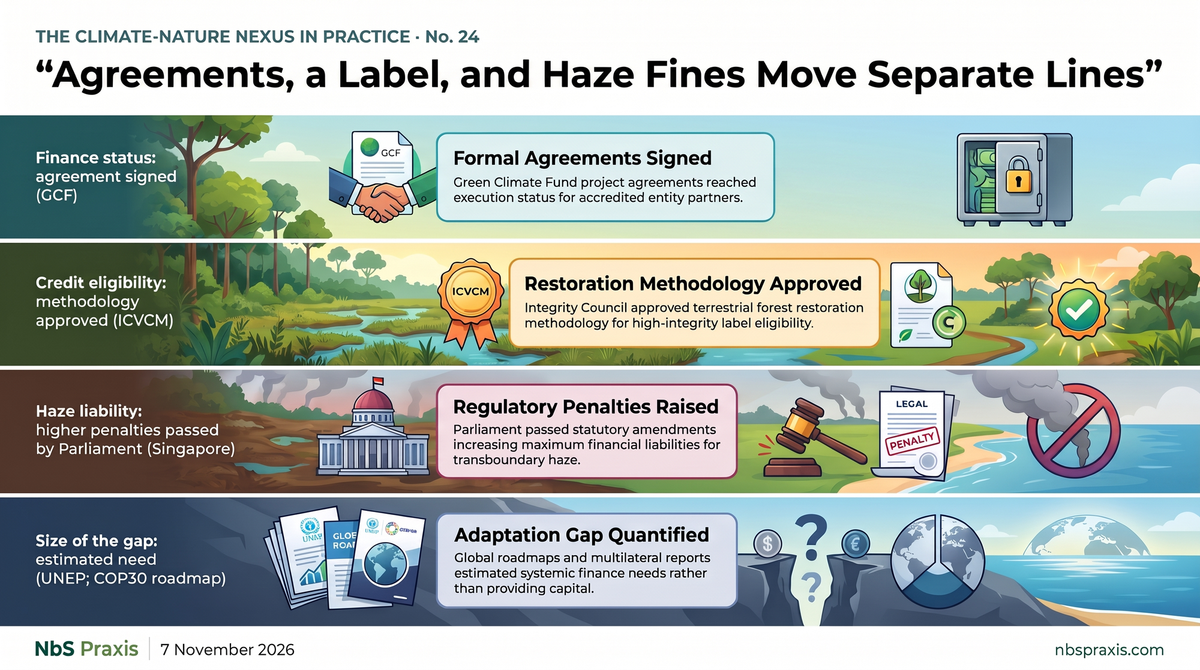
Ten Green Climate Fund agreements signed, a forest-restoration methodology cleared for a quality label, and tougher Singapore haze fines each changed a different line of a nature project's case. None substitutes for the others.

The Climate-Nature Nexus in Practice (Weekly Briefing to 7 November 2026)
Bottom line: Three developments reported this week affected three different lines of a nature project’s case. The Green Climate Fund reported that ten projects approved in October had signed agreements, moving them from approved to contracted finance. The Integrity Council for the Voluntary Carbon Market announced approval of one additional forest-restoration methodology for its quality label. Singapore’s Parliament passed a tenfold increase in the maximum fine for the main haze offense. Each development settles one question and leaves the others open, so a project case should update each line based on that line’s own evidence.
Here is the gateway into the field, and the briefing is the room you walk into: [Podcasts and Videos — Gemini Notebook: www.youtube.com/@nbspraxis]
Link to Explainer Video (Playlist of 1 Podcast and 4 Videos for Week 24, available at https://www.youtube.com/playlist?list=PLZi4x7q1rVRE
Last week’s briefing argued that grant-funded fieldwork should be scheduled around the expected first disbursement, not the Board approval date. The Green Climate Fund (GCF) provided the next step on 3 November, reporting that agreements for ten of the projects approved at its October Board meeting had been signed on 29 October, including Indonesia’s coastal project. [1] The second signal, the adopted decisions of the seventeenth Conference of the Parties to the Convention on Biological Diversity (COP17), was named last week and is still pending, as The Record notes. [2] The third, the instrument establishing Indonesia’s peatland and mangrove agency, is being discussed in ASEAN in Focus.
The week’s other developments did not alter the financial status of any named project. The Integrity Council for the Voluntary Carbon Market (ICVCM) cleared a forest-restoration methodology for its Core Carbon Principles (CCP) label; Singapore raised its haze penalties; and the United Nations Environment Programme (UNEP) published new estimates of the adaptation finance gap. [3] [4] [5] Each is different in kind: a contract, a methodology approval, a statute, and an estimate.
The implication for practitioners is to keep these lines separate:
- A signed agreement does not make credits eligible for a label.
- A methodology label does not fund a project.
- A heavier penalty for fire does not pay for prevention.
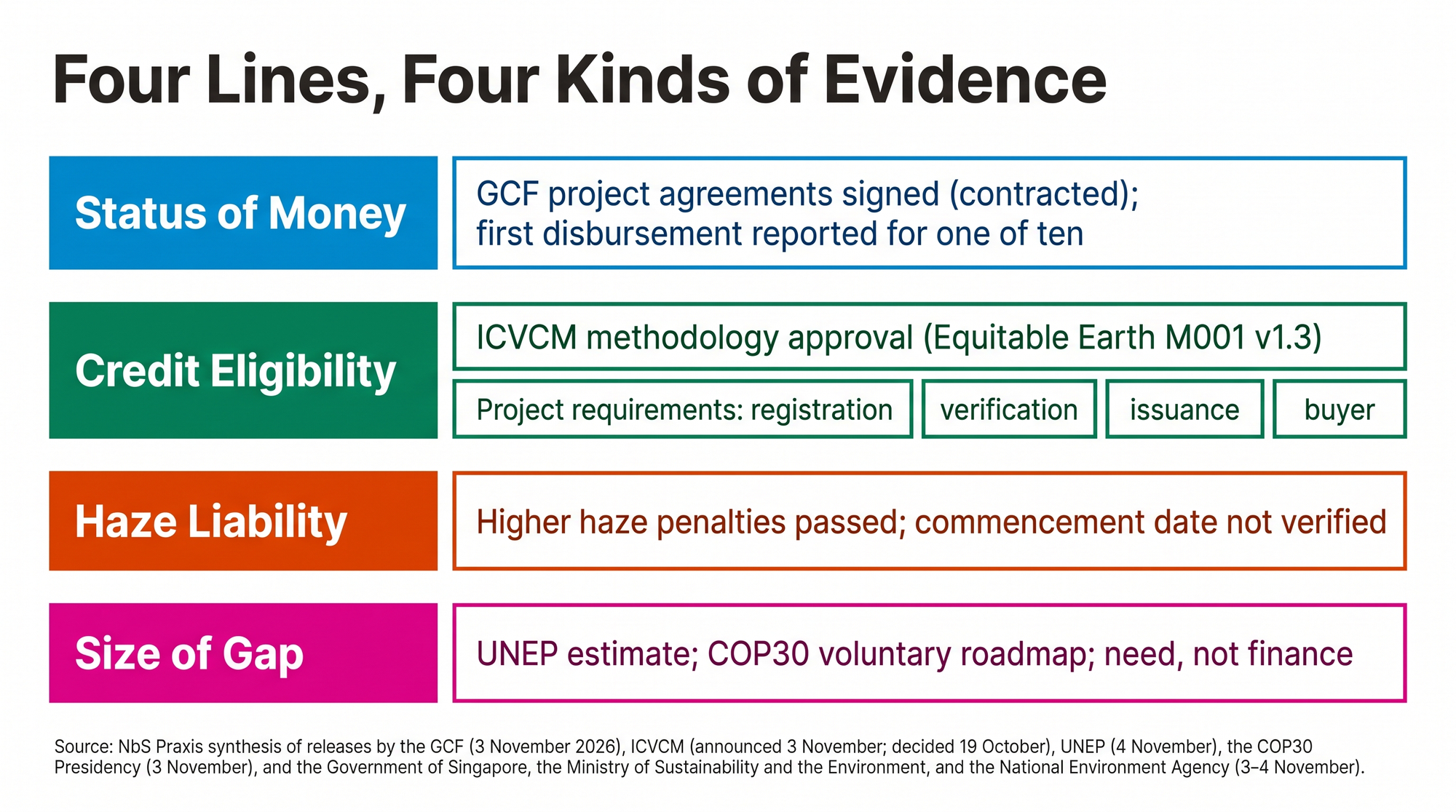
Four Lines, Four Kinds of Evidence
A nature project’s case moves line by line, and this week’s record shows which evidence moves each line.
- The first line shows the status of the funds. A signature moves a grant from approved to contracted finance. Of the ten projects, the release reports a first disbursement for one and a results-based payment to Mexico for forest results described as verified. [1] For the other nine, including the ecosystem projects in Fiji, Bogotá, and Indonesia, the release reports a signature and no disbursement. The Board decisions setting out which proposed conditions were adopted had not appeared in the Fund’s decisions listing by 7 November. [1] Contracted finance appears in a financing plan as contracted, with its drawdown conditions and timing recorded beside it until a disbursement is reported.
- The second line concerns whether credits from a project can carry a quality label. The ICVCM decision moved that line for one additional restoration methodology, not for restoration as a category. Afforestation and reforestation methodologies from Verra, ACR, and Isometric already held CCP approval, so the decision widens the choice of method for restoration developers rather than opening the category. [3] The decision does not reach forest conservation or peatland rewetting, and a labeled methodology does not make a project bankable: registration, verification, issuance, and a buyer still stand between the label and revenue.
- The third line is the legal cost of letting a landscape burn, and Singapore’s Parliament moved that line by passing amendments covering fires that risk haze in Singapore, although the official sources checked provide no commencement date. [4] A higher penalty, once in force, shifts the risk side of a concession’s prevention case, and the amendments’ powers to restrict financial dealings with designated entities, as ASEAN in Focus records, bring this line into a financier’s due diligence as well as an operator’s. Whether the change alters conduct on the ground is a question for enforcement records not yet written.
- The fourth line is the size of the gap a project claims to close, and two publications restated that line without adding money to it. UNEP’s Adaptation Gap Report re-estimated developing countries’ adaptation needs relative to current international public flows, and the COP30 Presidency presented a voluntary forest roadmap outlining how much forest finance would need to grow by 2030. [5] [6] Neither document is a source of finance for a named project; both are signals of where funders will be asked to pitch at COP31 in Antalya, Türkiye. UNEP’s release does not single out ecosystem-based measures in its estimate, so a proposal citing the report for an ecosystem-based adaptation (EbA) case should cite the gap, not an ecosystem share of the gap.
The Record
GCF reports that ten agreements were signed after its October Board meeting
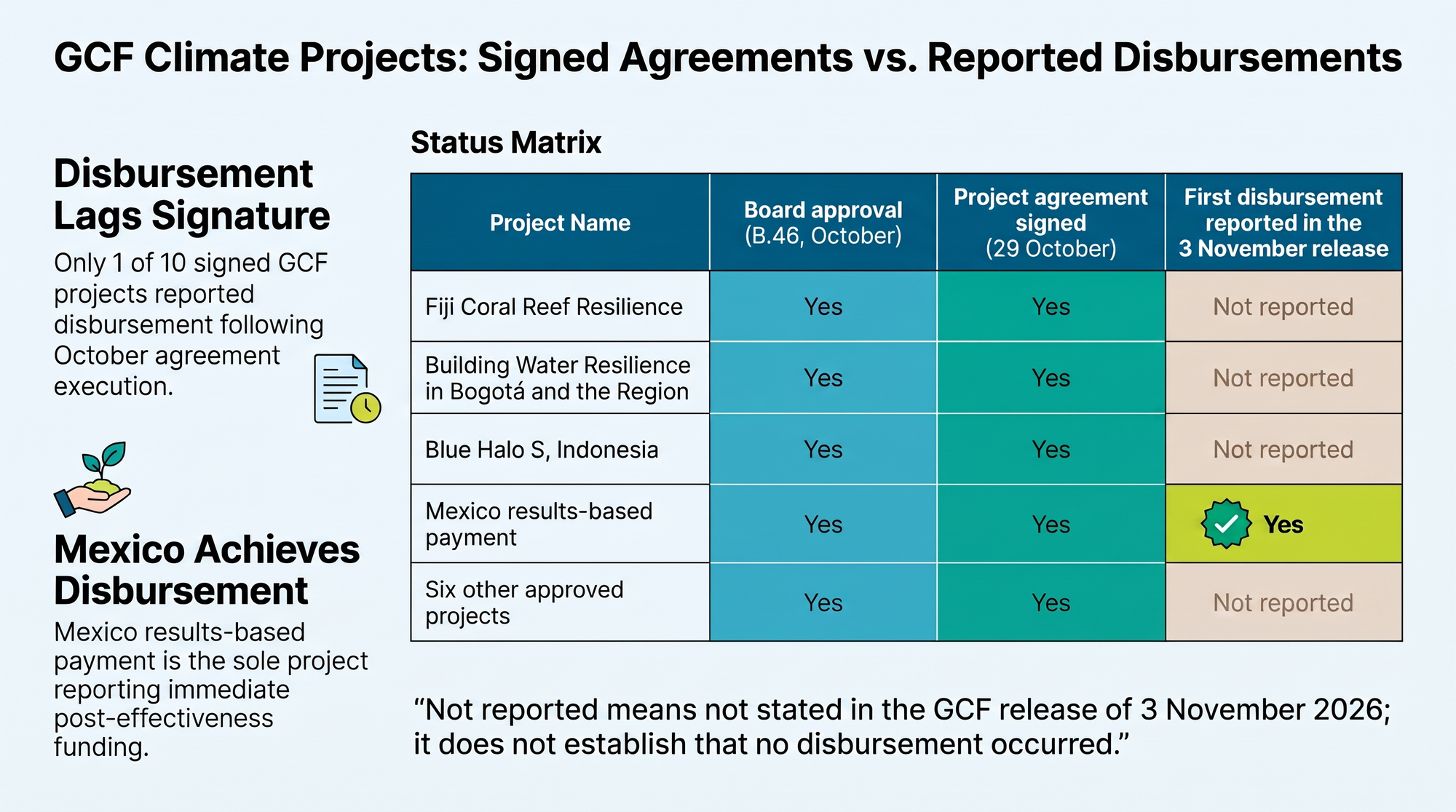
The Green Climate Fund reported on 3 November that project agreements for ten projects approved at its forty-sixth Board meeting were signed with the accredited entities on 29 October in Songdo, Incheon, Republic of Korea. The ten comprise nine funding proposals and one simplified-approval project, including the Fiji Coral Reef Resilience Project with WWF and Building Water Resilience in Bogotá and the Region with Conservation International. The release reports one first disbursement: Mexico’s results-based payment for 2018–2019 forest conservation and sustainable livestock, which recognizes 12.9 MtCO2eq of verified results under REDD+ (reducing emissions from deforestation and forest degradation) and was disbursed within three working days of the agreement’s becoming effective. The signature establishes a contractual commitment for each project; the release reports no disbursement for the other nine.
Current signal: agreements signed on 29 October, before the window, and reported on 3 November. Signed project agreements; the release reports a first disbursement only for Mexico. [1]
ICVCM announces approval of Equitable Earth’s forest restoration methodology
The ICVCM announced on 3 November that its Governing Board had approved Equitable Earth’s M001 Methodology for Terrestrial Forest Restoration, version 1.3, on 19 October, the first of the program’s methodologies to receive CCP approval. The Council had assessed Equitable Earth’s program, formerly ERS, as CCP-eligible in May 2025, so credits issued under the program and this methodology become eligible to carry the label. The Council stated that there were no conditions on the approval, in contrast to the Verra coal-transition methodology approved on 21 October and announced alongside the restoration methodology. The Council estimates that 120.7 million credits have been approved to use the label to date.
Current signal: decided on 19 October, before the window, and announced on 3 November. A methodology approval; program eligibility predates it. [3]
UNEP measures the adaptation finance gap once again
UNEP published its Adaptation Gap Report 2026 on 4 November. The report estimates developing countries’ adaptation needs at around USD 305 billion per year by 2035 in 2024 prices, largely excluding the private sector’s own needs, compared with international public adaptation finance from developed to developing countries of USD 28.2–31.7 billion in 2024. Even a tripling of that finance by 2035, UNEP finds, would cover only 20–29% of needs once future inflation is accounted for.
This week: modeled estimates of need and compiled flows, not commitments. [5]
COP30 Presidency presents its forest road map
The COP30 Presidency presented its Roadmap on Halting and Reversing Deforestation and Forest Degradation by 2030 on 3 November at the United Nations Development Programme (UNDP) office in Brazil. The Presidency describes the roadmap as a voluntary, non-prescriptive contribution, not subject to negotiation, with action areas that include restoration, reforestation and afforestation, and agroforestry. Citing UNEP, the roadmap states that annual forest finance must reach more than USD 300 billion by 2030, and it reviews 30 international forest financing mechanisms.
This week: presented on 3 November; a voluntary contribution first announced at COP30’s close in November 2025. [6]
COP17’s nature-based solutions text remains a draft on the record.
COP17 concluded in Yerevan, Armenia, at the end of October, but the Convention’s decisions page still ended at COP16 on 7 November. The latest published text on biodiversity and climate change is the Chair’s draft decision of 30 October, CBD/COP/17/L.19, which included bracketed paragraphs and annexed draft voluntary guidelines for nature-based solutions (NbS), including their inclusion in nationally determined contributions. The adopted wording cannot yet be determined from the published record.
Current signal: a draft text; adopted wording not yet published. [2]
ASEAN in Focus
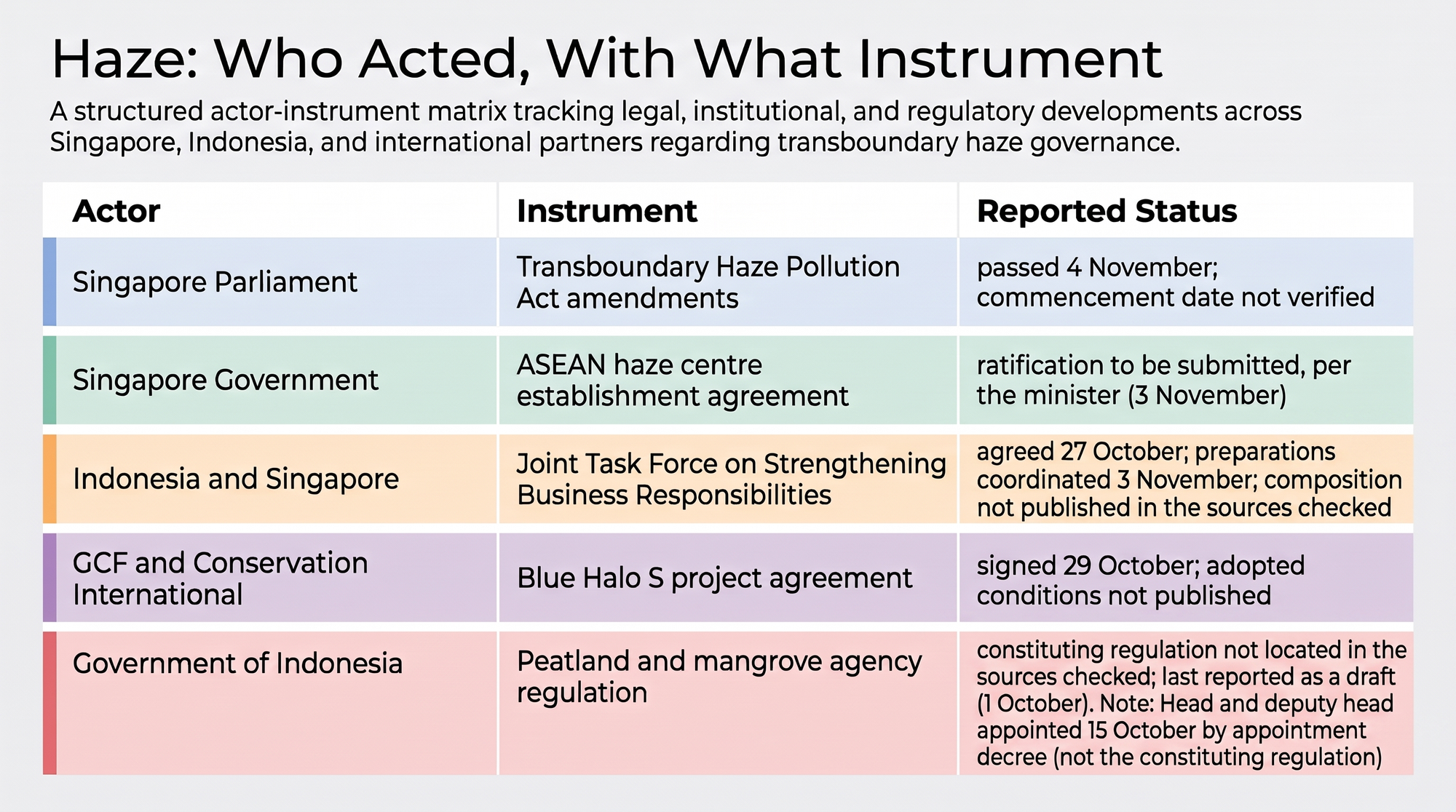
Singapore’s Parliament passed amendments to the Transboundary Haze Pollution Act on 4 November, raising the maximum fine for the main offense tenfold to S$20 million and the daily fine to S$1 million for causing or contributing to land or forest fires that risk haze in Singapore. The amendments also allow the Government to restrict business dealings with designated entities and individuals, including goods, services, loans, and other financial support. The official sources checked give no commencement date. [4] The day before, Minister for Sustainability and the Environment Grace Fu told Parliament that “Singapore will submit our Instrument of Ratification for the Establishment Agreement in the next few days” for the ASEAN Coordinating Centre for Transboundary Haze Pollution Control, an agreement that takes effect only after six ASEAN member states have ratified. [4] In Jakarta, Indonesia, Foreign Minister Arrmanatha Nasir chaired a coordination meeting on 3 November with the forestry and environment ministers and a finance ministry representative to prepare for the Indonesia–Singapore Joint Task Force on Strengthening Business Responsibilities, agreed in late October. The sources checked give no composition, staffing, or timetable for the task force, and an Indonesian foreign ministry official called the haze center a priority issue for the 49th ASEAN Summit in the Philippines this month. [7]
The fire season has not closed. By 21.00 Western Indonesia Time on 5 November, the Forestry Ministry counted 338 high-confidence hotspots nationwide, up 123 from the previous day, with Central Kalimantan recording 85. [8]
On finance, the GCF agreement for Blue Halo S, the USD 25.5 million coastal grant in Fisheries Management Area 572 approved in October, was among those signed on 29 October; the Board decision recording which proposed pre-disbursement conditions were adopted had not been published by 7 November. [1]
The regulation establishing the National Peatland and Mangrove Management Agency was again not found in the official and press sources reviewed. The agency’s head and deputy head were sworn in on 15 October under an appointment decree that does not set the agency’s mandate, budget, or operating capacity; the latest sources reviewed on the constituting regulation, dated 1 October, described it as a draft. [9]
What This Means
For an ecosystem project with a signed GCF agreement, the financing plan can now record the grant as contracted, with three entries: the conditions for the first disbursement, the party responsible for each, and the expected date of the first drawdown. Grant-funded fieldwork depends on that drawdown, not on the signature.
For a restoration developer, the ICVCM decision adds a labeled methodology option, but credit revenue enters the base case only once a project is registered under an approved methodology and has a credible path through verification to issuance and a buyer.
For concession holders and their financiers in Indonesian peat landscapes, Singapore’s amendments, once in force, raise the cost of fire for firms within the statute’s reach and allow restrictions on lending to designated entities; the due-diligence questions are when the amendments take effect and whether a prevention budget is costed and funded, not whether a penalty exists.
For program designers citing the adaptation gap or the forest roadmap at COP31, both documents describe need, not available finance. Two signals would change this reading: the GCF Board’s published decisions on the October approvals and COP17’s adopted text on the NbS guidelines.
Worth Watching Through Year-End
United Nations climate conference COP31: Antalya, Türkiye, 9 to 20 November, with Finance and Trade Day on 13 November.
COP31 thematic day on ocean, seas, nature, and land use: Antalya, 17 November, including coastal resilience and ecosystem restoration.
Global Landscapes Forum, 9th Investment Case Symposium: Antalya and online, 18 November, on accelerating finance for landscape restoration.
49th ASEAN Summit and Related Summits: the Philippines, November, under the Philippines’ chairmanship.
Endnotes
[1] Green Climate Fund. (2026, November 3). GCF advances 10 newly approved climate projects towards implementation (2026, October 5). GCF/B.46/02, Consideration of funding proposals; B.46 meeting page and decisions; and FP317 funding proposal package. Primary: signed project agreements. The release reports only the first disbursement for FP324 and does not state the disbursement status of the others. The ten are SAP073 and FP310, FP312, FP313, FP316, FP317, FP322, FP323, FP324, and FP325. FP317’s GCF grant is USD 25,491,313, within the total financing of USD 61.74 million, including co-financing; its proposed pre-disbursement conditions are in Annex II, Table 2, of GCF/B.46/02.
[2] Secretariat of the Convention on Biological Diversity. (2026, October 30). CBD/COP/17/L.19, Biodiversity and climate change; COP decisions page; and (2026, October 31). UN Biodiversity Conference charts Yerevan Pathway. Primary; a Chair’s draft submitted by Working Group II, not an adopted decision. The annexed guidelines are described as voluntary and creating no new obligations; the closing release reports nearly 50 decisions adopted.
[3] Integrity Council for the Voluntary Carbon Market. (2026, November 3). The Integrity Council approves methodologies for coal transition and forest restoration; Governing Board decisions on M001 v1.3 (19 October 2026) and VM0052 v1.1 (21 October 2026); ERS program eligibility decision (22 May 2025); and Assessment status (program table updated 27 October 2026). Primary. A credit carries the CCP label only where the program is CCP-eligible, and the methodology is CCP-approved. Afforestation, reforestation, and revegetation methodologies already approved include Verra VM0047, ACR’s Afforestation and Reforestation of Degraded Lands, and Isometric’s Reforestation and Mangrove Restoration. The 120.7 million figure is a market-wide estimate that the release attributes to MSCI data accessed 22 October 2026, not Equitable Earth issuance.
[4] Government of Singapore. (2026, November 4). Transboundary Haze Pollution (Amendment) Bill explainer; Ministry of Sustainability and the Environment. (2026, November 4). Second Reading of the Transboundary Haze Pollution (Amendment) Bill: opening speech by Minister Grace Fu; (2026, November 3). Oral reply to parliamentary question on haze-related issues; National Environment Agency. (2026, November 4). Singapore To Strengthen Transboundary Haze Pollution Act With Tougher Penalties And Expanded Enforcement Powers. Primary; passed by Parliament, commencement date not stated. The existing maxima are S$100,000 per day and S$2 million in aggregate; other penalties under the Act rise proportionately, and the Minister in charge of the Monetary Authority of Singapore will administer orders applying to financial institutions.
[5] United Nations Environment Programme. (2026, November 4). As world heads for overshoot of 1.5°C, adaptation is too slow; and Adaptation Gap Report 2026: Ready? Not. Executive summary, also reproduced by tralac. Primary: modelled needs and compiled flows. A tripling would bring international public adaptation finance to USD 85–120 billion a year by 2035, depending on the baseline. The 20–29% compares that range with a 2035 need of USD 420 billion after future inflation, not with the 2024-price estimate; private-sector needs could almost double the total.
[6] COP30 Presidency. (2026, November 3). COP30 Presidency launches international roadmaps to accelerate transition away from fossil fuels and halt deforestation and forest degradation by 2030; and Roadmap on forests; with World Resources Institute. (2026, November 5). STATEMENT: COP30 Presidency’s Global Roadmap on Halting Deforestation. Primary: a voluntary Presidency contribution, not a negotiated text. The finance figure is attributed to UNEP, from a 2023 level of USD 84.5 billion.
[7] Antara. (2026, November 4). Menlu pimpin koordinasi penanganan karhutla lintas batas; Koran Jakarta. (2026, November 5). Indonesia Bawa Isu Ratifikasi Pusat Koordinasi Kabut Asap di KTT ASEAN Manila; The Jakarta Post. (2026, November 4). Indonesia seeks stronger haze response ahead of ASEAN summit. Secondary reporting; Antara attributes its account to a written Foreign Ministry statement. The task force’s Indonesian name is Gugus Tugas Bersama Penguatan Tanggung Jawab Bisnis Indonesia-Singapura; Director General for ASEAN Cooperation Ina Krisnamurthi: “Iya (isu prioritas), karena center itu harus up and running.”
[8] Ministry of Forestry, Republic of Indonesia. (2026, November 6). Hotspot Nasional Naik Jadi 338 Titik, Menhut Turun Langsung Perkuat Penanganan Kalteng. Primary; SiPongi high-confidence counts for observations to 21.00 Western Indonesia Time on 5 November, not the release date. A hotspot is a satellite-detected surface temperature anomaly; the six priority provinces together rose from 41 to 86.
[9] Ministry of State Secretariat, Republic of Indonesia. (2026, October 15). Presiden Prabowo Lantik Kepala BNPB serta Kepala dan Wakil Kepala BPGMN; Antara. (2026, October 1). Menhut usulkan badan pengelola gambut dan mangrove miliki DIPA sendiri; dan Katadata. (2026, October 1). Perpres Badan Gambut Segera Terbit, Menhut Berharap Lebih Efektif Dari yang Dulu. Primary (appointment) and secondary; background. The appointments were made under Presidential Decree 43/M of 2026; Antara reported the agency as “masih dalam tahap perumusan mandat, struktur organisasi dan tata kerja (SOTK), serta rancangan Peraturan Presiden.”