No. 22 — Haze Notices Bind; Nature Disclosure Texts Open for Comment
Singapore’s haze statute and Indonesian permit freezes affected fire-prone concessions and their corporate groups; the ISSB’s nature proposal is open for comment, and the week’s finance moved as targets, aims, and approvals. Record each instrument’s status.

The Climate-Nature Nexus in Practice (Weekly Briefing to 24 October 2026)
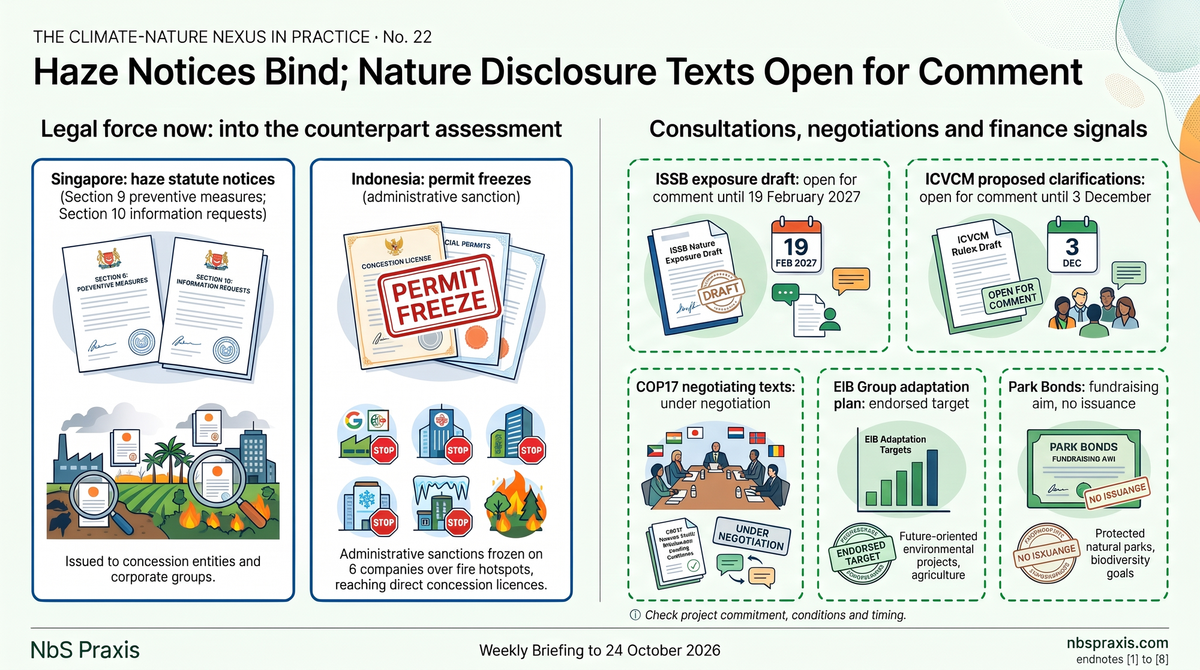
Bottom line: Instruments with legal force acted on fire-prone concessions this week, while those shaping nature disclosure and finance were consultations, negotiating texts, a target, and an aim. By 19 October, Singapore’s National Environment Agency had issued preventive measure notices to 10 companies in Indonesia, and on 23 October, the Agency sought information from 10 Singapore-registered palm oil and forestry companies. Indonesia’s Forestry Minister froze the permits of 6 companies. The International Sustainability Standards Board’s nature-disclosure proposal is open for comment until February. A design should record the status of each instrument it relies on.
Here is the gateway into the field, and the briefing is the room you walk into: [Podcasts and Videos — Gemini Notebook: www.youtube.com/@nbspraxis]
Link to Explainer Video (Playlist of 1 Podcast and 4 Videos for Week 22, available at https://www.youtube.com/playlist?list=PLOnhs3DMAi4E
Last week’s briefing argued that a design should read the instrument underlying a counterpart, a credit, or a pledge before relying on any of the three, and identified three signals that would change that reading. One arrived in full: the International Sustainability Standards Board (ISSB) published its nature-disclosure proposal on 22 October as a draft Practice Statement open for comment. [1] One remains open: the sources reviewed did not include the regulation establishing Indonesia’s new peatland and mangrove agency, even though the agency’s leadership announced its first work targets, as reported in ASEAN in Focus. [2] The third falls next week, when the Green Climate Fund Board meets from 26 to 29 October.
Reading this week’s instruments sorts them into two groups. Instruments with legal force acted on companies holding fire-prone concessions in Indonesia and reached the corporate groups behind them through Singapore’s haze statute and Indonesian administrative sanctions. The instruments shaping nature disclosure and nature finance were different, each with its own status: a proposal and a consultation open for comment, negotiating texts in Yerevan, Armenia, an endorsed institutional adaptation target, and a bond initiative’s fundraising aim. The two groups call for different planning. A binding instrument belongs in the counterpart assessment now. A consultation belongs in the calendar with its closing date and adopting body, and a finance signal belongs in the pipeline with its stated status.
For senior practitioners, the implication is clear: before a design names a concession holder as the land manager, or relies on a disclosure rule or a finance target, the design team should document each instrument’s status and state the assumption in the Theory of Change.
Two Kinds of Instrument
Enforcement reached the concessions and the groups behind them; disclosure and finance texts opened with dates attached.
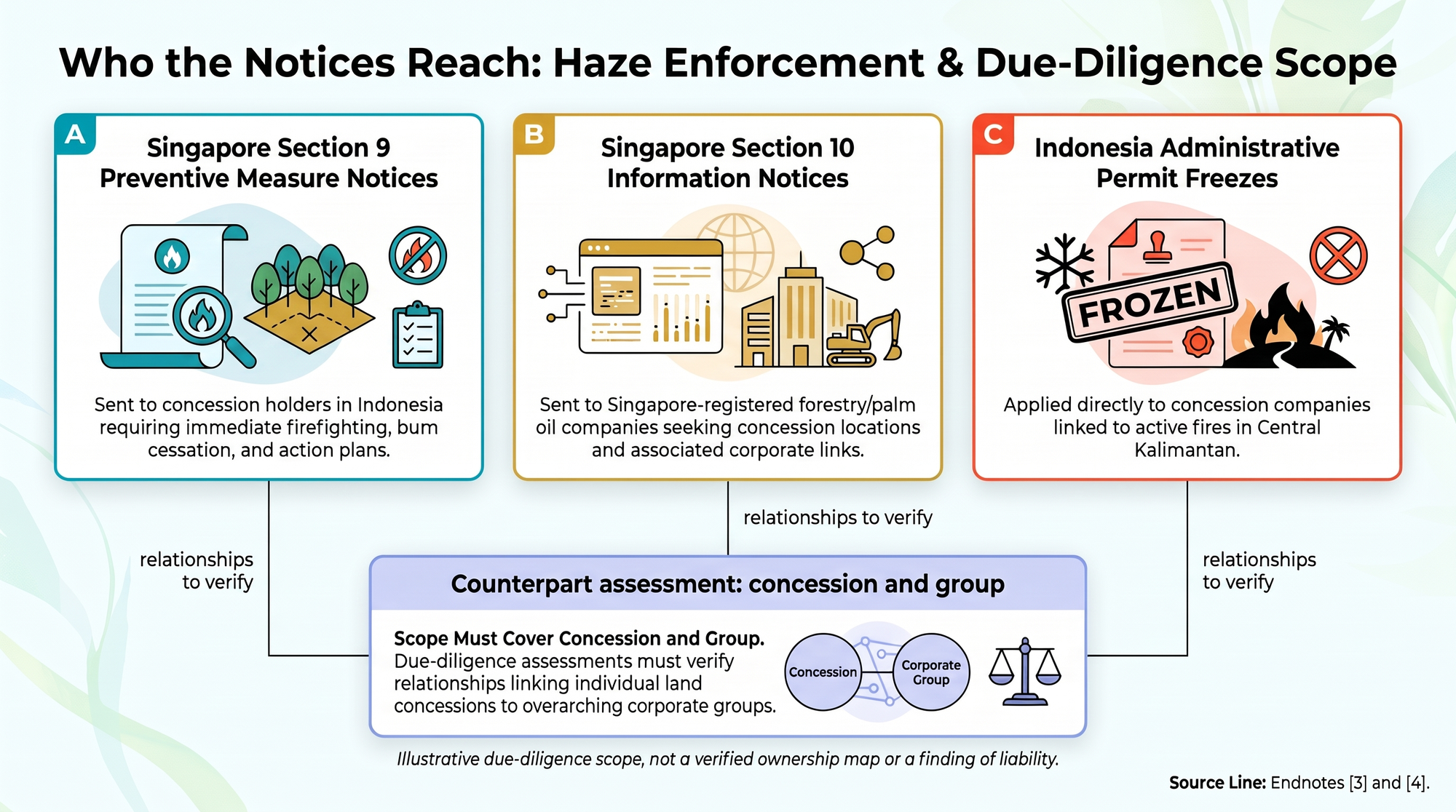
This week, enforcement extended beyond the concession to the corporate group. Singapore’s haze notices first went to companies holding land in Indonesia, then to Singapore-registered companies, asking about their links with associated companies and the locations of their concessions. Indonesia’s permit freezes applied to the concession license itself. ASEAN in Focus records both, with the dates. [3] [4] For a design working through a concession holder, the counterpart assessment should cover the group as well as the concession.
Disclosure moved toward text open for comment. The ISSB’s proposal builds on the Board’s two existing sustainability standards and, by the Board’s own account, draws extensively on the work of the Taskforce on Nature-related Financial Disclosures (TNFD). The Record sets out its form and closing date. [1] The Integrity Council for the Voluntary Carbon Market (ICVCM) opened a consultation on two proposed clarifications to its Core Carbon Principles (CCP) rules, including one on how crediting programs demonstrate that their safeguards protect the rights of Indigenous Peoples and local communities, open until 3 December. [5] Both texts may change before adoption, so the closing date is the action point and the adopted text is the instrument.
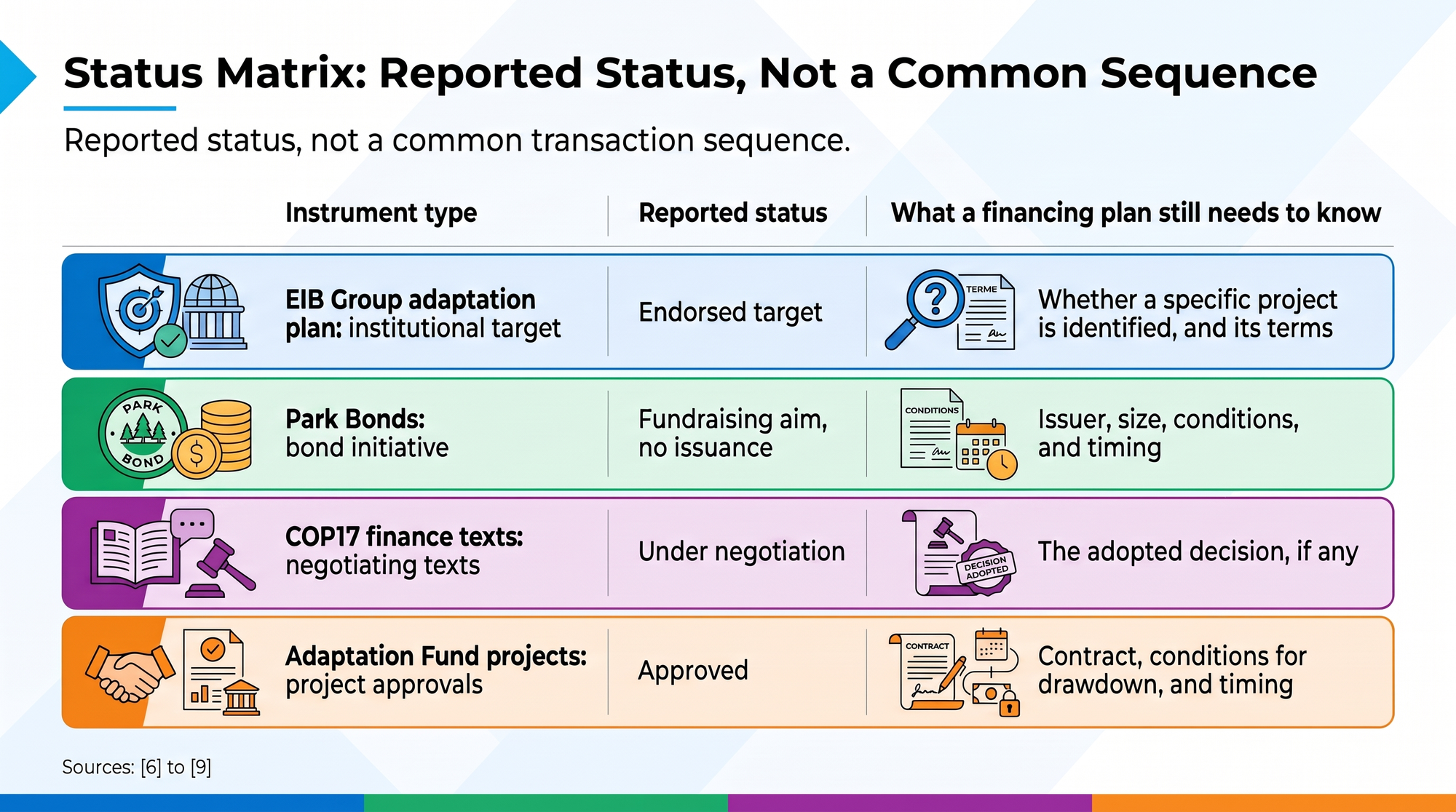
Finance is expressed through targets, aims, and approvals. The European Investment Bank (EIB) Group set a five-year adaptation target that names nature-based solutions among its priorities, and a West African protected-area bond initiative launched in Yerevan with a fundraising aim; neither release reports capital committed to a named project. [6] [7] In the Yerevan negotiations, the texts on the biodiversity fund and the contributor base remained unresolved at the end of the first week. [8] The Adaptation Fund Board approved USD 98.8 million in new projects at the close of its meeting in Bonn, Germany, on 23 October. [9] A target indicates where an institution intends to allocate funds. Prospective, approved, and contracted finance for a specific project are separate entries, and none, on its own, shows when funds can be drawn.
Science, published in Yerevan, linked a nature outcome to a climate pathway. The International Union for Conservation of Nature (IUCN) published its first global assessment of coral reef ecosystems, and the share of reefs in the highest-risk category depends heavily on whether it includes projected ocean warming. [10] A reef or coastal adaptation investment should therefore specify the warming pathway its outcome targets assume.
The Record
The ISSB proposed a practice statement regarding nature-related disclosures.
On 22 October, the ISSB requested feedback until 19 February 2027 on an exposure draft of IFRS Sustainability Disclosure Practice Statement 1, Nature-related Disclosures. The ISSB states that “a company is not required to comply with a Practice Statement to state compliance with ISSB Standards.” The exposure draft “proposes incremental requirements, building on the requirements in IFRS S1 and IFRS S2.”
Status: in-window development; exposure draft open for comment, nothing adopted. [1]
The EIB Group set an adaptation target for 2026 to 2030 that includes nature-based solutions.
The Boards of Directors of the EIB and the European Investment Fund endorsed the Group’s Phase 2 Adaptation Plan in Luxembourg this week. The 22 October release states that the Group will “deliver at least €30 billion for climate adaptation by 2030, doubling its financing compared with the previous five years,” and lists “nature-based solutions such as restoring wetlands, forests and floodplains” as investments the plan supports. The release sets no sub-target for nature-based solutions.
Status: in-window development; an endorsed institutional target, self-reported, not a commitment to projects. [6]
Negotiators in Yerevan worked on voluntary guidelines for nature-based solutions and ecosystem-based approaches.
During the first week of the seventeenth Conference of the Parties to the Convention on Biological Diversity (COP17), the contact group on biodiversity and climate change examined a non-paper whose annexes contain draft voluntary guidelines on nature-based solutions and ecosystem-based approaches, as well as a multilevel roadmap for cooperation among the Rio Conventions. On 21 October, delegates “broadly welcomed the annexes” while raising “terminology ambiguities, including on ‘carbon rights,’” and “overlap with UN Framework Convention on Climate Change mandates,” according to the Earth Negotiations Bulletin. In the financial mechanism group, delegates agreed to ask the Global Environment Facility to “report in detail to COP 18,” while disagreements remained over how to operationalize the Global Biodiversity Framework Fund.
Status: in-window development; negotiating texts, nothing adopted; independent secondary reporting. [8]
A West African protected-area bond initiative launched in Yerevan.
The African Development Bank Group, the Foundation for Parks and Reserves of Côte d’Ivoire, and West African conservation trust funds launched “Park Bonds,” described as a protected-area-indexed bond, on 20 October. The instrument “aims to mobilize funding of around 300 million euros” from capital markets and other sources, including carbon markets. A Bank-supported feasibility study “concluded that the Park Bonds concept is credible,” provided the model is financially viable, the environmental outcomes are verifiable, and governance is sound. The release names no issuer, issue size, or pricing.
Status: in-window development; an initiative launched with a fundraising aim, no issuance reported. [7]
IUCN’s first global coral reef assessment classified nearly all reef ecosystems as extremely likely to collapse.
The assessment under the IUCN Red List of Ecosystems, released on 22 October, covers 127 tropical and subtropical ecoregions and finds that “nearly every assessed shallow-water coral reef ecosystem on the planet faces an extremely high risk of collapse by 2075,” with 96% classified as Critically Endangered under a scenario projecting 2.7°C of atmospheric warming by the end of the century. The recommended actions include sustained investment in resilient coastal ecosystems, such as seagrass meadows and mangroves.
Status: in-window development; an assessment under IUCN’s standard, combining observed trends with a projected warming scenario. [10]
ASEAN in Focus
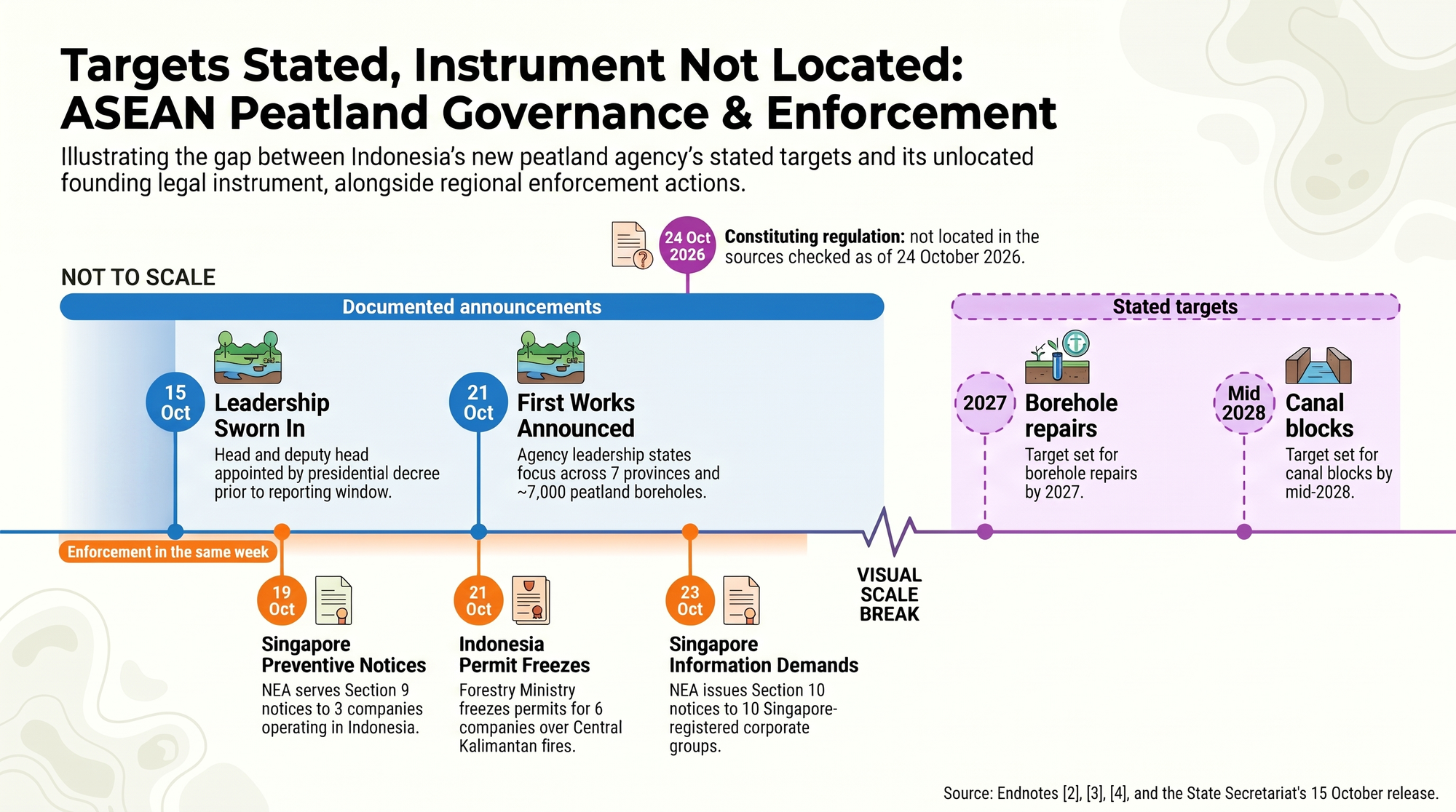
Singapore’s haze statute reached Singapore-registered corporate groups during the week. On 19 October, the National Environment Agency (NEA) served Preventive Measure Notices under Section 9 of the Transboundary Haze Pollution Act on 3 companies in Indonesia over fires in Kalimantan, following notices to 7 companies over fires in Sumatra on 16 October; the notices direct the companies to deploy firefighters, stop burning, and submit a plan of action. On 23 October, NEA sought documents and information under Section 10 from 10 Singapore-registered palm oil and forestry companies regarding their links with associated companies in Singapore and Indonesia, the locations of their concessions, and their fire measures this dry season. [3]
In Jakarta, Indonesia, Forestry Minister Raja Juli Antoni announced on 21 October that the ministry froze 6 companies’ permits due to fires in Central Kalimantan, bringing the number of companies under administrative sanctions to 32, with concessions covering 1,931,115 hectares. By 21.00 Western Indonesia Time on 22 October, the ministry counted 1,350 high-confidence hotspots nationwide, 874 of which were in Central Kalimantan; the ministry defines a hotspot as a satellite-detected surface temperature anomaly. [4] The new National Peatland and Mangrove Management Agency (BPGMN) set out its first work on 21 October: repair and build about 7,000 boreholes in peat ecosystems across 7 provinces by 2027, and canal blocks by mid-2028, using concession companies’ corporate social responsibility funds, according to ANTARA. [2] The press listings of the Forestry Ministry and the State Secretariat, and the ANTARA reports checked, did not include the regulation establishing the agency.
What This Means
For a program that would work through a concession holder in an Indonesian peat landscape, the due-diligence questions now reach the group. Has the counterpart, or any associated company, received a notice under Singapore’s haze statute or an Indonesian administrative sanction this season, and what does the action plan submitted to NEA commit to for that land? While a permit freeze stands, what may the company do on the concession, and who manages the peat water table there? A rewetting design that relies on the new agency’s borehole and canal works requires the agency's instrument and a funded budget line for those works before the works enter the baseline. [2] [3] [4]
For a company or a financial institution preparing nature-related reporting, the ISSB proposal is a document to comment on by its closing date, and until the ISSB finalizes a text, the proposal itself creates no obligation. The baseline already applies: entities applying IFRS S1 must disclose material information about sustainability-related risks and opportunities, including nature-related ones, subject to the Standard’s transition reliefs, and a jurisdiction may choose to mandate the Practice Statement. For a program designer counting on new nature finance, an institutional target and a bond initiative’s fundraising aim signal where to pitch, not finance for a named project. A financing plan can include prospective finance at the preparation stage, provided the plan records prospective, approved, and contracted finance separately, each with the recipient, amount, conditions, and timing that determine when funds can be drawn. [1] [6] [7]
Three signals would change this reading: the instrument establishing Indonesia’s peatland and mangrove agency, as recorded in the official register; the Green Climate Fund Board’s decisions from October 26 to 29; and COP17’s closing decisions on the voluntary guidelines for nature-based solutions.
Worth Watching Through Year-End
Convention on Biological Diversity COP17: Yerevan, Armenia, closing on 30 October, with the high-level ministerial segment on 27 and 28 October.
Green Climate Fund Board, forty-sixth meeting: Songdo, Incheon, Republic of Korea, 26 to 29 October, with 21 funding proposals before the Board, including ecosystem-based adaptation in Moldova and a blue ecosystem adaptation mechanism in Indonesia.
Nature-based Solutions International Congress: Paris, France, 2 to 6 November, with the scientific conference from 3 to 6 November.
United Nations climate conference COP31: Antalya, Türkiye, 9 to 20 November, with a nature and land-use day on 17 November.
49th ASEAN Summit: Manila, Philippines, in November, under the Philippines’ chairmanship.
Endnotes
[1] IFRS Foundation. (2026, October 22). ISSB consults on its proposals for nature-related disclosures; and (2026, October). Exposure Draft ISSB/ED/2026/1, IFRS Sustainability Disclosure Practice Statement 1 Nature-related Disclosures. Primary; a proposal for comment, nothing adopted. The exposure draft cover carries the month only; the release carries the date. The statements on existing IFRS S1 requirements, optional application, and a jurisdiction’s choice to mandate are in paragraphs IN6 to IN10.
[2] ANTARA. (2026, October 21). Cegah karhutla, BPGMN fokus kelola gambut di 7 provinsi dan konsesi and BPGMN targetkan perbaikan dan pembangunan 7.000 sumur bor pada 2027. National wire, reporting statements by the agency’s head, Satyawan Pudyatmoko, and deputy head, Major General Sriyanto; targets as stated, not adopted plans. The reports cite no regulation constituting the agency.
[3] National Environment Agency, Singapore. (2026, October 19). NEA Issues Additional Notices Under The Transboundary Haze Pollution Act; and (2026, October 23). NEA Serves Notices To 10 Singapore-Based Companies. Primary. Section 9 notices are preventive measure notices; Section 10 notices require documents and information; neither release states a penalty or a deadline, and neither makes a finding of liability.
[4] Ministry of Forestry, Republic of Indonesia. (2026, October 21). Menhut Raja Juli Antoni Bekukan Izin Enam Perusahaan Terkait Karhutla, Total 32 Perusahaan Dikenai Sanksi; and (2026, October 23). Hotspot Naik, Operasi dan Perlindungan Satwa Diperkuat. Primary. The total of 32 companies includes the six; a permit freeze (“pembekuan izin”) is an administrative sanction, not a revocation. The hotspot figures are from the SiPongi system and dated by observation, not by release.
[5] ICVCM. (2026, October 22). Integrity Council launches public consultation on proposed Clarifications under CCP rule architecture. Primary; proposed clarifications under consultation, nothing adopted. The second clarification concerns criterion 7.6 on safeguards; the release names no activity type.
[6] European Investment Bank. (2026, October 22). EIB Group doubles down on climate resilience with €30 billion adaptation plan. Primary and self-reported; a forward target for 2026–2030, not commitments to projects or disbursements. The release dates the endorsement only as “this week.”
[7] African Development Bank Group. (2026, October 21). COP 17: African countries pave the way for innovative financing for protected areas in West Africa. Primary and self-reported; the feasibility conclusion is the partners’ own, and carbon markets are named as a possible source of funds, not a contracted one.
[8] Earth Negotiations Bulletin. (2026, October 21). Daily report for 21 October 2026; and (2026, October 22). Daily report for 22 October 2026. Independent secondary reporting of informal negotiating texts; the Secretariat’s opening release of 19 October is primary for the conference itself.
[9] Adaptation Fund. (2026, October 23). Adaptation Fund Board Approves Nearly US$100M in New Projects, Underscores Urgency of Paris Agreement Transition. Primary and self-reported; Board approvals at the close of the forty-seventh meeting, not disbursements. The approved total includes USD 4.1 million in project formulation grants.
[10] IUCN. (2026, October 22). Press release on the first global coral reef assessment under the IUCN Red List of Ecosystems. Primary release; the underlying assessment combines observed trends with a projected warming scenario. Based solely on observed changes over the past 50 years and excluding climate projections, the release gives 24% of reef ecosystems as Critically Endangered.