No. 25 — Antalya’s Forest Money Sits at Four Different Stages
COP31’s first week brought a forest-fund pledge, a committed payment for past forest results, labeled credits with payments still to come, and adaptation envelopes opened for planning. Each sits at its own stage, and a project case should reflect that.
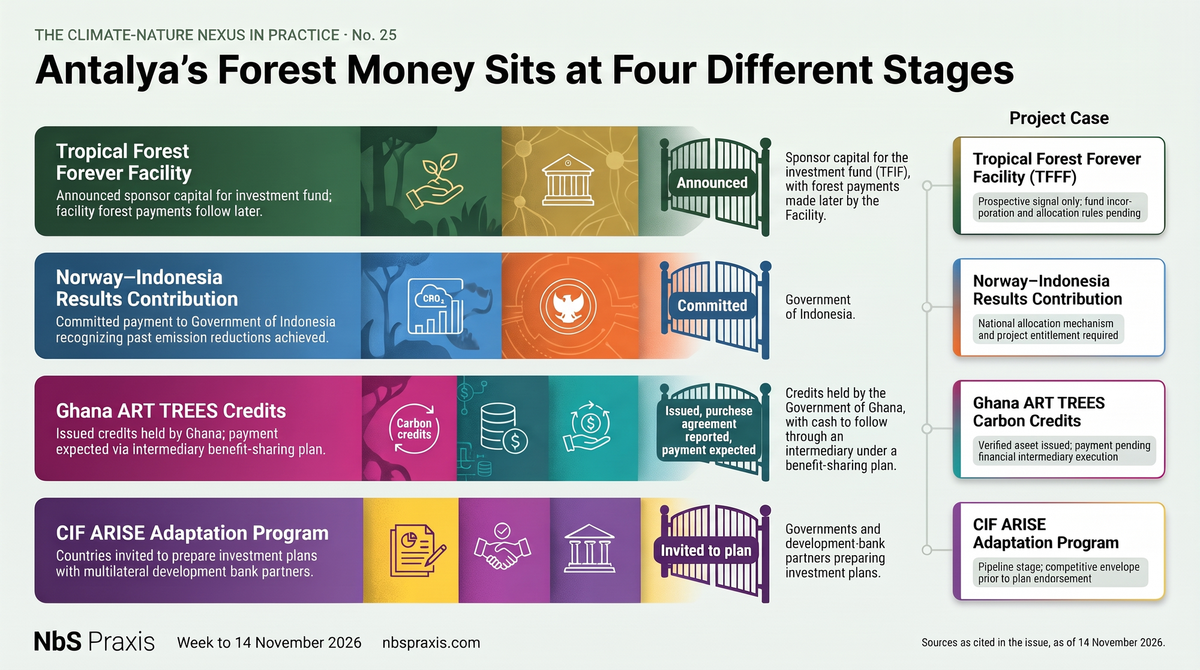
Bottom line: Forest and ecosystem funding progressed through four stages during COP31’s first week. The Netherlands and six philanthropic organizations announced investments in the Tropical Forest Forever Facility, whose investment fund is awaiting incorporation. Norway committed a fifth results-based payment to Indonesia for forest emissions reductions already achieved. Ghana became the first African country to receive ART TREES forest credits, with payment still expected. The Climate Investment Funds invited five countries and one region to plan adaptation investments, with mangroves and watersheds among ministers’ priorities. A project case should record each flow at its respective stage.
Here is the gateway into the field, and the briefing is the room you walk into: [Podcasts and Videos — Gemini Notebook: www.youtube.com/@nbspraxis]
Link to Explainer Video (Playlist of 1 Podcast and 4 Videos for Week 25, available at https://www.youtube.com/playlist?list=PLO9p5kO2MuoA
Last week’s briefing argued that a nature project’s case moves line by line, with each line supported by its own evidence. The first week of COP31 in Antalya, Türkiye, tested that argument on the finance line itself, because the forest and ecosystem funding announced there did not arrive as a single type of funding. The Netherlands and a group of foundations announced investments in the Tropical Forest Forever Facility (TFFF); Norway committed a fifth results-based contribution to Indonesia; Architecture for REDD+ Transactions (ART), a standard for crediting reduced emissions from deforestation and forest degradation (REDD+) across whole jurisdictions, issued forest credits to Ghana; and the Climate Investment Funds (CIF) invited countries to plan investments under its new adaptation and resilience program, ARISE. [1] [2] [3] [4] One flow is capital for a fund, one is a payment for results already achieved, one is a tradable asset under a purchase agreement with payment still to come, and one is an invitation to plan.
The two signals from last week’s issue, the Green Climate Fund’s adopted Board decisions and the adopted text of the seventeenth Conference of the Parties to the Convention on Biological Diversity (COP17) on nature-based solutions (NbS), were not found on the two bodies’ decisions pages, as The Record notes.
The implication for senior practitioners is that “COP31 forest finance” is not a line item in a financing plan. A project expecting to benefit records which stage the money has reached, who holds the money, and what has to happen before any money reaches the project.
Four Stages, One Week
The week’s forest and ecosystem money sat on different rungs of the finance ladder, and the rung, not the headline, determines what a project can book.
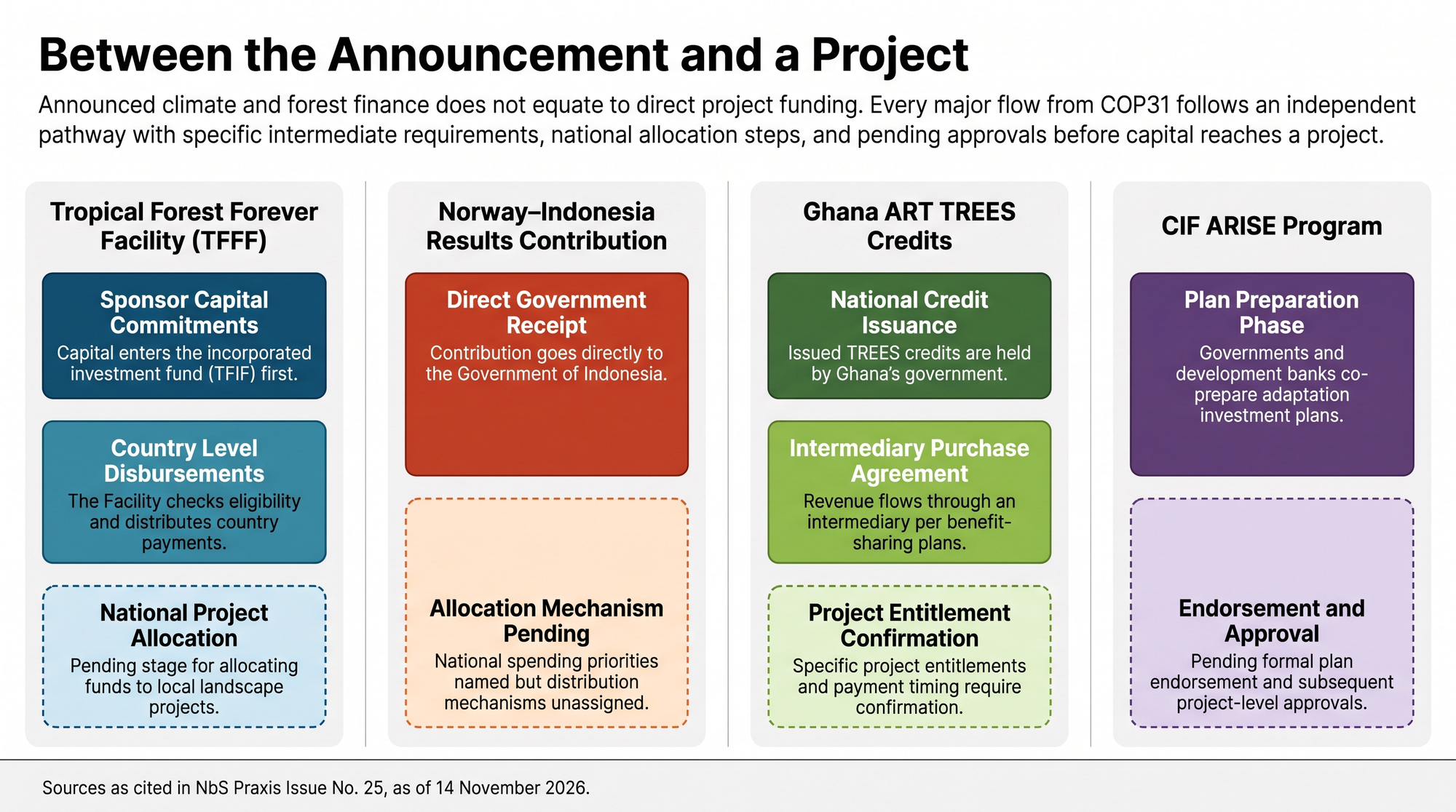
The first distinction is between money for a fund and money for a forest. The TFFF has two legally separate parts: the Tropical Forest Investment Fund (TFIF), which takes sponsor capital and generates returns, and the Facility, which checks eligibility and distributes forest payments. The week’s announcements are capital for the investment fund, which is expected to be incorporated in Luxembourg before year-end. The facility’s own timetable places the investment fund’s first transfer for forest payments no earlier than 2027. [1] Sponsor capital reaches a landscape only after the investment fund is incorporated, capitalized, and transferring proceeds, and after the Facility pays a forest country under its rules. Therefore, a project cannot cite the week’s announcements as a source of finance.
The second distinction is between rewarding the past and financing the future. Norway’s contribution, as outlined in ASEAN in Focus, recognizes reductions Indonesia achieved in earlier years, and Ghana’s credits represent reductions verified against a benchmark for a past period. [2] [3] Both flows go first to governments: Norway’s contribution to Indonesia and ART’s issuance to the Government of Ghana. A project’s access therefore runs through the national arrangement that allocates the money. For Ghana, the buyers’ coordinator describes an agreed benefit-sharing plan, which The Record sets out; the Norwegian and Indonesian releases name priorities for the money but do not specify an allocation mechanism. Even where a plan exists, a particular project still needs its own entitlement defined. Ghana’s minister drew the second line himself: issuance confirms verified credits, “but not the payments.” [3]
The third distinction concerns price. The week reported two per-tonne figures for forest results, set out in The Record and ASEAN in Focus: a bilateral contribution rate and a range at which a government expects to sell credits. One is a negotiated payment between governments, and the other is an expected sale of tradable units. Neither is a market price for the other, and neither prices a project’s own reductions.
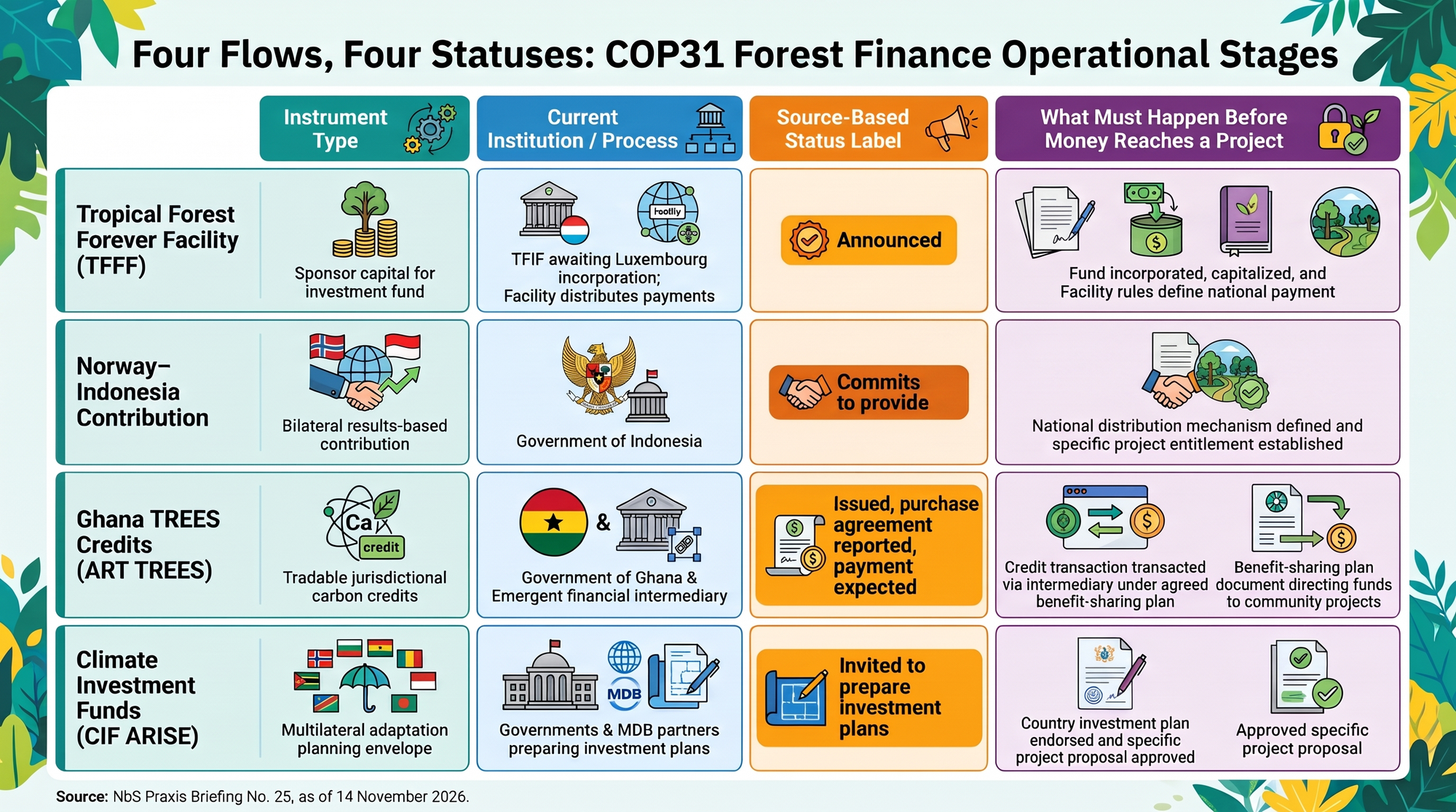
The fourth distinction is between a pipeline and an approval. The CIF selections open adaptation envelopes for planning, and ecosystem measures appear in what ministers said they would pursue rather than in approved plans. [4] For ecosystem-based adaptation (EbA), the CIF selections place mangrove and watershed restoration in the pipeline stage in specific countries.
The Record
The Netherlands and six philanthropic organizations announce investments in the TFFF
At the COP31 Leaders’ Summit Event on Forests on 11 November, Brazil’s President Luiz Inácio Lula da Silva and Norway’s Prime Minister Jonas Gahr Støre welcomed the Netherlands’ announcement of an investment of up to USD 500 million over 10 years in the TFFF, alongside USD 88 million announced by six philanthropic organizations. The Children’s Investment Fund Foundation described the philanthropic sum as planned commitments expected to go directly into the facility’s sponsor tranche, and said the facility must close a remaining USD 2.1 billion gap to reach its USD 10 billion capitalization goal for 2026. The facility is designed to direct at least 20% of payments to Indigenous Peoples and local communities.
This week: announced investments; the Dutch government first announced its intention on 26 October and described the contribution as still subject to conditions. [1]
ART issues the first TREES credits in Africa to Ghana
ART issued 6.57 million TREES credits to the Government of Ghana on 12 November for jurisdictional results across approximately 2.5 million hectares, making Ghana the first country in Africa and the third worldwide to receive TREES credits. ART states that these are the first TREES credits in its registry labeled Core Carbon Principles (CCP) Approved. In a statement read at the Ghana Pavilion, Minister for Lands and Natural Resources Emmanuel Armah-Kofi Buah said the issuance, for reductions achieved between 2017 and 2021, is expected to trigger initial payments of about USD 43 million to purchase about four million tonnes at USD 10 to 13 per tonne. Emergent, the coordinator of the Lowering Emissions by Accelerating Forest finance (LEAF) Coalition of government and corporate buyers, said the same day that finance would flow through an independent financial intermediary as credits are transacted, with over two-thirds of net proceeds going to local stakeholders under an agreed benefit-sharing plan. The transaction’s legal adviser reported on 13 November that Ghana has signed a purchase agreement with Emergent.
This week: credits issued and a purchase agreement reported; payments expected, per the Government of Ghana’s statement. [3]
CIF invites five countries and one region to plan adaptation investments
On 12 November in Antalya, CIF invited Bangladesh, Haiti, the Kyrgyz Republic, Morocco, and Sierra Leone to enter Phase One of ARISE, each to prepare an investment plan for up to USD 30 million. CIF also invited a Malawi–Mozambique regional program that may request up to USD 40 million. Ministers named their priorities: restoring mangroves at scale in Bangladesh, coastal ecosystem and watershed restoration and reforestation in Haiti, and mountain ecosystems in the Kyrgyz Republic.
This week: invitations to prepare investment plans; none approved. [4]
Two adopted texts not yet located
The Green Climate Fund’s decisions listing, published on 14 November, included one decision from its forty-sixth Board meeting, an Independent Redress Mechanism compliance report. The listing does not include the decisions recording which proposed conditions were adopted for the October approvals. [5]
The Convention on Biological Diversity’s decisions page still ended at COP16 on the same date. The latest published text on biodiversity and climate change remains the Chair’s draft CBD/COP/17/L.19 of 30 October, which notes progress on a draft supplement to the voluntary guidelines for ecosystem-based approaches and annexes the supplement for further consideration. [6]
Current signal: adopted texts not found on either decision page on 14 November. [5] [6]
ASEAN in Focus
Norway announced a fifth results-based contribution of USD 100 million to Indonesia in Antalya on 12 November for forest and land-use emission reductions from 2020 to 2023, at USD 10 per tonne of carbon dioxide equivalent, double the rate of the four earlier phases, through which Indonesia has received USD 216 million. [2] Norway’s release states that the contribution covers 10 million tonnes of those reductions and will support forest and mangrove restoration and forest fire prevention. Neither government’s release provides a payment date.
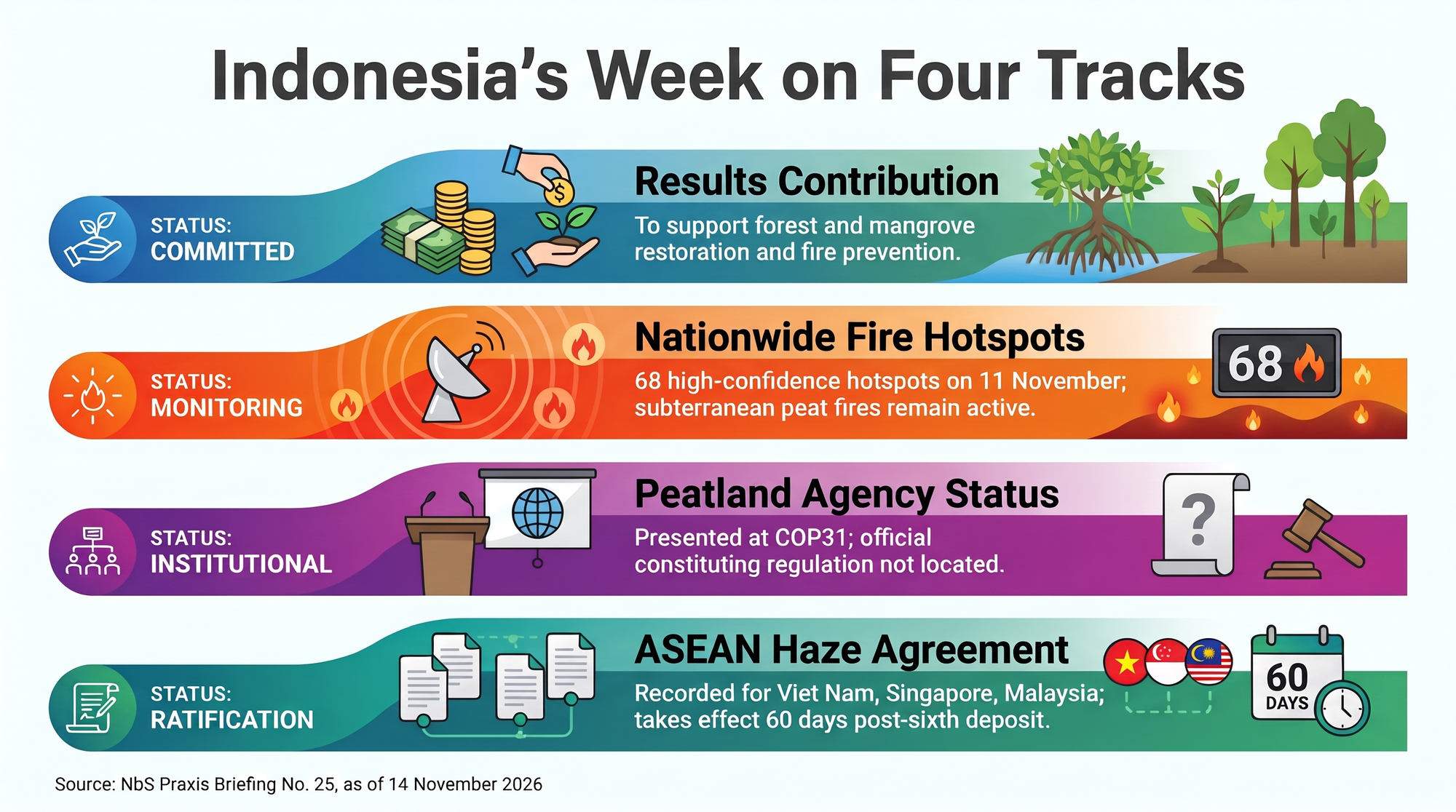
By 21.00 Western Indonesia Time on 11 November, the ministry counted 68 high-confidence hotspots nationwide, unchanged from the day before and down from 338 on 5 November; all six recorded in the priority provinces were in South Sumatra. The ministry cautioned that peat fires were still burning below the surface and that the absence of hotspots does not mean a fire is out. The ministry reports 241 individuals and 93 companies in legal proceedings, and administrative sanctions on 32 companies. [7] The ministry also said Indonesia would press at the 49th ASEAN Summit in Manila, the Philippines, for faster ratification of the agreement establishing the ASEAN Coordinating Centre for Transboundary Haze Pollution Control, noting that only Viet Nam had completed ratification. [7] The ASEAN Secretariat’s register of legal instruments has since recorded Singapore’s instrument of ratification on 13 November and Malaysia’s on 14 November, after Viet Nam’s instrument of approval in June. The agreement enters into force on the sixtieth day after the sixth instrument is deposited, so three more deposits are needed. [8]
At COP31 on 10 November, Deputy Forestry Minister Rohmat Marzuki introduced the National Peatland and Mangrove Management Agency as “newly formed” and proposed joint mangrove conservation with the Republic of Congo through the agency. The regulation establishing the agency was not found in the official and press sources reviewed. [9] For Indonesian peat and mangrove programs, the week brought a larger jurisdictional payment commitment and an agency presented abroad; the agency’s mandate and budget remain to be confirmed by that regulation.
What This Means
For a program designer counting on jurisdictional results money in Indonesia or Ghana, the decision condition is a defined entitlement, not a headline payment. Results revenue enters a project’s financing plan as prospective until a benefit-sharing arrangement designates the project or its landscape as a recipient and specifies the amount, conditions, and timing. In Ghana, the due-diligence questions focus on the benefit-sharing plan and the financial intermediary: which stakeholders are covered and what must happen before payment. In Indonesia, the ministry asks how the contribution will be distributed and on what results.
For a forest country or project citing the TFFF, the week’s announcements signal where future payments to forest countries may come from, not funding for any named activity. The key questions are when the investment fund expects its first transfer to the Facility and how a recipient country will allocate forest payments.
For adaptation designers in the five ARISE countries and the Malawi–Mozambique program, the investment plan is where ecosystem measures will compete for an envelope. The timely step is to submit costed mangrove, watershed, or mountain-ecosystem measures to the multilateral development bank partner preparing the plan. ARISE funding remains prospective until a plan is endorsed and a project is approved. The COP31 cover decision, the Green Climate Fund’s published decisions, and COP17’s adopted text are signals to watch, not conditions for any of these steps.
Worth Watching Through Year-End
49th ASEAN Summit and Related Summits: Manila, the Philippines, 14 to 17 November, with ratification of the haze center agreement on Indonesia’s agenda.
COP31 thematic days: Antalya, with the ocean, seas, nature, and land use day on 17 November and the scheduled close on 20 November.
Global Landscapes Forum, 9th Investment Case Symposium: Antalya and online, 18 November, on connecting capital with climate and nature solutions.
2026 UN Water Conference: Abu Dhabi, United Arab Emirates, 8 to 10 December, co-hosted by the United Arab Emirates and Senegal.
Endnotes
[1] Tropical Forest Forever Facility. (2026, November 11). President Lula and Prime Minister Støre welcome USD 500 million Dutch pledge and philanthropy’s USD 88 million commitment to the TFFF; and Children’s Investment Fund Foundation. (2026, November 11). Philanthropies plan to commit $88 million to Tropical Forest Forever Facility as race to close fundraising gap enters final stage; Tropical Forest Forever Facility. (2026, October 30). The Netherlands to announce up to USD 500 million investment into the TFFF; and Government of the Netherlands. (2026, October 26). Nederland investeert fors in bescherming tropische bossen. Primary; announced, not paid in. The October release names the two entities, records the Facility’s charter as adopted in July, and sets the first transfer of forest payments for 2027–2029; the Dutch release reads, “Op dit moment is de voorgenomen kapitaalbijdrage nog onder voorwaarden.” The facility’s release calls the philanthropic sum a commitment, and the foundation’s release calls it plans to commit; the six are the Bacon, Packard, Moore, and Quadrature foundations, the Children’s Investment Fund Foundation, and Conservation International. The two releases report the running total differently, so no total is provided.
[2] Ministry of Forestry, Republic of Indonesia. (2026, November 12). Indonesia dan Norwegia Umumkan Kontribusi Berbasis Hasil Tahap Kelima di COP31 Antalya; and Ministry of Climate and Environment, Norway. (2026, November 12). Indonesia Receives NOK 1 Billion Contribution Following Sharp Reduction in Deforestation. Primary, both governments; a commitment, not a disbursement. The Norwegian release gives the contribution as NOK 1 billion and Indonesia’s total reductions over the period as about 270 million tonnes; the dollar amount and the per-tonne rate are the Indonesian ministry’s. “Pemerintah Norwegia berkomitmen memberikan total 100 juta dolar AS untuk kontribusi tahap kelima ini.”
[3] Architecture for REDD+ Transactions. (2026, November 12). ART Issues 6.57 Million TREES Credits to Ghana; Emergent. (2026, November 12). Ghana to become first African country to access climate finance from the LEAF Coalition; Latham & Watkins. (2026, November 13). Latham Advises on Landmark Forest Protection Funding in Ghana; The Herald Ghana. (2026, November 13). Ghana secures first forest carbon credit issuance, with US$43m in expected payments. Primary (issuance), transaction participants’ announcements (purchase arrangement and benefit sharing), and secondary (payments). ART states no price, buyer, or crediting period; the expected payments, tonnage, price range, and period come from the Government of Ghana’s statement as reported. Emergent names the governments of the United Kingdom and Norway, Amazon, Bayer, PwC, and the Walmart Foundation as buyers; no source states the volume or value of the purchase agreement.
[4] Climate Investment Funds. (2026, November 12). CIF Selects Five Inaugural Countries and One Regional Program to Scale Climate Adaptation and Resilience Investments. Primary; invitations to plan, not approvals. The ecosystem measures appear in ministers’ statements, not in the program description.
[5] Green Climate Fund. Board decisions listing. Primary; the only decision from the forty-sixth meeting listed on 14 November was B.46/19.
[6] Secretariat of the Convention on Biological Diversity. COP decisions; and (2026, October 30). CBD/COP/17/L.19, Biodiversity and climate change. Primary; a draft, not an adopted decision. The draft describes the supplement as voluntary, non-prescriptive, and creating no new obligations (paragraph 6).
[7] Ministry of Forestry, Republic of Indonesia. (2026, November 12). Hotspot Nasional Tetap 68 Titik, Sumsel Kembali Terdeteksi 6 Hotspot; and (2026, November 12). Indonesia Bawa Solusi Pengendalian Karhutla ke ASEAN Sampai PBB. Primary, self-reported; SiPongi high-confidence counts for observations to 21.00 Western Indonesia Time on 11 November, and enforcement totals to date for the season. On ratification: “berdasarkan keterangan Kementerian Luar Negeri baru Vietnam yang telah menyelesaikan ketentuan ratifikasi tersebut.”
[8] ASEAN Secretariat. ASEAN legal instruments register, instruments of ratification; and (2025, May 27). Agreement on the Establishment of the ASEAN Co-ordinating Centre for Transboundary Haze Pollution Control. with the instruments of Singapore, Malaysia, and Viet Nam. Primary; depositary record. The dates are the Secretariat’s receipt stamps, with Viet Nam’s on 26 June 2026; Singapore’s and Malaysia’s instruments were both signed on 5 November. Article 25(1) sets the entry into force.
[9] Ministry of Forestry, Republic of Indonesia. (2026, November 11). Indonesia dan Republik Kongo Perkuat Kerja Sama Pasar Kayu Lestari, Gambut dan Mangrove; and Ministry of State Secretariat. (2026, October 15). Presiden Prabowo Lantik Kepala BNPB serta Kepala dan Wakil Kepala BPGMN. Primary: The Congo release is labeled a draft press release, and the appointment is background. “Wamenhut juga memperkenalkan Badan Pengelola Gambut dan Mangrove Nasional (BPGMN) yang baru dibentuk Indonesia.”