No. 23 — Ecosystem-based Adaptation Approved; Drawdown Comes With Conditions
The Green Climate Fund approved grants that use ecosystems for adaptation, and its Board document outlines what stands between approval and drawdown. Yerevan's pledges, an Asian Development Bank bond, and a nature-credits coalition each progressed at their own pace

The Climate-Nature Nexus in Practice (Weekly Briefing to 31 October 2026)
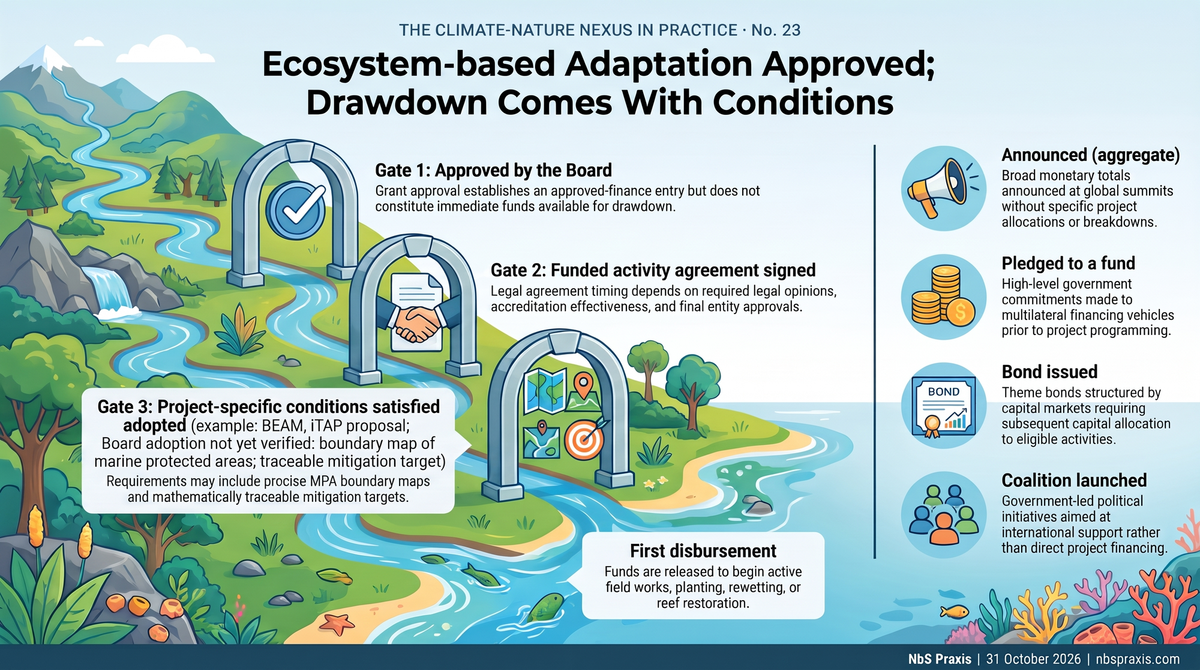
Bottom line: The Green Climate Fund Board approved grants that use ecosystems as adaptation measures in Moldova, Fiji, Colombia, and Indonesia this week. The Board document behind those approvals outlines what still stands between approval and drawdown. The document proposes a funded-activity-agreement condition for every project, and the Fund’s independent technical panel proposed that Indonesia’s coastal project map its marine protected areas before the first disbursement. Other nature finance news this week included announced pledges, an Asian Development Bank bond, and a government coalition. A financing plan should record each at its own status.
Here is the gateway into the field, and the briefing is the room you walk into: [Podcasts and Videos — Gemini Notebook: www.youtube.com/@nbspraxis]
Link to Explainer Video (Playlist of 1 Podcast and 4 Videos for Week 23, available at https://www.youtube.com/playlist?list=PLA9VT0qSuYNQ
Last week’s briefing asked for a design to record the status of each instrument the design relies on and to identify three signals that would change that reading. One arrived in full: the Green Climate Fund (GCF) Board closed its forty-sixth meeting in Songdo, Incheon, Republic of Korea, on 29 October, approving several projects that use ecosystem-based adaptation (EbA). [1] The second arrived in part: the seventeenth Conference of the Parties to the Convention on Biological Diversity (COP17) in Yerevan, Armenia, concluded with its decisions adopted, but the decision texts had not been published in the sources checked, so this issue does not report what the decisions on biodiversity and climate change say. [2] The third has not arrived, as ASEAN in Focus records.
An approval is a status, and the GCF’s Board document shows that, for one EbA project, the conditions proposed before money moves concern the ecosystem itself: the location of the protected areas’ boundaries and whether the mitigation target aligns with the area under management.
For senior practitioners, the practical implication is to schedule grant-funded fieldwork around the expected first disbursement, which occurs once the agreement is signed and the conditions for that disbursement are met, rather than around the Board approval date.
The Record
GCF approvals move EbA projects toward implementation
The Green Climate Fund Board approved 21 projects during its 26–29 October meeting in Songdo, Republic of Korea. The Fund reported USD 1.97 billion in new climate finance, including additional financing for an existing facility, bringing 2026 approvals to USD 3.3 billion. These are Board approvals, not disbursements. [1]
Three approved grants outside Southeast Asia use EbA. On 28 October, the Board approved Moldova Green Shield, accredited to the World Bank, for USD 39.28 million. On 27 October, it approved the Fiji Coral Reef Resilience Project, accredited to the World Wildlife Fund, for USD 35.2 million. On 28 October, the GCF also approved Building Water Resilience in Bogotá and the Region, accredited to Conservation International, for USD 45.7 million. These amounts represent GCF financing, not total project values. Indonesia’s Blue Halo S coastal project is examined in ASEAN in Focus. [1]
The GCF Board paper outlines general conditions proposed for all approvals, including signing a funded activity agreement, and project-specific conditions that the Board may adopt in full, in part, or not at all. The proposed 180-day signature period runs from the applicable starting events detailed in endnote 1, not necessarily from Board approval. The three grants above have no project-specific conditions in that table; this does not remove the general requirements. [1]
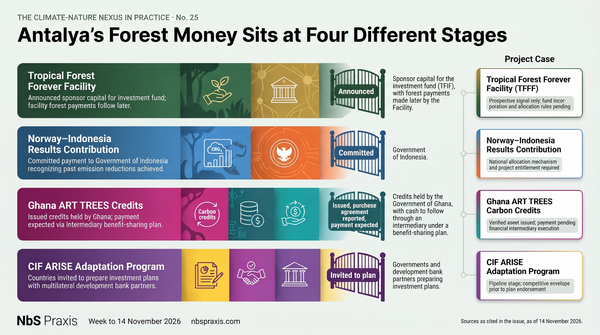
An approved grant can therefore be included in a financing plan as approved finance, but the implementation schedule must distinguish among approval, agreement signing, and the first disbursement. Indonesia’s proposed conditions illustrate how evidence supporting an ecosystem project can be integrated into that sequence.
Yerevan announcements represent different routes to finance
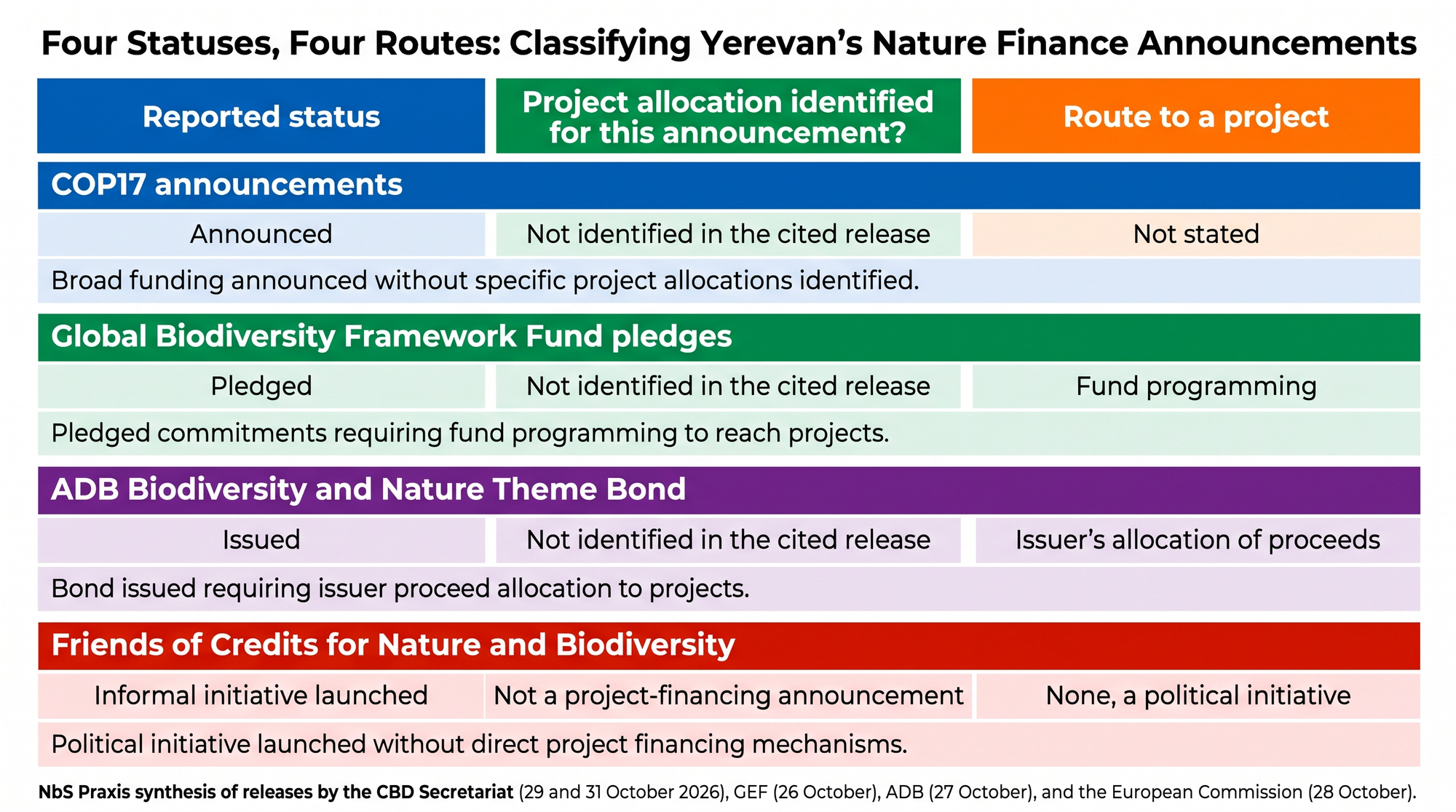
COP17 concluded in Yerevan, Armenia, on 31 October, adopting nearly 50 decisions, including the Yerevan Pathway, which responds to the first collective review of progress under the Kunming-Montreal Global Biodiversity Framework. The Convention’s Secretariat reported nearly USD 2 billion in new biodiversity funding, without a donor-by-donor breakdown. The sources reviewed for this issue did not include the adopted decision texts. [2]
Separately, the Global Environment Facility reported USD 60 million in government pledges to the Global Biodiversity Framework Fund (GBFF) at the conference. Since its launch in August 2023, the GBFF has received USD 446 million in commitments, of which USD 362.1 million has been allocated to 82 projects. These figures reflect different stages and periods and should not be included in the conference’s headline aggregate. [3]
On 27 October, the Asian Development Bank (ADB) announced a three-year Biodiversity and Nature Thematic Bond of about USD 50 million, arranged by Crédit Agricole CIB, to support projects such as nature-based solutions (NbS) for water management and coastal resilience. The announcement did not specify project allocations. ADB also launched a Nature Bond Incubator within the Nature Solutions Finance Hub. [4]
The European Commission’s Friends of Credits for Nature and Biodiversity, announced on 28 October, is an informal, government-led initiative to build international support for nature credits. It is a political initiative, not a project-financing approval, methodology or standard. [5]
For a financing plan, these are distinct entries: an announced aggregate, pledges to a fund, proceeds raised by a bond issuer, and a policy initiative. None of these announcements, by itself, establishes funding available to a particular project.
Restoration coverage shows uneven progress toward the target
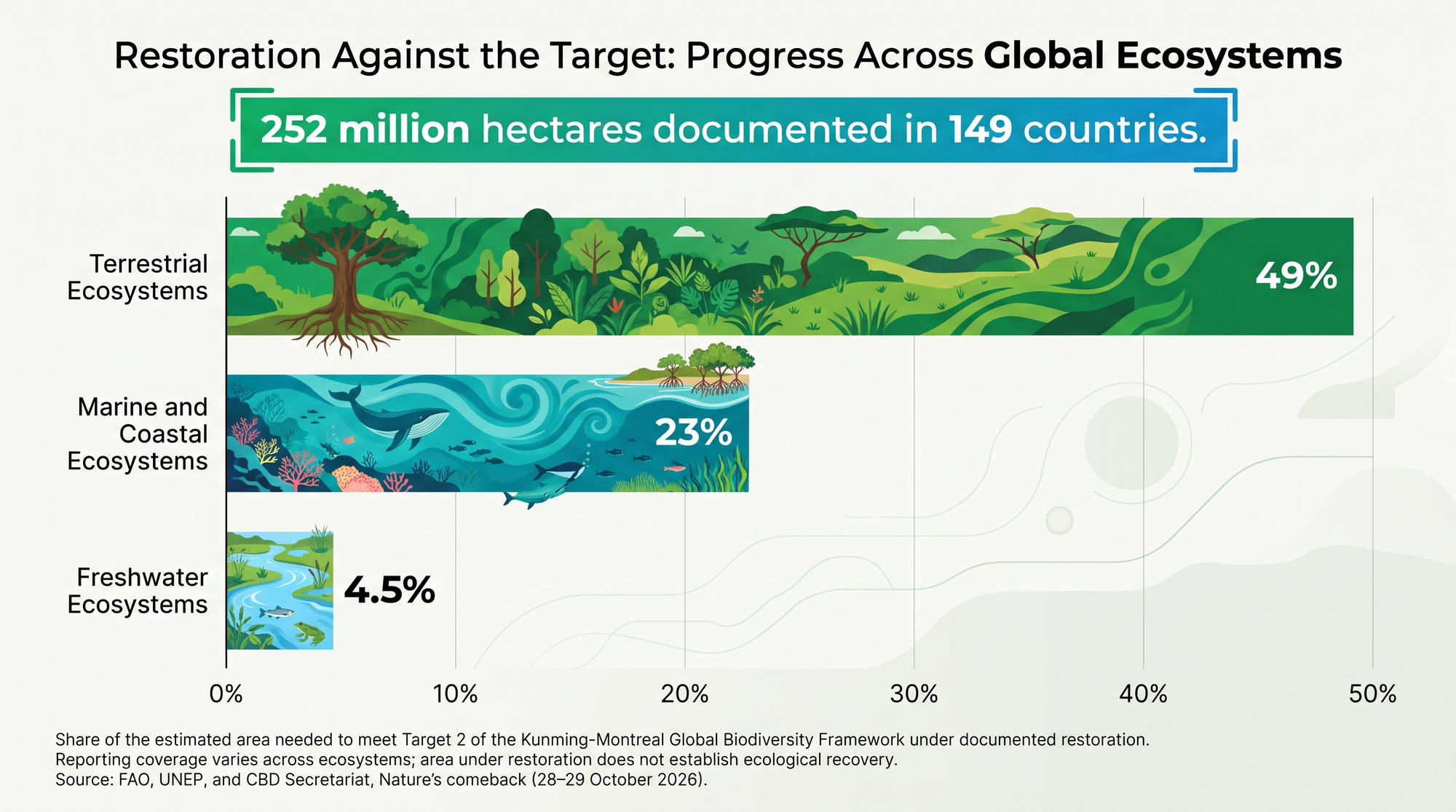
Nature’s comeback, published on 29 October by the Food and Agriculture Organization of the United Nations (FAO), the United Nations Environment Programme (UNEP), and the Convention’s Secretariat, documents restoration across 252 million hectares in 149 countries. FAO reports that 49% of the terrestrial target area is under restoration, compared with 23% for marine and coastal ecosystems and 4.5% for freshwater ecosystems, against the estimated area needed to meet Target 2’s goal of placing at least 30% of degraded ecosystems under effective restoration by 2030. The report calls for more than a fourfold increase in annual restoration finance by 2030. [6]
The comparison shows uneven progress toward the estimated target. Reporting coverage varies across ecosystems, and an area recorded as under restoration does not indicate ecological recovery.
ASEAN in Focus
Indonesia and Singapore opened a bilateral channel on the haze this week. During Singapore Foreign Minister Vivian Balakrishnan’s visit to Jakarta, Indonesia, from 27 to 29 October, he and Indonesian Foreign Minister Arrmanatha Christiawan Nasir “agreed to establish a Joint Task Force to strengthen information sharing and cooperation in addressing this issue, including through a hotline between both Ministries,” according to Singapore’s Ministry of Foreign Affairs. Asked for details the next day, Balakrishnan said the terms of reference were “to deal with this issue, exchange information, to facilitate each authority’s work in our respective jurisdictions,” and added that he was “not yet in a position to give you details about the composition and the staffing of the Task Force.” Neither source provides a timetable. [7]
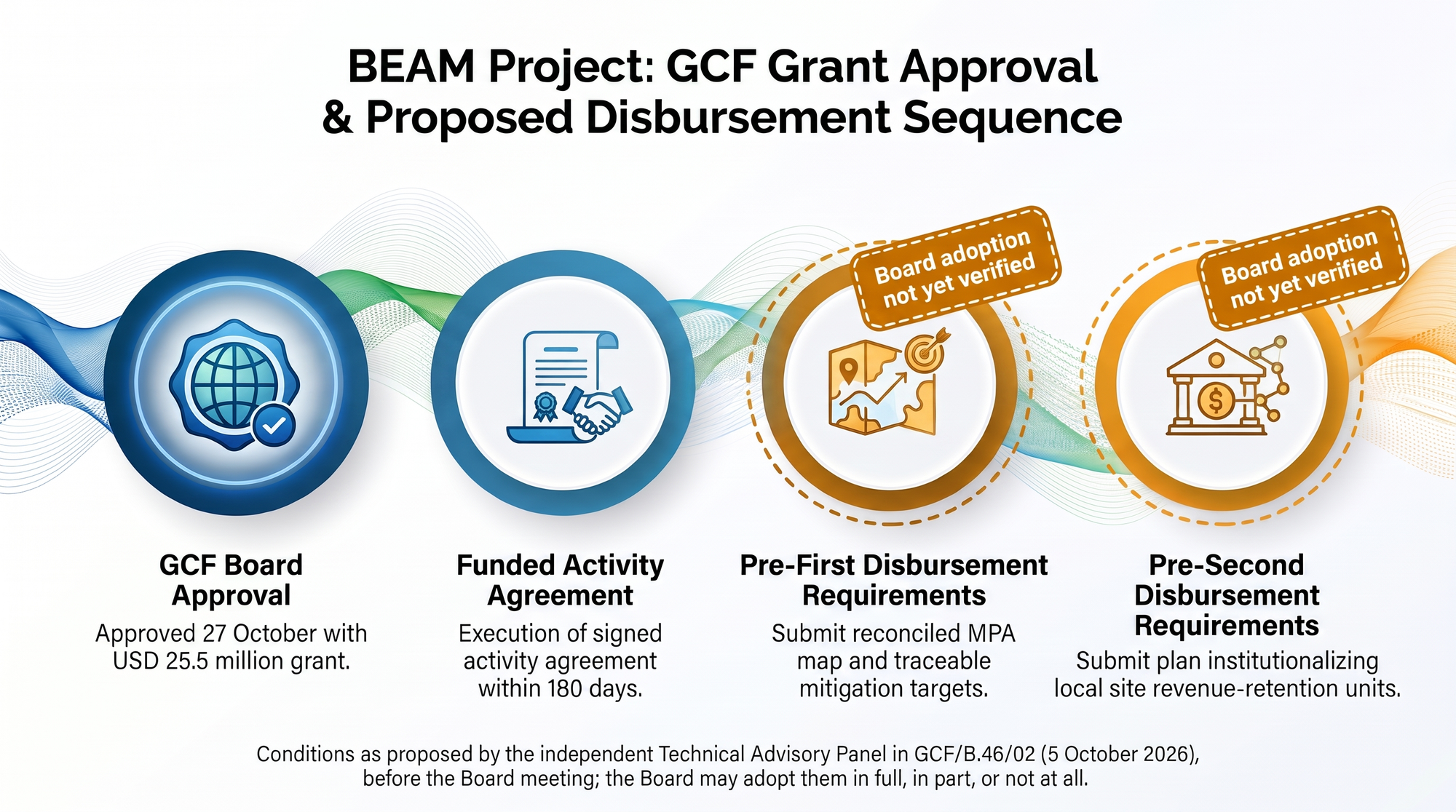
The GCF Board approved, on 27 October, a USD 25.5 million grant for Blue Halo S – Blue Ecosystem Adaptation Mechanism (BEAM), a project the GCF classifies as cross-cutting, spanning adaptation and mitigation, accredited to Conservation International, in Fisheries Management Area 572, which the proposal describes as “an extensive coastal and marine region covering 94.3 million hectares adjacent to six provinces.” [1] The independent Technical Advisory Panel proposed two conditions. Before the first disbursement, the accredited entity would submit “a reconciled, high-resolution geographic information system polygon map establishing the precise administrative boundaries of target MPAs,” with recalibrated annexes making the headline mitigation target “mathematically traceable to the committed management footprint.” Before the second, the entity would submit a plan to institutionalize regional public service units (Badan Layanan Umum Daerah) for the target marine protected areas “as entities empowered to retain and reinvest site-level revenues.” [1] Adoption of these proposed conditions was not verified in the sources reviewed for this issue.
On the fire line, the Forestry Ministry’s satellite count fell to 79 hotspots nationwide by 21.00 Western Indonesia Time on 27 October, then rose to 154 by the same hour on 29 October, with South Papua leading the count on 28 October. [8] The regulation establishing the National Peatland and Mangrove Management Agency was again not found: the Cabinet Secretariat’s release on the swearing-in of the agency’s head and deputy head on 15 October cites an appointment decree, and the ministry’s press listings for the week contain no regulation. [9]
What This Means
For an approved EbA project, assign each first-disbursement requirement an owner, a completion date, and a place in the implementation schedule. Schedule grant-funded fieldwork around the expected first disbursement, once the agreement is signed and the conditions for that disbursement are met. Where applicable, treat the boundary map and mitigation calculations as preparation deliverables, and distinguish them from requirements attached to later disbursements. For proposals involving protected areas and quantified mitigation claims, two due-diligence questions follow:
- Can the protected-area boundaries and the area under management be reconciled on a single map today, and
- does the mitigation figure in the proposal trace to that area? [1]
For a program designer counting the Yerevan announcements, an announced aggregate and a pledge to a fund are signals of where to pitch, not finance for a named project, and theme-bond proceeds reach a project only through the issuer’s allocation. In Indonesian peat landscapes, last week’s questions remain: the bilateral task force has stated terms of reference but no published composition, staffing, or timetable, and work that relies on the new agency still needs its constituting instrument and a funded budget line before it can enter a baseline. [2] [4] [7] [9]
Three signals would change this reading: the GCF Board’s published decisions identifying which proposed conditions were adopted; COP17’s adopted decision texts on biodiversity and climate change; and the instrument establishing Indonesia’s peatland and mangrove agency, as recorded in the official register.
Worth Watching Through Year-End
Nature-based Solutions International Congress: Paris, France, 2 to 6 November, with the scientific conference from 3 to 6 November.
United Nations climate conference COP31: Antalya, Türkiye, 9 to 20 November, with the presidency’s thematic day on ocean, seas, nature, and land use on 17 November.
49th ASEAN Summit: Metro Manila, Philippines, in November, under the Philippines’ chairmanship.
Endnotes
[1] Green Climate Fund. (2026, October 29). GCF financing tops USD 3 billion for consecutive record year as reforms continue to deliver (2026, October 5). GCF/B.46/02, Consideration of funding proposals; project pages FP311, FP316, FP317, FP321, and FP323; and FP317 funding proposal package. Primary and self-reported; Board approvals, not disbursements. Annex II, Table 1, condition (a), proposes signature of the funded activity agreement within 180 days of the latest of Board approval, the accredited entity’s provision of the required certificate or legal opinion, and, where applicable, effectiveness of its accreditation master agreement. The certificate or legal opinion must be satisfactory to the GCF Secretariat and confirm the entity’s final internal approvals, capacity, and authority to implement the project or programme; the FP317 conditions are in Annex II, Table 2, headed “Conditions proposed by iTAP,” and Annex II, paragraph 2, states that the Board may adopt them in full, in part, or not at all. FP317’s grant is USD 25,491,313; the project pages classify FP317 and FP321 as cross-cutting and FP316 and FP323 as adaptation.
[2] Secretariat of the Convention on Biological Diversity. (2026, October 31). UN Biodiversity Conference charts Yerevan Pathway to accelerate global action for nature; and (2026, October 29). High-Level Segment brings renewed momentum and new commitments as Biodiversity Conference enters decisive final days. Primary and self-reported; announcements, not disbursements, with no breakdown by donor. The closing release’s aggregate includes USD 560 million under GEF-9 and its GBFF, USD 500 million through the Species Recovery Alliance, and over USD 330 million through the Value Nature Fund; the 29 October release gave more than USD 1.8 billion at the close of the high-level segment.
[3] Global Environment Facility. (2026, October 26). UN biodiversity conference gets finance boost for action on nature. Primary and self-reported; pledges and commitments, not disbursements; “programmed” denotes allocation to projects.
[4] Asian Development Bank. (2026, October 27). ADB accelerates nature finance at COP17 with new bond incubator and tracking report. Primary and self-reported; the release gives no pricing and no formal title for the joint report.
[5] European Commission, Directorate-General for Environment. (2026, October 28). EU launches Friends of Credits for Nature and Biodiversity. Primary: a political initiative, not a methodology or a standard.
[6] Food and Agriculture Organization of the United Nations. (2026, October 29). Nature is making a comeback, but the world must move faster to meet restoration targets – UN report (2026, October 28). Nature’s comeback in numbers: how far has global restoration come?. Primary: a compiled report of country-documented restoration. The estimated Target 2 area is about 738 million hectares, of which 232 million hectares are terrestrial, 11 million hectares are freshwater, and 5.7 million hectares are marine and coastal, with 3.2 million unassigned. The release gives annual restoration finance rising from USD 64 billion to USD 296 billion by 2030.
[7] Ministry of Foreign Affairs, Singapore. (2026, October 28). Visit by Minister for Foreign Affairs Dr Vivian Balakrishnan to Jakarta, Indonesia, 27 to 29 October 2026; and (2026, October 28). Transcript of wrap-up interview with Singapore media in Jakarta. Primary; an agreement to establish, with terms of reference stated orally in answer to CNA TV.
[8] Ministry of Forestry, Republic of Indonesia. (2026, October 28). Hotspot Nasional Turun Jadi 79 Titik, Enam Provinsi Prioritas Nihil; (2026, October 29). Hotspot Nasional 118 Titik, Enam Provinsi Prioritas Tetap Nihil; (2026, October 30). Hotspot Naik Jadi 154 Titik, Kalteng Jadi Fokus Penguatan Operasi. Primary: SiPongi counts are based on observations at 21.00 Western Indonesia Time, not on release; a hotspot is a satellite-detected surface temperature anomaly. South Papua recorded 84 of the 118 hotspots observed on 28 October.
[9] Cabinet Secretariat, Republic of Indonesia. (2026, October 15). Presiden Prabowo Lantik Kepala BNPB serta Kepala dan Wakil Kepala BPGMN. Primary; background. The release cites Presidential Decree 43/M of 2026, an appointment decree, not a regulation establishing the agency.