No. 21 — Read the Instrument Behind the Counterpart and the Credit
Indonesia swore in the head of its new peat agency under an appointment decree; ART is correcting Guyana’s 2023 forest credits; and 29 investors endorsed the Tropical Forest Forever Facility without committing capital. Read the instrument that sets each status first.


The Climate-Nature Nexus in Practice (Weekly Briefing to 17 October 2026)
Bottom line: Before a design relies on a counterpart, a credit, or a pledge, the design team should review the instrument that establishes each. Indonesia’s President swore in the head of a new peatland and mangrove agency on 15 October under an appointment decree; the sources checked found no regulation establishing the agency. The Architecture for REDD+ Transactions Secretariat is correcting Guyana’s 2023 forest credits and will cancel any over-issuance once the corrected volume is verified. Investors signing a statement on the Tropical Forest Forever Facility undertake to explore contributing; the statement commits no capital.
Here is the gateway into the field, and the briefing is the room you walk into: [Podcasts and Videos — Gemini Notebook: www.youtube.com/@nbspraxis]
Link to Explainer Video (Playlist of 1 Podcast and 5 Videos for Week 21, available at https://youtu.be/WxXpP1ZYEyo?si=-icNyp4pnENNeaNt
Last week’s briefing argued that a design relying on a pending rule, approval, or counterpart should name and date the dependency and include a fallback, and it identified three signals to watch. One arrived in part: Indonesia’s President swore in the leadership of the new peatland and mangrove agency on 15 October. [1] The Green Climate Fund Board meets from 26 to 29 October, so the proposals remain proposals. The reversal-risk tool for afforestation and reforestation did not arrive, and a secretariat note prepared for the Article 6.4 Supervisory Body’s October meeting states that the SBM “would not be considered for adoption by the SBM in 2026.” [2]
The week’s other developments support the agency's reading. A verified volume of jurisdictional forest credits is being corrected under the standard’s own procedure. [3] A statement supporting a forest finance facility gained signatories who have committed to exploring contributions. [4] None of these readings implies failure: the agency may yet publish its mandate, and the credit correction follows a published process. The operative instrument, not the announcement, sets each status.
The implication for senior practitioners is clear. Before a design names a counterpart, books a credit, or counts a pledge, the design team should review the instrument that establishes each one's status and record that status in the Theory of Change's assumptions.
Read the Instrument, Not the Announcement
A counterpart, a credit, and a pledge each moved this week, and each requires a different document before a design can rely on any of the three.
A counterpart passes through separate milestones. Last week’s issue listed three: permission to initiate a regulation, the regulation itself, and a staffed body with a budget. The week added a milestone the list had not separated: named leadership, appointed by presidential decree, while the regulation constituting the agency remained unlocated in the sources checked. ASEAN in Focus sets out the sequence. [1] The State Secretariat identifies the decree by a title that concerns the appointment of a head and a deputy head. The sources checked do not set out the agency’s functions, its authority over peat landscapes, or its budget, and a design that names the agency as implementing partner needs the instrument that does.
An issued credit carries a second status: whether the standard can still correct the credit. The Architecture for REDD+ Transactions (ART) Secretariat said it is correcting Guyana’s 2023 volume under its published process for errors found after verification, and will cancel any over-issuance once the corrected volume is verified. [3] The correction is underway but not yet complete. The design lesson is that a verified volume can change after issuance through a channel the standard publishes, and that the exposure varies by position under the registry terms. The Record sets out: credits already transferred to another participant sit outside the remedy, while volumes still held by the sovereign are where a cancellation can fall.

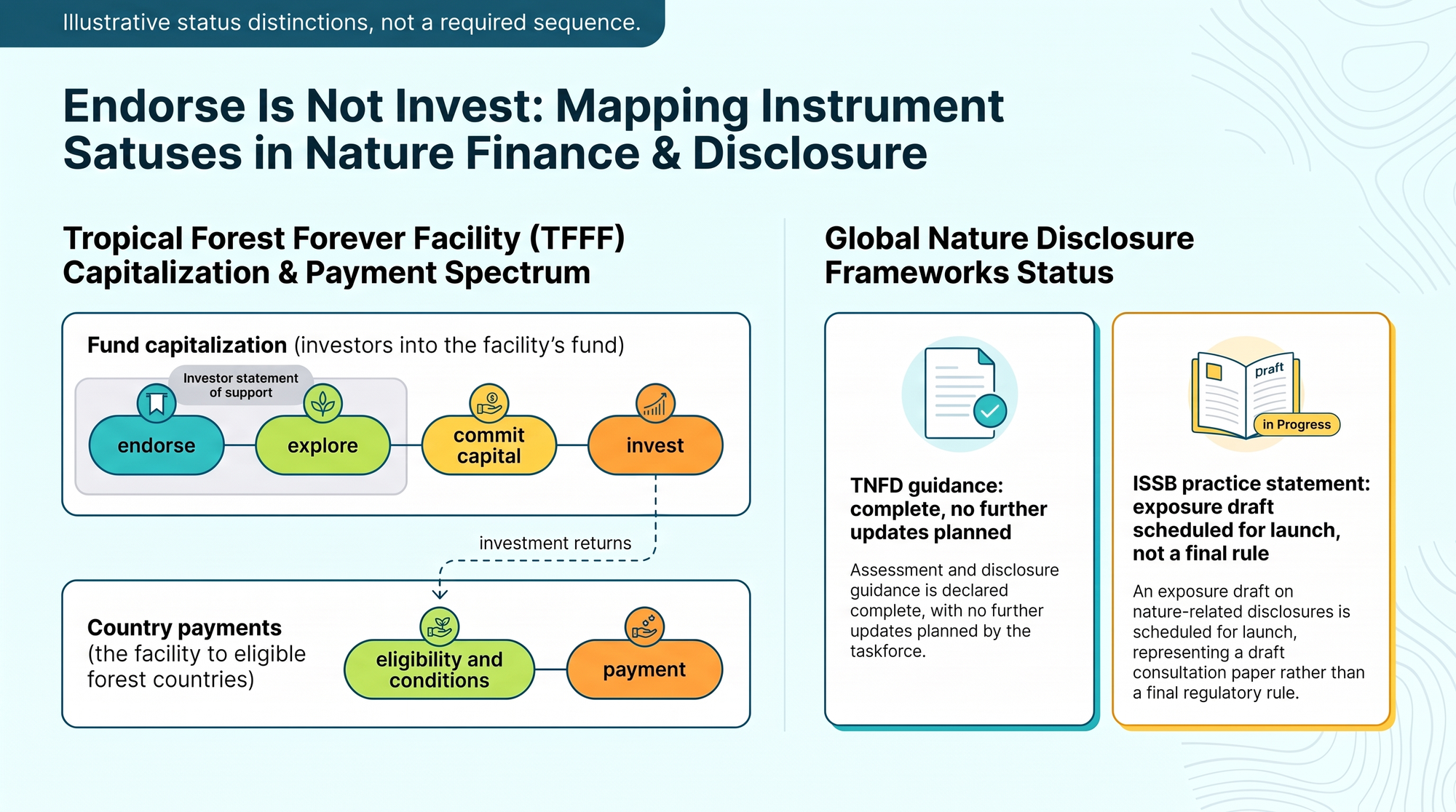
The pledge has the longest ladder of the three. The investor statement on the Tropical Forest Forever Facility, whose signatories The Record counts below, asks them to endorse, explore, encourage, support, and work constructively. [4] None of those verbs commits capital. A signed investment would not settle the question either, because investment capitalizes the facility’s fund, and the facility uses investment returns to reward tropical forest countries for protecting forests. A forest-country financing plan therefore needs the facility’s payment pathway for that country, including its conditions, timing, and uncertainty.
Disclosure guidance shifted the other way, toward fixed text. The Taskforce on Nature-related Financial Disclosures (TNFD) declared its assessment and disclosure guidance complete, with no further updates planned, and said it looks forward to the International Sustainability Standards Board (ISSB) exposure draft on nature-related disclosures, whose launch is Worth Watching. [5] For a company preparing a nature assessment, the open question shifts to the ISSB’s proposed practice statement.
The Record
ART is correcting Guyana’s 2023 jurisdictional forest credits.
The ART Secretariat, which administers The REDD+ Environmental Excellence Standard (TREES), said on 13 October that it was aware of and working to correct a calculation error in Guyana’s 2023 TREES credits before receiving a notification from the rating agency BeZero. The Secretariat is working with the Government of Guyana and the validation and verification body under its published process. Guyana has transferred a conservative volume of untransacted 2023 credits to an ART Registry Administrator account. Once the corrected volume is verified, ART will cancel any over-issuance “in line with the requirements of the ART Registry Terms of Use” and transfer the remaining credits back to the government. Section 8(h) of those terms makes the sovereign program developer responsible for compensating over-issuance and states that such action “will not affect” credits already retired, canceled, or transferred to a different registry participant. The statement gives no volume.
Status: in-window development; correction under way, cancellation pending verification of the corrected volume. [3]
A statement of support for the Tropical Forest Forever Facility reached 29 investor signatories.
The Finance for Biodiversity Foundation’s list for the Rotterdam TFFF Statement of Support from Investors, dated 15 October, includes 29 signatories and five supporting organizations. Recruitment opened on 23 June, with 12 founding signatories. Signatories “signal our endorsement” of the facility’s ambition and commit to “actively explore opportunities to contribute to its success.” The foundation’s 16 October release states that “the statement does not represent an investment commitment.”
Status: in-window development; a voluntary endorsement, not a capital commitment. [4]
Nature assessment, target-setting, and indicator guidance was released in aligned versions before the biodiversity conference.
On 13 October, TNFD released version 2.0 of its LEAP assessment approach, alongside the Science Based Targets Network’s Science-Based Targets for Nature 2.0 and the Nature Positive Initiative’s four core state-of-nature indicators, approved by the initiative’s 27 core member organizations. LEAP version 2.0 incorporates nature into transition planning. On October 15, TNFD published the first update to its recommendations since September 2023 and stated: “No further updates are planned.” TNFD reports that 836 organizations are publicly committed to reporting in line with its recommendations.
Status: in-window development; voluntary guidance; the adopter count is self-reported commitments to report. [5]
The State of Biodiversity Action report found fewer than half of assessed national targets on track.
The report, launched by UN Secretary-General António Guterres on 15 October, finds that nearly 90% of the 196 Parties to the Convention on Biological Diversity have set national biodiversity targets, close to 60% have national biodiversity strategies and action plans, and over 70% have submitted national reports. “Fewer than half of national targets assessed by Parties are on track,” and targets requiring action beyond environment ministries, including those on business action, sustainable consumption, harmful incentives, and finance, are among the furthest behind. The report will inform the first global review of collective progress under the Kunming-Montreal Global Biodiversity Framework at the seventeenth Conference of the Parties (COP17).
Status: in-window development; an assessment compiled from Parties’ own targets and reports. [6]
ASEAN in Focus
Indonesia’s peatland and mangrove agency took the lead this week. On 15 October, President Prabowo Subianto swore in Satyawan Pudyatmoko as head and Major General Sriyanto as deputy head of the National Peatland and Mangrove Management Agency (BPGMN) under Presidential Decree 43/M of 2026, which concerns their appointment; the Forestry Minister had announced on 24 September that the President decided to form the agency. [1] After the ceremony, the head said the agency would map about 500 peat hydrological units; the deputy head cited a peat water level below 40 centimeters as an indicator to monitor for fire risk; and ANTARA reported that no targets for area to be rewetted or for canal blocks had yet been set. The agency's founding regulation could not be found in the State Secretariat’s releases or in the national wire reports checked. The Forestry Ministry’s national count of high-confidence hotspots stood at 793 on 10 October, 1,085 on 12 October, 372 on 14 October, and 799 on 15 October, with Central Kalimantan leading the six priority provinces on each of those days; the ministry repeats that a hotspot is a satellite-detected temperature anomaly, not a fire count. [7]
In Singapore, the 24-hour Pollutant Standards Index read 159 to 222 at 8 p.m. on 16 October, in the Unhealthy to Very Unhealthy range, and the National Environment Agency attributed the dense smoke haze to fires in Kalimantan, where on 11 October the agency had named southern Sumatra and West Kalimantan. [8]
Malaysia’s foreign minister said he would raise transboundary haze at the ASEAN foreign ministers’ meetings in November, ahead of the 49th ASEAN Summit in Manila, noting that haze is not classified as a natural disaster under the existing regional mechanism, and the Philippines, as chair, confirmed the item is on the agenda. [9]
Separately, Verra said on 13 October that Singapore had made Verra’s improved forest management methodology, VM0010, eligible under the International Carbon Credit framework, where eligibility varies by bilateral implementation agreement; Singapore’s eligibility list for its agreement with Rwanda, updated on 7 October, includes the methodology, with both governments reserving the right to refuse authorization of an activity. [10]

What This Means
The reading discipline varies by instrument. For a program that would name Indonesia’s new agency as the counterpart, the due-diligence questions are which instrument sets the agency’s functions, whether that instrument gives the agency authority over the peat hydrological units where a project sits, and which body signs. These questions remain until that instrument is located and read. The Forestry Ministry’s interim role is a question to put to the ministry, not an assumption to write. [1]
For a buyer of jurisdictional credits, exposure depends on position. Credits already transferred to another registry participant fall outside the over-issuance remedy, though that protection says nothing about their market value or eligibility under other schemes. A forward purchase from Guyana’s 2023 vintage draws on volumes still held by the sovereign, so the decision condition for counting that purchase is ART’s verification of the corrected volume and the completed cancellation. A credit purchase agreement should state how the standard’s error procedure affects the buyer’s position before and after transfer. [3]
For a forest-country financing plan, an endorsement of the Tropical Forest Forever Facility is not finance, and a signed investment in its fund is not a country payment; the assumption is that the facility’s payment pathway applies to that country. [4]
Three signals would change this reading: the instrument constituting Indonesia’s agency, as recorded in the official register; the Green Climate Fund Board’s decisions from 26 to 29 October; and the text of the ISSB exposure draft.
Worth Watching Through Year-End
Convention on Biological Diversity COP17: Yerevan, Armenia, 19 to 30 October, with the opening ceremony on 18 October and the high-level segment on 27 and 28 October. The ISSB will mark the launch of its exposure draft proposing a practice statement on nature-related disclosures on 22 October, initiating a consultation that ends on 19 February 2027.
Adaptation Fund Board, forty-seventh meeting: Bonn, Germany, 19 to 23 October.
Green Climate Fund Board, forty-sixth meeting: Songdo, Incheon, Republic of Korea, 26 to 29 October.
Nature-based Solutions International Congress: Paris, France, 2 to 6 November, with the scientific conference from 3 to 6 November.
United Nations climate conference COP31: Antalya, Türkiye, 9 to 20 November.
Endnotes
[1] Ministry of State Secretariat, Republic of Indonesia. (2026, October 15). Presiden Prabowo Lantik Kepala BNPB serta Kepala dan Wakil Kepala BPGMN and Usai Dilantik, Kepala BPGMN Tegaskan Fokus Tekan Karhutla dan Pulihkan Ekosistem Gambut; (2026, September 24). Presiden Prabowo Putuskan Bentuk BPGMN; and ANTARA. (2026, October 15). Cegah karhutla, badan baru bentukan Prabowo petakan 500 kawasan gambut. Primary releases and national wire. The decree is “Keputusan Presiden Republik Indonesia Nomor 43/M Tahun 2026 tentang Pengangkatan Kepala dan Wakil Kepala Badan Pengelolaan Gambut dan Mangrove Nasional”; the September release uses the form “Badan Pengelola.” The decree’s text is not published with the releases; the State Secretariat uses its own title.
[2] UNFCCC secretariat. (n.d., prepared for the twenty-third meeting of the Article 6.4 Supervisory Body, 5 to 9 October 2026). Note on transitioning CDM afforestation and reforestation activities, annex to the annotated agenda of the twenty-third meeting of the Article 6.4 Supervisory Body, agenda item 3.3. Primary: a secretariat note with recommendations, not a decision of the Body. The adopted meeting report, A6.4-SBM023, paragraph 19, requests continued work on the tool for afforestation and reforestation activities, subject to prioritization in the expert panel’s work plan, and sets no date. The note adds that the tool “would require approximately six months to be finalized, i.e., by mid-2027 at the earliest.”
[3] ART Secretariat. (2026, October 13). ART Secretariat statement on error in calculation of Guyana’s 2023 credits. Primary and self-reported; the statement gives neither the size of the error nor the volume held in the administrator account. Validation and verification fall under ART’s TREES Validation and Verification Standard, version 3; the cancellation remedy sits in the Registry Terms of Use. ART. (2026, March). Registry Terms of Use, version 3, section 8(h). Primary.
[4] Finance for Biodiversity Foundation. (2026, October). The Rotterdam TFFF Statement of Support from Investors. Primary; signatory list as of 15 October 2026. Finance for Biodiversity Foundation. (2026, October 16). 34 financial institutions back Tropical Forest Forever Facility ahead of COP17. Primary release; the 34 includes 29 institutional investors and five supporting organizations.
[5] TNFD. (2026, October 13). TNFD, SBTN and Nature Positive Initiative release aligned guidance to strengthen corporate action on nature; and (2026, October 15). TNFD releases updated guidance as adoption passes USD 26 trillion in AUM. Primary and self-reported; claims rest on the release text, and adopters are organizations publicly committed to report, not verified disclosures.
[6] Secretariat of the Convention on Biological Diversity. (2026, October 15). UN Report Finds Growing Global Commitment to Biodiversity Goals, Highlights Urgent Need to Accelerate Action Through 2030. Primary release on the State of Biodiversity Action report; findings compiled from Parties’ national targets and reports.
[7] Ministry of Forestry, Republic of Indonesia. Press releases of 11 October, 13 October, 15 October, and 16 October 2026. Primary series from the SiPongi system; each figure is dated by the observation time (21.00 Western Indonesia Time), not the release. The ministry’s press listing includes no release for the 11 and 13 October observations.
[8] National Environment Agency, Singapore. Haze situation updates of 11 October and 16 October 2026. Primary: each reading is the 24-hour range at the stated hour, not a daily maximum.
[9] Bernama. (2026, October 12). Report from Sepang on Malaysia raising transboundary haze at the ASEAN foreign ministers’ meeting; and Reuters, syndicated by KELO. (2026, October 13). ASEAN foreign ministers to tackle transboundary haze in November meetings. National wire and international wire; the reports give November for the preparatory meetings but no date.
[10] Verra. (2026, October 13). Verra IFM methodology now eligible under Singapore’s International Carbon Credit framework. Self-reported by the standard-setter; corroborated by Singapore’s eligibility list under the Singapore–Rwanda implementation agreement, item 23, version 1.4. The list’s update date is not stated as the eligibility decision date, and VM0010 does not appear on the Singapore–Thailand list.