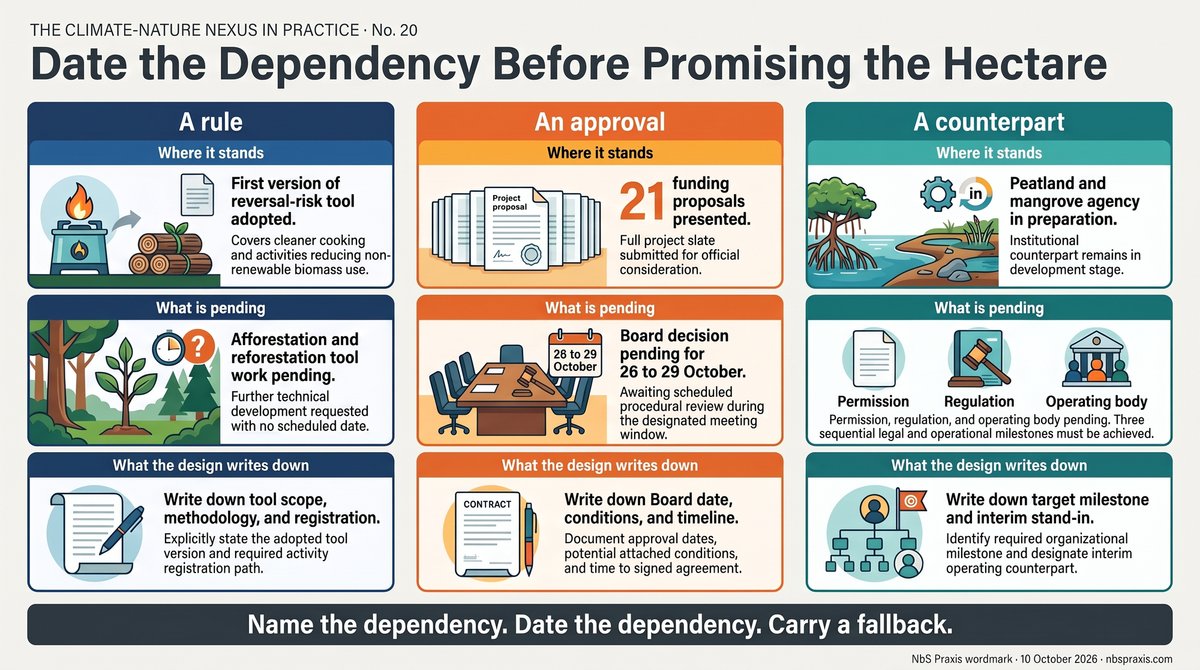
No. 20 — Date the Dependency Before Promising the Hectare
The Paris mechanism adopted a reversal-risk tool whose first version covers cleaner cooking, and 21 Green Climate Fund proposals await a Board decision. A design that relies on a pending rule, approval, or counterpart should name the dependency, date the dependency, and carry a fallback.

The Climate-Nature Nexus in Practice (Weekly Briefing to 10 October 2026)
Bottom line: A design that relies on a pending rule, approval, or counterpart should name the dependency, date the dependency, and carry a fallback. At a meeting that closed on 9 October, Article 6.4 Supervisory Body adopted the first version of a reversal-risk tool for cleaner cooking and other activities that reduce the use of non-renewable biomass, and asked for further work on afforestation and reforestation. The Green Climate Fund Secretariat put 21 proposals worth USD 1,866.7 million before the Board, which will decide on 26 to 29 October. Indonesia’s high-confidence hotspots passed 1,000 on three consecutive days, and Singapore’s pollution index read 135 to 192.
Here is the gateway into the field, and the briefing is the room you walk into: [Podcasts and Videos — Gemini Notebook: www.youtube.com/@nbspraxis]
Link to Explainer Video (Playlist of 1 Podcast and 4 Videos for Week 20, available at https://youtu.be/WxXpP1ZYEyo?si=-icNyp4pnENNeaNt
Last week’s briefing set out a ladder for hectares and identified three signals that would change the reading: a reversal-risk tool for land, the Green Climate Fund’s full proposal list, and a regulation establishing Indonesia’s peatland and mangrove agency. One arrived in part, one arrived in full, and one was not found in the reviewed sources.
The Article 6.4 Supervisory Body adopted a first version of the tool, leaving afforestation and reforestation for further work. [1] The Green Climate Fund replaced an initial batch of proposals with the full list. [2] Indonesia’s Forestry Ministry reported a higher hotspot peak than the previous week, and air quality worsened in Singapore and Malaysia. [3] [4]
The three are different kinds of dependency, and none shows an institution ranking nature behind something else. A crediting rule is being built one activity type at a time. A funding proposal waits for a scheduled Board meeting, which is procedure. An agency is being designed while a ministry fights fires, and nothing in the record says one was chosen over the other. What the three share is narrower and more useful: each is an external condition that a project design can depend on without saying so.
The implication for senior practitioners is clear. A design that relies on a rule, an approval, or a pending counterpart should state this in its assumptions, including a date and a fallback, before the first hectare is promised.
Three Dependencies, Three Different Tests
A rule, an approval, and a counterpart were each pending. A design should test each dependency differently before leaning on any of the three.
Adoption is a status word, and the word needs a scope. The Supervisory Body’s tool turns a year-old standard on reversals into a procedure a developer can apply. [1] UN Climate Change describes the first version as covering cleaner cooking and other activities that reduce the use of non-renewable biomass, with future versions expected to cover other types of activity. The meeting report asks the expert panel to continue work on afforestation and reforestation, subject to the panel’s priorities, and sets a documentation deadline for forestry projects transitioning from the Clean Development Mechanism, counted from the adoption of that later version. A deadline counted from an undated decision cannot be set.
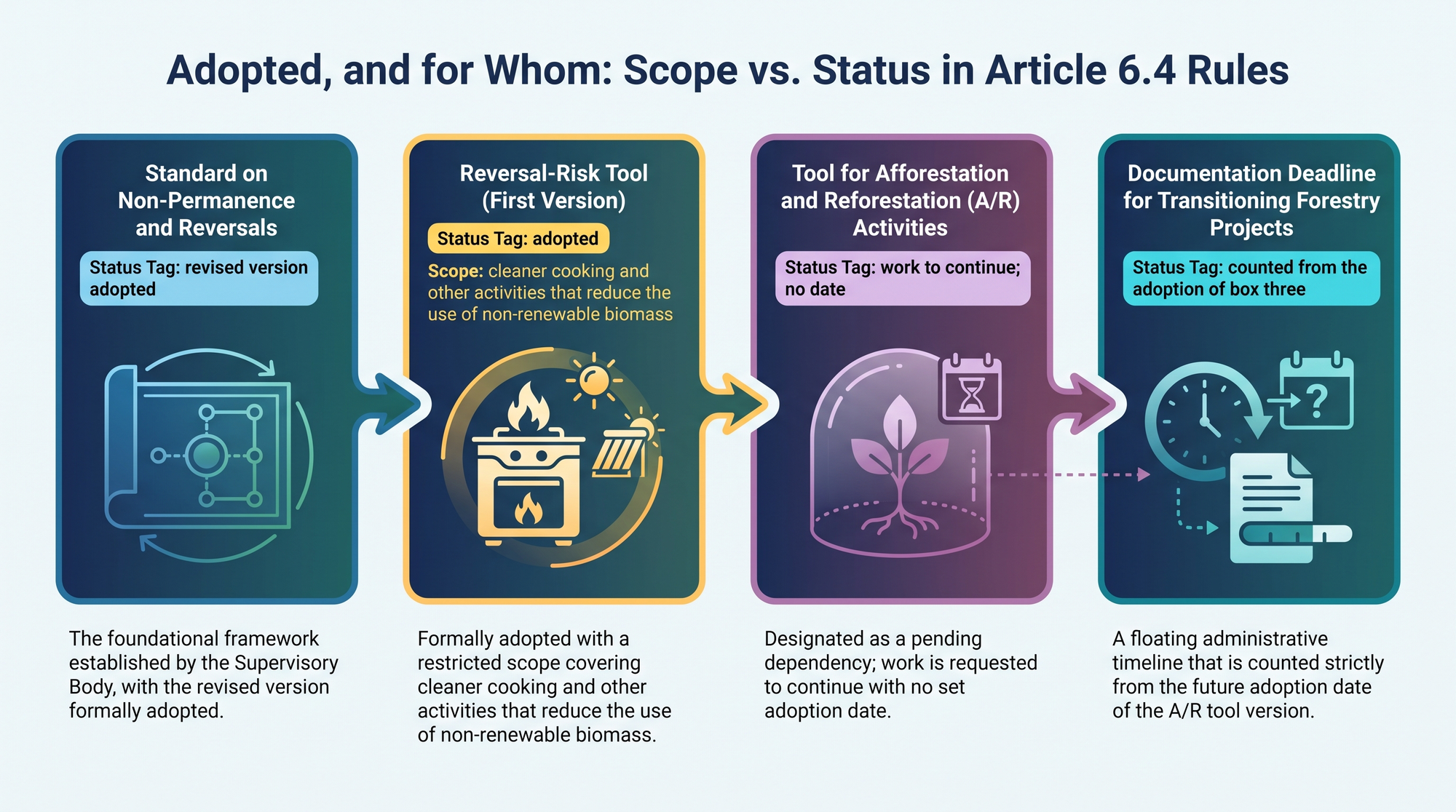
The same meeting left an accounting question unresolved. The Body acknowledged that the buffer pool for reversal risk has inconsistent accounting implications and asked the secretariat for options, including aligning with the accounting for Nationally Determined Contributions (NDCs). [1] A request for options is not a finding against the instrument. Whether a later forestry version would rely on the same pool is a matter for the panel’s further work.
Finance provided a different kind of dependency. A proposal presented for consideration has a scheduled decision date, and the Green Climate Fund’s document, whose figures The Record sets out below, lists every item on those terms. [2] Waiting for a scheduled meeting is procedure and says nothing about priority. The test for a design is plain: an activity that needs the Fund’s money in a given year should include the Board date, the conditions an approval may attach, and the time to a signed agreement as assumptions.
The counterpart dependency is the hardest to date. Indonesia’s agency for peatland and mangroves was still being prepared, as ASEAN in Focus records. [5] Preparation has three separate milestones: permission to initiate the regulation, the regulation itself, and a staffed body with a budget. A design that names the agency as counterpart should specify which of the three the design needs and who stands in until then.
The Record
The Supervisory Body adopted a first reversal-risk tool, leaving afforestation and reforestation for further work.
The Article 6.4 Supervisory Body met in Bonn, Germany, from 5 to 9 October and adopted two methodologies for household cooking, a revised standard on non-permanence, and what UN Climate Change calls “the first version of a tool to assess reversal risk,” which covers cleaner cooking and other activities that reduce the use of non-renewable biomass. The Body asked its Methodological Expert Panel to continue work on the tool “for application to A/R activities,” meaning afforestation and reforestation, and requested a concept note with options for the buffer pool for reversal risk.
Status: in-window development; adopted for a first scope; work on afforestation and reforestation requested, with no date. [1]
The Green Climate Fund Secretariat put its full slate before the Board, which decides on 26 to 29 October.
A Board document dated 5 October presents 21 funding proposals for consideration at the forty-sixth Board meeting, requesting USD 1,866.7 million from the Fund against a total value of USD 6,798.3 million with co-financing; an earlier batch dated 28 September had carried 7. Energy access and power generation take the largest results-area share, at 20%. Seven proposals carry forest, reef, coastal-ecosystem, or landscape titles in Algeria, Cameroon, Fiji, Indonesia, Moldova, Central Asia, and Mexico. Their combined envelopes total about one-fifth of the request, a proxy derived from titles, not a measured allocation to ecosystem activities.
Status: in-window development; the Secretariat’s submission for Board consideration, with the decision due between 26 and 29 October. [2]
The Pacific Pre-COP included ocean and forest ecosystems in a leaders’ text and sent a regional request to the Green Climate Fund’s Board.
Leaders meeting in Fiji and Tuvalu adopted the Taku Pakasoa Declaration on 6 October, which affirms “the importance of maintaining the integrity of our ocean and natural forest ecosystems.” The text includes no financial figures and does not mention nature-based solutions. On 7 October, the Asian Development Bank said that a regional resilience program for its 14 Pacific members is due before the Green Climate Fund Board this month for USD 250 million. The proposal lists nature-based solutions among the practices to mainstream.
Status: in-window development; a political declaration, not a decision under the climate convention; a proposal, not an approval. [6] [7]
Australia announced a fourth nature-repair registration, again paired with carbon credits.
The Clean Energy Regulator announced on 9 October the registration of the Silva Capital Cooplacurripa Biodiversity Project No. 2, which aims to restore 1,230 hectares in north-east New South Wales under the method for replanting native forest and woodland. The proponent “intends to combine the project outcomes with carbon abatement activities.” The announcement follows the third registration by a week.
Status: in-window development; statutory registration of an intended restoration, with no certificate reported. [8]
Two publications framed the upcoming biodiversity conference: one on decline and one on where mangroves can live.
WWF published the Living Planet Report 2026 on 7 October: the average size of monitored vertebrate populations fell by 73% between 1970 and 2022, a measure of relative abundance rather than of animals lost. A study in Nature, published on 30 September, tested a wave-based model at 400 open-coast sites and predicted mangrove presence or absence with 78.2% accuracy. The authors conclude that waves are a primary control on open-coast mangroves, supporting the screening of restoration sites by wave exposure before planting.
Status: in-window advocacy report; background anchor, peer-reviewed. [9] [10]
ASEAN in Focus
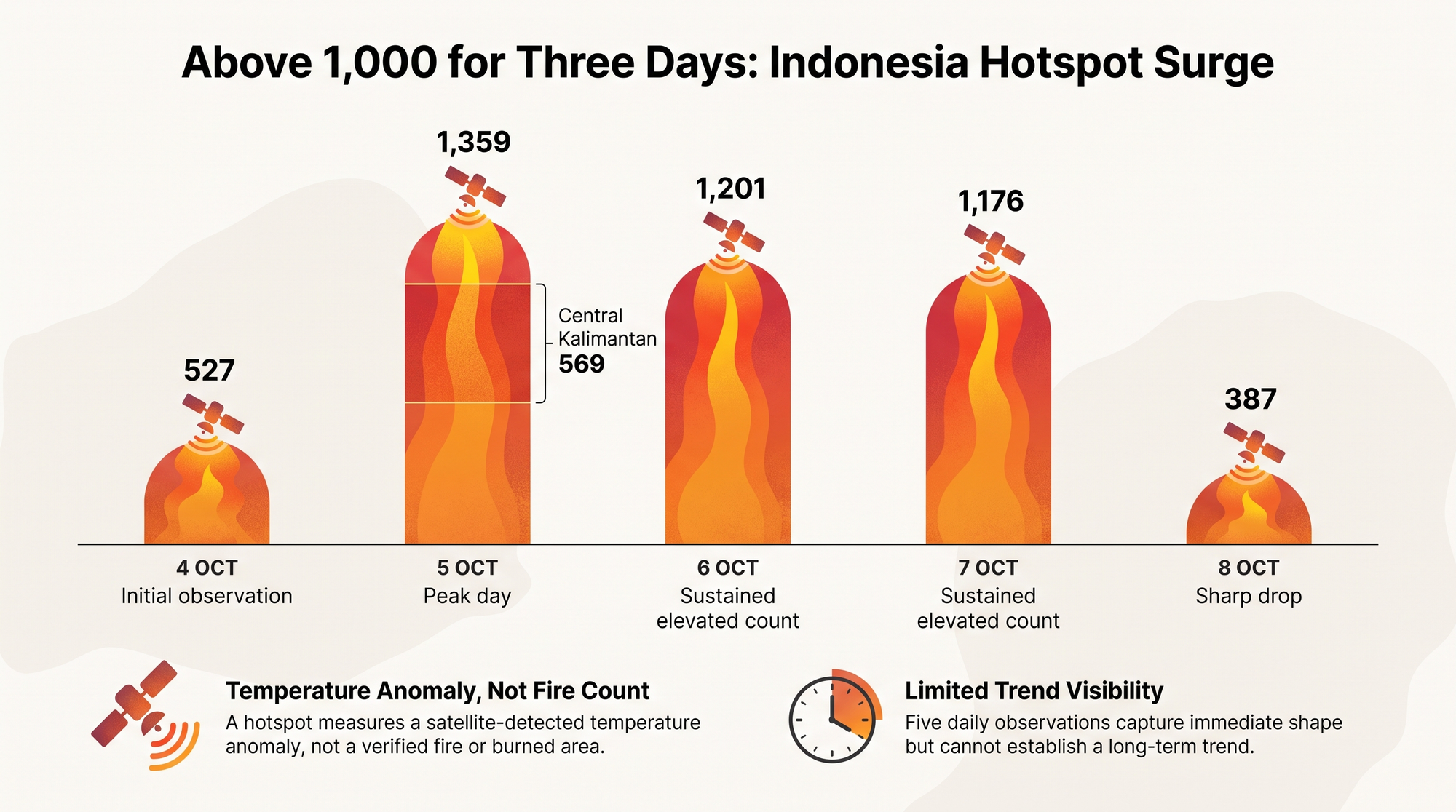
Indonesia’s hotspot counts rose again before falling. The Forestry Ministry’s high-confidence series recorded 527, 1,359, 1,201, 1,176, and 387 from 4 to 8 October; the ministry reiterates that a hotspot is a satellite-detected temperature anomaly, not a fire count or burned area. [3] Central Kalimantan accounted for 569 of the 5 October peak. Singapore’s twenty-four-hour Pollutant Standards Index ranged from 135 to 192 at 6 p.m. on 9 October, in the Unhealthy range, with the National Environment Agency observing moderate to dense smoke haze from southern and central Sumatra. [4] Malaysia recorded 36 areas with unhealthy air the same afternoon. [11]
The peatland and mangrove agency remained in preparatory stages. On 1 October, ANTARA reported that the minister aimed to submit an initiative-permission letter to the Minister of State Secretariat by 5 October, and on 6 October, Katadata reported that the presidential regulation was still being drafted. [5] No source consulted confirms the permission, the regulation, or an operating body. Two coastal items remain at earlier stages. The Green Climate Fund’s slate includes a USD 25.49 million grant proposal from Conservation International for a blue ecosystem adaptation mechanism off western Sumatra. The proposal projects reducing 483,322 tonnes of carbon dioxide equivalent over six years, against a baseline of historical loss rates of mangroves and seagrass, and restoring about 291 hectares. [12] On 7 October, a deputy at the coordinating ministry for infrastructure said that the Giant Sea Wall’s groundbreaking would “first involve mangroves as a nature-based solution,” with gray infrastructure next year; no area, budget, or site was provided. [13] Five observations are not a trend, and a proposal is not an approval.
What This Means
A dependency on an external rule, approval, or counterpart is a design risk and should be included in the Theory of Change as a named assumption with a date and a fallback. The three shown here require different tests.
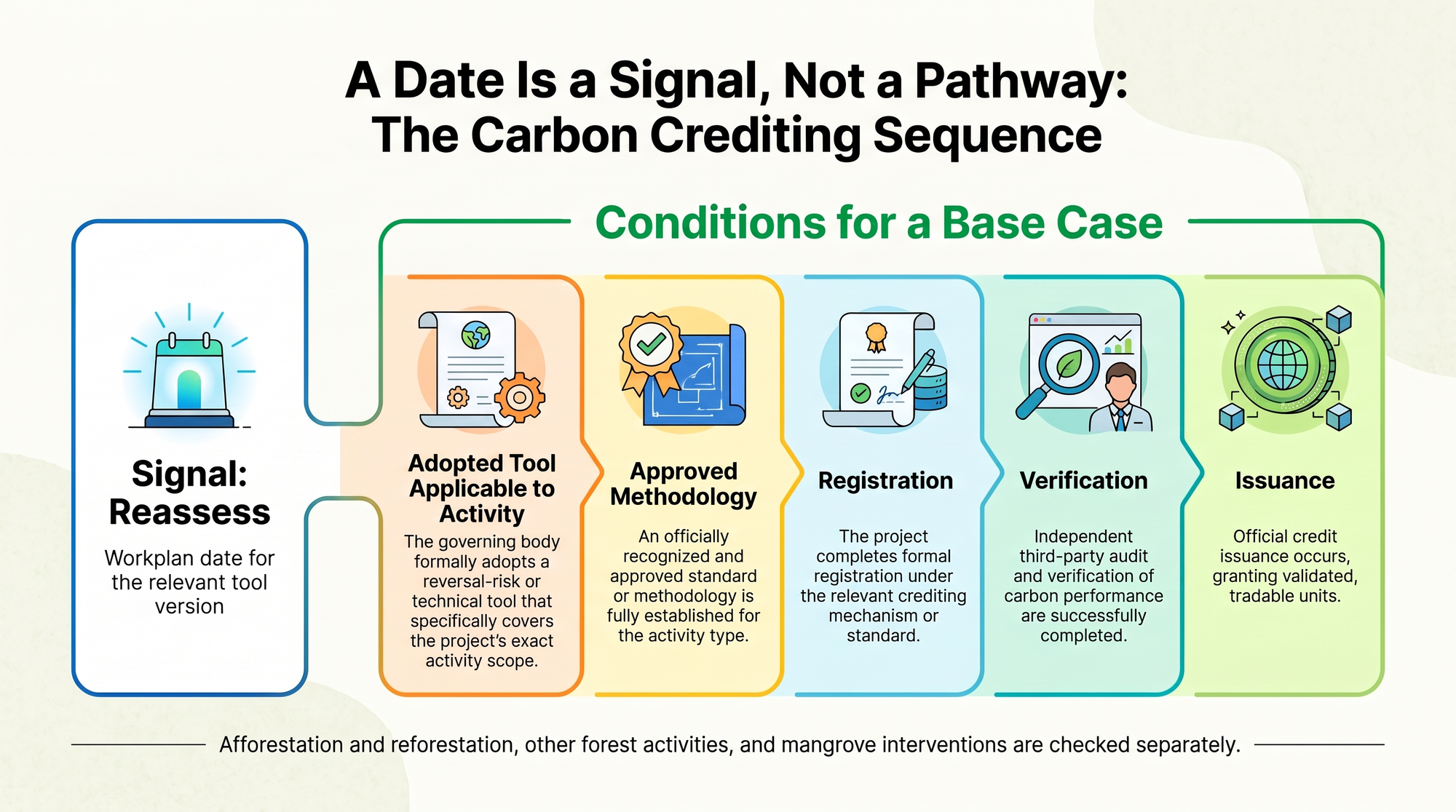
For crediting, a date is a signal, not a pathway. A workplan date for an afforestation-and-reforestation version of the tool would justify reassessing a revenue assumption. Putting the revenue in a financing base case requires more: an adopted tool that applies to the activity, an approved methodology, registration, and a credible route through verification to issuance. [1] Afforestation and reforestation, other forest activities, and mangrove interventions are different activity types, and each needs that check made separately.
The blue ecosystem mechanism raises a different question before the Green Climate Fund Board, because the proposal is a grant and the issue is accounting, not credit revenue. Indonesia’s Second NDC includes mangroves in the national greenhouse gas inventory and notes that mapping and estimation methods for seagrass are still being developed for future inclusion. [14] The National Adaptation Plan adopts ecosystem- and community-based approaches as the core implementation model. [15] The two habitats therefore stand at different stages of accounting readiness for mitigation, and a Theory of Change should track them separately. Separate tracking is not attribution: the link between a project’s measurements and national reporting has to be demonstrated for either habitat, and seagrass can serve the plan’s adaptation objectives regardless of the state of mitigation accounting. The first outcome is the service the plan invokes, natural flood defense and fisheries support, with habitat condition as the intermediate outcome and area restored as the output. Who owns monitoring over the 20-year lifespan after the six-year grant is a due-diligence question to include in the full proposal. [12]
Three signals would change this reading. An adopted version of the tool that applies to afforestation and reforestation would mark the first step in a crediting pathway. The Board’s decisions on 26 to 29 October will show which proposals move from presented to approved and on what conditions. A constituting regulation for Indonesia’s agency, confirmed in the official register, would settle the counterpart.
Worth Watching Through Year-End
Convention on Biological Diversity COP17: Yerevan, Armenia, 19 to 30 October, with the high-level segment on 27 and 28 October. The International Sustainability Standards Board announced the launch of an exposure draft proposing a practice statement on nature-related disclosures at the conference on 22 October.
Adaptation Fund Board, forty-seventh meeting: Bonn, 19 to 23 October.
Green Climate Fund Board, forty-sixth meeting: Songdo, Incheon, Republic of Korea, 26 to 29 October.
Nature-based Solutions International Congress: Paris, 2 to 6 November, with the scientific conference from 3 to 6 November.
United Nations climate conference COP31: Antalya, Türkiye, 9 to 20 November.
Endnotes
[1] UN Climate Change News. (2026, October 9). Clean cooking projects gain access to UN carbon market; and UNFCCC, Article 6.4 Supervisory Body. (2026, October 9). Meeting report of the twenty-third meeting, A6.4-SBM023, paragraphs 19, 26, 28, 37 and 38 to 41. Primary. The announcement gives the tool’s scope, and the adopted annex governs detailed interpretation. The conditions listed for a base case are this briefing’s reading of the steps the announcement describes before credits are issued.
[2] Green Climate Fund. (2026, October 5). Consideration of funding proposals, GCF/B.46/02; and the early batch, GCF/B.46/02/Drf.01 of 28 September. Primary Board documents; the Secretariat’s figures before Board action. A further request of USD 98.7 million for a second tranche of an approved facility brings the amount for consideration to USD 1,965.4 million. The seven are FP310, FP312, FP316, FP317, FP321, FP322, and FP324, whose envelopes total USD 393.7 million; the grouping is this briefing’s and not a category the Fund reports.
[3] Ministry of Forestry, Republic of Indonesia. Daily press releases, 5 to 9 October 2026, including those reporting the observations of 5 October and 8 October. Primary series, each figure dated by the observation and not by the release. The meteorological agency publishes a separate series on a different basis.
[4] National Environment Agency, Singapore. (2026, October 9). Haze situation update. Primary; the agency adds that cloud cover prevented a full reading of hotspots and haze.
[5] ANTARA. (2026, October 1). Menhut usulkan badan pengelola gambut dan mangrove miliki DIPA sendiri; and Katadata. (2026, October 6). Perpres Badan Gambut digodok. Secondary reporting. Neither report establishes the legal status of the regulation on 10 October.
[6] The Taku Pakasoa Declaration: Strength in Unity. (2026, October 6). Primary text, paragraph 13; adopted at the leaders’ event of the Pre-COP, a meeting that takes no decisions under the climate convention.
[7] Asian Development Bank. (2026, October 7). ADB President Joins Pre-COP31, Calls for Faster Resilience Finance; and Green Climate Fund, funding proposal package for FP318. Primary and self-reported. The proposal gives total financing of USD 1,059.3 million, which includes the Bank’s own projects.
[8] Clean Energy Regulator, Australia. (2026, October 9). Fourth project registered under Nature Repair Market. Primary. The announcement states no permanence period for this project.
[9] WWF. (2026, October 7). Wildlife population sizes decline 73% on average. Primary release on the Living Planet Report 2026; the index is compiled with the Zoological Society of London from 35,803 populations of 5,790 species. The report states 73.2%, with a range of 67% to 78%.
[10] Wells, S., et al. (2026, September 30). Global mangrove distribution on the open coast is controlled by waves. Nature; and university release of 6 October 2026. Peer-reviewed; background anchor. The site-screening implication is this briefing’s reading of the finding.
[11] Malay Mail, carrying Bernama. (2026, October 9). Haze: 36 areas record unhealthy API readings, Pasir Gudang highest at 190. National wire reporting Department of Environment Malaysia readings at 5.45 p.m.; the report gives no cause.
[12] Green Climate Fund. (2026, October 5). Funding proposal package for FP317, Blue Halo S – Blue Ecosystem Adaptation Mechanism, paragraphs 65 and 66. Primary; ex-ante estimates in a proposal the Board has not yet considered. Total financing is USD 61.74 million with co-financing, and the executing entity is Konservasi Indonesia. The split of the estimate between avoided loss, restoration, and other activities sits in the proposal’s annex 22.
[13] ANTARA. (2026, October 7). Indonesia to begin Giant Sea Wall project with mangroves. National wire and single source; a stated intention by Nazib Faizal, Deputy for Basic Infrastructure Coordination at the Coordinating Ministry for Infrastructure and Regional Development.
[14] Republic of Indonesia. (2025, October). Second Nationally Determined Contribution, page 12. Primary.
[15] Republic of Indonesia. (2025, November). National Adaptation Plan 2026–2030, pages 20 and 29. Primary.