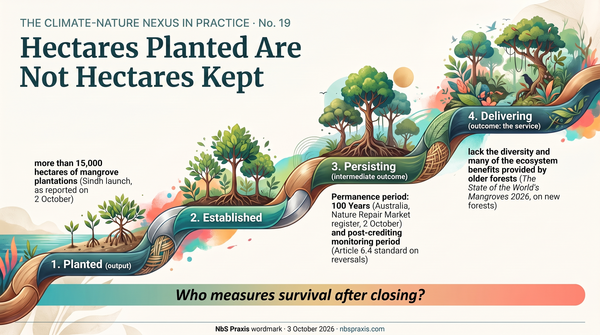
From Assurance to Architecture: The Financial Instruments That Close the Nexus
More money is necessary but not sufficient. Between a climate-finance pledge and a financed project stands the architecture that turns a valued ecosystem into a payment someone is obliged to make, and that architecture is thin.

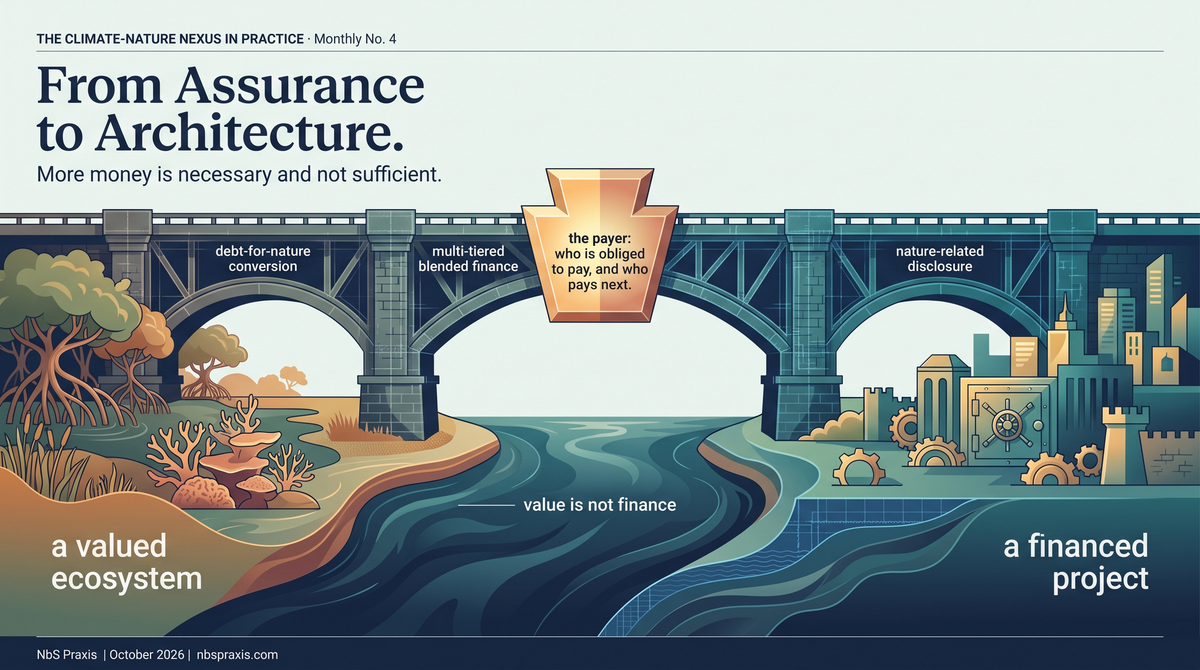
Bottom line: Governments in Baku, Azerbaijan, agreed in November 2024 to scale climate finance for developing countries to at least USD 300 billion a year by 2035 and to work toward at least USD 1.3 trillion from all sources.[1] Both are climate-finance goals rather than nature-finance pools. Neither is money in hand, and the public-finance base beneath them faces cuts.[2] Money is scarce, and this paper does not argue otherwise. Its argument is about what money needs to move. A nature-based project can be worth a great deal and remain unfinanceable because worth and finance answer different questions. The instruments the field relies on, debt-for-nature conversions, multi-tiered blended finance, and nature-related disclosure, each perform a different and partial function. None of them, on its own, creates the thing a financier needs: a payer legally obliged to pay a named recipient from a recurring source for a verified service, and a plan for who pays next. The practitioner’s task is to design that payment obligation and its succession, the risk allocation around it, and the assurance that makes it credible, together, and to recognize when the honest answer for a public good is a grant or a budget line, not a more elaborate debt structure.
The Gap Is Also Architectural
The New Collective Quantified Goal on Climate Finance (NCQG), agreed in Baku in November 2024, sets a target of at least USD 300 billion per year by 2035 for developing countries, drawn from public and private sources, with developed countries leading. It also calls on all actors to scale finance from all sources to at least USD 1.3 trillion per year by the same date.[1] The Baku to Belém Roadmap, delivered by the two presidencies in November 2025, describes its task as coordinating and scaling existing initiatives across five workstreams, while noting that political agreement on mechanisms, allocations, and contributions remains unresolved.[3]
Whether the larger goal is reached depends on sustaining a growth rate in international climate finance that recent data show is slowing, and the range of plausible trajectories is wide enough that no single extrapolation can predict the outcome.[4] The point for practitioners is narrower. However much of the goal is met, and whatever share reaches nature, capital arrives at a project only through an instrument, and an instrument only works on a project built to carry it. The binding constraint this publication has tracked, a bankable pipeline rather than the size of the pledge, does not disappear when the pledge grows. Architecture is a necessary complement to funding, not a substitute, and is the part of the problem a practitioner can act on.
Value Is Not Finance
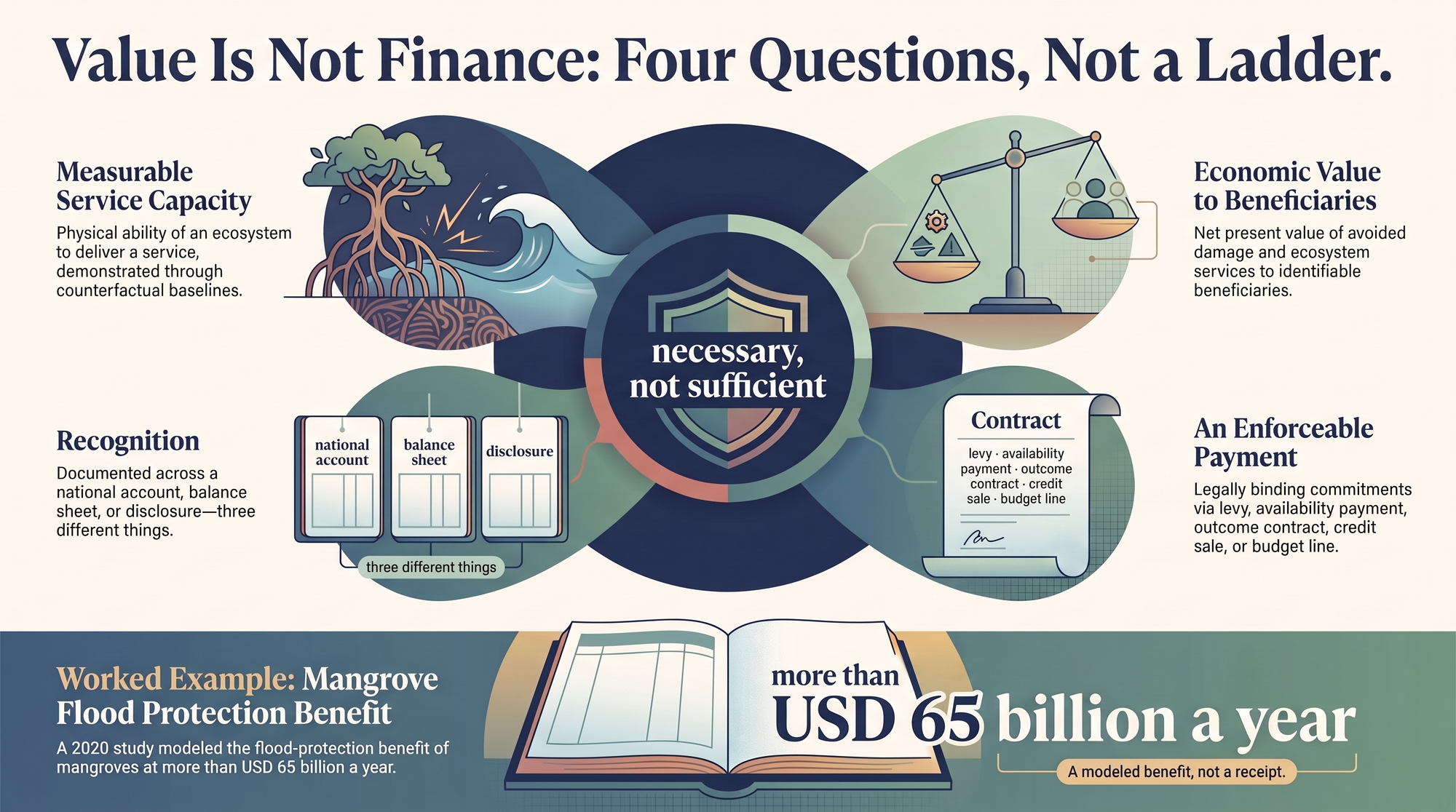
The word that does the damage in a project appraisal is “value.” A single claim that a project is “bankable” hides four distinct questions, and they are distinct rather than sequential.
- Does the ecosystem have measurable service capacity, such as the physical ability to attenuate a storm surge, store carbon, or sustain a fishery, as demonstrated by monitoring, models, and counterfactual baselines?
- What is the economic value of that service to identifiable beneficiaries, the present value of avoided losses and ecosystem services net of lifecycle and opportunity costs, as established by cost-benefit analysis and natural-capital accounts?
- Is that value recognized anywhere, and by whom: in a national statistical account, on a reporting entity’s balance sheet under a standard that tests control and reliable measurement, or in a sustainability disclosure, which are three different things? And
- Is any part of it captured as a legally enforceable payment, such as a levy, an availability payment, an outcome contract, a credit sale, or a budget appropriation, that can cover operating costs, service debt, or remunerate investors?
The questions do not form a ladder.
- A payment contract does not require prior balance-sheet recognition;A legislature can enact a levy for a service that no account has ever booked.
- An enforceable payment promise is necessary for bankability but not sufficient: the promise can be too small relative to the delivery cost, exposed to counterparty default, mismatched in currency or tenor, or undermined by tenure and delivery risk that no contract cures.[5]
- Recognition without a payer improves visibility and creates no cash flow.
A 2020 study modeled the global flood-protection benefit of mangroves at more than USD 65 billion a year in avoided property damage, a with-and-without comparison that is a real figure in the economic-value column, not an observed receipt, a project revenue, or a pool any project can draw on, because no beneficiary is obliged to remit any of it.[6] The instruments the field relies on operate at different points around that gap, and the honest case for each begins with the function it performs.
Three Instruments, Three Different Functions
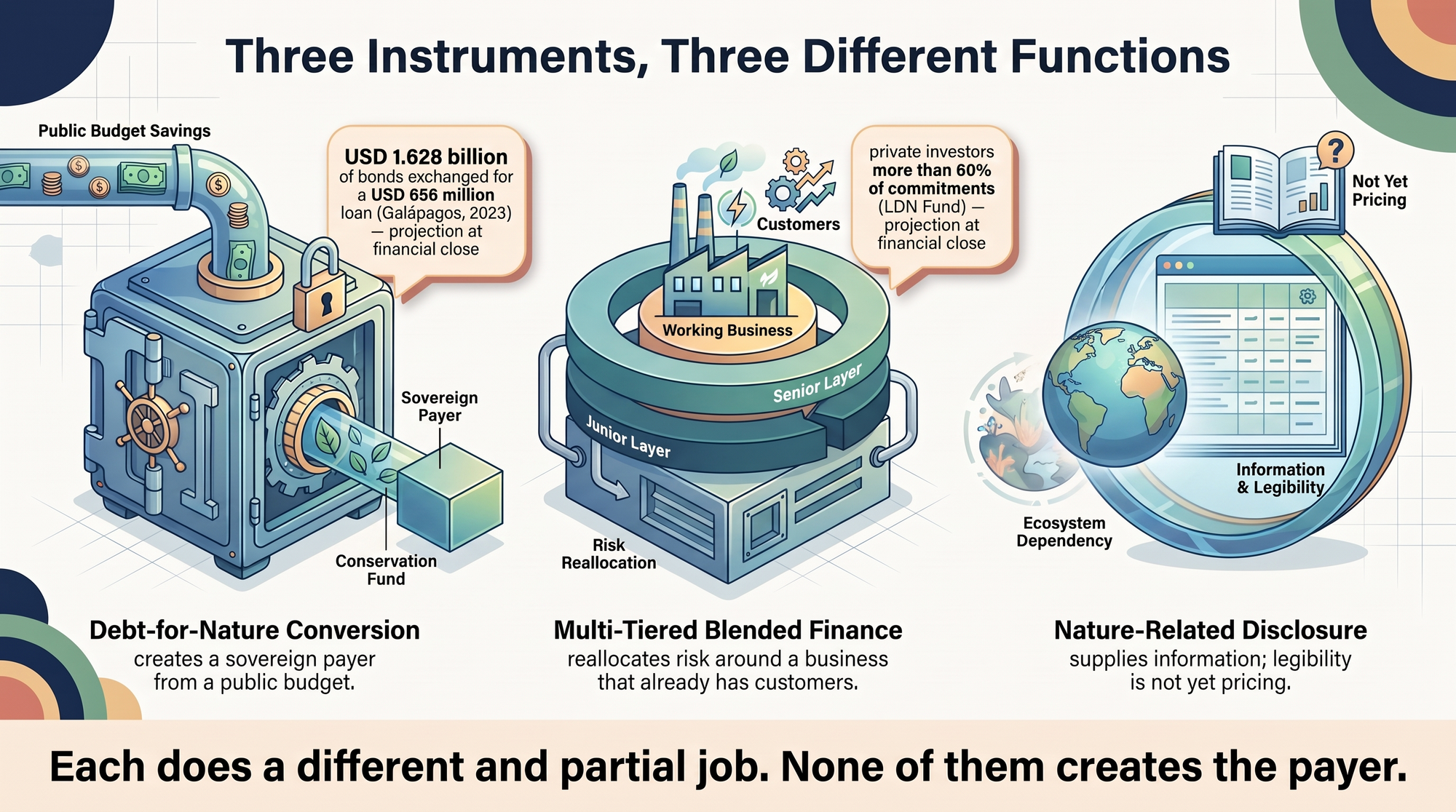
The three instruments below are often presented as a menu for turning ecosystem value into revenue. They do not all do that. A debt conversion provides earmarked sovereign conservation payments from a public budget; a blended fund reallocates investment risk around an underlying business; and disclosure provides information. Each complements the others and creates a payment obligation that none of them does on its own.
Debt-for-Nature Conversions: Fiscal Space Earmarked for Conservation:
A debt-for-nature conversion refinances a portion of a country’s sovereign debt on better terms and commits part of the savings to conservation. The transactions have occurred in sequence: Belize in 2021, Barbados in 2022, Ecuador’s Galápagos conversion in May 2023, Gabon in August 2023, the Bahamas in 2024, El Salvador’s Río Lempa conversion in October 2024, and Ecuador’s Amazon conversion in December 2024.[7]
The Galápagos transaction remains the reference case. A USD 656 million conservation-linked bond arranged by Credit Suisse financed the exchange of USD 1.628 billion of Ecuador’s bonds for a USD 656 million loan, a roughly 60% reduction in face principal, backed by political risk insurance from the United States International Development Finance Corporation (DFC) and a guarantee from the Inter-American Development Bank (IDB). The parties projected more than USD 1.126 billion in lifetime debt-service savings, of which about USD 323 million flows to marine conservation over 18.5 years; with the endowment it capitalizes, the projected conservation total exceeds USD 450 million.[8]
El Salvador’s October 2024 conversion refinanced about USD 1 billion of debt and committed USD 350 million of the savings to the Río Lempa watershed over 20 years, the largest such commitment at the time; two months later, Ecuador’s Amazon conversion, its first for terrestrial and freshwater ecosystems, projected about USD 460 million over 17 years for forest and freshwater conservation.[9] These are projections at financial close, not audited outcomes.
The function is precise: the conversion creates a sovereign payer, the treasury, which is obliged under the transaction documents to remit debt-service savings to a named conservation fund on a schedule, with an independent trust and a conservation partner, such as The Nature Conservancy’s Nature Bonds program, providing the scaffolding. The conversion does not finance a pipeline of investable projects; it funds a program from a public budget, and its limits are design constraints rather than defects. The conservation flow is long-dated and modest relative to the refinanced debt, favoring continuity over concentrated capital spending unless the receiving fund can pool or front-load it; transaction costs and structuring complexity are high; and modern commercial conversions are a handful of illustrative cases, not a track record for the instrument class.[10]
Multi-Tiered Blended Finance: Risk Reallocated Around a Business
Multi-tiered blended finance places concessional capital where first losses occur, enabling private capital to enter on terms it accepts. The Land Degradation Neutrality (LDN) Fund, an independent impact fund co-initiated with the Global Mechanism of the United Nations Convention to Combat Desertification and managed by Mirova, serves as the reference case. A junior tranche of concessional capital from national governments, including the United Kingdom and Canada, and from foundations absorbs initial losses and de-risks a senior tranche of commercial capital from private institutions, including Allianz France and BNP Paribas Cardif, as well as development finance institutions such as the European Investment Bank (EIB). The fund reached a final close of about USD 208 million in March 2021, with private investors accounting for more than 60% of commitments.[11] The fund’s director has said that without the concessional capital, the commercial capital would not have come in; that is a participant’s account of the counterfactual, not an independently estimated mobilization effect.[12]
The function is risk reallocation, and its object matters. The LDN Fund’s investees are revenue-generating forestry and agroforestry businesses with customers; concessional capital shifts who bears early losses and does not itself create a buyer for an unpriced public benefit such as a restored watershed. The design problem is unforgiving in both directions: a first-loss layer too thin fails to mobilize, and one too generous subsidizes commercial returns without additionality. The judgment sits between them. The catalytic-finance literature now gives that judgment a formal shape. The catalytic multiplier falls as market failure severity rises, so interventions aimed at the deepest distortions achieve the least leverage. Full de-risking is rarely the optimal design: blended finance works at the margin of bankability and does not rotate deeply negative economics into viability.[13]
Two design rules follow.
- Concessional support should be sized to the binding constraint and carry a sunset: the support withdraws as private investors internalize the new risk-return profile, or the market comes to depend on the subsidy.
- The lasting value of a catalytic layer lies in what the layer leaves behind, a market, capacity, and rules, not in the initial leverage ratio.
Land-restoration projects of this kind typically take five to seven years to reach positive cash flow, a horizon commercial lenders are reluctant to finance, which is why junior capital and technical assistance are load-bearing. Market participants convened on nature finance in 2025 cited data availability and metric standardization among the most frequent obstacles to private participation.[13]
Disclosure: Legibility Is Not Yet Pricing
The third instrument is not a financing vehicle but the information layer that determines whether the first two have anything to price. The Taskforce on Nature-related Financial Disclosures (TNFD) published its final recommendations in September 2023, accommodating both financial-materiality and double-materiality approaches based on reporting choice or jurisdiction, and supporting Target 15 of the Kunming-Montreal Global Biodiversity Framework (GBF) on corporate nature-related reporting.[14]
By September 2026, 802 organizations had registered as adopters committed to TNFD-aligned disclosure, including financial institutions managing USD 26.6 trillion in assets; more than 1,000 organizations across 56 countries had published TNFD-aligned reporting, twice the number a year earlier. These are TNFD’s own uptake indicators, representing two different populations, and assets under management are not capital allocated to nature.[15] In November 2025, the International Sustainability Standards Board (ISSB) decided to begin standard-setting on nature-related risks and opportunities, drawing on the TNFD’s recommendations and its Locate, Evaluate, Assess, Prepare (LEAP) approach; that is a standard-setting project with proposals still to come, not an adopted standard or a jurisdictional mandate.[16]
Disclosure improves legibility. The case for disclosure rests on the World Economic Forum’s 2020 estimate that more than half of global economic output is moderately or highly dependent on nature, an estimate of dependency, not a measurement of loss or an investable pool.[17] Disclosure is not balance-sheet recognition, and legibility is not pricing: a disclosed dependency is not a lender or insurer repricing a portfolio against that dependency.
The European Commission’s July 2025 “quick fix” to the European Sustainability Reporting Standards allowed first-wave reporters to defer certain biodiversity data points for the 2025 and 2026 financial years while retaining summary disclosure where the topic is material; the Omnibus I directive, in force since March 2026, sharply reduced the number of companies in scope; and the revised standards, adopted in July 2026 and cutting mandatory data points by more than 60%, were awaiting entry into force for financial years from 2027. In the same period, more than 70% of the market participants
TNFD surveyed said they wanted the certainty of mandatory nature-related reporting.[18] The regulatory floor is moving in one direction, and market demand in the other.
Plan Alignment Is Necessary, Not Sufficient
No instrument works on a project a country has not committed to, and the anchor for that commitment is the country’s own plan: its Nationally Determined Contribution (NDC), its National Adaptation Plan (NAP), and, where relevant, its biodiversity and sector plans. This publication anchors project design in those plans because a financier reads the plan as evidence that the service has a policy basis and a plausible counterparty. But plan alignment is one test among several, not a switch. The Green Climate Fund (GCF), for example, treats country ownership and alignment as one of six investment criteria; a project can be listed in a plan and still fail the others, and a country’s formal endorsement through its national designated authority is a separate requirement.[19]
Three things are therefore distinct:
- Policy alignment with a national plan,
- Country’s endorsement a fund requires,
- Institution’s own eligibility and appraisal conditions, including creditworthiness where lending is involved.
The sequence follows: anchor the project, then design the instrument to the anchor, rather than choosing one and searching for a project to fit that instrument.
The Missing Payer: One Transaction Map
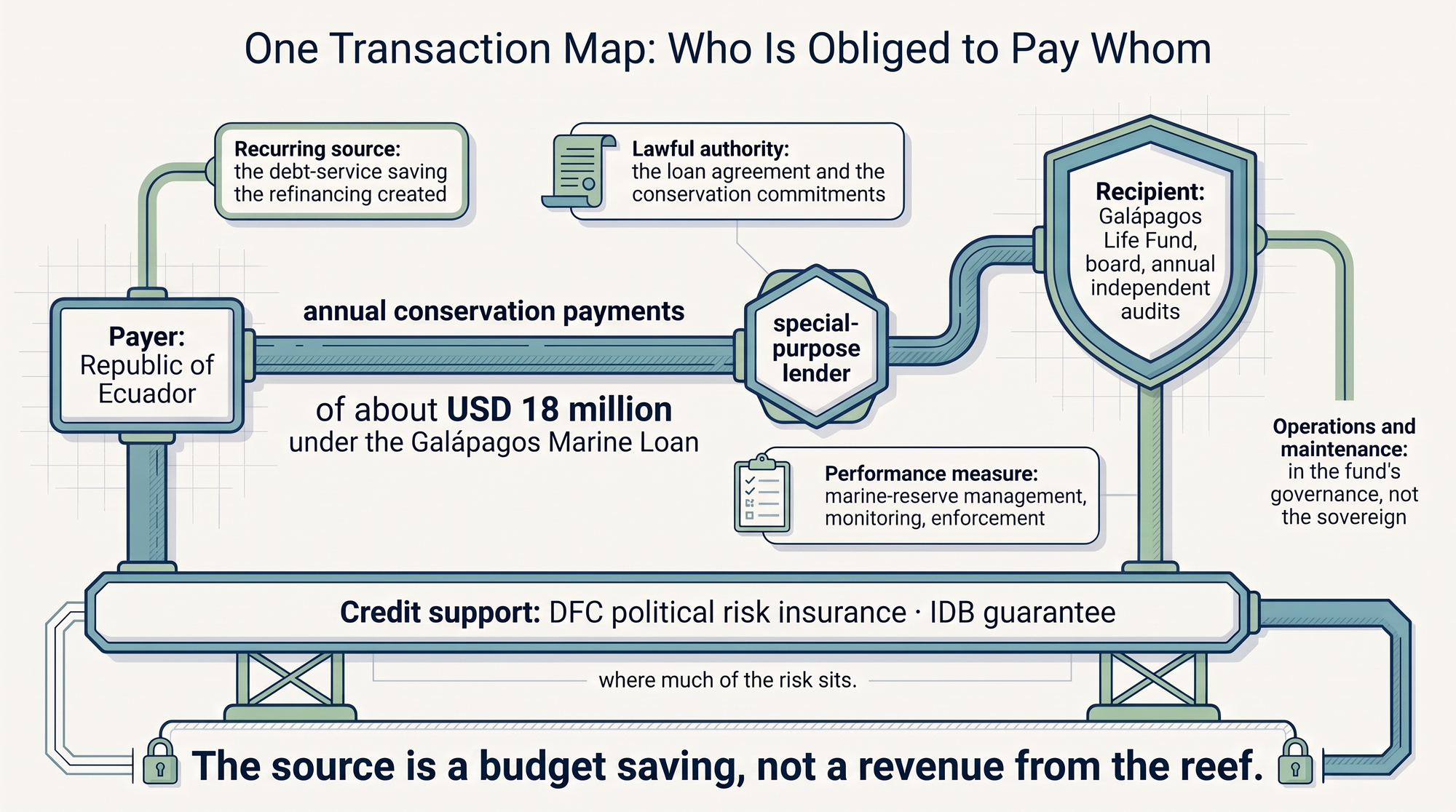
The operational question that none of the three instruments answers by itself is the payment obligation: who is legally obliged to pay whom, for what, from which recurring source, on what trigger, and with what consequence when performance falls short.
A financing case is complete only when a single map answers each item, and the Galápagos conversion is instructive because its map is legible. The payer is the Republic of Ecuador, obliged under the Galápagos Marine Loan to make annual conservation payments, reported at about USD 18 million, to the special-purpose lender; the recipient is the Galápagos Life Fund, a private entity whose board oversees project approval and annual independent audits; the lawful authority is the loan agreement and the conservation commitments the government took on at closing; the recurring source is the debt-service saving created by the refinancing; the performance measure is the government’s commitments to marine-reserve management, monitoring, and enforcement; the credit support is DFC’s political risk insurance and IDB’s guarantee, which is where much of the risk sits; and the operations-and-maintenance obligation resides in the fund’s governance rather than in the sovereign.[20] Every element is named, and the map also shows the instrument’s boundary: the source is a budget saving, not reef revenue.
The Payer Migrates: Designing the Copernicus Effect
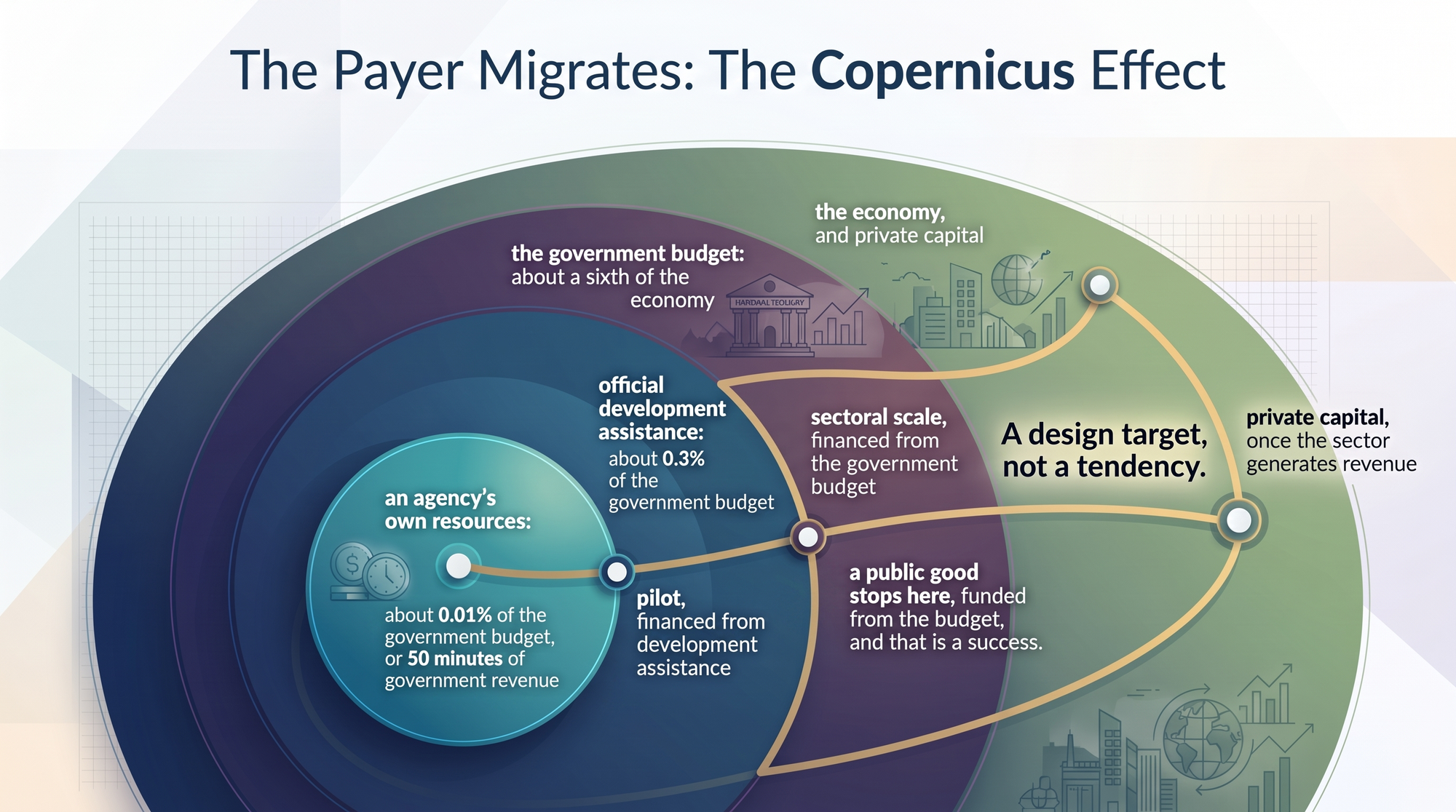
The map shows who pays at one moment. A program that lasts needs a series of payers over time, and development agencies call the planned series the Copernicus effect. A grant agency makes the point with nested circles: the agency’s own resources sit inside official development assistance, which sits inside the government budget, itself about a sixth of the economy. The inner circle is vanishingly small, about 0.01% of the government budget, or 50 minutes of government revenue in the region.[21] Money that small matters only if it moves the outer rings, and the Copernicus effect describes how: a pilot financed from development assistance proves a model; the government carries the model to sectoral scale from its own budget, which is orders of magnitude larger; and private capital enters once the scaled sector generates the activity and revenue that make it investable. The effect is a design target, not a tendency. Each hand-off has to be built into the instrument from the start, with the measurement that lets a treasury trust the pilot, the budget line and institutional home that let it absorb the recurrent cost, and the revenue model that gives private capital a reason to arrive. The budget process, not the donor’s grant, is the decisive arena.
The sequence also sets the stop condition. When a project’s benefits are public, a coastline is protected, a fishery is sustained for people who will never be billed, and no credible mechanism obligates a beneficiary to pay, the program stops at the second rung, funded indefinitely from the budget. That is a successful outcome rather than a failed one; the GCF’s own investment framework draws the same line, reserving lending for financially sound, revenue-generating activities and directing grants to the rest.[19] What fails is a program designed for a hand-off that never comes: a pilot with no treasury willing to adopt it and no market able to. Forcing commercial debt onto a public good does not manufacture a payer; it manufactures a default.
The Practitioner’s Move: Design the Payment, the Risk, and the Assurance Together
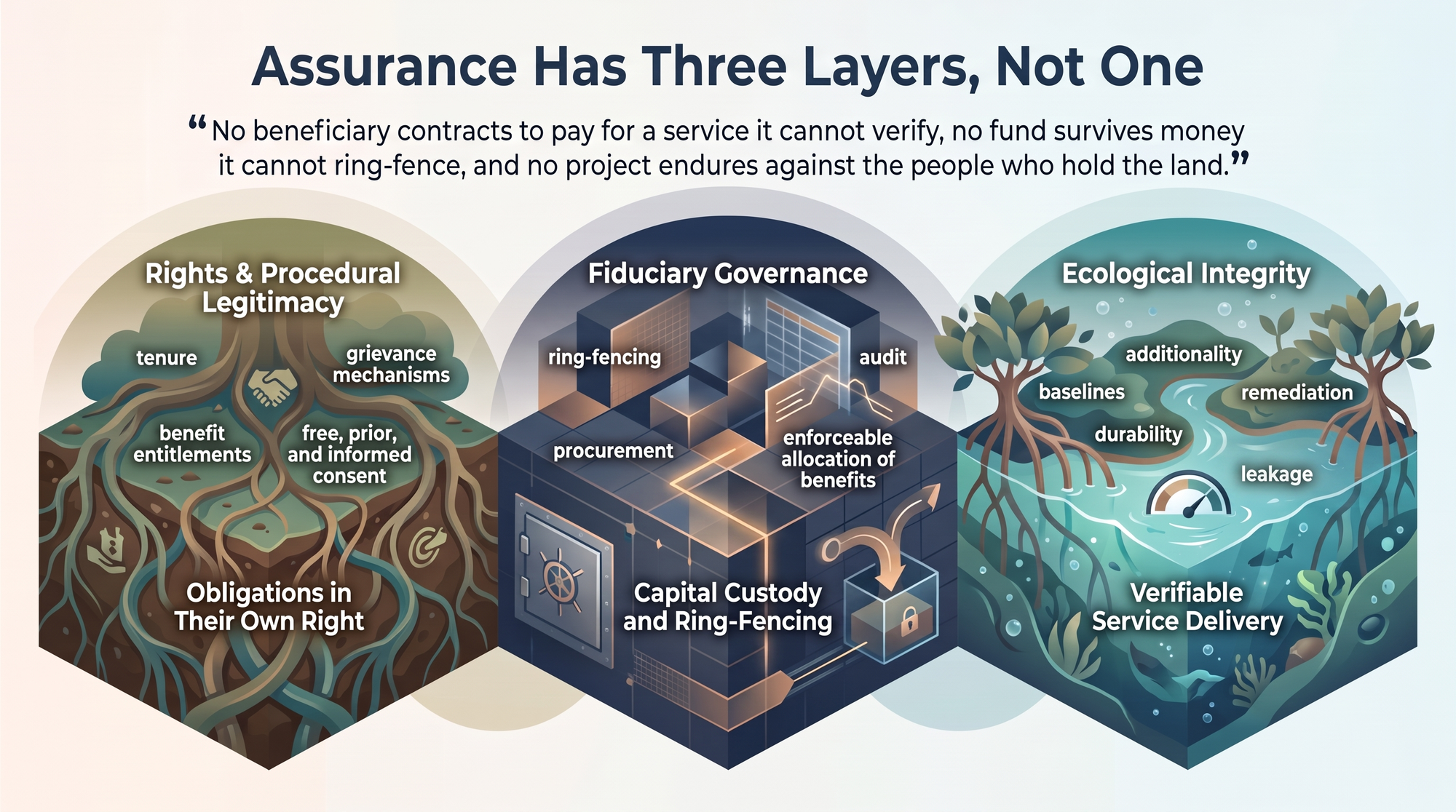
The recurring error is retrofitting: design a project on ecological and economic merit, then look for an instrument and bolt on the assurance layer when a funder asks. What separates a financeable project from a valued one is designing the payment obligation and its succession, the risk allocation, and the assurance architecture together from the outset; assurance has three layers, not one.
- The first is rights and procedural legitimacy: tenure, benefit entitlements, grievance mechanisms, and free, prior, and informed consent where Indigenous Peoples are affected. These are obligations in their own right, not merely protections for an investor’s cash flow.
- The second is fiduciary governance: ring-fencing of funds, procurement, audit, and an enforceable allocation of benefits, as illustrated by the Galápagos Life Fund’s board and annual audits.
- The third is ecological integrity: baselines, additionality, durability, leakage, remediation, and independent verification of the service as delivered.
No beneficiary contracts to pay for a service that cannot be verified, no fund survives money that cannot be ring-fenced, and no project endures against the people who hold the land.
The practitioner who builds all three into the instrument’s design is building the counterparty’s confidence into the cash flow, which is the only place bankability has ever come from.
The Difference Is Architecture
Strip away the headline, and the surviving proposition is positive. Value is not finance; a payment obligation, a risk allocation, and an assurance layer must be designed together; and where no credible payer exists, a grant is the right instrument, not a failure. The instruments exist. What the field lacks is not a new one but the discipline to build the ones it has to a standard a financier can underwrite, and to stop quoting a valuation as though it were a cash flow. More money is necessary. Whether it becomes a functioning system or merely looks like one depends on the architecture beneath it.
Watch an overview and explainer podcast and video of this paper on the NbS Praxis YouTube channel (www.youtube.com/@nbspraxis). The written analysis above is the definitive version.
Link to Explainer Videos and Podcast for the Monthly Long Form Analysis From Assurance to Architecture: The Financing Instruments that Close the Nexus https://www.youtube.com/playlist?list=PLd-SBCVpwxsM
ENDNOTES
[1] United Nations Framework Convention on Climate Change, Decision 1/CMA.6, New collective quantified goal on climate finance, adopted 24 November 2024, paras. 7–8 and 14. https://unfccc.int/sites/default/files/resource/cma2024_17a01E.pdf
[2] Natural Resources Defense Council, “Midway Through a Tumultuous 2026, Where Do We Stand on International Public Climate Finance?” (July 2026), reporting multilateral development bank climate finance of USD 103 billion in 2025 alongside projected 2025 cuts to official development assistance. https://www.nrdc.org/midway-through-tumultuous-2026-where-do-we-stand-international-public-climate-finance
[3] COP29 and COP30 Presidencies, Report on the Baku to Belém Roadmap to 1.3T (November 2025), p. 10, on the exercise’s scope and the unresolved agreements on mechanisms, allocation, and contributions. The five workstreams are replenishing concessional finance, rebalancing fiscal space and debt, rechanneling private capital, revamping institutions, and reshaping financial systems. https://unfccc.int/sites/default/files/resource/Relatorio_Roadmap_COP29_COP30_EN_final.pdf
[4] Joe Thwaites, Natural Resources Defense Council, “International Climate Finance Goals: Where Are We, Where Do We Need to Be, and How Do We Get There?” (29 October 2025). The analysis presents two extrapolations of 2017–2023 flows: a straight-line continuation reaching about USD 427 billion in 2035, and continued 16% compound growth reaching about USD 1.17 trillion, with 17% average growth required to reach USD 1.3 trillion; it notes a preliminary Climate Policy Initiative estimate that growth slowed to 6.5% in 2024. The body carries neither figure; this note records both and their assumptions. https://www.nrdc.org/bio/joe-thwaites/international-climate-finance-goals-where-are-we-where-do-we-need-be-and-how-do-we
[5] Green Climate Fund, Investment framework for GCF-2 (effective 1 January 2024), on the financing conditions assessed alongside country ownership. https://www.greenclimate.fund/access-funding/project-approval-process/investment-framework
[6] Pelayo Menéndez, Iñigo J. Losada, Saul Torres-Ortega, Siddharth Narayan and Michael W. Beck, “The Global Flood Protection Benefits of Mangroves,” Scientific Reports 10, 4404 (10 March 2020), doi:10.1038/s41598-020-61136-6. NbS Praxis develops the economic-value-versus-contracted-financing distinction in Coastal Protection that Appreciates (July 2026).
[7] The Nature Conservancy Nature Bonds transactions (Seychelles 2016, Belize 2021, Barbados 2022, Gabon 2023, Bahamas 2024, Ecuador 2024), as summarized in Climate Policy Lab, Tufts University, “Ecuador’s Debt-for-Nature Swap: A Small Deal, Powerful Message” (16 January 2025); the DFC-insured sequence (Belize, Ecuador Galápagos, Gabon, El Salvador, Ecuador Amazon) per the DFC release at [9].
[8] U.S. International Development Finance Corporation, “Financial Close Reached in Largest Debt Conversion for Marine Conservation to Protect the Galápagos” (9 May 2023); Inter-American Development Bank, “Ecuador Completes World’s Largest Debt-for-Nature Conversion with IDB and DFC Support” (9 May 2023). The USD 323 million is the conservation allocation over 18.5 years and the USD 1.126 billion the lifetime debt-service savings; the combined conservation total above USD 450 million includes the endowment’s expected growth. DFC provided USD 656 million in political risk insurance and IDB a USD 85 million guarantee; the USD 323 million comprises about USD 12 million a year in new funding and about USD 5.4 million a year to capitalize the endowment. https://www.dfc.gov/media/press-releases/financial-close-reached-largest-debt-conversion-marine-conservation-protect; https://www.iadb.org/en/news/ecuador-completes-worlds-largest-debt-nature-conversion-idb-and-dfc-support
[9] U.S. International Development Finance Corporation, “World’s Largest Debt Conversion for Conservation of a River and its Watershed Completed in El Salvador” (16 October 2024); and “DFC Announces $1 Billion in Political Risk Insurance for Ecuador’s First Debt Conversion to Support Terrestrial and Freshwater Conservation” (17 December 2024). El Salvador’s USD 1 billion financing repurchased USD 1.031 billion of bonds at a discount, with projected savings above USD 352 million; DFC described the USD 350 million allocation as the largest conservation commitment in any debt conversion at the time, a record the Amazon transaction then surpassed. The Amazon figure comprises USD 400 million in funding plus an estimated USD 60 million in endowment returns, to improve management of 4.6 million hectares of existing protected areas and protect a further 1.8 million hectares of forest and wetland. https://www.dfc.gov/media/press-releases/worlds-largest-debt-conversion-conservation-river-and-its-watershed-completed; https://dfc.gov/media/press-releases/dfc-announces-1-billion-political-risk-insurance-ecuadors-first-debt
[10] Yale Journal of International Affairs, “Macro-Fiscal Impact and Governance Dynamics in Ecuador’s Debt-for-Nature Swaps” (7 December 2025), for the analysis of the long-dated payment profile; its characterization of the USD 323 million as fiscal savings is superseded here by the transaction documentation at [8]. https://www.yalejournal.org/publications/macro-fiscal-impact-and-governance-dynamics-in-ecuadors-debt-for-nature-swaps-t82tf
[11] Green Finance Institute, “Mirova Land Degradation Neutrality Fund” (case study, undated, accessed 30 September 2026); United Nations Convention to Combat Desertification, “Impact Investment Fund for Land Degradation Neutrality” (undated, accessed 30 September 2026). https://www.greenfinanceinstitute.com/hive/revenues-for-nature/case-studies/mirova-land-degradation-neutrality-fund/ ; https://www.unccd.int/land-and-life/land-degradation-neutrality/impact-investment-fund-land-degradation-neutrality
[12] Green Finance Institute (as [11]), quoting LDN Fund Director Gautier Quéru.
[13] Ugo Panizza, “The Catalytic Effect of Blended Finance,” CEPR Discussion Paper 21387 (2026), and the accompanying VoxEU column “When public money multiplies, and when it does not: A guide to the catalytic effect of blended finance” (2026), on the catalytic multiplier, its decline with the severity of the market failure, and the suboptimality of full de-risking (https://cepr.org/voxeu/columns/when-public-money-multiplies-and-when-it-does-not-guide-catalytic-effect-blended); Global Donor Platform for Rural Development, “Blended finance in action,” technical note chapter 6 (June 2024), on the typical multi-year horizon to positive returns for land-degradation-neutrality projects; IDH, “What we’re learning from blended finance in sustainable land use” (14 October 2025), on first-loss architecture; Convergence, “Insights from the Nature Finance Forum 2025,” on data availability and metric standardization as frequently cited obstacles.
[14] Taskforce on Nature-related Financial Disclosures, Recommendations of the TNFD (September 2023), pp. 41–43 on materiality. https://tnfd.global/wp-content/uploads/2023/08/Recommendations-of-the-Taskforce-on-Nature-related-Financial-Disclosures-1.pdf
[15] Taskforce on Nature-related Financial Disclosures, TNFD 2026 Status Report (September 2026). https://tnfd.global/publication/tnfd-2026-status-report/
[16] IFRS Foundation, “ISSB welcomes TNFD support for nature-related disclosure” (7 November 2025); IFRS Foundation, September 2026 ISSB update. https://www.ifrs.org/news-and-events/news/2025/11/issb-welcomes-tnfd-support-nature-related-disclosure/
[17] World Economic Forum, Nature Risk Rising: Why the Crisis Engulfing Nature Matters for Business and the Economy (19 January 2020). https://www.weforum.org/publications/nature-risk-rising-why-the-crisis-engulfing-nature-matters-for-business-and-the-economy/
[18] European Commission, “Commission adopts ‘quick fix’ for companies already conducting corporate sustainability reporting” (11 July 2025), and Commission Delegated Regulation C(2025) 4812 amending ESRS 2 para. 17; Directive (EU) 2026/470 (Omnibus I), in force 19 March 2026; European Commission, “Commission adopts revised sustainability reporting standards” (3 July 2026), adopting the revised ESRS (2026) by delegated act, reducing mandatory datapoints by over 60%, transmitted to the European Parliament and Council for scrutiny and, if not rejected, applying to financial years beginning on or after 1 January 2027 with early application for 2026 permitted; TNFD 2026 Status Report (as [15]) on survey support for mandatory reporting. https://finance.ec.europa.eu/news/commission-adopts-revised-sustainability-reporting-standards-2026-07-03_en
[19] Green Climate Fund, Investment framework for GCF-2 (as [5]), on the six investment criteria (impact potential, paradigm-shift potential, sustainable development potential, needs of the recipient, country ownership, and efficiency and effectiveness) and the distinction between grants and lending to revenue-generating activities.
[20] Pew Bertarelli Ocean Legacy, “Innovative Financing Tool Helps Protect Galápagos Islands” (issue brief, updated 11 February 2025), on the annual conservation payments of about USD 18 million under the Galápagos Marine Loan and the Galápagos Life Fund’s governance; Environmental Finance, Impact Awards 2023 profile of the transaction, on the fund board’s oversight and annual independent audits. https://www.pew-bertarelli-ocean-legacy.org/en/research-and-analysis/issue-briefs/2024/12/innovative-financing-tool-helps-protect-galapagos-islands
[21] The Copernicus effect is a practitioner’s term from development-agency financing practice rather than from the published finance literature; it describes the staged scaling of a proven pilot to an entire sector, with the payer shifting from official development assistance to the domestic budget and then to private capital. The nested proportions (a government budget of about 16% of GDP, official development assistance of about 0.3% of the government budget, and grant agency resources of about 0.01% of the government budget, equivalent to about 50 minutes of government revenue in East Asia and the Pacific) are derived from World Bank World Development Indicators and agency expenditure data.