No. 19. Hectares Planted are Not Hectares Kept
Mangrove area is rising, yet the Global Mangrove Alliance warns that new stands do not replace mature ones. The week’s launches counted hectares; the designs beneath them already count more, and it remains unclear who measures survival after closing.

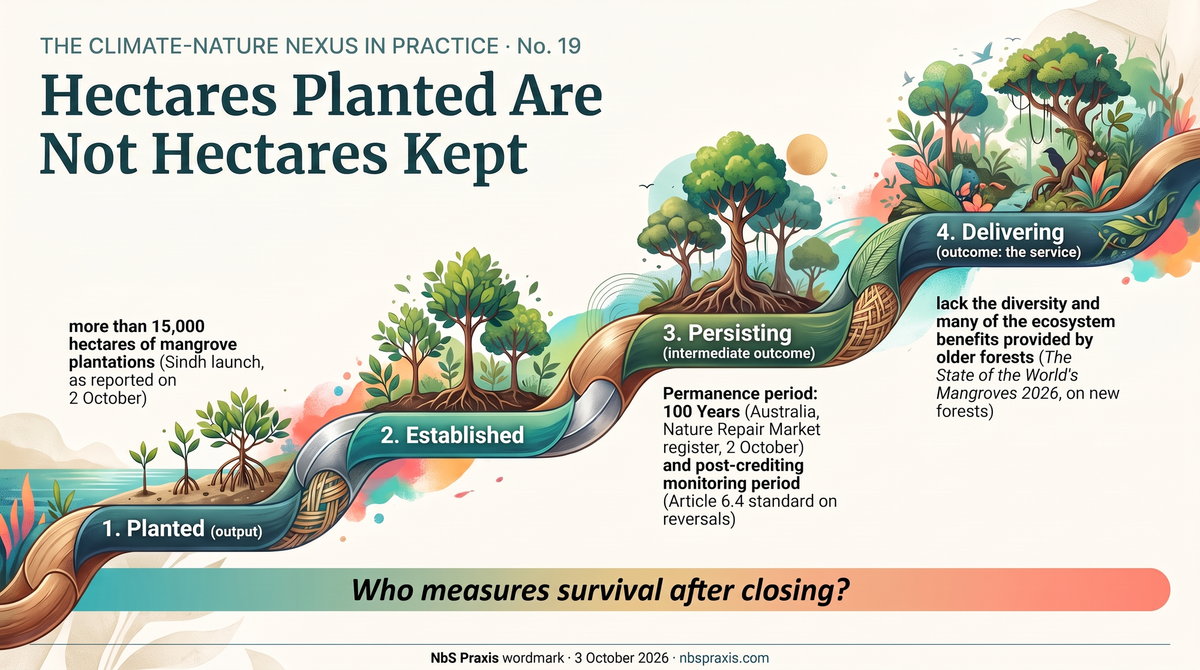
The Climate-Nature Nexus in Practice (Weekly Briefing to 3 October 2026)
Bottom line: A hectare planted is not yet a hectare kept, and a hectare kept is not yet a benefit delivered. The Global Mangrove Alliance reports a net global gain in mangrove area, with 65% of mangroves established since 2010 located in new places, and warns that new stands do not replace mature ones. A launch in Pakistan’s Sindh province counted hectares; the Asian Development Bank’s design counts a carbon outcome estimated from area. Indonesia’s high-confidence hotspots more than doubled in one day, to 1,271. Durability rules exist; who measures survival after closing remains open.
Here is the gateway into the field, and the briefing is the room you walk into: [Podcasts and Videos — Gemini Notebook: www.youtube.com/@nbspraxis]
Link to Explainer Video (Playlist of 1 Podcast and 4 Videos for Week 19, available at https://www.youtube.com/playlist?list=PLN6YQ7aUa6_U
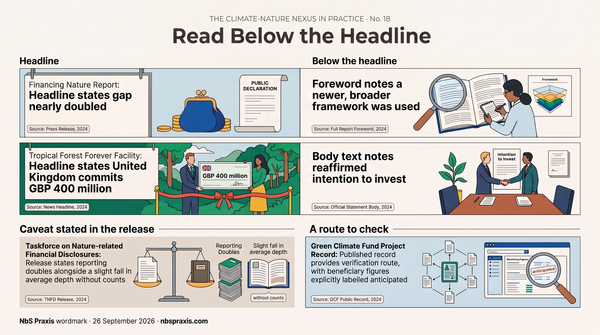
Last week’s briefing asked readers to check a headline’s status word against the document beneath. [1] This week the same discipline applies to land. A hectare can be planted, established, still standing a decade later, and delivering the service the planting was meant to secure. The week’s announcements reported the first rung; the documents beneath them reach higher.
The Global Mangrove Alliance’s 2026 report provided the test case. Mangrove area has shifted from net loss to net gain, yet most new mangroves are in new locations, and the report says new forests cannot be seen as a simple replacement for original cover. [2] On the same day, a coastal project was launched in Pakistan’s Sindh province, and the African Development Bank publicized financing in Côte d’Ivoire; both were announced in hectares or seedlings. [3] [4] Both designs go further: each includes a carbon indicator, and the Sindh design adds stewardship agreements and maintenance covenants.
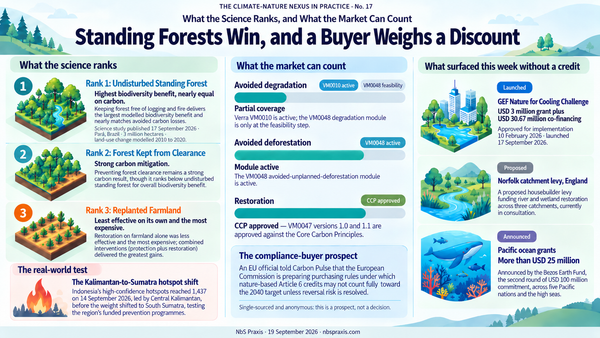
Permanence is already documented in the Paris Agreement Crediting Mechanism’s standards, Australia’s nature market, and the Green Climate Fund’s policy on forest payments. [5] [6] [7] Indonesia’s hotspot count spiked twice. [8]
Planted area is an output. The implication for senior practitioners is clear: before a hectare figure enters a results framework, ask which rung the figure stands on, which service the hectare is intended to deliver, and who will still be measuring after the project closes.
A Status Ladder for Hectares
Finance has a ladder from pledge to disbursement. Land has one too, and this week the documents stood higher on that ladder than the announcements.
The mangrove report makes the case for a ladder. Extent is a net figure: mangroves spread onto newly deposited sediment while mature stands are lost elsewhere, and the global total still rises. [2] New forests, the report says, “lack the diversity and many of the ecosystem benefits provided by older forests.” Planted area is an output. Established and persisting area are intermediate outcomes, necessary but not sufficient. The outcome is the service: carbon held, risk reduced, habitat restored. Persistence proves none of the three until someone measures the service.
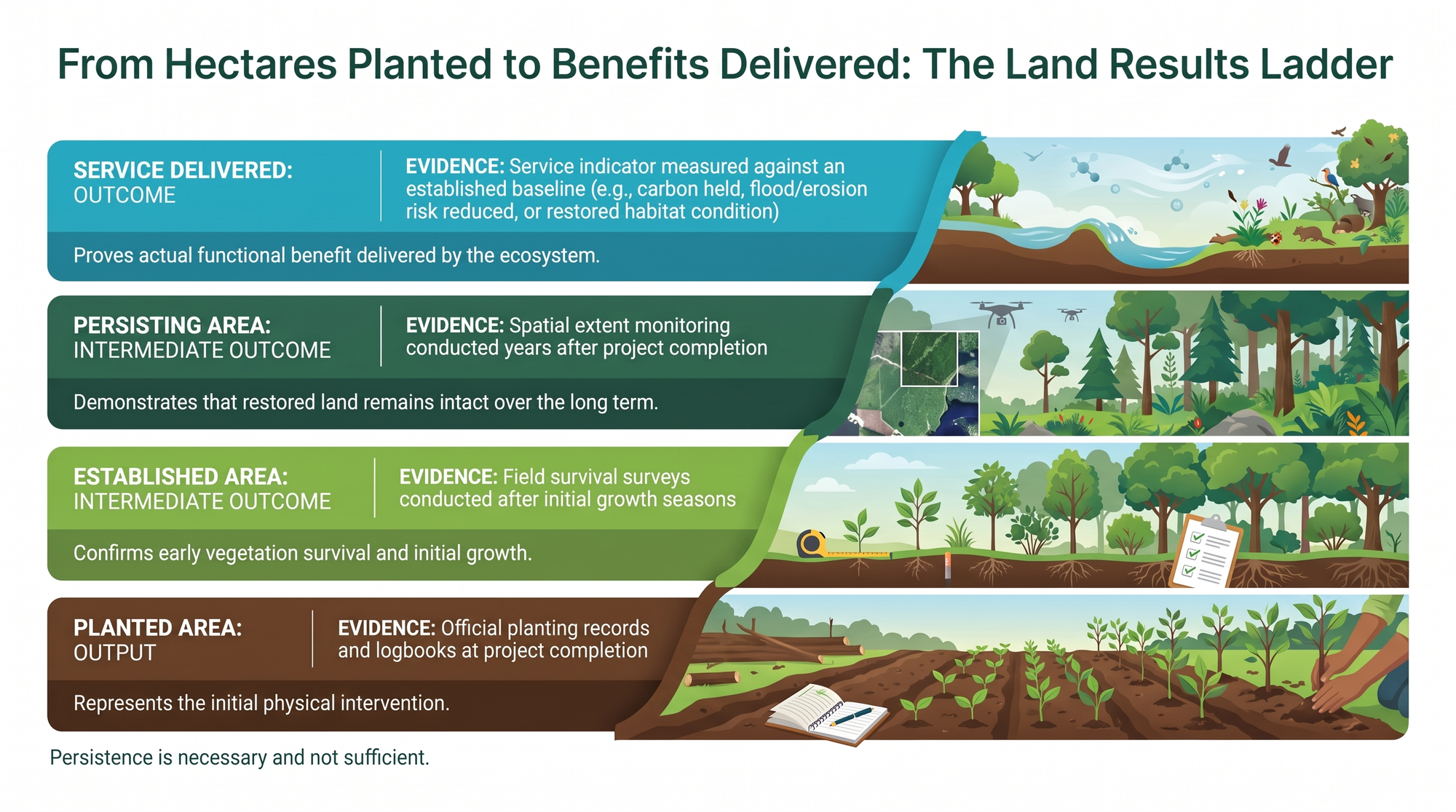
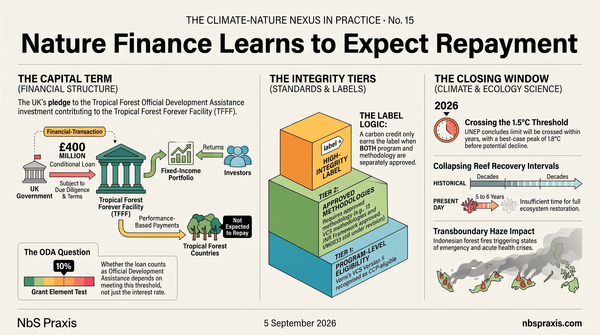
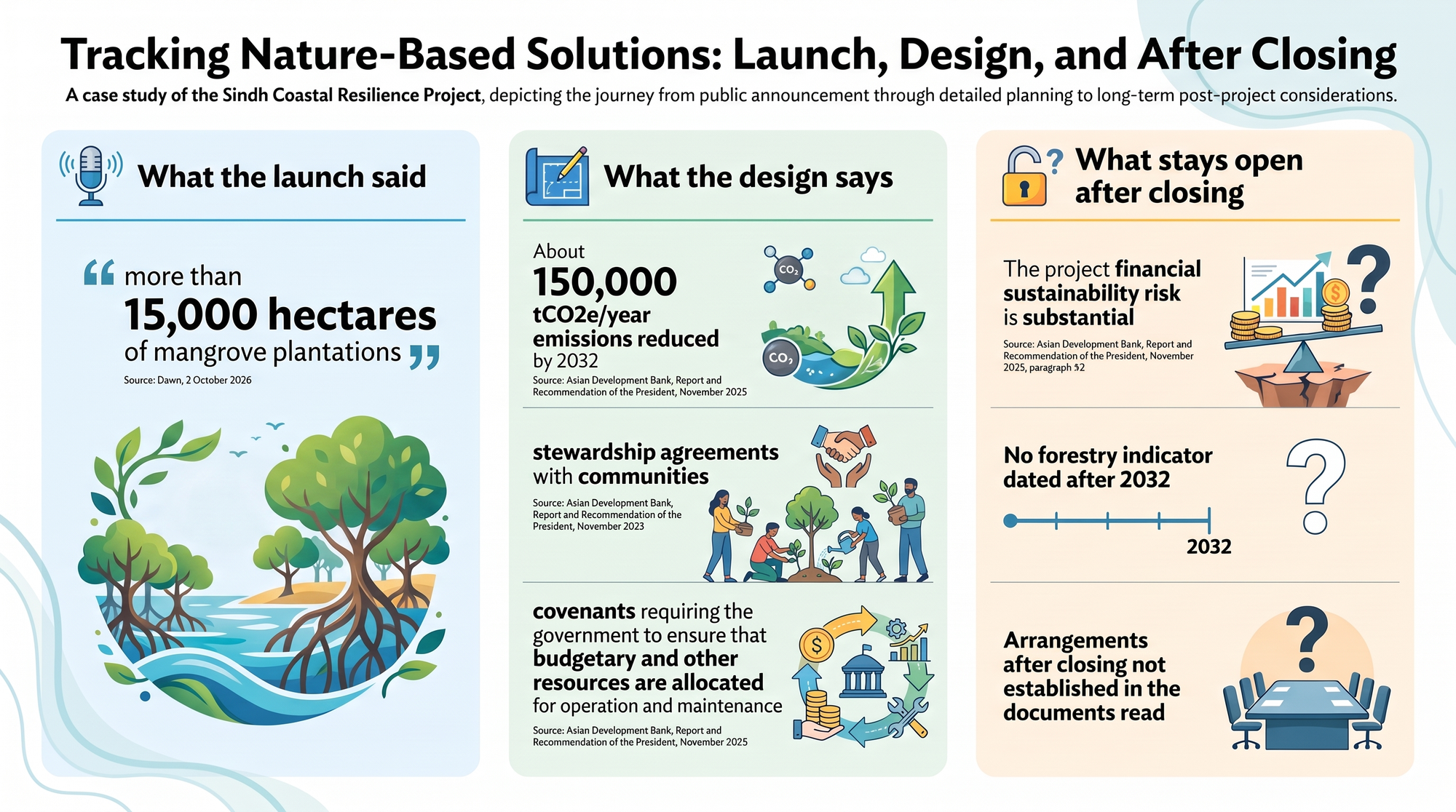
Announcements occupy the lowest rung, and the designs beneath them rise higher. The Sindh launch spoke of hectares; the Asian Development Bank’s design, whose figures The Record sets out below, includes a carbon outcome, stewardship agreements, and covenants on operation and maintenance budgets. [3] The carbon target is an estimate based on area and a default factor. No forestry indicator extends beyond the closing year. The open question is not whether the project counts more than planting. The open question is whether survival and ecological function are specified and financed after closing; the Bank itself rates the financial sustainability risk as substantial.
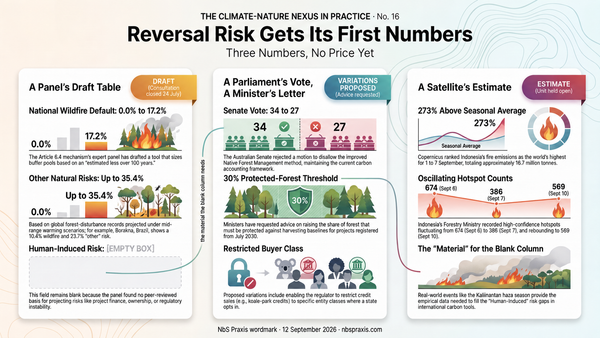
Permanence rules are not new. The crediting mechanism’s standard on reversals is a year old; the tool, before its Supervisory Body next week, will make that standard usable, so far only for clean-cooking activities. [5] Australia’s nature market attaches a permanence period to a biodiversity project, and the Green Climate Fund’s policy deducts for reversal risk before paying for forest results. [6] [7] The biodiversity convention’s voluntary guidelines have called for risk-oriented indicators and baselines since 2018. [9] An obligation is not the same as permanence. Each rule here runs ahead of its evidence: the tool is unadopted, the certificate unissued, the payment unapproved.
Indonesia supplied the reminder of why the upper rungs matter: hotspot counts spiked twice within the week, as ASEAN in Focus sets out. [8] A hectare restored on peat is only as permanent as the next dry month allows.
The Record
A global report found mangrove area in net gain, with new stands and no replacement.
The Global Mangrove Alliance released The State of the World’s Mangroves 2026 on 30 September. The report maps about 14.7 million hectares of mangroves in 2025 and finds that the global area shifted from net loss to net gain from 2010 onward. Of the mangroves newly established since 2010, 65% expanded into new areas, often onto new sediment partly produced by inland deforestation; the rest re-established where mangroves had stood. New forests, the report states, “cannot be seen as a simple replacement” for original cover, and adds: “Quick-fix mass plantings are rarely the solution.”
Status: advisory assessment. [2] Source Source
The Green Climate Fund announced an initial slate weighted toward forests, landscapes, and coasts.
A Board document dated 28 September presents 7 funding proposals ahead of the forty-sixth Board meeting, requesting USD 340.5 million from the Fund against a total value of USD 615.5 million with co-financing; the full list is due on 5 October. The slate spans dry forests in Algeria, permanent forests in Cameroon, Caribbean coasts, and a results-based payment for Mexico’s 2018 and 2019 forest results. Under the Fund’s policy, the Mexico proposal deducts 10% of the offered volume for reversal risk and temporarily sets aside 12% of eligible tonnes until later years of the results period are assessed. Separately, Diego Mesa Puyo took office on 1 October as chief executive of the Global Environment Facility.
Status: proposals for Board consideration; none approved. [7] [10] Source Source Source
Two launches announced hectares and seedlings; both designs carry carbon indicators.
Sindh’s chief minister launched the Sindh Coastal Resilience Project in Pakistan on 1 October; Dawn reports “more than 15,000 hectares of mangrove plantations.” The Asian Development Bank’s November 2025 design targets about 22,000 hectares of forest “restored or afforested” by 2031 and, as an outcome by 2032, about 150,000 tonnes of carbon dioxide equivalent in reduced emissions, alongside about 50 cooperation agreements with communities and covenants on maintenance budgets. In Côte d’Ivoire, the African Development Bank announced on 28 September additional financing totaling USD 24.07 million for the Niger Basin adaptation programme, mostly loans, toward more than 7 million forest seedlings and 6,000 hectares of agroforestry; the appraisal report also tracks carbon dioxide sequestered.
Status: launches; targets and ex-ante estimates, not outcomes. [3] [4] Source Source Source Source
Two assessments supplied the week’s largest numbers, both of them estimates.
The Food and Agriculture Organization published The State of the World’s Forests 2026 on 28 September, stating that restoring more than 1 billion hectares of degraded land “could generate” USD 1.8 trillion a year in benefits. On 1 October, the Organisation for Economic Co-operation and Development estimated global biodiversity finance at USD 74.9 to 92.4 billion a year, averaged over 2023 to 2025, and flagged gaps in the data that countries report to the Convention on Biological Diversity.
Status: modelled benefit, not realized finance; compiled flow estimate. [11] [12] Source Source
A reversal-risk tool reaches the Supervisory Body, and Australia registers a hundred-year obligation.
The annotated agenda for the Article 6.4 Supervisory Body’s twenty-third meeting, dated 21 September, invites the Body to “consider and adopt” a draft reversal-risk assessment tool. The standard underlying the tool entered into force in October 2025 and requires methodologies to include monitoring during and after the crediting period. The tool’s first version applies only to clean-cooking activities, and a cover note states that the version for afforestation and reforestation will not be considered in 2026. Australia’s Clean Energy Regulator registered the third Nature Repair Market project on 2 October, a 968-hectare native revegetation project in New South Wales with a 100-year permanence period and a forecast gain in ecosystem condition; the proponent intends to add carbon credits.
Status: draft for consideration; statutory registration, no certificate issued. [5] [6] Source Source Source Source
ASEAN in Focus
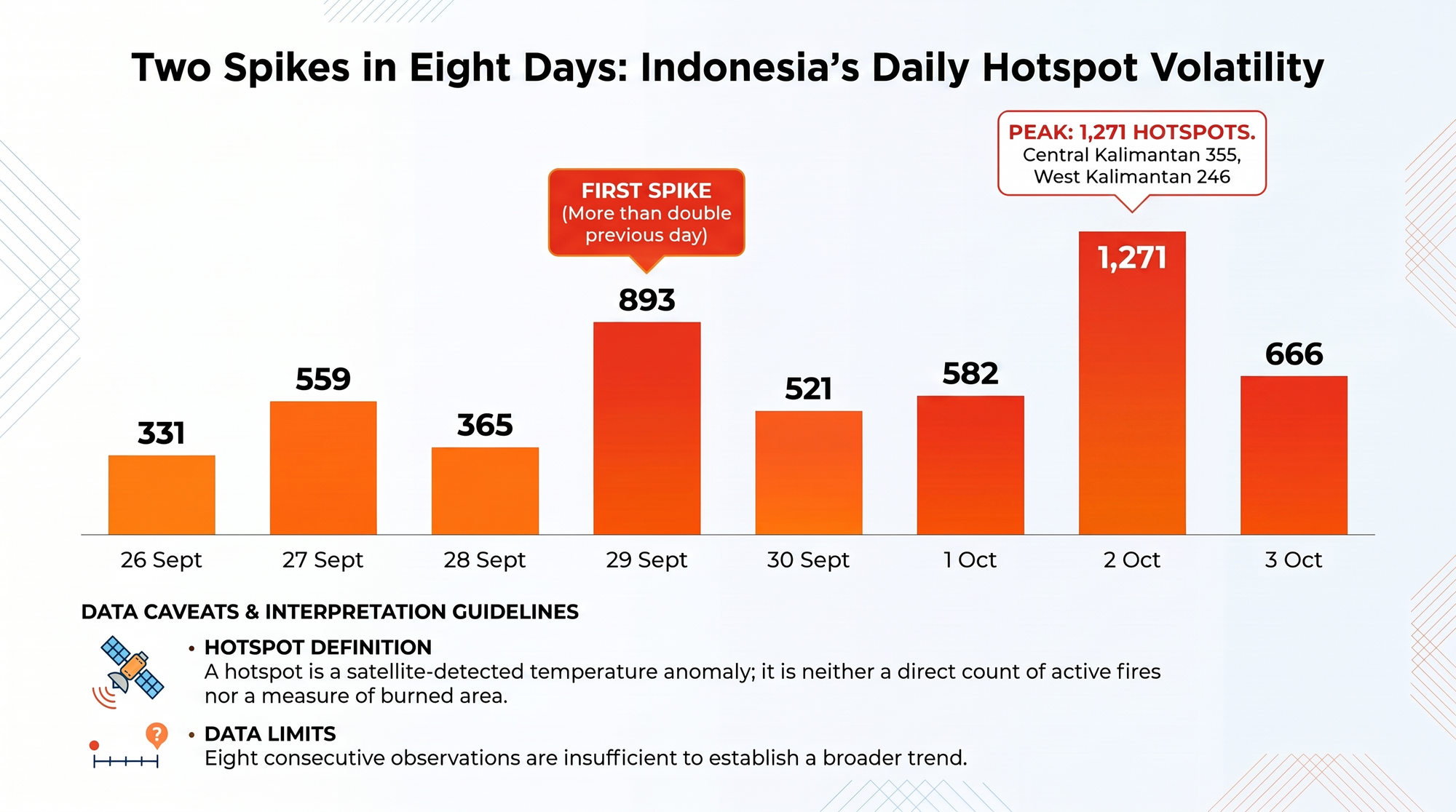
Indonesia’s hotspot count spiked twice in the week. According to the Forestry Ministry’s high-confidence series, daily hotspots were 331, 559, 365, 893, 521, 582, 1,271, and 666 from 26 September to 3 October. The ministry cautions that these are satellite-detected temperature anomalies, not a fire count or burned area. [8] Central Kalimantan and West Kalimantan accounted for 355 and 246 of the 2 October peak. On 29 September, Singapore’s twenty-four-hour Pollutant Standards Index ranged from 107 to 157, in the Unhealthy range. The National Environment Agency cited fires in Kalimantan and southern Sumatra, and Malaysia recorded 36 areas with unhealthy air. [13] [14]
The mangrove report adds a regional warning: Southeast Asia is one of two regions with a consistent net loss of mangroves over 40 years, where gains “so far make little impact on the vast losses that have preceded them.” [2] The Indonesian Forestry Ministry, as the initiating ministry, said on 2 October that it would submit a request for a presidential regulation and inventory programs now spread across ministries. [15] In Jambi, the ministry reported on 28 September that carbon trading in the Bujang Raba village forests was halted in 2021 pending regulation, that approval to issue 238,281 tonnes of carbon dioxide equivalent was handed over in July, and that the project documents are being processed in the national registry. The release reports no issuance, sale, or payment, and the ministry’s regulation gives such approvals 6 months. [16]
What This Means
A hectare figure has a status, and that status determines how the figure can be used. Planted area is an output. Persisting extent is an intermediate outcome. The outcome that justifies the finance is the service: carbon held, flood or erosion risk reduced, or habitat function restored. Each service needs its own indicator and baseline. [2] [9]
The mechanism runs through indicators, covenants, and payment rules, each with a limit. The Sindh design extends beyond planting, yet no forestry indicator runs beyond the closing year; after that, survival rests on the forest department’s maintenance budget and on stewardship agreements. [3] Mexico’s proposed payment follows measurement, but sequence is not persistence: the deduction for reversal risk is a flat rate, and the set-aside tests later years within the same results period. [7] Crediting rules oblige methodologies to provide for monitoring after the crediting period, but for land, the tool that makes the obligation usable is not due this year. [5]
Consider a mangrove component within a coastal resilience program in Indonesia now entering design. The country’s Second Nationally Determined Contribution places mangroves in the national greenhouse gas inventory and the forest reference emission level, and the National Adaptation Plan names mangroves as threatened by sea-level rise and coastal development and adopts ecosystem- and community-based approaches as the core implementation model. [17] [18] The Theory of Change should therefore include planted area as an output, persisting extent as an intermediate outcome, and the natural flood defense the plan invokes as the outcome, with a risk-oriented indicator and a baseline. Tidal hydrology, sediment supply, and tenure are the assumptions. Monitoring should continue beyond completion, with a named owner and a budget line. The counterpart is also an assumption to confirm: the Forestry Ministry is initiating the new agency, but no release names an interim counterpart or a handover. [15]
Three signals would change this reading. First, an afforestation and reforestation version of the reversal-risk tool, which the meeting’s documents place beyond 2026, would turn an obligation into a viable pathway for land. [5] Second, the Green Climate Fund’s full proposal list will show whether the early slate's forest and coastal weighting holds. [7] Third, a presidential regulation establishing Indonesia’s agency would settle the counterpart. [15]
Worth Watching Through Year-End
Article 6.4 Supervisory Body, twenty-third meeting: https://unfccc.int/event/Supervisory-Body-23
Convention on Biological Diversity COP17: https://www.cbd.int/meetings/COP-17
Green Climate Fund Board, forty-sixth session: https://www.greenclimate.fund/about/governance/board-meetings/b46
Nature-based Solutions International Congress: https://nbscongress.sciencesconf.org/
United Nations climate conference COP31: https://unfccc.int/cop31
Endnotes
[1] NbS Praxis. (2026, September 27). No. 18 — Read Below the Headline. The Climate-Nature Nexus in Practice, Weekly Briefing to 26 September 2026. Prior issue of this series, cited for continuity of argument only.
[2] Spalding, M. D., and Leal, M. (Eds.). (2026). The State of the World’s Mangroves 2026. Global Mangrove Alliance; announced in a release on 30 September 2026. Primary report; an advisory assessment. The quotations are from the executive summary (section 1.2, pages 6 to 7) and the 65% share from section 2.2. The mapped extent is 147,289 square kilometers, with a 95% confidence interval of 137,376 to 161,429, which the release rounds to 15 million hectares.
[3] Dawn. (2026, October 2). Rs87bn coastal resilience project launched for three Sindh districts; and Asian Development Bank. (2025). Sindh Coastal Resilience Sector Project: Report and Recommendation of the President and Project Administration Manual. Dawn is secondary reporting, and the launch date follows from its “on Thursday”; the launch covered a wider programme that the International Fund for Agricultural Development also finances. The Bank’s documents are primary, and their figures are targets and ex-ante estimates: the carbon outcome is computed from the planned area at 7 tonnes of carbon dioxide equivalent per hectare a year. The only indicators timed after the closing date of 30 June 2032 are two survey indicators in the gender action plan.
[4] African Development Bank Group. (2026, September 28). Côte d’Ivoire and African Development Bank Group launch $24 million investment to strengthen climate resilience and restore forest landscapes; and appraisal report (November 2025). Primary. The financing was disclosed on 16 September, so the item is a background anchor publicized in the reporting window. The release’s figures are self-reported targets; the appraisal report gives larger programme-wide targets of 13,997,700 nursery plants and 15,000 hectares of agroforestry.
[5] UNFCCC, Article 6.4 Supervisory Body. Standard: Addressing non-permanence and reversals in mechanism methodologies (in force from 10 October 2025), sections 7.2 and 7.4; annotated agenda of the twenty-third meeting (21 September 2026); draft tool on reversal risk assessment; cover note to the draft transition procedure, paragraph 20; and approved methodologies. Primary. The standard binds methodologies, not activities. The agenda and the tool are drafts dated before the reporting window and carried as a current signal. That an obligation without an adopted tool is not yet a usable pathway for land is this briefing’s reading.
[6] Clean Energy Regulator, Australia. (2026, October 2). Third project registered under Nature Repair Market; and Biodiversity Market Register, project NR001016. Primary. The activity area of 967.74 hectares sits within a 6,150-hectare project area, and the carbon credits are the proponent’s stated intention.
[7] Green Climate Fund. (2026, September 28). Consideration of funding proposals, GCF/B.46/02/Drf.01; funding proposal package for FP324, sections C.1 and E; and Policy for results-based payments for REDD+ (decision B.40/16, annex VIII). Primary Board documents. The count and totals describe the early batch only, with up to 21 proposals expected. For Mexico, the set-aside is USD 10,237,243.
[8] Ministry of Forestry, Republic of Indonesia. Daily press releases, 27 September to 4 October 2026, including those reporting the observations of 2 October and 3 October. Primary series, each figure dated by the observation and not by the release. An official quoted by ANTARA on 1 October gave a different series on an undefined basis.
[9] Conference of the Parties to the Convention on Biological Diversity. (2018, November 30). Decision 14/5, Biodiversity and climate change, annex, Step F. Primary; voluntary guidelines.
[10] Global Environment Facility. (2026, October 1). Diego Mesa Puyo takes over as CEO and Chairperson of the Global Environment Facility. Primary release.
[11] Food and Agriculture Organization of the United Nations. (2026, September 28). FAO report: restoring forests and landscapes is critical to meeting global food security and development goals. Primary release on The State of the World’s Forests 2026.
[12] Organisation for Economic Co-operation and Development. (2026). An overview of global biodiversity finance. OECD Environment Policy Papers, No. 51. Primary report. The range is in constant 2024 United States dollars and averages the observations available for 2023 to 2025; the report states that the aggregate is not a balanced three-year average (section 3.1.1).
[13] National Environment Agency, Singapore. (2026, September 29). Haze situation update. Primary; a reading at 6 p.m.
[14] Bernama. (2026, September 29). 36 areas record unhealthy API readings as of 4.30 pm, Johan Setia highest. National wire reporting Department of Environment Malaysia readings; the wire gives no cause.
[15] Ministry of Forestry, Republic of Indonesia. Releases of 30 September and 2 October 2026 on the national peatland and mangrove management agency. Primary. No regulation, head, or budget had been published when this issue closed; ANTARA reported that the minister aimed to send the request by 5 October.
[16] Ministry of Forestry, Republic of Indonesia. (2026, September 28). Release on the Bujang Raba social forestry landscape; Regulation of the Minister of Forestry 6 of 2026, Article 24; and KKI Warsi, annual report to Plan Vivo, 2022 to 2023. Primary and self-reported. The project’s report lists 238,280 saleable certificates as unissued; this briefing infers that the approved volume is this backlog.
[17] Republic of Indonesia. (2025, October). Second Nationally Determined Contribution, page 12. Primary.
[18] Republic of Indonesia. (2025, November). National Adaptation Plan 2026–2030, pages 20 and 29. Primary.