No. 18 — Read Below the Headline
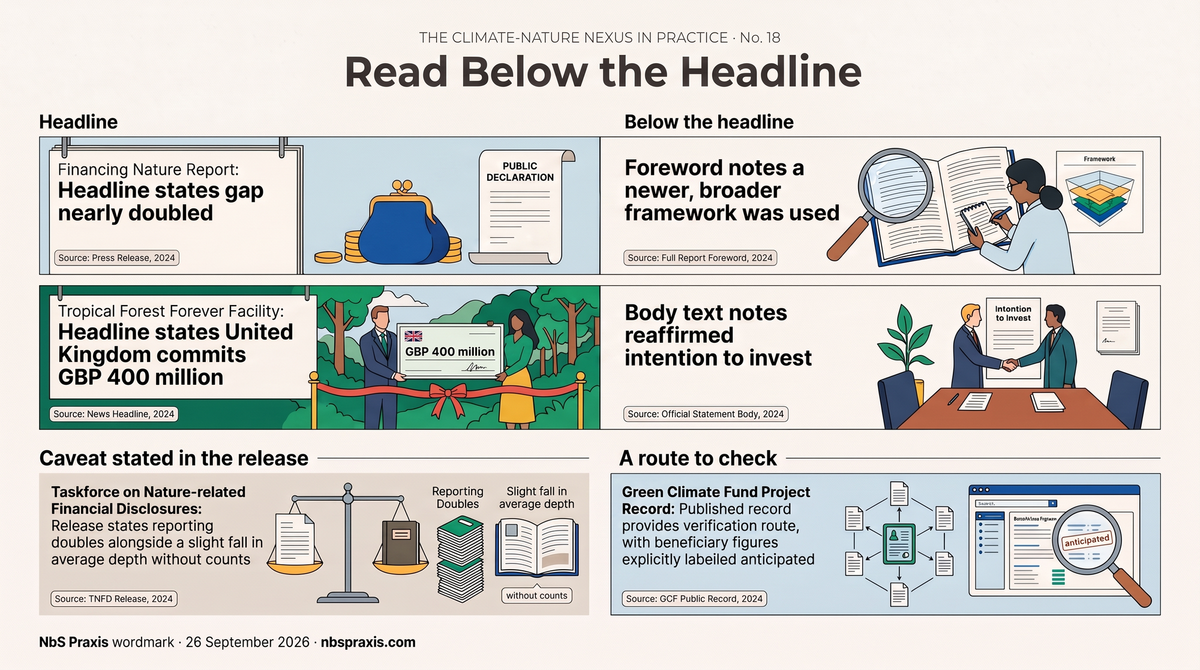
Two of the week's nature-finance headlines read a rung higher than the documents beneath them: a gap estimate whose framework change appears in the report's foreword but not in its release, and a forest-fund commitment that its own body text calls an intention.

The Climate-Nature Nexus in Practice (Weekly Briefing to 26 September 2026)
Bottom line: Two of this week's nature-finance headlines read a rung higher than the documents beneath them. The Paulson Institute, The Nature Conservancy, and WWF put the biodiversity finance gap at around USD 1.317 trillion a year, using what the report's foreword calls a newer, broader framework. The release omits this change, and the report's own findings pass it over. The Tropical Forest Forever Facility headlined a United Kingdom commitment that the facility's own body text calls a reaffirmed intention. The disclosure taskforce's doubling is accurate but not like-for-like. Practitioners should read below the headline before quoting.
Here is the gateway into the field, and the briefing is the room you walk into: [Podcasts and Videos — Gemini Notebook: www.youtube.com/@nbspraxis]
Link to Explainer Video for Week 18, available at https://youtu.be/2jYChHtjNXg
Last week's briefing highlighted an accounting gap: the science ranks avoided degradation first, and a deforestation baseline cannot register a forest that is logged or burned and left standing. [1] This week, accounting improved on four fronts, and two of the week's headlines read a rung higher than the documents beneath them. [2] [3] [4] [5] A mid-decade nature finance report restated the biodiversity finance gap and, in its foreword, disclosed that the new figure comes from a different producer working under a broader framework than the one behind the 2020 estimate; the release, and later the report's own findings chapter, read the change as a widening. [2] A disclosure taskforce stated in its release both a doubling and a slip in average depth, based on samples that changed year to year. [3] The United Kingdom presented its Global Environment Facility pledge as new funding from aid allocations. [6] A tropical forest facility's headline verb outran its own body text, and an asset manager's Paraguayan forestry announcement listed carbon credits among expected revenue streams without disclosing a crediting standard. [7] [8]
None of these items is fabricated, and none fails the numbers. Where the week's writing slipped, the slip sat one layer above the number, in the headline carrying that number to market. The headline is the layer most often cited and least often checked against its source. The discipline is the oldest in the practice: read below the headline.
Where the Qualifier Lives
Nature's measurement apparatus improved on four fronts this week; in two cases, the qualifier that keeps a figure honest sat below the headline, and a third figure carries a comparability caveat, as its own release states.
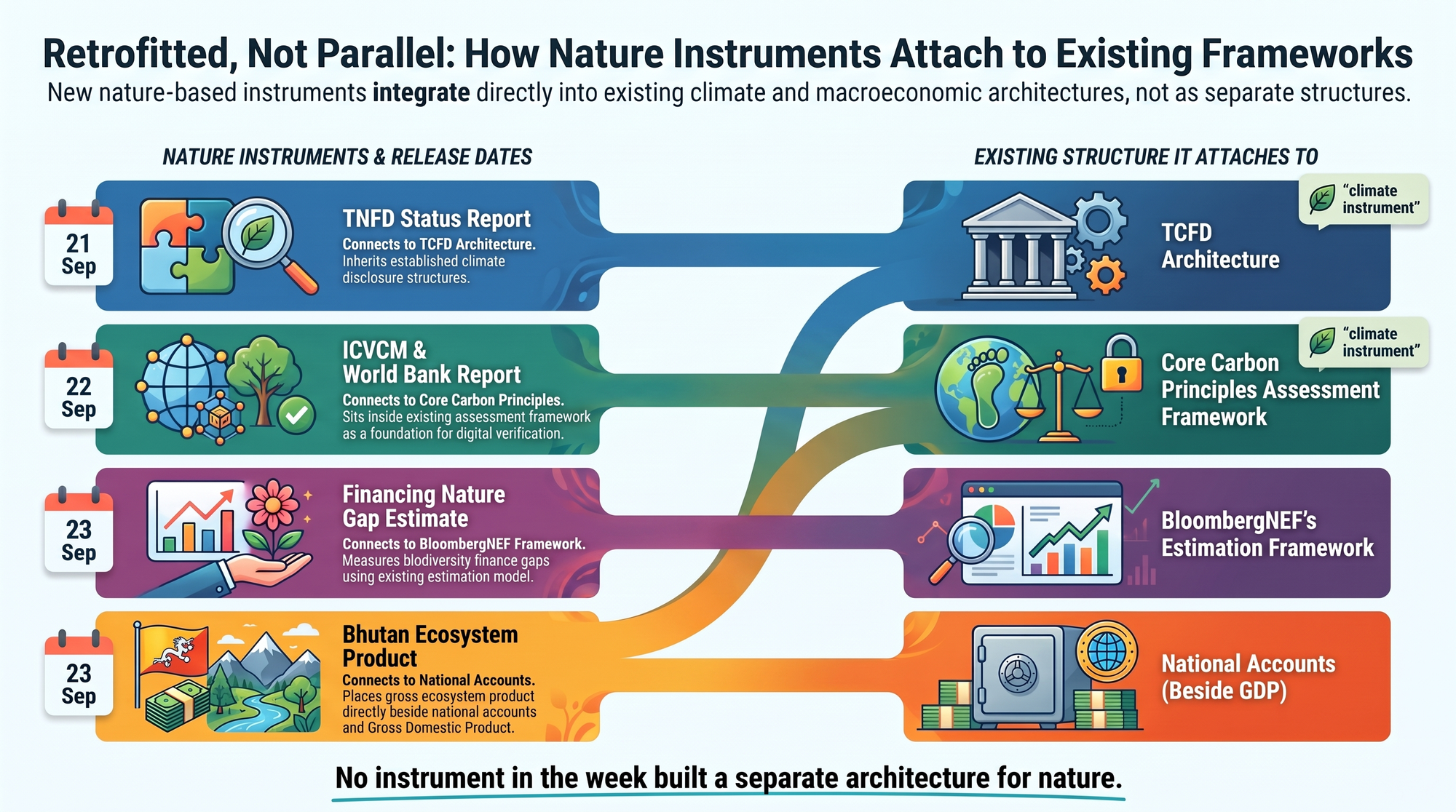
The apparatus itself is real. Four measurement instruments landed within three days: a re-measured finance gap, a widened disclosure base, a sovereign ecosystem account set beside gross domestic product, and an integrity report on digital monitoring, reporting and verification. [2] [3] [4] [5] None built a parallel structure. The disclosure taskforce inherits the climate taskforce's architecture; the digital-monitoring report sits within the Core Carbon Principles assessment framework rather than beside it, and Bhutan's account sits beside the national accounts. Nature is being retrofitted into existing instruments, with climate's chief among them, which is why interoperability, not invention, is the thing to watch.
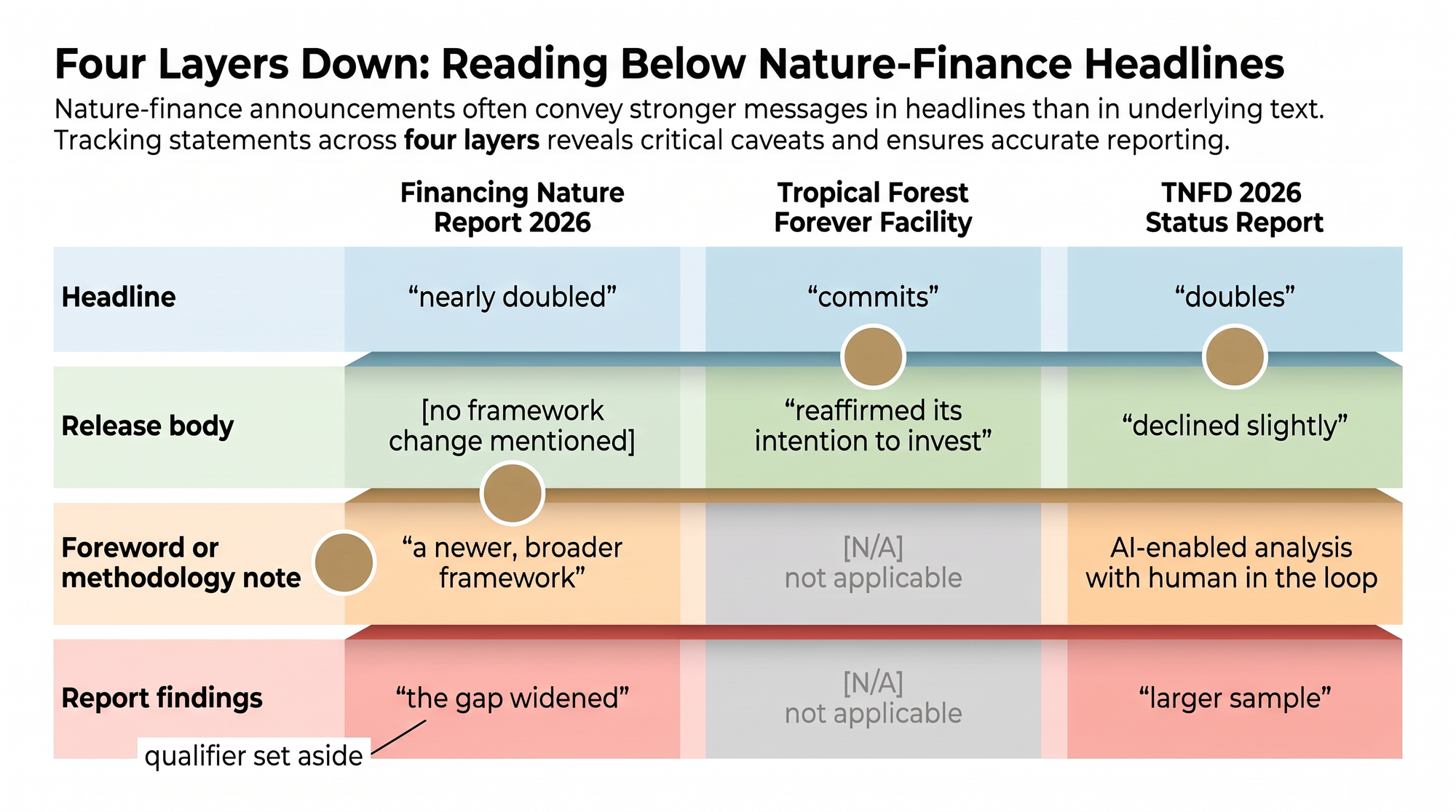
The numbers held; two headlines did not. The Financing Nature foreword discloses a framework change that the release omits and that the report's findings chapter sets aside when it describes the gap as having widened. The Tropical Forest Forever Facility's body text says "reaffirmed its intention to invest" beneath a headline that says "commits." [2] [7] The disclosure count is a different case: the taskforce's release states both the doubling and the slight fall in average depth, and its report attributes that fall to a sample that doubled, so the question is comparability rather than inflation. [3] A headline travels further than its body: a board paper cites the headline, and a results framework inherits its verb. Read that way, an intention becomes a commitment and a changed method becomes a doubling, a status ladder read upward against the rule this briefing has held for several issues. [1]
One instrument shows what a verification route looks like. The Green Climate Fund and the Korea International Cooperation Agency signed a project agreement on September 17 for urban nature-based solutions in Addis Ababa and Jimma, Ethiopia, to restore forests, wetlands, and river corridors to reduce flood and heat risk, with a total project value of USD 47 million. [9] The board approval dates from March; the record is public, and the beneficiary figure is marked as anticipated in that record, so any reader can test the announcement against the document. A published project record does not prevent overstatement; it makes overstatement checkable.
The Record
A mid-decade report restated the biodiversity finance gap within a framework its foreword says has changed.
The Paulson Institute, The Nature Conservancy, and WWF published the Financing Nature Report 2026: A Mid-Decade Update on 23 September, estimating the gap at around USD 1.317 trillion per year "under BloombergNEF's broader framework estimation." The foreword states that the estimate comes from a different producer working under "a newer, broader framework" than the 2020 report's, yet the findings chapter describes the gap as having widened and attributes the widening mainly to harmful financial flows growing faster than nature-positive finance, without separating that effect from the change in framework. The figure carries no uncertainty range.
This week: primary report and release, 23 September 2026; a modelled estimate without an uncertainty range and not method-comparable with the 2020 estimate, a caveat the foreword states and the release omits. (Paulson Institute; TNC; WWF.) Source Source Report
Nature-related reporting roughly doubled on a changing sample, while average disclosure depth slipped.
The Taskforce on Nature-related Financial Disclosures published its 2026 Status Report on 21 September, reporting that "more than 1,000 organizations across 56 countries or areas have published some level of disclosure aligned with the TNFD recommendations." The release notes this is a doubling year over year, alongside a slight decline in average depth, which the report attributes to a larger, broader sample rather than to deterioration within the same organizations. Final sector guidance for technology and communications followed on 22 September.
This week: primary report, methodology note and releases, September 2026; counts derived by AI screening of corporate reports with human reconciliation, self-reported at source. (TNFD.) Source Source Methodology Source
The week's capital came as a first-time GEF-9 pledge, a reaffirmed intention, and a platform announced without a disclosed standard.
At the United Nations General Assembly on 24 September, the United Kingdom announced GBP 330 million for the Global Environment Facility, described on the government's page as "new funding from Official Development Assistance (ODA) allocations" for the 2026 to 2030 replenishment. The Facility's interim chief executive said the same day that donors "have now pledged more than $4.3 billion for GEF-9," a cumulative pledge rather than a programming level. The Tropical Forest Forever Facility published a page on 23 September titled "United Kingdom commits GBP 400 million," which states that the minister "reaffirmed its intention to invest" in a conditional loan first announced on 3 September; the new figure is the aggregate, with sponsor-tranche contributions reaching approximately USD 7.3 billion. J.P. Morgan Natural Capital, Paraguay's Office of the President, and Grupo Robinson announced approximately USD 200 million on 24 September for commercial forests and native forest restoration, listing timber, wood products, and carbon credits as expected value streams, with capital deployment expected to begin in early 2027.
This week: primary releases of 23 and 24 September 2026; pledges and announcements, not contributions received or capital deployed; the Paraguayan release does not disclose a crediting standard or verification protocol, which is not evidence that none exists. (FCDO; GEF; TFFF; J.P. Morgan Natural Capital.) Source Source Source Source
Two measurement instruments landed, neither carrying legal nor eligibility force.
Prime Minister Tshering Tobgay announced in New York on 23 September that Bhutan has calculated its gross ecosystem product at approximately USD 6.2 billion for 2024, which Stanford University's Natural Capital Alliance describes as "about twice the size of the country's gross domestic product." The Alliance built the accounts with Bhutan's National Statistics Bureau and claims it is the first national adoption; neither source cites a statute or cabinet decision. The Integrity Council for the Voluntary Carbon Market published a report on 22 September, co-facilitated with the World Bank, that includes sixteen recommendations on digital monitoring and verification and concludes that "technology alone cannot guarantee integrity."
This week: primary releases on 22 and 23 September 2026; a statistical adoption announced in a speech with no legal instrument cited; a primacy claim from a party that co-produced the accounts; and an advisory report conferring no Core Carbon Principles eligibility. (Natural Capital Alliance; ICVCM.) Source Source Source
ASEAN in Focus
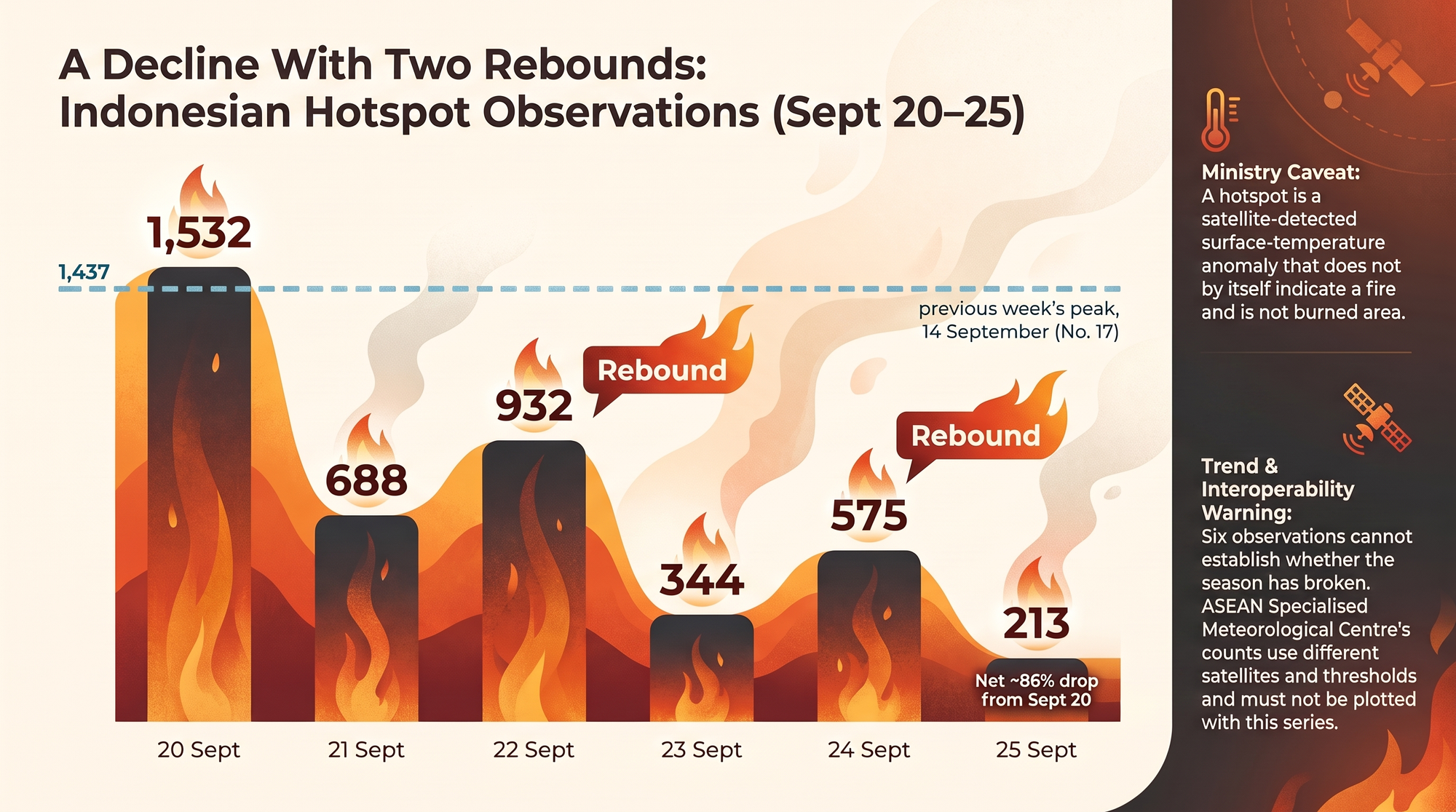
Indonesia's fire season opened with conditions worse than the previous week's closing and then declined unevenly. In the Forestry Ministry's high-confidence series, hotspots peaked at 1,532 on 20 September, above the prior week's peak, then fell to 688, 932, 344, 575, and 213 through 25 September, a roughly 86% decline with two rebounds, under the ministry's own caveat that a hotspot is a satellite-detected temperature anomaly that does not by itself indicate a fire and is not burned area. [10] The ministry revoked five Kalimantan concessions totaling 92,464 hectares on 21 September, and the Health Ministry counted 174,694 acute respiratory infection cases across seven provinces as of 21 September, including 40,363 in children under five. [11] [12] On 24 September, President Prabowo decided to establish a national peatland and mangrove agency reporting directly to the President across six peat provinces, succeeding a predecessor that wound up in 2025; no presidential regulation constituting the agency had been published as of 26 September, so the agency is decided and not yet constituted. [13] Malaysia's environment ministry said the same day that it is examining Singapore's 2014 transboundary haze law with a view to drafting its own, a law studied and not a bill, while three Sarawak stations read Very Unhealthy, led by Lundu at 219, and Singapore's realized index held at Moderate. [14] [15] [16]
What This Means
For anyone about to move one of this week's figures into a document of their own, the key step is to open the primary and read the qualifier before the number travels; a results framework that inherits a headline's verb carries that verb into a board decision. [2] [7]
For program designers, the Ethiopian project shows the value of a published project record, which does not guarantee an accurate announcement but lets every reader test it. [9]
For institutions in Southeast Asia, an agency without its constituting instrument and a law under study are real progress, and neither is yet something to plan against. [13] [14]
Worth Watching Through Year-End
The Article 6.4 Supervisory Body holds its twenty-third meeting in Bonn, Germany from 5 to 9 October 2026; the Pre-COP31 hosted by Fiji, with a leaders' event in Tuvalu, runs from 5 to 8 October; and the Global Tipping Points Conference meets in Kuala Lumpur, Malaysia from 12 to 15 October.
(UNFCCC; COP31 Pacific; Sunway Centre for Planetary Health. The Pre-COP venue split is unpublished.) Source Source Source
The IMF and World Bank Group Annual Meetings run in Bangkok, Thailand from 12 to 18 October 2026; the Adaptation Fund Board meets in Bonn from 19 to 23 October; and the Convention on Biological Diversity's COP17 convenes in Yerevan, Armenia from 19 to 30 October for the first global review of progress against the Kunming-Montreal framework.
(IMF; Adaptation Fund; CBD Secretariat. No annotated Adaptation Fund agenda published yet.) Source Source Source
The Green Climate Fund Board meets for its forty-sixth session from 26 to 29 October 2026 in Songdo, Incheon, Republic of Korea, a venue now published where the previous issue carried dates alone; the Nature-based Solutions International Congress runs in Paris, France from 2 to 6 November; and UNFCCC COP31 follows in Antalya, Türkiye from 9 to 20 November.
(GCF, venue corroborated in Board decision B.43/15; congress organizers, whose pages disagree on the component split inside the span; UNFCCC.) Source Source Source
Endnotes
[1] NbS Praxis. (2026, September 19). No. 17 — Standing forests win, and a buyer weighs a discount (The Climate-Nature Nexus in Practice, Weekly Briefing to 19 September 2026). Prior issue of this series, cited for continuity of argument and for the status-ladder discipline restated here, not as a source for any external fact. https://www.nbspraxis.com/no-17-standing-forests-win-and-a-buyer-weighs-a-discount/
[2] Paulson Institute, The Nature Conservancy, and WWF. (2026, September 23). Financing Nature Report 2026: A Mid-Decade Update — From Isolated Progress to Implementation at Scale. https://www.nature.org/en-us/newsroom/financing-nature-2026-report/ and https://www.prnewswire.com/news-releases/new-financing-nature-2026-report-offers-playbook-for-financing-nature-protection-at-scale-302887126.html — Primary report and its publicity release; the estimate is BloombergNEF's modelled figure measured against Kunming-Montreal Global Biodiversity Framework 2030 targets, published without an uncertainty range. Full report: https://www.conservationgateway.org/content/dam/tnc/nature/en/documents/f/i/FinancingNature2026MidDecadeUpdate-d2.pdf. The 2020 report put the gap at around USD 711 billion a year as a range midpoint, and an interim update in September 2025 put it at USD 942 billion for 2024 on the newer method. The release describes the move from USD 711 billion to USD 1.317 trillion as a near doubling, which is arithmetically fair (an 85% rise), but the foreword places the new figure "under a newer, broader framework" (p. 4); the report notes that gap estimates are also affected by inflation (p. 13), and the newer framework measures the gap against the Global Biodiversity Framework's finance and harmful-subsidy reform targets (p. 12). The findings chapter states that "the financing gap has widened mainly because harmful financial flows have grown faster than nature-positive finance" (p. 19) without separating that effect from the change of framework; that part of the measured widening may be definitional is an inference drawn here, not a statement at source.
[3] Taskforce on Nature-related Financial Disclosures. (2026, September 21 and 22). Market momentum on nature accelerates as TNFD-aligned reporting doubles worldwide; TNFD 2026 Status Report; TNFD releases final sector guidance for technology and communications. https://tnfd.global/market-momentum-on-nature-accelerates-as-tnfd-aligned-reporting-doubles-worldwide/, https://tnfd.global/wp-content/uploads/2026/09/TNFD-2026-Status-Report-2026_WEB.pdf and https://tnfd.global/tnfd-releases-final-sector-guidance-for-technology-and-communications/ — Primary releases and report by the body whose own uptake they measure; the counts are machine-derived and self-reported, and the report publishes the 2025 and 2026 sample sizes and averages and attributes the change in average depth to sample expansion. The report puts the screened reporters at 542 in 2025 and 1,154 in 2026, with average coverage falling from 8.7 to 8.1 of fourteen recommended disclosures. The separate methodology note (September 2026), https://tnfd.global/wp-content/uploads/2026/09/260916_TNFD-Status-Report-Methodologies-1.pdf, describes Neural Alpha's AI screen of more than 10,000 companies' disclosures, of which about 2,700 mention TNFD, narrowed by an "intentionality filter" to 1,191 companies (564 in 2025) "intentionally referencing TNFD with respect to their own reporting plans and activities for nature-related disclosures rather than simply acknowledging the initiative in passing or stating awareness" (p. 23; p. 24 gives 1,192 for the same set), followed by "Human in the Loop" reconciliation of adopter lists and AI cross-checks, with no error rates published (pp. 23 to 25). The note's counts differ slightly from the report's, with no stated reconciliation; both exceed 1,000 and roughly double, which is why the body carries only the release's "more than 1,000." The note also says a targeted web search reached more smaller companies, which "may explain some of the changing topography of scores," corroborating the report's sample attribution. The note does not state how the report's 1,154 was derived from the filtered set. The note's cover is dated September 2025, while its page headers and file name give September 2026.
[4] Natural Capital Alliance, Stanford University. (2026, September 23). Bhutan becomes first country to adopt gross ecosystem product at national level. https://naturalcapitalalliance.stanford.edu/news/bhutan-becomes-first-country-adopt-gross-ecosystem-product-national-level; reference year from Bhutan Broadcasting Service, https://www.bbs.bt/246611/ — Announcement by an institution that co-produced the accounts, so the primacy claim is an interested party's; no statute, royal decree or cabinet decision is cited, and the comparison with gross domestic product is the Alliance's; against the USD 3.35 billion the World Bank records for 2024 (series NY.GDP.MKTP.CD) the ratio computes here at roughly 1.9.
[5] Integrity Council for the Voluntary Carbon Market, with the World Bank. (2026, September 22). New report explores integrity requirements for digital monitoring, reporting and verification. https://icvcm.org/new-report-explores-integrity-requirements-for-digital-monitoring-reporting-and-verification-dmrv/; assessment status at https://icvcm.org/assessment-status/ — Primary release of a report co-facilitated with the World Bank, advisory in status, conferring no Core Carbon Principles eligibility on any methodology or credit and making no change to the assessment framework; the register's tables were last updated before the reporting window, so a stale table is not proof that no decision occurred off-register.
[6] Foreign, Commonwealth and Development Office. (2026, September 24). UK invests £331 million to tackle climate-driven instability and protect vulnerable communities. https://www.gov.uk/government/news/uk-invests-331-million-to-tackle-climate-driven-instability-and-protect-vulnerable-communities — Primary government release announcing a GBP 331 million package, of which GBP 330 million is for the Global Environment Facility and GBP 1 million for the UN Climate Security Mechanism; a pledge rather than a contribution agreement or a disbursement. The GEF-9 figure is the Facility's interim chief executive's statement of cumulative pledges, https://www.thegef.org/newsroom/news/interim-gef-ceo-statement-uk-governments-pledge-gef-9-replenishment; the replenishment page, https://www.thegef.org/who-we-are/funding/gef-9-replenishment, still recorded a programming level of USD 3.9 billion when checked, so the two figures measure different things.
[7] Tropical Forest Forever Facility. (2026, September 23). United Kingdom commits GBP 400 million to Tropical Forest Forever Facility. https://tfff.earth/united-kingdom-commits-gbp-400-million-to-tropical-forest-forever-facility-strengthening-global-coalition-for-forest-finance/; and Department for Energy Security and Net Zero. (2026, September 3). Investment boost for climate action and forest protection. https://www.gov.uk/government/news/investment-boost-for-climate-action-and-forest-protection — Primary release; the United Kingdom instrument is a loan remaining subject to due diligence and finalization of the facility's governance and operational arrangements, the sponsor-tranche total reflects announced contributions rather than capital received, and the facility's own page contains a unit error that renders the amount GBP 400 billion.
[8] J.P. Morgan Natural Capital and Office of the President of the Republic of Paraguay. (2026, September 24). Announcement of a USD 200 million investment in sustainable forestry in Paraguay, via PR Newswire. https://www.prnewswire.com/news-releases/office-of-the-president-of-the-republic-of-paraguay-and-jp-morgan-asset-management-announce-200-million-investment-in-sustainable-forestry-in-paraguay-302889654.html — Primary joint release; an announced investment with deployment expected to begin in early 2027, naming no area, biodiversity metric, crediting standard, methodology or verification protocol, and whose only acreage figure describes the manager's existing global portfolio rather than the Paraguayan platform.
[9] Green Climate Fund. (2026, September 22). GCF and KOICA sign landmark urban climate resilience project in Ethiopia; and project record FP289. https://www.greenclimate.fund/about/news-and-updates/gcf-and-koica-sign-landmark-urban-climate-resilience-project-ethiopia and https://www.greenclimate.fund/portfolio/projects/fp289 — Primary release and portfolio record; the release describes a project agreement signed on 17 September 2026 and the Board approval dates from B.44 on 28 March 2026, both before this reporting window, so the item is carried as background, and the beneficiary figure on the record is labelled anticipated rather than measured.
[10] Ministry of Forestry, Republic of Indonesia. Dated press releases, 21 to 26 September 2026, including SP.557/HKLN/09/2026 of 26 September reporting observations for 25 September, https://www.kehutanan.go.id/pers/hotspot-nasional-turun-362-titik-pengendalian-karhutla-terus-diperkuat; the remaining daily releases are listed at https://www.kehutanan.go.id/pers — Primary dated series of high-confidence hotspots, each figure dated by the observation it reports rather than by the release that carries it; the ministry's own caveat is that hotspots are satellite-detected surface-temperature anomalies that do not by themselves indicate a fire event and are not burned area, and the ASEAN Specialised Meteorological Centre's same-day counts rest on different satellites and thresholds and are not reconcilable with this series. The 25 September observation was published after the first draft's cut-off and is added here.
[11] Ministry of Forestry, Republic of Indonesia. (2026, September 21). Release SP.544/HKLN/09/2026 on revoking five concessions. https://www.kehutanan.go.id/pers/menhut-raja-antoni-kembali-cabut-izin-5-perusahaan-terkait-karhutla-harus-jera-1 — Primary; the hectare total is concession area revoked, not burned area, which the same release puts far lower.
[12] Ministry of Health, Republic of Indonesia, figures reported by ANTARA (2026, September 22) and IDN Times (2026, September 23). https://www.antaranews.com/video/5753740/kasus-ispa-akibat-karhutla-capai-174694-kemenkes-imbau-warga-waspada — Ministry figures carried through wire reporting, which the body gives without attribution to cause; the wire's headline and summary describe the cases as due to the fires (akibat karhutla), wording that appears to be the outlet's framing rather than a quoted ministry statement; the case definition is not stated and the attribution's clinical basis is not established.
[13] Ministry of State Secretariat, Republic of Indonesia. (2026, September 24). Presidential decision to form a national peatland and mangrove management agency. https://setneg.go.id/baca/index/presiden_prabowo_putuskan_bentuk_bpgmn_perkuat_pencegahan_karhutla_dari_desa; predecessor's end from Mongabay Indonesia. (2025, May 9). BRGM bubar. https://mongabay.co.id/2025/05/09/brgm-bubar-restorasi-gambut-dan-mangrove-makin-gelap/ — Primary for the decision, which was announced with no constituting presidential regulation found published as of 26 September, so no legal instrument, budget line, or named head is on the public record found in this pass; the predecessor's term was ended by a State Secretary's letter in April 2025, per secondary reporting.
[14] The Star. (2026, September 25). Haze: Govt mulls special act to tackle recurring issue. https://www.thestar.com.my/news/nation/2026/09/25/haze-govt-mulls-special-act-to-tackle-recurring-issue — Secondary reporting of remarks made on 24 September by an undersecretary of the Ministry of Natural Resources and Environmental Sustainability; a ministry examining another state's law, with no bill, draft, or timetable announced.
[15] National Environment Agency, Singapore. Haze situation updates, 24 and 25 September 2026. https://www.nea.gov.sg/media/news/advisories/index/haze-situation-update-24-september-2026 — Primary release; realized twenty-four-hour Pollutant Standards Index readings rather than forecasts, with the agency's attribution naming Kalimantan and southern Sumatra only, and the agency cautioning that extensive cloud cover prevented determining the full extent of the hotspot situation.
[16] The Borneo Post. (2026, September 24). Sarawak haze: three stations record Very Unhealthy API. https://www.theborneopost.com/2026/09/24/sarawak-haze-three-stations-record-very-unhealthy-api-12-at-unhealthy-level/ — Secondary reporting of Department of Environment Malaysia Air Pollutant Index readings timestamped at 1 p.m. on 24 September; the ASEAN Specialised Meteorological Centre's own page did not render on this pass, so its counts are carried second-hand.