Coastal Protection that Appreciates: What Nature-Based Solutions Reveal About Financing Resilience
Coastal protection is financed backward: we fund the seawall that depreciates while leaving off the ledger the ecosystem that, under the right conditions, appreciates.

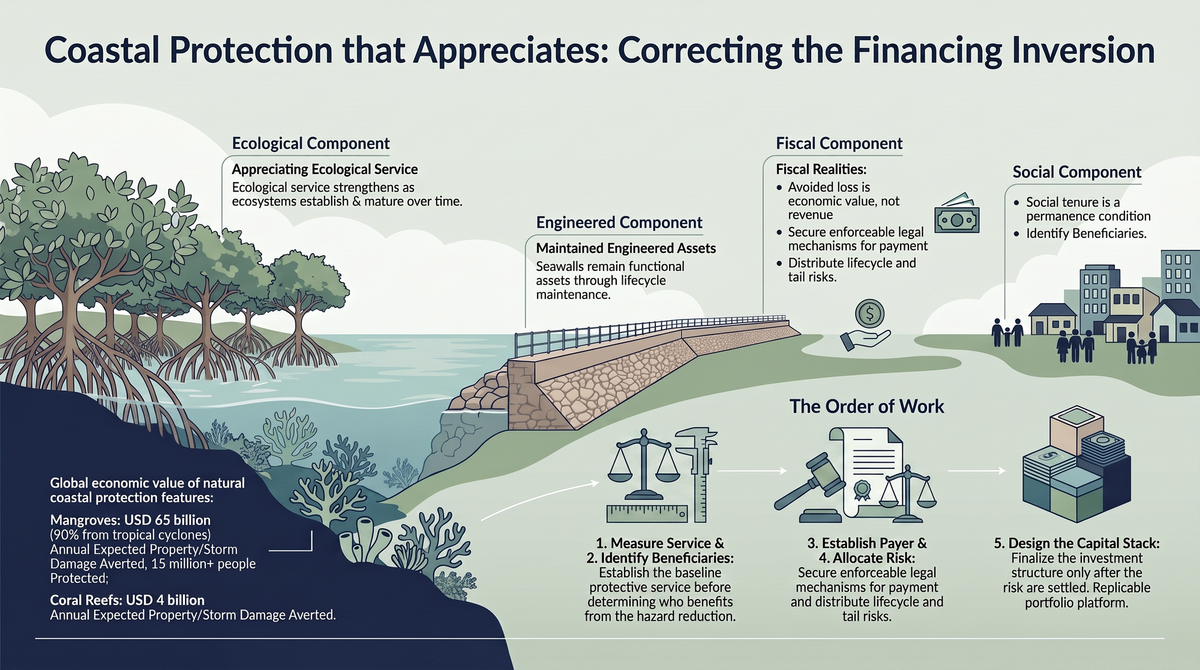
Bottom line. Coastal protection is often assessed by the asset that is easiest to procure and record: the constructed defense. Yet a mangrove, marsh, seagrass meadow, or reef may provide protective services that increase as ecological condition improves. That does not make every ecosystem an appreciating financial asset. Ecological maturation, economic value, accounting recognition, insurance, and investable cash flow are distinct concepts. The financing task is to connect them: select the right solution for the hazard and site, measure the service, identify who benefits, and create a lawful payment mechanism to fund stewardship and capital. Nature-based solutions should be preferred where conditions support them; hybrid and engineered measures remain appropriate where they do not.
Off the coast of Kep in southern Cambodia, a dugong was recorded again in 2024 after a prolonged absence. The observation is an encouraging biological signal because dugongs depend on a functioning seagrass habitat. It is not, by itself, proof that fisheries, carbon storage, and coastal protection have fully recovered; each service requires its own baseline and measurement. The distinction matters. A credible financing case begins not with an emblematic species or a global value estimate, but with a service measurable at a specific site and linked to a beneficiary. The dugong is therefore best read as an invitation to investigate recovery, not as a substitute for evidence of recovery.[1]
The central argument of this paper is that coastal ecosystems should be treated as productive resilience infrastructure rather than incidental environmental co-benefits. Conventional project systems tend to prioritize seawalls or breakwaters over the local ecosystem. This bias is understandable: engineered assets have defined owners, quantities, design standards, construction contracts, and maintenance schedules. Ecosystems cross property boundaries, produce both public and private benefits, and remain exposed to ecological disturbance and governance failure. The response should not be to pretend that nature behaves like concrete, but to build the accounting, contracting, and stewardship architecture appropriate to a living asset.
The argument runs in one direction. Measure the protective service, identify the beneficiaries, establish the payer and the legal mechanism, allocate lifecycle and tail risk, and only then design the capital stack. Skipping a step means the financing does not close.
A note on method and evidence. This is a practitioner analysis rather than a systematic review, and it draws on evidence of varying weight, with distinctions noted in the text where they matter. In descending order of strength, it rests on peer-reviewed research, official institutional and project documentation, independently evaluated transactions, results reported by implementers, and, most provisionally, proposed financing models and the author’s own field recollection. Evidence is current as of July 2026.
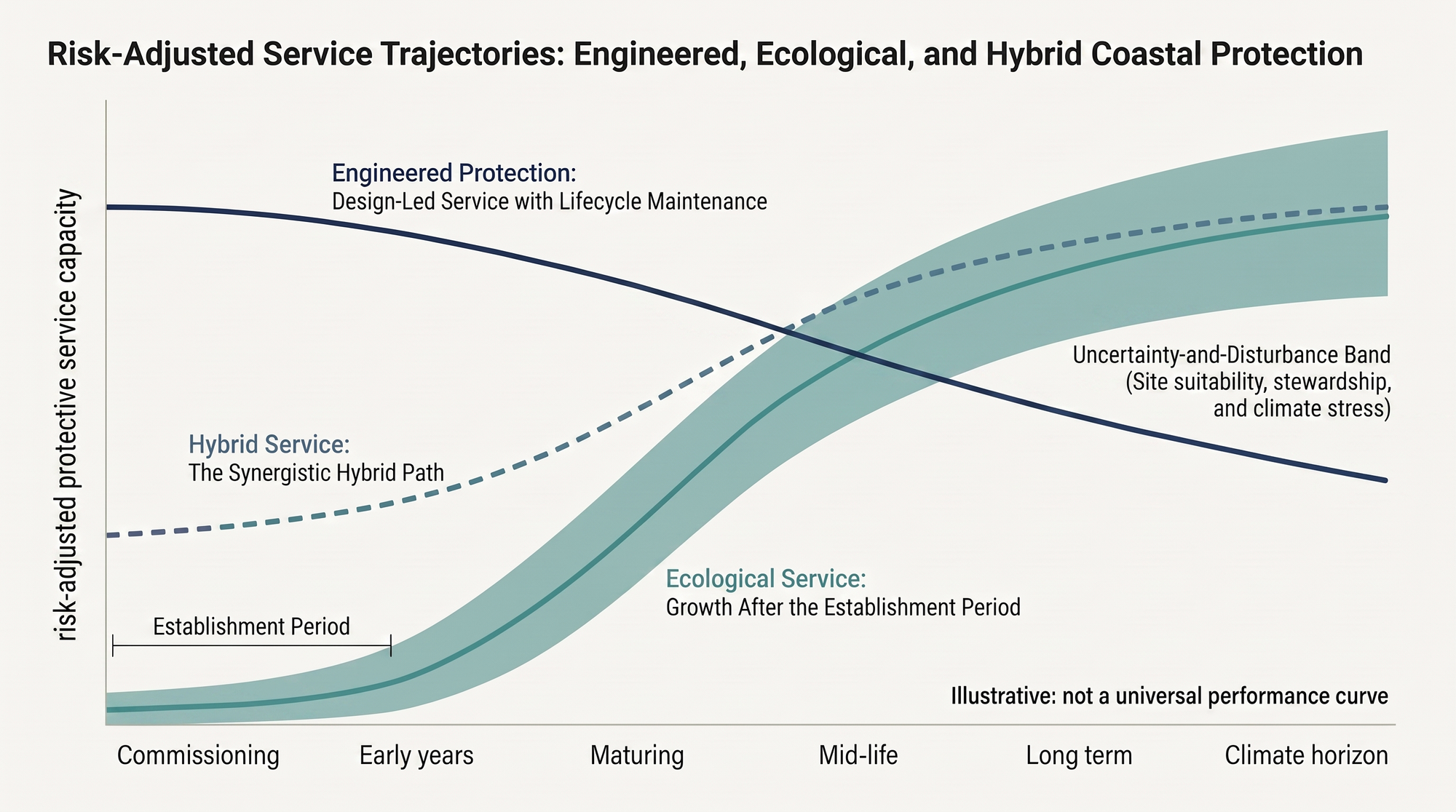
The stronger proposition is that coastal protection should be evaluated using a risk-adjusted lifecycle service approach. The engineered component has a service curve defined by design, maintenance, and upgrades. The ecological component has an establishment curve, a range of possible performance outcomes, and ongoing stewardship costs. A hybrid intervention combines these trajectories. In some locations, the structure serves as a temporary scaffold while sediment and vegetation establish; in others, it remains a permanent defense because the ecosystem alone cannot meet the required service standard.
Accounting is changing, but the gap remains: we can no longer say that ecosystems are worth nothing on the ledger. The United Nations System of Environmental-Economic Accounting—Ecosystem Accounting organizes information on ecosystem extent, condition, services, and asset values, and can link those accounts to economic activity.[3] In January 2026, the International Public Sector Accounting Standards Board issued IPSAS 51, Tangible Natural Resources Held for Conservation, with an effective date of 2028 and earlier application permitted.[4] These developments narrow an important reporting gap, though one still remains. Ecosystem accounts are statistical accounts, not automatically general-purpose financial statements. IPSAS 51 concerns tangible natural resources held for conservation and does not convert every ecosystem service into a recognizable asset or a tradable claim. More importantly, neither accounting system creates a payer. A government may quantify the value of mangrove protection and still lack a budget appropriation, levy, contract, or tariff through which that value funds restoration. The practical objective is therefore broader than “booking nature,” making green infrastructure visible in planning, appraisal, asset management, and fiscal decision-making, while constructing the payment arrangements needed for financing.
The Gradient: A Financing Principle, Not a Technology Preference
Coastal protection spans a gradient from fully engineered to predominantly ecological. The family of Natural and Nature-Based Features, developed in international flood-risk guidance, recognizes that natural features and intentionally designed nature-based features can complement conventional engineering.[5] The appropriate point on the gradient is determined by the hazard, required service level, geomorphology, available space, time horizon, asset criticality, lifecycle affordability, tenure, and climate trajectory, not by an ideological preference for gray or green.[6]
This fit-to-context discipline is essential because delayed ecological establishment carries a financial cost. When communities or critical infrastructure face immediate exposure, a measure that takes years to mature may have low present value or pose unacceptable interim risk. Hybrid design can bridge that gap. At Demak in Central Java, permeable brushwood and bamboo structures were used to reduce wave energy and capture sediment, allowing mangroves to recolonize naturally. These structures were enabling works, not substitutes for the ecosystem; they also required repair and did not eliminate the need to restore sediment and hydrological processes.[7]
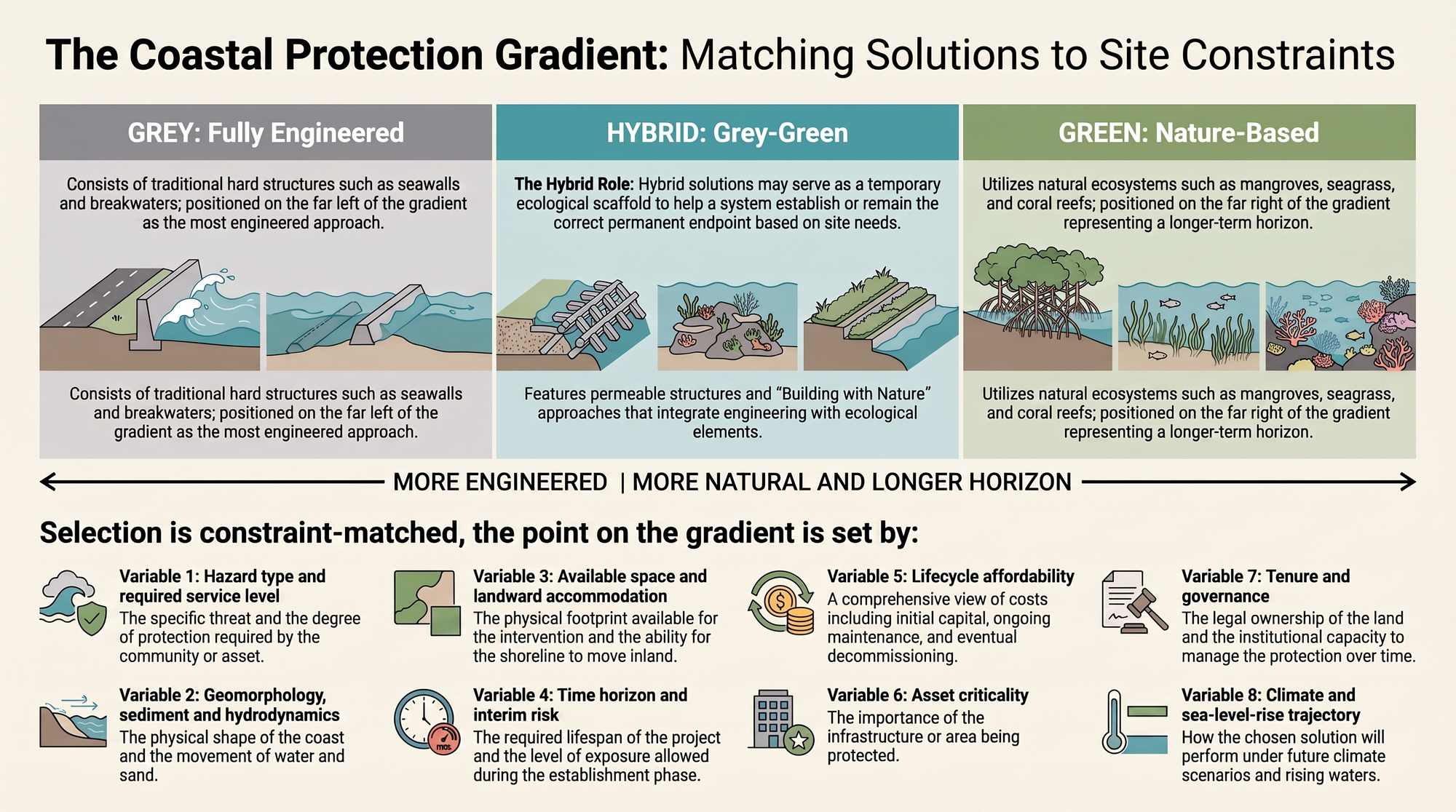
Mangroves, seagrass, salt marshes, and coral reefs are not automatically Ecosystem-based Adaptation merely because they are natural. Under the Convention on Biological Diversity and IUCN formulations, Ecosystem-based Adaptation uses biodiversity and ecosystem services as part of an adaptation strategy for people. The intervention must therefore be intentionally designed to reduce climate vulnerability, provide equitable benefits, avoid ecological harm, and operate within a broader adaptation plan.[8] A locally quarried stone structure with geotextile may fall within the hybrid family; a mangrove plantation in unsuitable hydrology may fail to qualify as an effective nature-based solution.
Calibrate the Claim to the Hazard
The case for financing coastal ecosystems weakens, not strengthens, when every ecosystem is presented as protection against every coastal hazard. Underwriters, engineers, and affected communities need hazard-specific performance data. The strongest evidence concerns wind waves, erosion, and selected components of cyclone-related flooding.
Das and Vincent’s analysis of 409 villages in Odisha, India, affected by the 1999 Odisha super cyclone found significantly fewer deaths in villages protected by wider mangrove belts, after controlling for other factors. The analysis also showed that the government’s early-warning system saved more lives.[9] At the global scale, Menéndez and colleagues estimated that mangroves avert more than USD 65 billion in expected property damage annually and protect more than 15 million people; approximately 90% of the estimated benefit was associated with tropical cyclones.[10] Beck and colleagues estimated that coral reefs avert more than USD 4 billion in expected storm damage each year, with large proportional benefits from frequent events.[11] These estimates establish a material economic value. They do not imply that every hectare produces the global average, nor that a local project can monetize an allocated share of those totals.
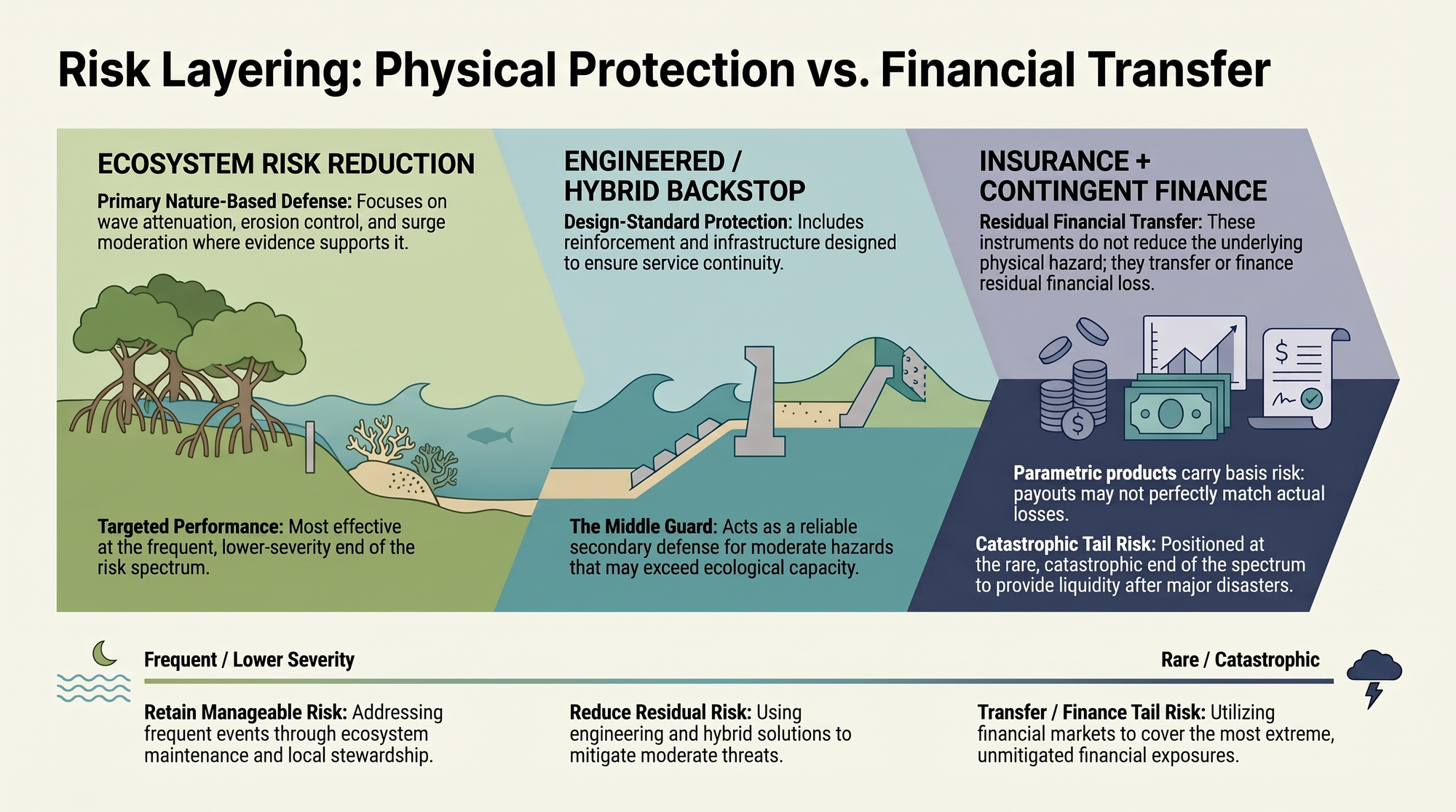
Performance depends on belt width, vegetation density and structure, bathymetry, water depth, storm duration, sediment dynamics, and the location of exposed assets. A credible project therefore translates global evidence into a local damage function: a relationship among ecosystem condition, hazard intensity, exposure, and expected loss. The function must specify the counterfactual and quantify uncertainty. Otherwise, “avoided loss” remains a narrative rather than an underwritable proposition. Tsunami protection illustrates the need for restraint. Research following the 2004 Indian Ocean tsunami found evidence of protection in some settings, while other studies were criticized for inadequate controls for elevation and exposure. Vegetation cannot be assumed to protect areas of maximum tsunami intensity.[12] The honest conclusion is that ecosystems can attenuate selected hazards within defined envelopes, while engineered measures, evacuation, warning systems, land-use planning, and financial protection remain necessary to address residual and catastrophic risk.
Three Environmental Outcomes and One Socioeconomic Engine in One Asset
A well-designed coastal ecosystem intervention can deliver adaptation, mitigation, and biodiversity outcomes through a single ecological system. These outcomes are governed by different policies and measurement frameworks, and only some are readily monetized. Local livelihoods and benefit sharing should not be treated as a decorative co-benefit; when communities determine whether an ecosystem remains intact, livelihood value is a primary socioeconomic outcome and a key risk control for permanence.
Adaptation: a calibrated protective service. Adaptation is the service most directly linked to coastal protection, reducing wave energy, erosion, flooding, and disruption. Countries increasingly include coastal ecosystems in their adaptation commitments. Cambodia’s Nationally Determined Contribution (NDC 3.0) includes the restoration, management, and conservation of mangroves, seagrass, coral reefs, flooded forests, and other aquatic habitats.[13] Such policy alignment can support country ownership and eligibility for concessional finance. However, it does not replace project-level evidence of hazard reduction, distributional benefits, or lifecycle performance.
Mitigation: protection and restoration are distinct carbon propositions. Mangroves, tidal marshes, and seagrass meadows store large quantities of carbon, particularly in soils. Coral reefs are not conventionally counted as blue-carbon ecosystems. A global synthesis estimated that restoring blue-carbon ecosystems could contribute approximately 841 million metric tons of carbon dioxide equivalent per year by 2030 under the scenarios it assessed.[14] This estimate is a potential outcome, not a guaranteed one, and should not be presented as a combined drawdown figure for both protection and restoration. Restoration can increase sequestration and carbon removal. Protection primarily avoids emissions from conversion or degradation and preserves existing stocks and ongoing sequestration. The strongest carbon case often lies in conserving intact systems because restoration can fail when hydrology, elevation, sediment supply, or species selection is inappropriate. Southeast Asia contains globally important mangrove resources and has also been a major locus of human-driven loss; the evidence on regional drivers and the global concentration of loss should be cited separately rather than collapsed into a single statistic.[15]
Biodiversity: co-equal but not automatically cash-generating. Biodiversity is a primary outcome, not a subordinate climate benefit. The planetary boundaries framework assesses biosphere integrity and climate change as transgressed, with biosphere integrity far outside its defined safe operating space; the apparent degree of transgression is framework-dependent and should not be interpreted as a directly commensurable measure of damage.[16] IPBES estimates that approximately one million species face extinction risk.[17] The World Economic Forum’s 2026 Global Risks Report continues to rank biodiversity loss and ecosystem collapse second on the ten-year horizon, behind extreme weather.[18] The Kunming–Montreal Global Biodiversity Framework commits parties to placing at least 30% of degraded terrestrial, inland-water, coastal, and marine ecosystems under effective restoration by 2030 and conserving at least 30% of terrestrial, inland-water, coastal, and marine areas through effective, representative, and equitably governed systems.[19] These commitments strengthen the public-policy case for coastal investment. They do not create a uniform biodiversity market. Biodiversity value may be reflected through regulation, public budgets, compensation mechanisms, grants, or emerging crediting approaches, but it should not be presented as a predictable revenue line without a specific legal and market structure.
Livelihoods, tenure, and permanence. A mangrove that sustains fisheries, tourism, restoration employment, or locally owned enterprises gives surrounding communities a tangible stake in its survival. In the Gulf of California, mangrove-related species accounted for approximately 32% of small-scale fishery landings, and the cited study estimated a median annual fishery value of about USD 37,500 per hectare of mangrove fringe.[20] That is a powerful result, but it is location- and period-specific rather than a transferable global coefficient. Small-scale fisheries support the livelihoods of roughly 500 million people and account for most employment in capture fisheries value chains. Women participate extensively in harvesting, processing, trading, and subsistence activities, although the relevant percentages vary by role and denominator and should not be reduced to a single claim that women comprise half of all direct workers.[21] Coral-reef tourism has been valued at nearly USD 36 billion annually worldwide.[22] The financing question is who captures those benefits. Local income does not automatically fund ecosystem stewardship unless rights, fees, concessions, cooperatives, trust arrangements, or benefit-sharing rules link the income to the asset.
Projects affecting Indigenous Peoples must meet applicable Free, Prior and Informed Consent requirements. Other coastal projects require meaningful and inclusive participation, informed decision-making, lawful tenure and resource-access arrangements, equitable benefit-sharing, and functioning grievance mechanisms.[23] Consent and tenure are critical, but they operate alongside hydrology, sediment, water quality, enforcement, and financing. Treating any single variable as universally binding would repeat the oversimplification this paper seeks to correct.
From Economic Value to Bankable Cash Flow
Avoided loss is the most important economic benefit in the coastal-protection case, but it is not automatically revenue. It becomes revenue only when an identifiable beneficiary agrees to pay the ecosystem manager, project company, or public authority, or is required by law to do so. A global estimate of USD 65 billion in annual damage avoided by mangroves is not a cash pool that can service project debt. The financing structure must identify the payer, payment basis, recipient, legal authority, performance metric, appropriation risk, and consequences of underperformance.
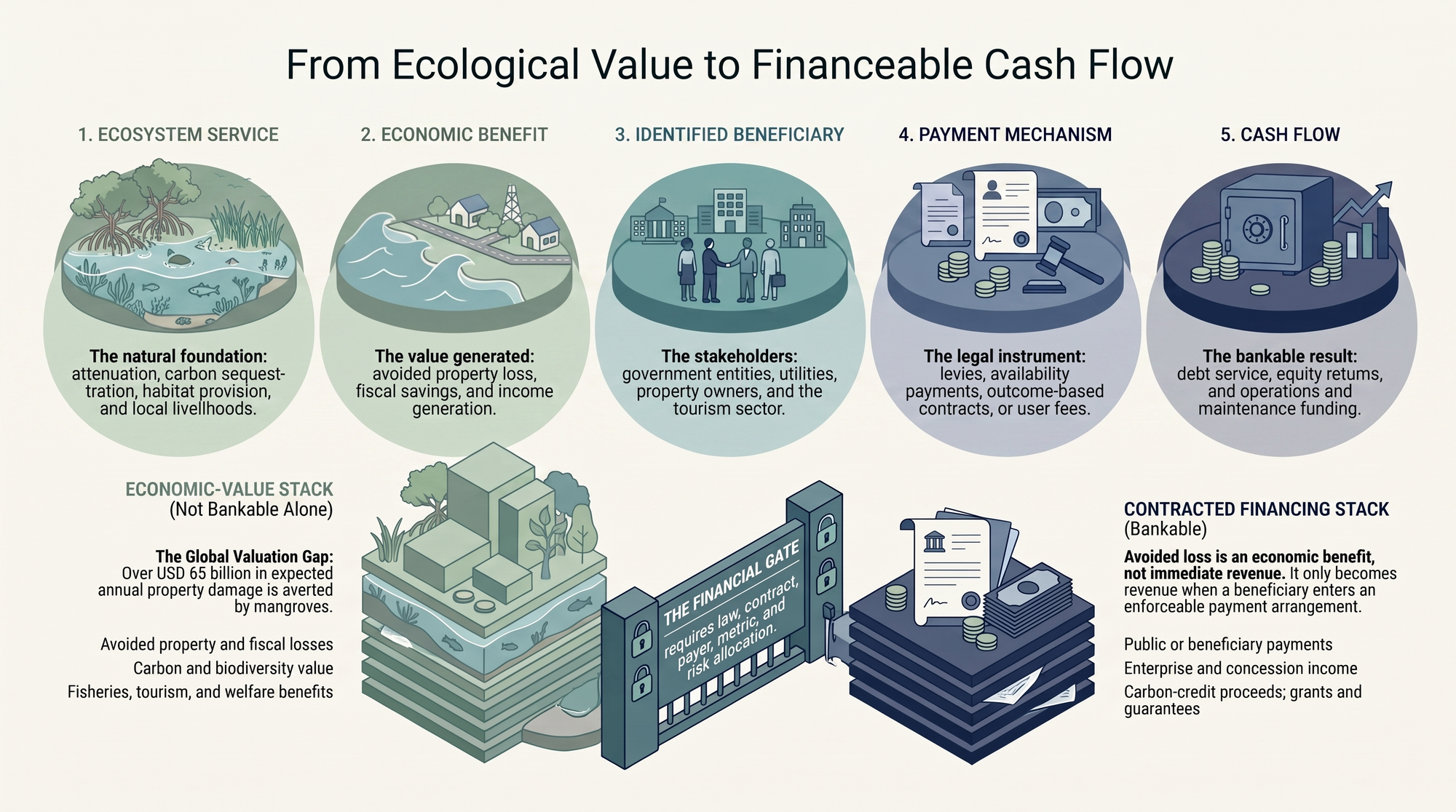
The payer architecture. In practice, coastal resilience can be funded through several payer models. A government may procure protection through an availability payment, a performance-based service contract, or a multiyear budget program. Property owners, hotels, or tourism operators may contribute through a levy or a coastal management trust, provided the benefit base and governance are credible. Utilities, ports, or transport operators may pay when an ecosystem protects a defined asset or service. Fisheries and tourism businesses may generate conventional enterprise income under concessions or community arrangements. Carbon proceeds may supplement the structure when methodology, additionality, leakage, permanence, and rights are robust. Grants, guarantees, and concessional first-loss capital can finance public goods and risks that cannot be allocated commercially. This is why we should distinguish an economic-value stack from a contracted financing stack. The first includes avoided losses, carbon value, biodiversity, livelihoods, and welfare. The second contains only cash flows and risk-bearing instruments legally available to the project. Mixing the two creates the appearance of bankability without the underlying contracts.
Insurance: protection of the balance sheet, not payment for every avoided loss. The Mesoamerican Reef transaction in Quintana Roo, Mexico, demonstrated that a natural asset can be insured. A coastal management trust, funded by public and private beneficiaries, purchased a parametric policy that paid out USD 850,000 after Hurricane Delta in 2020 to fund rapid reef repair.[24] The innovation is important: beneficiary contributions funded the premium, the wind-speed trigger provided liquidity, and trained teams repaired the natural asset. The payout was not compensation for ex ante avoided damage, and the insurer did not purchase the reef’s risk-reduction service. The distinction also clarifies the experience of the Restoration Insurance Service Company (RISCO). Its original design contemplated annual fees from insurers for mangrove-related risk reduction, supplemented by blue-carbon revenues. According to a 2024 Climate Policy Initiative review, insurer buy-in proved difficult without demonstrated results. The model was restructured into RISCO Insurance, an agent selling parametric coverage, and RISCO Fund, which is intended to invest revenue and concessional capital in mangrove-positive businesses and green–gray infrastructure. The revised structure explores insurance commissions, carbon proceeds, premium cost savings, and concessional debt, while facing slow implementation, small ticket sizes, pipeline constraints, and limited insurance-industry participation.[25] RISCO is therefore evidence of useful experimentation, not proof that avoided-loss underwriting has become a scalable anchor revenue stream. The broader lesson is more valuable: insurers can contribute data, catastrophe modeling, product design, and contingent liquidity, but a coastal project still needs beneficiaries able and willing to pay premiums, fees, or contracted performance payments.
Cambodia: Resource Recovery Before Infrastructure
Cambodia presents a strong public investment case, provided the chronology and attribution are clearly stated. The Sustainable Coastal and Marine Fisheries Project, approved in December 2022, operates across Kampot, Kep, Koh Kong, and Preah Sihanouk and is financed by an ADB-administered package of about USD 93 million, including USD 20 million in cofinancing from the Agence Française de Développement, administered by ADB, for a total project cost of about USD 104 million.[26] The project combines climate-resilient post-harvest infrastructure and value chain development with the restoration and management of coastal and marine ecosystems, including mangroves, seagrass, and coral habitats. It targets roughly 20,000 households and about 200,000 people. It was described as ADB’s first significant investment in Cambodia’s marine fisheries sector, not necessarily the first such investment by every partner. The policy rationale now sits within Cambodia’s NDC 3.0 and its fisheries and coastal management frameworks.[13]
Marine Conservation Cambodia’s work in Kep predates the project and includes marine monitoring, protection against destructive trawling, restoration structures, and support for the Marine Fisheries Management Area. The renewed dugong observation and reported seagrass recovery are consistent with habitat improvement, but the cited material has not independently isolated the causal attribution among conservation measures, enforcement, natural recovery, and the development project.[1] The author’s recollection of the project’s design logic, relayed by a former ADB colleague, remains analytically useful: financing fishing landing sites and value chains for a depleted resource could leave the infrastructure stranded, so resource recovery had to be treated as a productive precondition. The claim should be presented as practitioner recollection unless project records or interviews corroborate the sequence. Properly framed, the case illustrates a central principle: development banks should finance the ecological production base and the dependent infrastructure as a single program, rather than treating the ecosystem as an external safeguard.
Five Pathways Practitioners Can Build
Pathway 1: Public procurement of resilience services. When avoided losses are broadly borne by the state and the public, public procurement remains the most direct approach. The government sets service standards, funds establishment and stewardship, and pays based on availability, ecological condition, or verified performance. Concessional finance can provide long-term capital, while the budget supports recurrent stewardship. The critical design questions are the damage function, appropriation commitment, performance regime, adaptive-management rights, and treatment of extreme events outside the design envelope.
Pathway 2: Beneficiary-funded trusts and levies. When benefits are concentrated among identifiable hotels, property owners, ports, or tourism businesses, a statutory levy or a negotiated trust can pool payments. Quintana Roo illustrates the governance logic: beneficiaries contribute to a vehicle that funds maintenance and purchases insurance. The structure requires a defensible benefit area, transparent governance, representation of affected communities, credible use-of-funds rules, and protection against free riding.
Pathway 3: Aggregated coastal-resilience portfolios. Aggregation can reduce transaction costs, diversify ecological and permanence risks, standardize monitoring, and create a pipeline large enough to attract development finance or institutional participation. It does not, by itself, create bankability. Each site must still have a payer or a public funding commitment. The portfolio manager pools contracts, harmonizes metrics, provides technical assistance, and uses guarantees or first-loss capital to address early performance, currency, political, and credit risks. Given the early stage of nature-based investment markets, the more accurate objective is a replicable portfolio platform rather than a fully formed asset class.[27]
Pathway 4: Tenure-and-livelihoods-first conservation. When preserved ecosystems provide the highest carbon and protection value, finance should prioritize avoiding conversion. The approach begins with rights, enforcement, and benefit-sharing rather than planting. Community enterprises, sustainable fisheries, tourism concessions, restoration employment, and conservation payments can generate local cash flows, while public and philanthropic capital funds public-good components. The project’s financial model must include the costs of governance, monitoring, and conflict resolution rather than treating them as external safeguards.
Pathway 5: Lifecycle hybrid contracting. Hybrid projects should be contracted as sequenced service systems. The engineered component may provide immediate protection and ecological establishment conditions, while the ecosystem assumes an increasing share of service as performance allows. The contract specifies handoff criteria, monitoring, maintenance, adaptation to sea-level rise, and responsibility if ecological thresholds are not met. This approach avoids both extremes: a seawall procured without regard for the ecosystem and an ecological intervention expected to meet an engineering standard that cannot be reliably met.
The Practitioner Agenda
The field faces both a financing shortage and a transaction-infrastructure shortage. UNEP’s 2025 Adaptation Gap Report estimates that developing-country adaptation needs will reach approximately USD 310–365 billion annually by 2035, compared with international public adaptation finance of USD 26 billion in 2023.[28] Affordable grants, concessional capital, project-development finance, and long-tenor local-currency funding are therefore scarce. At the same time, more money will not solve projects that lack service standards, rights, payers, contracts, or credible delivery institutions.
On the technical front, practitioners must shift from generic ecosystem values to site-specific performance metrics: baseline condition, hazard calibration, counterfactual loss, uncertainty, establishment period, climate stress, monitoring protocol, and lifecycle cost. Catastrophe-model integration is useful, but it should not be the sole gateway to action; many public investments can proceed with robust economic appraisal even before insurer-grade models are available.
On the financial and contractual front, every proposal should identify the beneficiary and payer before presenting the revenue stack. The financing model should distinguish among grants for public goods, budget payments for public services, enterprise income, environmental credit proceeds, risk transfer, and investor cash flow. Guarantees and first-loss capital should address identified risks, such as performance, credit, currency, or political risk, rather than compensate for a missing revenue model.
On the institutional front, interventions should be anchored in national climate, adaptation, and biodiversity plans, but policy alignment is not a substitute for mandates. Finance, environment, fisheries, maritime, infrastructure, and subnational authorities need clearly defined roles. Asset registers and ecosystem accounts should inform capital planning. Procurement rules must accommodate adaptive management and long-term stewardship. Where benefits cross jurisdictional boundaries, a dedicated trust, facility, or programmatic platform may be necessary.
On the social front, rights and distribution are integral to asset performance. Projects need lawful tenure, inclusive participation, appropriate FPIC when Indigenous Peoples are affected, transparent benefit-sharing, and accessible grievance mechanisms. Women’s roles across fisheries value chains should be reflected in design and measurement, rather than invoked by an imprecise global percentage. Local institutions require funding over the same time horizon as ecological stewardship.
The order of work is therefore precise: “Measure the service.” Test ecological and social conditions. Identify the beneficiaries. Determine which benefits are public, private, or shared. Establish the payer and the legal mechanism. Allocate lifecycle and extreme-event risks. Only then design the capital stack. This sequence is less dramatic than declaring a new asset class, but it is the path to making coastal ecosystems bankable without overstating what the evidence or the market can yet support.
Conclusion: Finance the Service, Steward the System
The coast off Kep is not simply a conservation story with a financing footnote. It is a production system in which habitat conditions, fisheries, public resilience, and infrastructure value are interdependent. The return of a dugong is a sign worth noting; the investment case begins when ecological recovery, protective performance, and local value are measured and managed.
Coastal protection appreciates when ecological conditions and service capacity improve and when institutions preserve those gains over time. Economic value appreciates when exposure, service quality, and avoided losses are justified. Financeable value appears only when beneficiaries and public authorities convert part of that value into enforceable cash flow. The seawall is not the enemy, and nature is not a maintenance-free bond. The practical innovation is to design the coast as a single lifecycle resilience system, ecological, engineered, fiscal, and social, and to finance each component according to the service it actually provides.
Watch an overview and explainer podcast and video of this paper on the NbS Praxis YouTube channel. The written analysis above is the definitive version.
Produced by the author. Visuals produced with Claude and NotebookLM. Initial research and consolidation are AI-augmented using Perplexity and Claude. Peer-reviewed by ChatGPT and the author. Fact-checked by Perplexity. All substance, drafting, and final editing are the author's.
Endnotes
[1] Marine Conservation Cambodia, organizational material on the Kep Marine Fisheries Management Area, seagrass monitoring and marine-mammal observations; Cambodianess, “Dugongs Make Triumphant Return to Kep After Decade-Long Absence,” 2 September 2025, reporting the first renewed observations in 2024. Implementer-reported recovery and causal attribution have not been independently re-derived. https://cambodianess.com/article/dugongs-make-triumphant-return-to-kep-after-decade-long-absence
[2] Intergovernmental Panel on Climate Change, Climate Change 2022: Impacts, Adaptation and Vulnerability, Working Group II, Chapter 3, “Oceans and Coastal Ecosystems and their Services,” including high-confidence risks to habitat-forming coastal ecosystems and widespread decline of coral reefs. https://www.ipcc.ch/report/ar6/wg2/chapter/chapter-3/
[3] United Nations, System of Environmental-Economic Accounting—Ecosystem Accounting, an integrated statistical framework for ecosystem extent, condition, services and asset values. https://seea.un.org/ecosystem-accounting
[4] International Public Sector Accounting Standards Board, IPSAS 51, Tangible Natural Resources Held for Conservation, issued 22 January 2026; effective for periods beginning on or after 1 January 2028, with earlier application permitted. https://www.ipsasb.org/publications/ipsas-51-tangible-natural-resources-held-conservation
[5] T. S. Bridges, J. K. King, J. D. Simm, M. W. Beck et al., eds., International Guidelines on Natural and Nature-Based Features for Flood Risk Management (U.S. Army Corps of Engineers, Engineering With Nature Initiative, 2021). https://ewn.erdc.dren.mil/international-guidelines-on-natural-and-nature-based-features-for-flood-risk-management/
[6] World Bank and Global Facility for Disaster Reduction and Recovery, Implementing Nature-Based Flood Protection: Principles and Implementation Guidance (Washington, DC: World Bank, 2017). https://www.gfdrr.org/en/publication/implementing-nature-based-flood-protection
[7] EcoShape and Wetlands International, Building with Nature Indonesia, Demak, Central Java, 2015–2021. The program used permeable structures to attenuate waves and capture sediment, alongside restoration of hydrological and sediment processes and community measures. https://www.wetlands.org/case-study/building-with-nature-indonesia/
[8] Convention on Biological Diversity, Decision X/33 and subsequent guidance on Ecosystem-based Adaptation; IUCN, Global Standard for Nature-based Solutions (2020). EbA is defined through its adaptation purpose and social-ecological criteria rather than by vegetation type alone. https://www.cbd.int/decision/cop?id=12299
[9] S. Das and J. R. Vincent, “Mangroves Protected Villages and Reduced Death Toll during Indian Super Cyclone,” Proceedings of the National Academy of Sciences 106, no. 18 (2009): 7357–7360. https://doi.org/10.1073/pnas.0810440106
[10] P. Menéndez, I. J. Losada, S. Torres-Ortega, S. Narayan and M. W. Beck, “The Global Flood Protection Benefits of Mangroves,” Scientific Reports 10 (2020): 4404. https://doi.org/10.1038/s41598-020-61136-6
[11] M. W. Beck, I. J. Losada, P. Menéndez, B. G. Reguero, P. Díaz-Simal and F. Fernández, “The Global Flood Protection Savings Provided by Coral Reefs,” Nature Communications 9 (2018): 2186. https://doi.org/10.1038/s41467-018-04568-z
[12] F. Danielsen et al., “The Asian Tsunami: A Protective Role for Coastal Vegetation,” Science 310 (2005): 643; K. Kathiresan and N. Rajendran, “Coastal Mangrove Forests Mitigated Tsunami,” Estuarine, Coastal and Shelf Science 65 (2005): 601–606; and subsequent methodological rebuttals addressing elevation, exposure, and causal inference. https://www.iatp.org/documents/the-asian-tsunami-a-protective-role-for-coastal-vegetation https://www.science.org/doi/10.1126/science.1118387
[13] Kingdom of Cambodia, Cambodia’s Third Nationally Determined Contribution (NDC 3.0), submitted 8 August 2025, including restoration, management and conservation of mangroves, seagrass, coral reefs and aquatic habitats. https://unfccc.int/sites/default/files/2025-08/Cambodia-NDC%203.0_0.pdf
[14] P. I. Macreadie et al., “Blue Carbon as a Natural Climate Solution,” Nature Reviews Earth & Environment 2 (2021): 826–839. The synthesis estimated the restoration potential of 841 (621–1,064) Tg CO2e per year by 2030 under assessed scenarios and distinguished blue-carbon ecosystems from coral reefs. https://doi.org/10.1038/s43017-021-00224-1
[15] D. R. Richards and D. A. Friess, “Rates and Drivers of Mangrove Deforestation in Southeast Asia, 2000–2012,” Proceedings of the National Academy of Sciences 113 (2016): 344–349; and L. Goldberg et al., “Global Declines in Human-Driven Mangrove Loss,” Global Change Biology 26 (2020): 5844–5855, on geographic concentration and changing drivers of mangrove loss. https://www.pnas.org/doi/10.1073/pnas.1510272113
[16] K. Richardson, W. Steffen, W. Lucht, J. Rockström et al., “Earth beyond Six of Nine Planetary Boundaries,” Science Advances 9, no. 37 (2023): eadh2458. https://doi.org/10.1126/sciadv.adh2458
[17] Intergovernmental Science-Policy Platform on Biodiversity and Ecosystem Services, Global Assessment Report on Biodiversity and Ecosystem Services: Summary for Policymakers (2019). https://www.ipbes.net/global-assessment
[18] World Economic Forum, The Global Risks Report 2026, 21st edition. On the ten-year horizon, extreme weather ranks first and biodiversity loss and ecosystem collapse second. https://www.weforum.org/publications/global-risks-report-2026/
[19] Convention on Biological Diversity, Kunming–Montreal Global Biodiversity Framework, Decision 15/4 (2022), especially Target 2 on placing at least 30 percent of degraded ecosystems under effective restoration and Target 3 on effective conservation and management of at least 30 percent of terrestrial, inland-water, coastal and marine areas by 2030. https://www.cbd.int/gbf/targets
[20] O. Aburto-Oropeza, E. Ezcurra, G. Danemann, V. Valdez, J. Murray and E. Sala, “Mangroves in the Gulf of California Increase Fishery Yields,” Proceedings of the National Academy of Sciences 105, no. 30 (2008): 10456–10459. https://doi.org/10.1073/pnas.0804601105
[21] FAO, Duke University and WorldFish, Illuminating Hidden Harvests: The Contributions of Small-Scale Fisheries to Sustainable Development (Rome: FAO, 2023), including estimates of approximately 492–500 million people depending at least partly on small-scale fisheries and detailed gender-disaggregated roles across value chains. https://openknowledge.fao.org/items/bbc2093d-69d9-4f1b-ae51-cfaa2969b52f
[22] M. Spalding, L. Burke et al., “Mapping the Global Value and Distribution of Coral Reef Tourism,” Marine Policy 82 (2017): 104–113. https://doi.org/10.1016/j.marpol.2017.05.014
[23] International Finance Corporation, Performance Standard 7: Indigenous Peoples (2012), including circumstances in which Free, Prior and Informed Consent is required, together with broader consultation and participation requirements under the IFC Performance Standards. https://www.ifc.org/en/insights-reports/2012/ifc-performance-standard-7
[24] The Nature Conservancy, Government of Quintana Roo, and insurance partners, reef insurance and post-storm response documentation. The parametric policy produced a USD 850,000 payout following Hurricane Delta in 2020 for reef repair and restoration. See A Post-Storm Response Reef Insurance Primer (2021). https://www.conservationgateway.org/collections/ocean/post-storm-response-reef-insurance-primer/
[25] A. Brasil-Leigh, R. Byrd, P. Käfer, G. Miao, M. Ruiz-Sierra, A. Vieira and W. Wallock, Toolbox on Financing Nature-Based Solutions (Climate Policy Initiative, September 2024), pp. 31–35. The review documents RISCO’s original insurer-fee model, restructuring into RISCO Insurance and RISCO Fund, and implementation and scaling constraints. https://www.climatepolicyinitiative.org/publication/toolbox-on-financing-nature-based-solutions/
[26] Asian Development Bank, Sustainable Coastal and Marine Fisheries Project, Cambodia, project 53261-001, approved 8 December 2022. The ADB-administered financing package of about USD 93 million comprises a USD 41 million ADB loan, a USD 22 million Asian Development Fund grant, a USD 10 million ASEAN Infrastructure Fund loan under the ASEAN Catalytic Green Finance Facility, and USD 20 million in Agence Française de Développement cofinancing administered by ADB. The project data sheet reports total project financing of about USD 104 million, comprising USD 63 million in ADB financing, USD 30 million in ADB-administered cofinancing, and USD 11 million in non-ADB (government and other counterpart) financing. https://www.adb.org/projects/53261-001/main
[27] Climate Policy Initiative, Toolbox on Financing Nature-Based Solutions (2024), concluding that NbS markets remain early-stage, private engagement is not mainstream, benefits are difficult to capture and monetize, and ecosystem-building, technical assistance, public support, guarantees, and beneficiary engagement are required before direct investment can scale. https://www.climatepolicyinitiative.org/publication/toolbox-on-financing-nature-based-solutions/
[28] United Nations Environment Programme, Adaptation Gap Report 2025 (29 October 2025), estimating developing-country adaptation finance needs of USD 310–365 billion annually by 2035 and international public adaptation finance flows of USD 26 billion in 2023. https://www.unep.org/resources/adaptation-gap-report-2025