No. 16 — Reversal Risk Gets Its First Number
A UN panel's draft tool would size carbon buffer pools from published disturbance data; Australia's ministers asked to tighten a forest method; the Senate refused to strike it down; and Copernicus ranked Indonesia's fire emissions the world's highest. Three numbers, none with a price tag yet.

The Climate-Nature Nexus in Practice (Weekly Briefing to 12 September 2026)
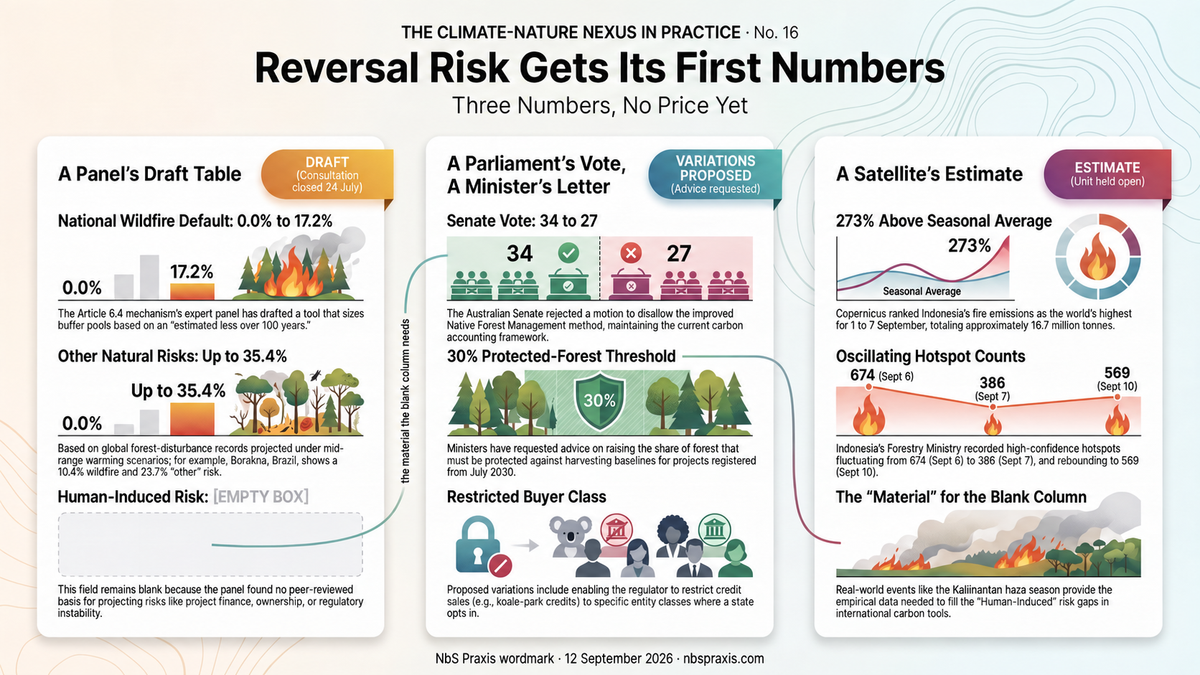
Bottom line: The Article 6.4 mechanism’s expert panel has drafted a reversal-risk tool that sizes buffer pools using published forest-disturbance data. More than 30 organizations submitted views before the Supervisory Body meets from 5 to 9 October. Australia’s Senate refused to disallow its native-forest carbon method by 34 votes to 27, while ministers asked their assurance committee to raise its protected-forest threshold to 30% starting July 2030. Copernicus ranked Indonesia’s fire emissions as the world’s highest in the first week of September. Three numbers, none final; What This Means sets out who must answer them.
Here is the gateway into the field, and the briefing is the room you walk into: [Podcasts and Video — Gemini Notebook: www.youtube.com/@nbspraxis]
Link to Explainer Video (Playlist of 1 Podcast and 3 Videos for Week 16, available at https://www.youtube.com/playlist?list=PLN6YQ7aUa6_U
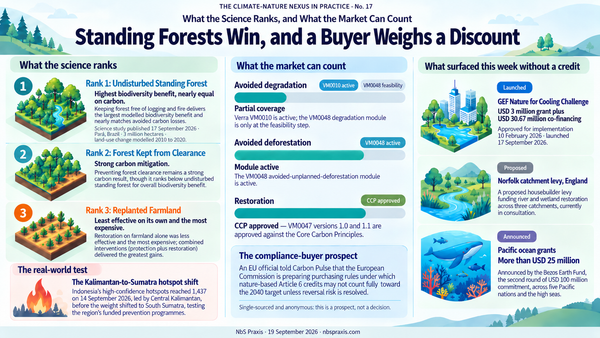
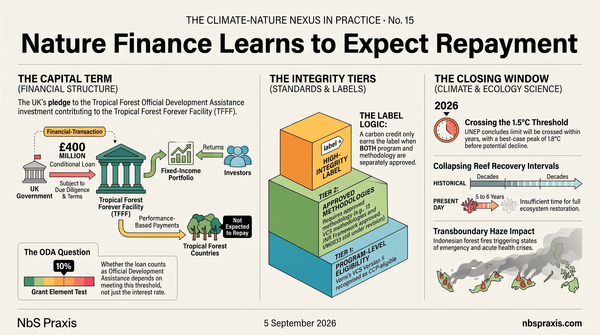
Last week’s briefing closed with a deadline: sovereign nature capital arrived with covenants and labeled conditions, and the science faced a shrinking window. [1] This week, the first numbers on what happens when stored carbon returns were released, and every one is provisional:
- In Bonn, Germany, the Article 6.4 mechanism’s Methodological Expert Panel has a draft reversal-risk tool that derives buffer-pool contributions from global forest-disturbance records; the draft applies only to clean-cooking activities and drew more than 30 submissions ahead of the Supervisory Body’s 5 to 9 October meeting. [2] [3]
- In Canberra, Australia, the Senate rejected a motion to disallow the Improved Native Forest Management method by 34 votes to 27, hours after ministers asked their assurance committee to advise on a 30% protected-forest threshold and a buyer restriction. [4] [5]
- In Kalimantan, Indonesia, Copernicus ranked the country’s fire emissions as the world’s highest for 1 to 7 September. [6]
Permanence has moved out of the methodology annex and into draft tables, ministerial letters, and satellite estimates, where practitioners can still shape the figures.
Numbers Before Prices
A draft table, a proposed variation, and an emissions estimate put figures on stored carbon coming back this week; none is yet a price.
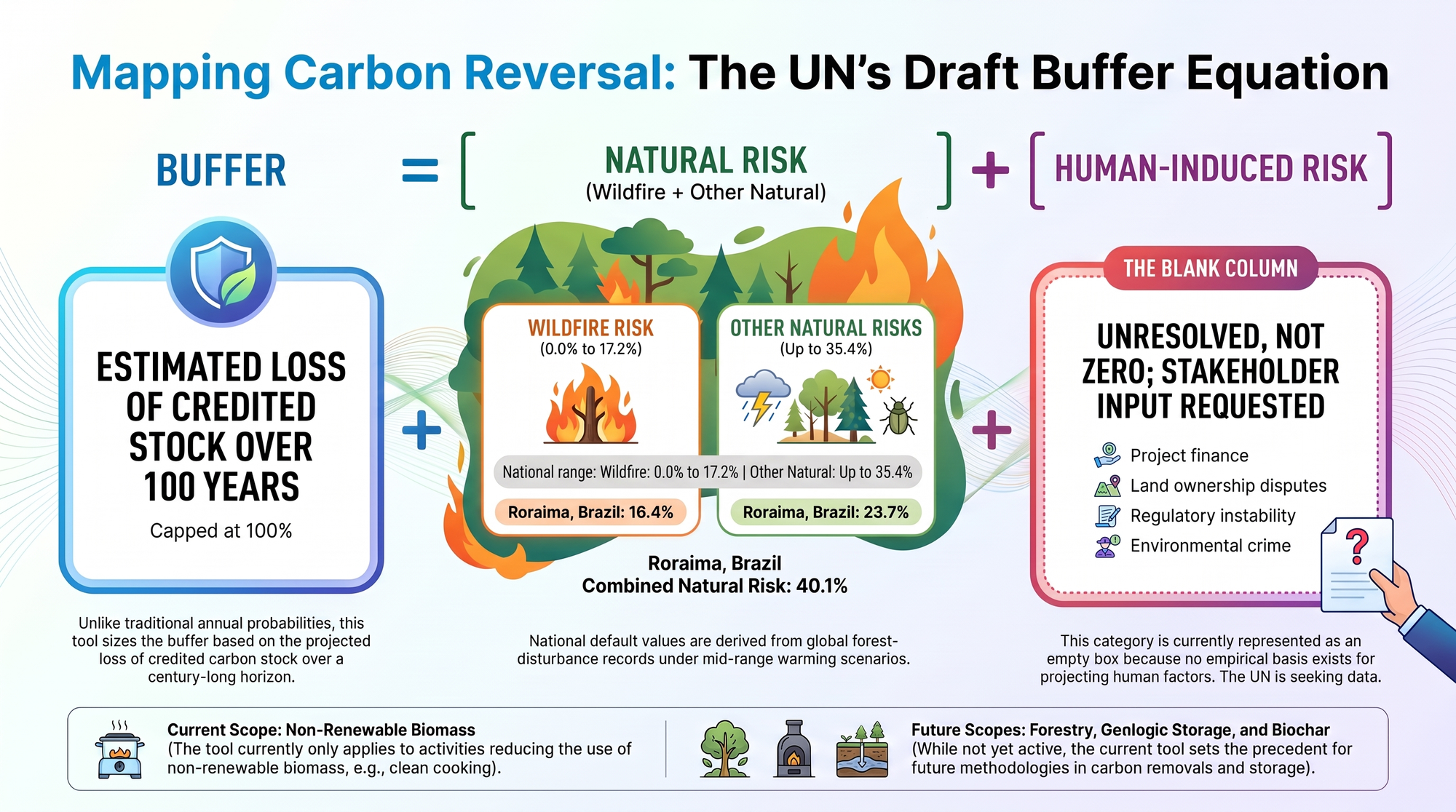
The draft tool is the week’s most consequential document. The July draft sets the buffer contribution as the sum of a natural-risk rating and a human-induced rating, each capped at 100%. Each rating reflects an estimated loss of credited stock over 100 years, not an annual probability.
Natural risk splits wildfire from other drivers and uses default values from global satellite records of forest disturbance projected under a mid-range warming scenario; national wildfire defaults range from 0.0% to 17.2%, and other natural risks up to 35.4% (Roraima, Brazil, at the subnational level: 16.4% plus 23.7%).
The human-induced fields are blank, unresolved rather than zero: the panel found no peer-reviewed basis for projecting risks such as project finance, ownership, regulatory instability, or crime, and asked stakeholders to supply one. [2]
Climate Home News reports more than 30 submissions with overlapping text and names Apple, the Beyond Alliance, Conservation International, The Nature Conservancy, and UNEP among the critics, three of whom reject the reading that they want a weaker tool. [3] The tool applies today only to activities reducing non-renewable biomass, and the Paris Agreement Crediting Mechanism has no approved nature-based methodology; what the Supervisory Body settles in October is a precedent for the forestry version, not a forest rule. [2] [7] [8]
Australia moved the same question through parliament, and the sequence matters. The Improved Native Forest Management method credits emissions avoided by cutting less native forest than an established harvesting baseline. On 10 September, before the vote, Ministers Bowen and Wilson announced that the Emissions Reduction Assurance Committee had been asked to advise on raising to 30% the share of forest that must be protected against the baseline before any credits are issued for projects registered from 1 July 2030, and on clarifying the definitions of plantation and native forest; the Clean Energy Regulator would also be enabled to restrict koala-park credit sales to a specified class of entities where a state opts in. [4] The Senate then rejected the disallowance motion by 34 votes to 27. [5] [9] Nothing in the method has changed yet; the variations await advice, and the buyer restriction is a stated intention. The design point stands: demand-side eligibility within a nature method, with liquidity as the cost.
Kalimantan supplied the estimate. Reuters reported Copernicus data showing Indonesia’s fire emissions for 1 to 7 September at 19.7 million tonnes, second only to the same week in 2015; the wire gave no unit, so this briefing carries the ranking and leaves the mass open. [6] Carbon Brief put the year to 7 September at 76 million tonnes of carbon, against 333 million for all of 2015. [10] The Forestry Ministry’s hotspot count fell from 674 on 6 September to 386 the next day, then rebounded to 569 on 10 September. [11] The connection to Bonn is a hypothesis, not a finding: the tool’s wildfire defaults are historical disturbance rates projected forward, while an El Niño season tracking 2015 in a jurisdiction where the ministry attributes most fires to deliberate burning is the kind of human-induced risk the draft leaves blank. [1] [2]
Capital produced two transactions and one restatement.
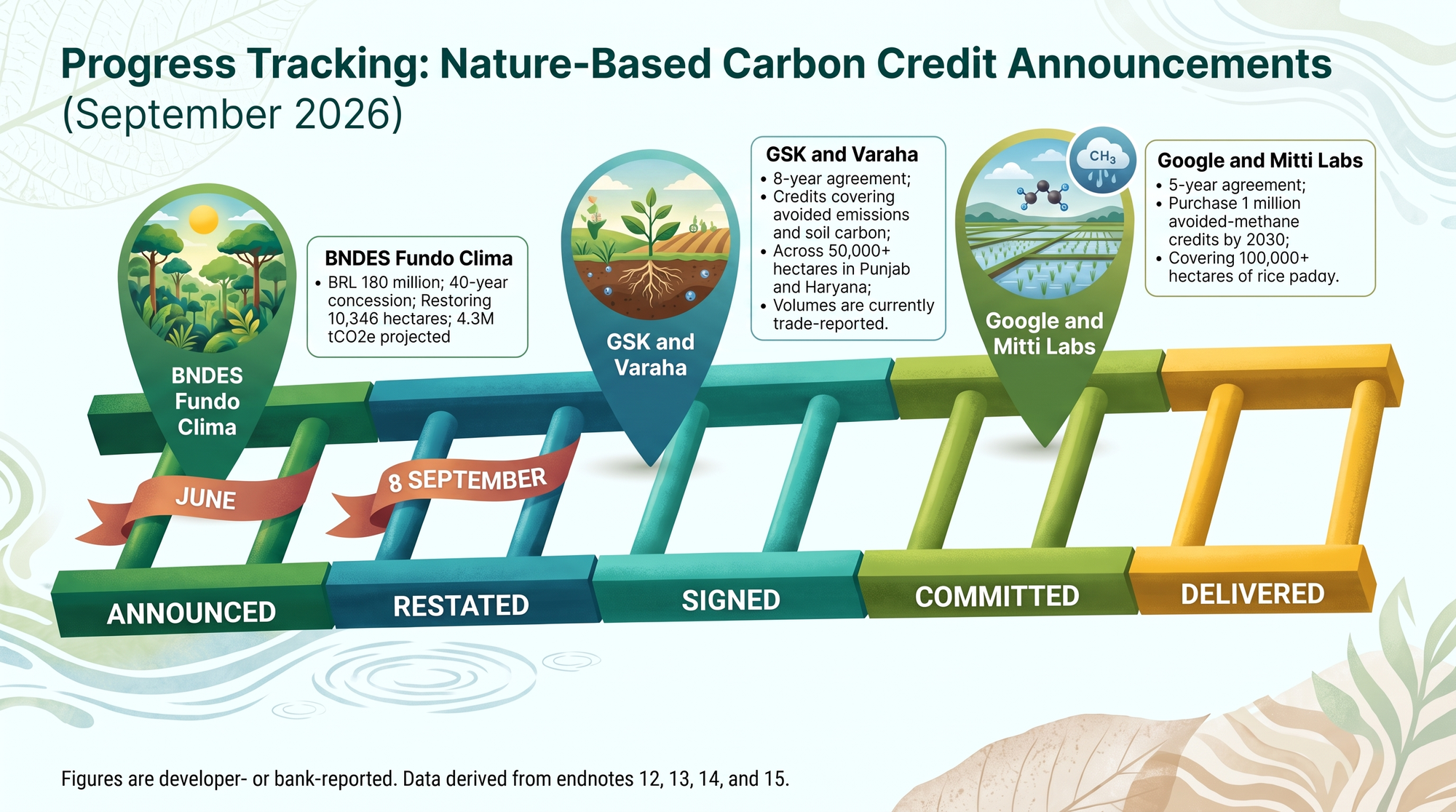
Google’s five-year agreement with Mitti Labs purchases 1 million credits by 2030 from alternate wetting and drying on more than 100,000 hectares of paddy; the release names neither the registry nor the methodology. [12] GSK’s eight-year agreement with Varaha covers credits from direct-seeded rice and reduced tillage on more than 50,000 hectares in Punjab and Haryana, a mix of avoided emissions and soil-carbon storage. [13] Neither announcement discloses a price, a risk premium, or an allocation away from forests, so any corporate shift toward low-reversal credits remains a hypothesis.
BNDES announced at the Dia da Amazônia event in Brasília on 8 September BRL 180 million from Fundo Clima, covering up to 80% of early-years investment in a 40-year concession restoring 10,346 hectares in Pará; the peer review of this issue places the same operation among the Fundo Clima financing letters BNDES announced in June, so the event restated a commitment rather than adding capital, and no approval, contract, or disbursement was stated. [14] [15]
The CBD’s Kunming Dialogue, closing on 9 September, named the structural problem: reliance on short-term funding creates barriers to long-term planning. [16]
The Record
The Article 6.4 mechanism’s draft reversal-risk tool drew more than 30 submissions ahead of the October Supervisory Body meeting.
The draft combines a natural-risk rating, an estimated loss over 100 years derived from global forest-disturbance records, and a human-induced rating left blank for lack of an empirical basis; national wildfire defaults range from 0.0% to 17.2%. The tool applies only to activities that reduce non-renewable biomass.
Current signal: the draft dates from July, consultation closed 24 July; the in-window development is the 8 September reporting. Primary UNFCCC document; critics per Climate Home News. (UNFCCC, July 2026; Climate Home News, 8 September 2026.) Source | Source
Australia’s Senate rejected disallowance of the Improved Native Forest Management method by 34 votes to 27, after ministers requested advice on tightening it.
The ministerial statement asks the Emissions Reduction Assurance Committee to advise on a 30% protected-forest threshold for projects registered from 1 July 2030 and says the regulator can restrict koala-park credit sales to a specified class of entities if a state opts in. Variations proposed, not made.
This week: statement and vote on 10 September; primary statement via a wire mirror; division per Hansard as reproduced by Wood Central; no amended instrument yet. (Ministers Bowen and Wilson, 10 September 2026; Wood Central, 11 September 2026.) Source | Source
BNDES restated BRL 180 million from Fundo Clima for the Triunfo do Xingu restoration concession in Pará.
The financing covers up to 80% of the project's initial investment, with the project costing about BRL 257 million to restore 10,346 hectares under a 40-year concession; the concessionaire projects 4.3 million tCO2e over the term. The announcement was part of BRL 235.8 million in BNDES actions presented at the event.
This week: announced 8 September; primary BNDES and MMA releases; first listed in June per the peer review; not a disbursement; the removal figure is a projection. (BNDES and MMA, 8 September 2026.) Source | Source
Google and GSK signed the week’s two largest nature-based offtake agreements, both on Indian farmland.
Google committed to 1 million rice-methane credits by 2030 from Mitti Labs under a five-year agreement covering more than 100,000 hectares; GSK signed an eight-year agreement for regenerative-agriculture credits from Varaha across more than 50,000 hectares in Punjab and Haryana, with trade press reporting more than 500,000 credits.
This week: Mitti Labs release of 10 September (primary; registry and methodology not stated); the GSK agreement was announced by Earthly on 8 September per the peer review, the volume trade-reported. (PR Newswire, 10 September 2026; ESG Today, 11 September 2026.) Source | Source
ASEAN in Focus
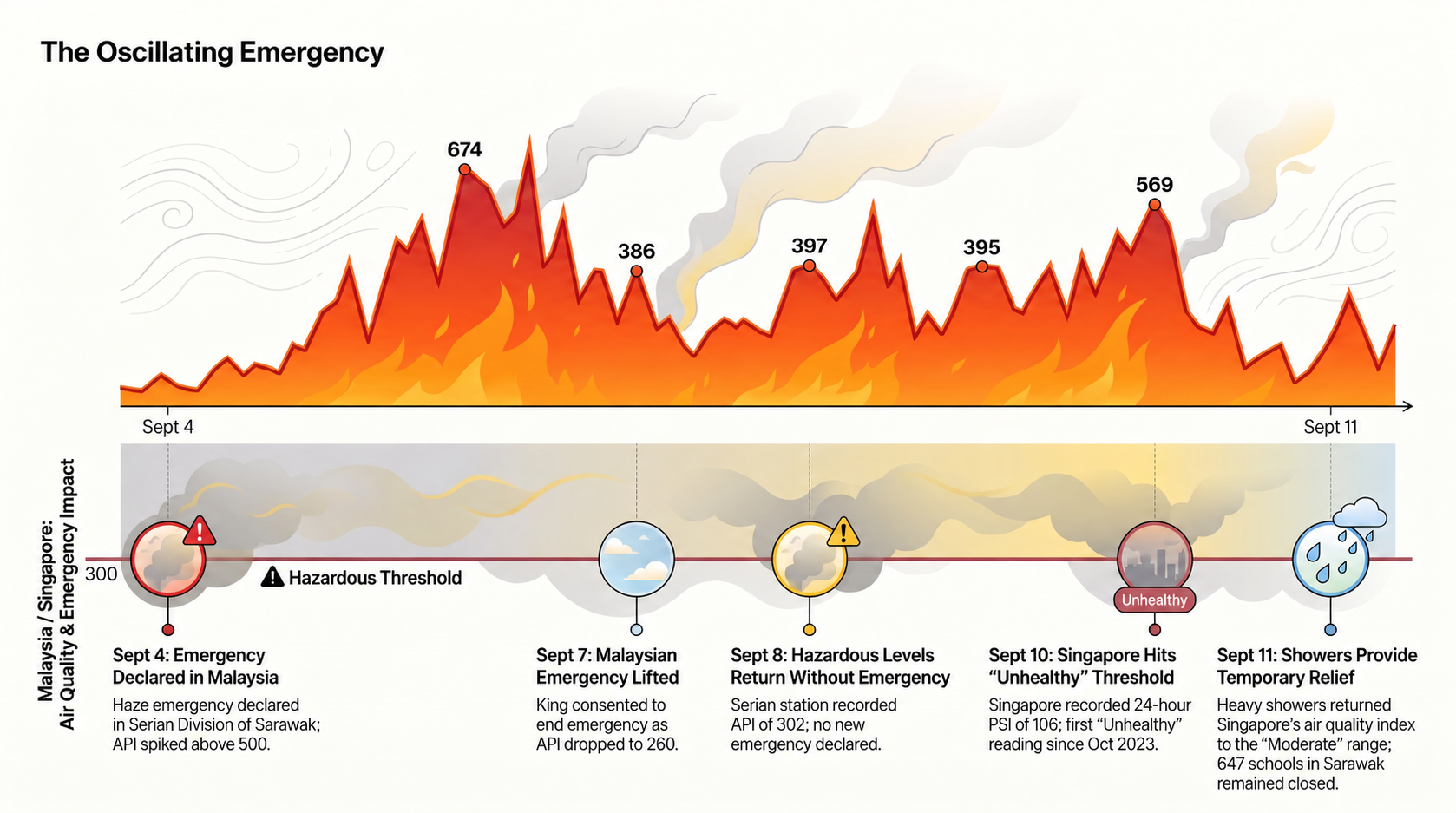
The haze season shifted from spreading to oscillating this week. On 7 September, the Prime Minister’s Office announced that the King had consented to end the Serian Division emergency in Sarawak, Malaysia, because the Air Pollutant Index was no longer at the hazardous level. At 10 am the next morning, the Serian station read 302, with no new emergency declared, while 647 Sarawak schools remained closed through 11 September. [17]
Indonesia’s Forestry Ministry counted 674 high-confidence hotspots on 6 September, 386 on 7 September, and 569 on 10 September. [11] Vice President Gibran Rakabuming Raka apologized to the people of Kalimantan on 10 September and ordered subsurface peat wetting. [18]
Singapore recorded its first Unhealthy 24-hour reading since October 2023 on 10 September, before showers returned the index to Moderate the next day. [19]
The regional mechanism showed its limits in public: Prime Minister Anwar Ibrahim said on 8 September that the ASEAN haze arrangement has room for improvement and that Malaysia would not defend Malaysian companies found responsible in Indonesia. Malaysia’s offer of firefighting assets had drawn no reply from Jakarta by 9 September. [20] For the region’s peatland and forest credit proponents, this season is the case study for the draft tool’s blank column. [2]
What This Means
For developers and standard-setters with land-based credits in the Article 6.4 pipeline, the draft tool is the definitive document. The panel has asked for an empirical basis for human-induced reversal risk, and the Indonesian season provides material for one. A submission that quantifies that risk will shape the forestry version more than one arguing that natural defaults down. [2]
For program designers, the Australian variations and the BNDES structure are the instruments to study, status quo held exactly: a request for advice on a protection threshold and buyer eligibility within a nature method, and a public climate fund covering up to 80% of a concession’s early years, funded by revenue from credits that do not yet exist. [4] [14]
For ASEAN institutions, the oscillating Sarawak emergency shows the limit of index-triggered instruments when the source is unchanged. [17] [20]
Worth Watching Through Year-End
Climate Week NYC runs in New York from 20 to 27 September 2026; the Taskforce on Nature-related Financial Disclosures releases its 2026 status report online on 21 September. (Climate Week NYC; TNFD event page.) Source | Source
The Article 6.4 Supervisory Body holds SBM 023 in Bonn from 5 to 9 October 2026; the Pre-COP31 in Fiji and a leaders’ gathering in Tuvalu run from 5 to 8 October. (UNFCCC event page; joint letter of the COP31 President-Designate hosted on unfccc.int.) Source | Source
The World Bank Group and IMF Annual Meetings take place in Bangkok, Thailand, from 12 to 18 October 2026; the 47th Adaptation Fund Board meets in Bonn from 19 to 23 October; CBD COP17 convenes in Yerevan, Armenia, from 19 to 30 October; and the Green Climate Fund Board meets in Songdo, the Republic of Korea, from 26 to 29 October. (World Bank; Adaptation Fund; CBD; GCF decision B.45/22.) Source | Source | Source | Source
The Nature-based Solutions International Congress convenes in Paris, France, from 2 to 6 November 2026; UNFCCC COP31 follows in Antalya, Türkiye, from 9 to 20 November 2026. (NbS International Congress organizers; UNFCCC COP31 page.) Source | Source
Endnotes
[1] NbS Praxis. (2026, September 5). Nature finance learns to expect repayment (The Climate-Nature Nexus in Practice, Weekly Briefing No. 15). Prior issue, cited for series continuity and for the Forestry Ministry’s attribution of most fires to deliberate burning as carried there; not an external primary source. https://www.nbspraxis.com/nature-finance-learns-to-expect-repayment/
[2] UNFCCC, Article 6.4 mechanism Methodological Expert Panel. (2026, July). Draft methodological tool: Reversal risk assessment, version 01.0 (A6.4-MEP014-A07). https://unfccc.int/sites/default/files/resource/A6.4-MEP014-A07.pdf Primary UNFCCC draft: buffer contribution equals the natural-risk rating plus the human-induced rating, capped at 1.0; each rating is an estimated loss of credited stock over a 100-year period, not an annual probability; natural defaults derived from global forest-disturbance records projected under SSP2-4.5 following a method the document attributes to Wu et al. (2026), tabulated in Appendix 1 at multinational (Table 1), national (Table 2), and subnational (Table 3) level; national Table 2 wildfire values 0.0% to 17.2% and other natural risks up to 35.4% (the lower bound of that column was read as 1.6% by the peer review and 2.9% by this run’s extraction, so no lower bound is carried); the Roraima example (16.4% and 23.7%) is subnational; human-induced fields are blank pending stakeholder input; scope limited to activities reducing non-renewable biomass, with forestry, geologic storage, and biochar named for future versions. A draft is under development; the consultation closed on 24 July 2026 per the Article 6 Observatory (https://g.article6observatory.org/article-6-updates-july-2026/).
[3] Climate Home News (Civillini, M.). (2026, September 8, updated September 9). Industry and NGOs lobby to weaken UN carbon credit rules in coordinated push. https://www.climatechangenews.com/2026/09/08/industry-and-ngos-lobby-to-weaken-un-carbon-credit-rules-in-coordinated-push/ Trade reporting on the consultation submissions: more than 30 organizations aired their views, with overlapping text; Apple, the Beyond Alliance, Conservation International, The Nature Conservancy, and UNEP named among the critics; the Beyond Alliance rejects any characterization that it advocates a weaker tool, Conservation International accepts the underlying science while recommending multiple models and datasets, and UNEP describes its input as politically neutral and science-based; the outlet states the panel meets in Bonn for five days in the week of 7 September.
[4] Bowen, C., and Wilson, J. (2026, September 10). Senate to endorse practical action on climate [Ministerial statement, read via the Mirage News mirror]. https://www.miragenews.com/senate-to-endorse-practical-action-on-climate-1741790/ Primary ministerial statement, issued before the vote (“awaits the Senate vote”): the Assistant Minister has written to the Emissions Reduction Assurance Committee seeking advice on variations, namely “increasing the amount of forest that must be protected against established harvesting baselines before projects can receive any carbon credits, rising to 30 per cent for projects registered from 1 July 2030” and “clarifying the definitions of plantation forest and native forest within the method”; the Clean Energy Regulator is to be enabled to support New South Wales’ commitment to restrict the sale of units generated within the Great Koala National Park to a specified class of entities, applying only to Improved Native Forest Management projects and only where a state opts in. Proposed variations subject to committee advice, not an amended instrument.
[5] Wood Central. (2026, September 11). Senate forest carbon debate in full, Hansard 10 Sep 2026. https://woodcentral.com.au/senate-forest-carbon-debate-hansard/ Trade outlet reproducing the Senate Hansard of Thursday 10 September 2026: division 27 Ayes to 34 Noes on Senator Ross Cadell’s disallowance motion, “Question negatived,” five days before the notice-paper date of 15 September; floor-crossers named.
[6] Reuters, via The Star (Malaysia). (2026, September 9). Indonesian wildfire emissions surge to world’s highest, data shows. https://www.thestar.com.my/news/world/2026/09/09/indonesian-wildfire-emissions-surge-to-world039s-highest-data-shows Wire report of Copernicus Atmosphere Monitoring Service Fire Emissions Watch data: 19.7 million metric tons of fire emissions from Indonesia for 1 to 7 September, 273% above the seasonal average, against 21.7 million tons in the same week of 2015, the highest in the world for that period; the wire gives no unit qualifier, secondary rewrites disagree (one carries it as carbon dioxide), and CAMS conventionally reports fire emissions as carbon, so the mass is held open and only the ranking is carried in the body’s summary lines. Modelled satellite-derived estimates, which the CAMS scientist quoted, describe undercounting subsurface peat fires; national totals do not measure losses from credited projects.
[7] UNFCCC. (2026). Article 6.4 mechanism (PACM): Methodologies [Web page, checked 12 September 2026]. https://unfccc.int/process-and-meetings/the-paris-agreement/article-6/article-64-pacm/methodologies Primary inventory: three approved methodologies (landfill gas, nitric-acid N2O abatement, renewable electricity), none nature-based; afforestation and reforestation and peatland rewetting proposals at submission or clarification stage; the reversal-risk tool listed as in development. Inventory as displayed on the check date.
[8] UNFCCC. (2026). 23rd meeting of the Article 6.4 Supervisory Body (SBM 023), 5 to 9 October 2026, Bonn, Germany. https://unfccc.int/event/Supervisory-Body-23 Primary event listing; the expectation that the tool is considered there is Climate Home News’ reporting, not a published agenda item.
[9] Wood Central. (2026, September 10). Koala park carbon deal splits Greens before Senate vote. https://woodcentral.com.au/koala-park-carbon-deal-greens/ Trade reporting of the Greens party-room position and the ministerial statement; the 22 million credits figure is New South Wales’ promotional estimate; the ministerial wording in endnote 4 governs.
[10] Carbon Brief. (2026, September 11). El Niño: Indonesia fire emissions in 2026 on track to match record for this century. https://www.carbonbrief.org/el-nino-indonesia-fire-emissions-in-2026-on-track-to-match-record-for-this-century. Analytical reporting drawing on the Global Fire Emissions Database: 76 million tonnes of carbon to 7 September 2026 against 333 million tonnes of carbon for 2015 (2.6 million hectares burned that year); quotations from Guido van der Werf and Mark Parrington as published. Modelled estimates on a carbon basis, a different dataset and period from the weekly CAMS figure in endnote 6.
[11] Kementerian Kehutanan, Republic of Indonesia. (2026, September 11). Hotspot Kalbar turun tajam, Kemenhut perkuat pengendalian karhutla wilayah prioritas (SP.512/HKLN/09/2026). https://www.kehutanan.go.id/news/hotspot-kalbar-turun-tajam-kemenhut-perkuat-pengendalian-karhutla-wilayah-prioritas Primary ministry release series (with SP.504 of 8 September and SP.508 of 9 September): 674 high-confidence hotspots on 6 September, 386 on 7 September, 397 on 8 September, 395 on 9 September, 569 on 10 September at 21:05 WIB; the ministry’s own caveat that a hotspot does not necessarily indicate one fire event. Official satellite counts, not burned-area measurements; no cumulative burned-area figure was published inside the window, and conflicting background totals are omitted.
[12] Mitti Labs. (2026, September 10, dateline; distributed September 10–11). Google and Mitti Labs partner to eliminate methane and scale climate-smart ag practices across India’s rice fields [Press release via PR Newswire]. https://www.prnewswire.com/news-releases/google--mitti-labs-partner-to-eliminate-methane-and-scale-climate-smart-ag-practices-across-indias-rice-fields-302873982.html Developer release: 1 million credits by 2030 under a five-year agreement; more than 100,000 hectares and more than 70,000 farmers; methane reduction of up to 50%; 3 million tonnes GWP20 stated as equivalent to 1 million tonnes GWP100; Sylvera A rating cited. A forward purchase commitment of avoided-methane credits, not delivered credits; registry, methodology, and price not stated; impact figures developer-reported.
[13] ESG Today. (2026, September 11). GSK signs 500,000 tonne carbon removal deal with Varaha. https://www.esgtoday.com/gsk-signs-500000-tonne-carbon-removal-deal-with-varaha/ Trade reporting, corroborated by Carbon Herald (2026, September 9, https://carbonherald.com/gsk-invests-in-regenerative-agriculture-carbon-credits-from-varaha/), which reports registration under Verra methodology VM0042 with a planned move to version 2.2. The credits combine avoided emissions with soil-carbon storage, so the headline “removal” overstates the removal share.
[14] BNDES. (2026, September 8). BNDES financia restauração no Pará com R$ 180 milhões do Fundo Clima [Press release]. https://agenciadenoticias.bndes.gov.br/noticia/BNDES-financia-restauracao-no-Para-com-R$-180-milhoes-do-Fundo-Clima/ Primary bank release, verb “anunciou,” at the Amazônia Protegida event at the Palácio do Planalto: BRL 180 million under the Florestas Nativas e Recursos Hídricos sub-programme, covering up to 80% of early-years investment in a project of about BRL 257 million; 10,346 hectares; 40-year concession formalized July 2025 through Ideflor-Bio; 4.3 million tCO2e over 40 years. Announced and restated, not disbursed; no approval, contract, or first-loss structure is stated; the removal figure is the concessionaire’s projection.
[15] Ministério do Meio Ambiente e Mudança do Clima. (2026, September 8). Em celebração ao Dia da Amazônia, decretos criam quatro reservas no Amazonas e ampliam parque nacional no Piauí. https://www.gov.br/mma/pt-br/noticias-defeso-eleitoral/em-celebracao-ao-dia-da-amazonia-decretos-criam-quatro-reservas-no-amazonas-e-ampliam-parque-nacional-no-piaui Primary ministry release on the 8 September event: BRL 235.8 million in BNDES actions comprising BRL 180 million from Fundo Clima for restoration in the APA Triunfo do Xingu, BRL 50.5 million non-reimbursable from Fundo Amazônia for the Naturezas Quilombolas project, and BRL 5.3 million under the Floresta Viva initiative. Announcements, not disbursements.
[16] Secretariat of the Convention on Biological Diversity. (2026, September 9). Kunming Dialogue closes with call for accelerated biodiversity action ahead of COP 17 [Press release]. https://www.cbd.int/doc/press/2026/pr-2026-09-10-kunming-en.pdf Primary secretariat release on the 7 to 9 September dialogue: the sentence on short-term funding and the Executive Secretary’s quotation are verbatim; the release gives no numeric progress metrics and does not itself state that targets will be missed. An informal dialogue; the global report remains a draft until COP17.
[17] Radio Televisyen Malaysia. (2026, September 7). Agong perkenan tamatkan darurat jerebu di Serian. https://berita.rtm.gov.my/nasional/senarai-berita-nasional/senarai-artikel/agong-perkenan-tamatkan-darurat-jerebu-di-serian/ National broadcaster carrying the Prime Minister’s Office announcement of 7 September (12:38 pm) that the emergency ended because the Air Pollutant Index in Serian Division was no longer at the hazardous level, with Serian and Samarahan at 260. The 8 September reading of 302 at 10 am, the only hazardous station nationwide, is from Malay Mail (2026, September 8, https://www.malaymail.com/news/malaysia/2026/09/08/serian-air-quality-hazardous-again-just-a-day-after-emergency-ends/234368), citing the Department of Environment’s APIMS portal, corroborated by Malaysia Tribune and, per the peer review, Borneo Post; a station reading, not a renewed emergency. The closure of 647 schools from 7 to 11 September was decided on 4 September (Malay Mail, https://www.malaymail.com/news/malaysia/2026/09/04/sarawak-to-close-647-schools-for-five-days-from-sept-7-to-11-as-haze-persists/233944); any extension beyond 11 September is unconfirmed.
[18] Antara News. (2026, September 10). Gibran apologizes as toxic haze from land fires persists in Kalimantan. https://en.antaranews.com/news/430837/gibran-apologizes-as-toxic-haze-from-land-fires-persists-in-kalimantan. State news agency report of the Vice President’s remarks at the Guntung Damar fire post, Banjarbaru, on 10 September; the agency’s background hectare figures conflict with other outlets and are not carried.
[19] National Environment Agency, Singapore. (2026, September 11). Haze situation update, 11 September 2026, 6 pm. https://www.nea.gov.sg/media/news/advisories/index/haze-situation-update-11-september-2026. Primary advisory: 24-hour PSI 69 to 88 (Moderate) after heavy showers; risk of haze remaining under southeasterly or southerly winds. The 10 September reading of 106 and the “first Unhealthy since October 2023” framing are from Malay Mail (2026, September 11, https://www.malaymail.com/news/singapore/2026/09/11/singapore-haze-eases-as-psi-readings-return-to-moderate-range/234800).
[20] Malay Mail. (2026, September 8). Anwar: Asean haze mechanism needs stronger action, Malaysia won’t shield firms. https://www.malaymail.com/news/malaysia/2026/09/08/anwar-asean-haze-mechanism-needs-stronger-action-malaysia-wont-shield-firms/234382. National press transcription of the Prime Minister’s remarks at the Plantation and Commodities Ministry assembly in Putrajaya; no official transcript located, and the remarks do not name the ASEAN Agreement on Transboundary Haze Pollution. The asset offer without reply is from Malay Mail (2026, September 9, https://www.malaymail.com/news/malaysia/2026/09/09/fahmi-malaysia-ready-to-help-indonesia-fight-forest-fires-awaiting-green-light/234569); no ASEAN ministerial or Haze Agreement meeting was found in the window, a search-absence finding.