No. 15 — Nature Finance Learns to Expect Repayment
The UK pledged a conditional GBP 400 million loan to the Tropical Forest Forever Facility. Verra carried its flagship standard’s program-level integrity recognition into Version 5, while UNEP and reef scientists narrowed the window in which all that capital must work.

The Climate-Nature Nexus in Practice (Weekly Briefing to 5 September 2026)
Bottom line: The United Kingdom pledged a GBP 400 million loan to the Tropical Forest Forever Facility on 3 September, a conditional commitment that the facility, not any forest country, will repay. Verra announced that the Integrity Council recognized Version 5 of the Verified Carbon Standard as CCP-eligible at the program level and opened its main tidal-wetland restoration methodology for revision. UNEP concluded that the world will cross 1.5°C within a few years, and reef scientists reported that bleaching events occur every five or six years. Indonesia’s haze covers four neighboring countries. What This Means below sets out the actions.
Here is the gateway into the field, and the briefing is the room you walk into: [Podcasts and Video — Gemini Notebook: www.youtube.com/@nbspraxis]
Link to Explainer Video (Playlist of Podcast and Video for Week 15, available at https://youtu.be/H0VMbhymCdg
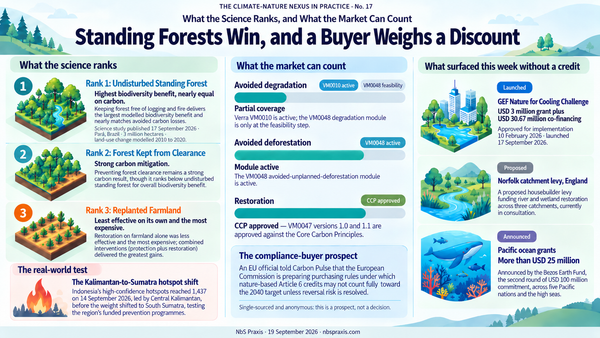
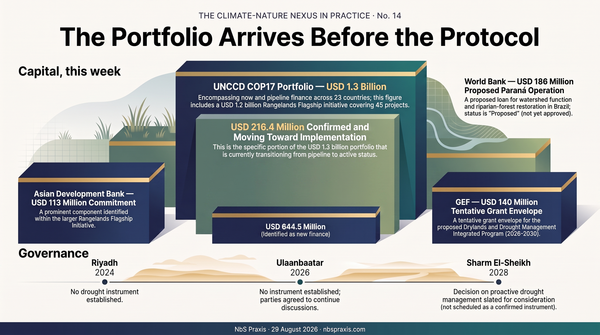
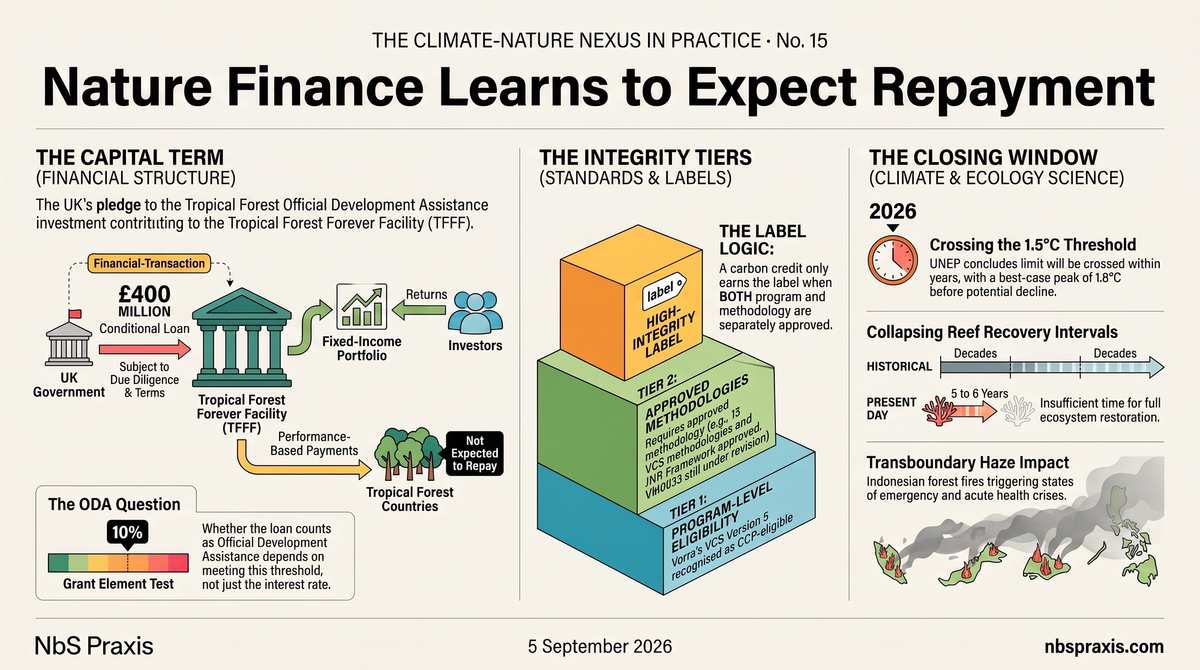
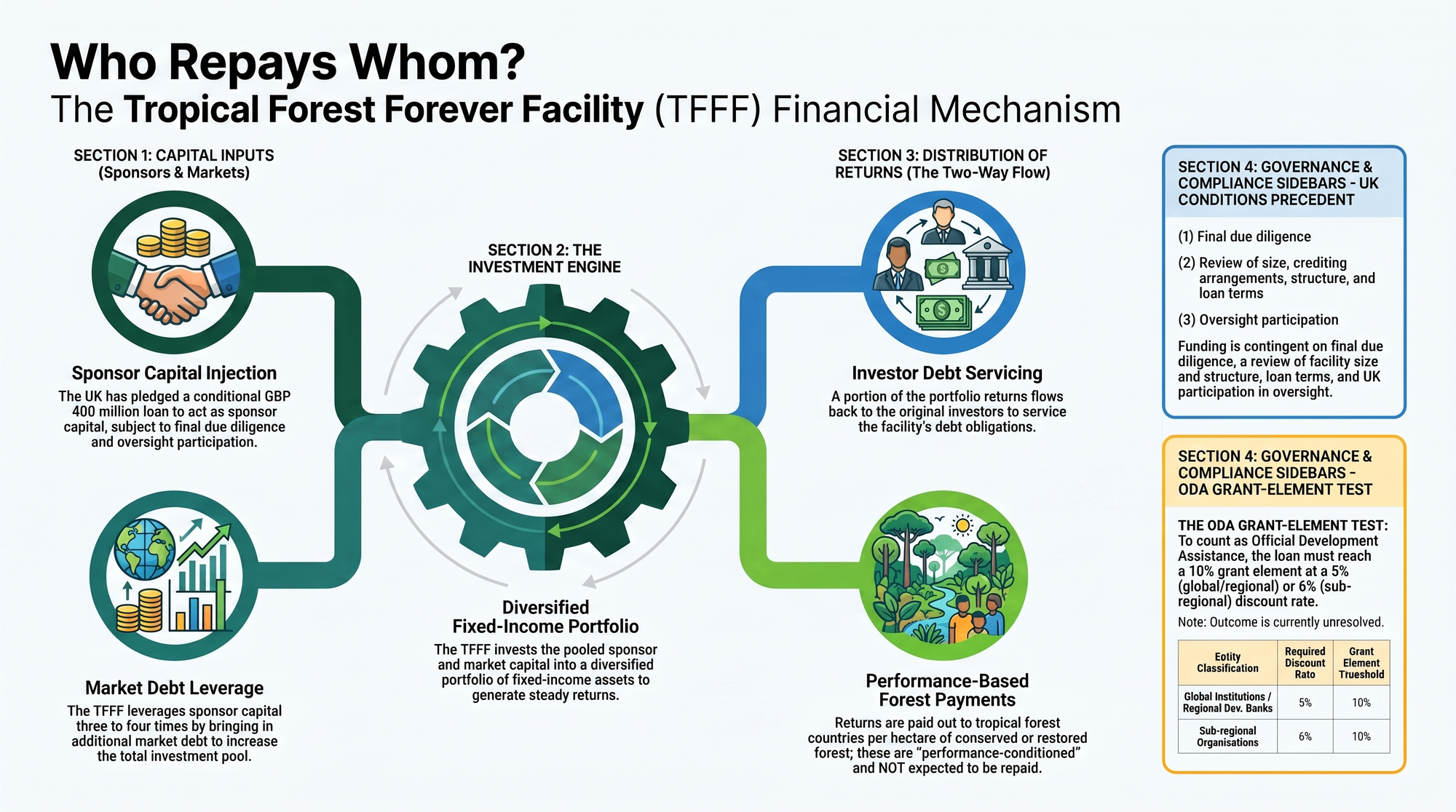
Last week’s briefing argued that the portfolio was arriving before the protocol: finance was consolidating into aggregates faster than any instrument arrived to govern delivery. [1] This week supplied the sequel. The United Kingdom pledged a GBP 400 million loan to the Tropical Forest Forever Facility (TFFF) on 3 September, adding to more than USD 6.7 billion announced by COP30’s close in November 2025. [2] [3] [4] The pledge is conditional on final due diligence and a review of the facility’s size, structure, and loan terms. The UK records the sum in a financial-transactions budget rather than as grant aid. [2] The design point matters more than the amount: the facility repays the loan from returns on a fixed-income portfolio, while forest countries receive performance-based payments that, in the UK’s words, they will not be expected to repay. [2] [5]
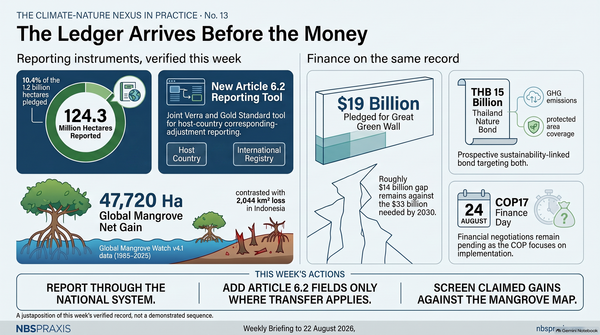
The market’s integrity apparatus moved the same week: Verra announced that the ICVCM recognized Version 5 of the Verified Carbon Standard as CCP-eligible at the program level, continuing a 2024 eligibility, and opened VM0033, the tidal wetland and seagrass restoration methodology, to structural revision. [6] [7]
The science narrowed the room the capital must work in: UNEP openly planned for overshoot of 1.5°C, and the global coral monitoring network reported recovery windows collapsing below what recovery requires. [8] [9]
The implication for practitioners is narrower than a market-wide shift and sharper for that: this week’s sovereign nature capital came with covenants, its labels with conditions, and its science with a deadline.
The Creditor’s Turn
This week’s sovereign nature capital came as a loan the facility must service; its labels came with conditions; and the science window kept closing.
The week’s defining transaction was a loan, and its structure matters more than its amount. The UK’s GBP 400 million would enter the TFFF as sponsor capital: the facility invests sponsor and market capital in a diversified fixed-income portfolio, leverages that capital three to four times with market debt, and pays forest countries a fixed amount per hectare of conserved or restored forest from the returns. [1] [5] The UK release states that forest countries will not be expected to repay the funding; the facility repays investors, so forest countries’ payments are subject to performance conditions and exposure to the facility’s returns, not its debt, and the UK pledge changes none of that. What changes is where a contributor’s money sits: on a budget that expects repayment rather than in grant aid. [2] Whether the loan will count as official development assistance is unresolved, and the test is the grant element, not the coupon: OECD rules count a loan to a multilateral institution as ODA only where the grant element reaches 10% at a 5% discount rate for global institutions and regional development banks, or 6% for sub-regional organizations, so the answer turns on classification and final terms, as Climate Home News has asked. [10] [11] Reuters puts the TFFF at almost three-quarters of its USD 10 billion first-year public-money ambition; no current paid-in figure has been published. [3] [5]
The standards layer is being consolidated in parallel, and the tiers need to be kept separate. Version 5’s CCP eligibility, announced by Verra and not yet reflected in the ICVCM’s own register as of 4 September, is the program-level tier, continuing eligibility first granted to Version 4.7 in May 2024. Methodologies are approved separately, and only credits issued under an eligible program from an approved methodology carry the label. Verra lists 13 approved methodologies, plus the Jurisdictional and Nested REDD+ Framework v4.1. [6] VM0033, opened for revision the next day, is not among them, although the ICVCM approved Isometric’s mangrove restoration protocol in May, so blue carbon already has one labeled route. [7] [12] The revision, under consultation through 5 October, rebuilds the methodology as modules with a dynamic performance benchmark and an updated leakage approach. [7] After the ICVCM’s 4 August program decisions for BioCarbon Standard, Cercarbono, and Plan Vivo, the voluntary market’s integrity architecture is nearing completion, while the Paris Agreement Crediting Mechanism, whose first issuance in February was a cookstove project, has three approved methodologies and no approved nature-based one, with an afforestation and reforestation methodology submitted in May remaining at proposal stage. [13] [14] [15]
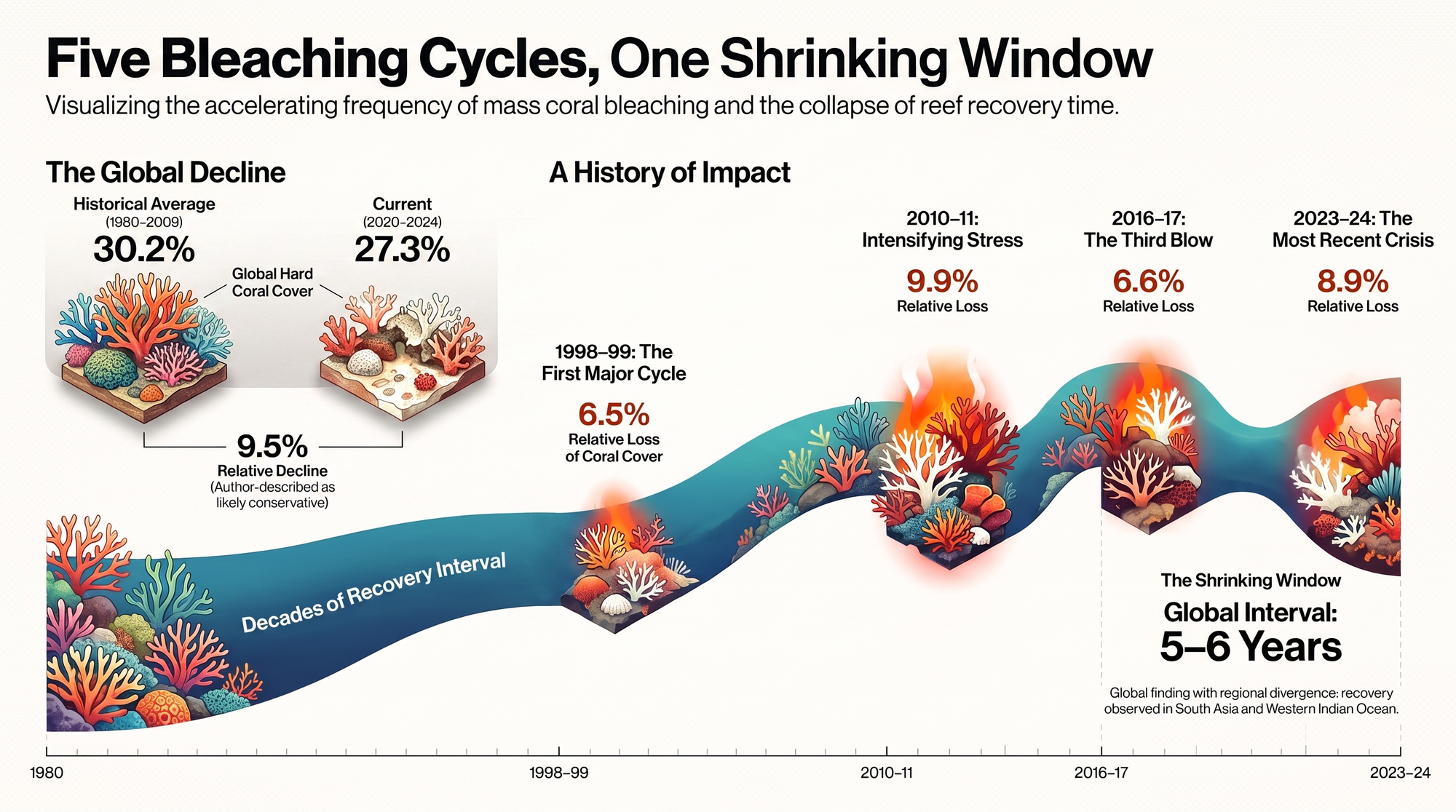
The science closed the loop. UNEP’s Limiting Overshoot: Navigating Exceedance concludes that the world is set to cross 1.5°C within a few years, with the most optimistic scenario peaking near 1.8°C. It frames overshoot-peak-decline as the best remaining pathway, with carbon dioxide removal essential as a complement and mitigation-plus-adaptation interventions, such as nature-based cooling, the priority. [8] The Global Coral Reef Monitoring Network supplies the other half: a roughly 9.5% relative decline in global hard coral cover, which the authors call likely conservative, and intervals between mass bleaching events down from decades to five or six years, below what recovery requires. [9] The overshoot decades are precisely when ecosystems are most stressed and most needed. The plausible inference, not a demonstrated finding, is that permanence and maintenance finance, the questions Nos. 13 and 14 left open, belong among the binding constraints, because capital that expects repayment and labels that certify durability both fail where ecosystems cannot be kept alive.
The Record
The United Kingdom pledged a GBP 400 million loan to the Tropical Forest Forever Facility.
The pledge, valued at about USD 541 million, remains subject to final due diligence and a review of facility size, crediting arrangements, structure, and loan terms. The facility invests sponsor capital in a fixed-income portfolio, repays investors from returns, and pays forest countries per hectare of standing forest; the UK states that forest countries will not be expected to repay. The TFFF recorded more than USD 6.7 billion in announced contributions by the close of COP30.
This week: announced on 3 September; primary UK release; a conditional loan pledge, not a disbursement; the aggregate is announced contributions, not paid-in capital. (GOV.UK, 3 September 2026.) Source
Verra announced that Version 5 of the VCS Program is CCP-eligible.
Program-level eligibility continues the recognition granted to Version 4.7 in May 2024. Separately, the ICVCM has approved 13 active VCS methodologies and the Jurisdictional and Nested REDD+ Framework v4.1.
This week: announced on 2 September; primary Verra announcement; the ICVCM has published no release, and its assessment register, last updated on 4 September, still shows the May 2024 program decision, so attribution rests with Verra. (Verra, 2 September 2026.) Source
Verra opened a public consultation on a revised VM0033 blue carbon methodology.
The revision reorganizes the methodology into modules, introduces a dynamic performance benchmark for tidal-wetland revegetation projects, and updates default factors to reflect current science; the consultation runs from 3 September to 5 October 2026.
This week: opened on 3 September; primary Verra announcement; a proposed revision under consultation, not a final methodology. (Verra, 3 September 2026.) Source
UNEP published Limiting Overshoot: Navigating Exceedance.
The report concludes that the world is set to cross 1.5°C within the next few years and frames overshoot-peak-decline as the best remaining pathway, with carbon dioxide removal essential as a complement to emissions cuts and nature-based cooling among priority interventions.
This week: published on 2 September; primary UNEP release; a modelled scenario assessment, not an observed outcome. (UNEP, 2 September 2026.) Source
The GCRMN published Status of Coral Reefs of the World: 2025.
Built on 21.1 million observations from 36,886 reef sites in 124 countries and territories, the report finds that global hard coral cover has declined from a 30.2% average (1980–2009) to 27.3% (2020–2024), a roughly 9.5% relative decline described as likely conservative. Four global bleaching episodes each removed 6.5 to 9.9% of cover. Recovery intervals have shrunk to five or six years, regional trajectories are diverging, and nearly 1 billion people depend on reef services.
This week: released on 31 August; primary monitoring-network report; declines are relative to the historical average. (GCRMN, 31 August 2026; UNEP, 4 September 2026.) Source | Source
ASEAN in Focus
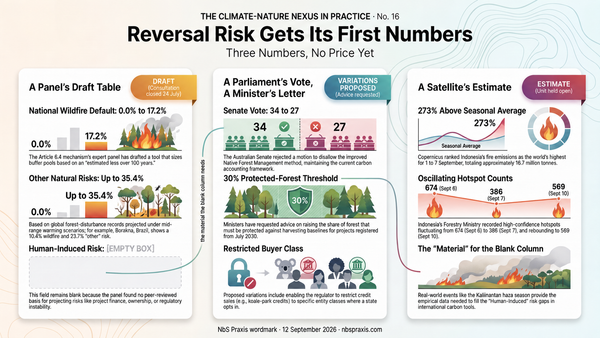
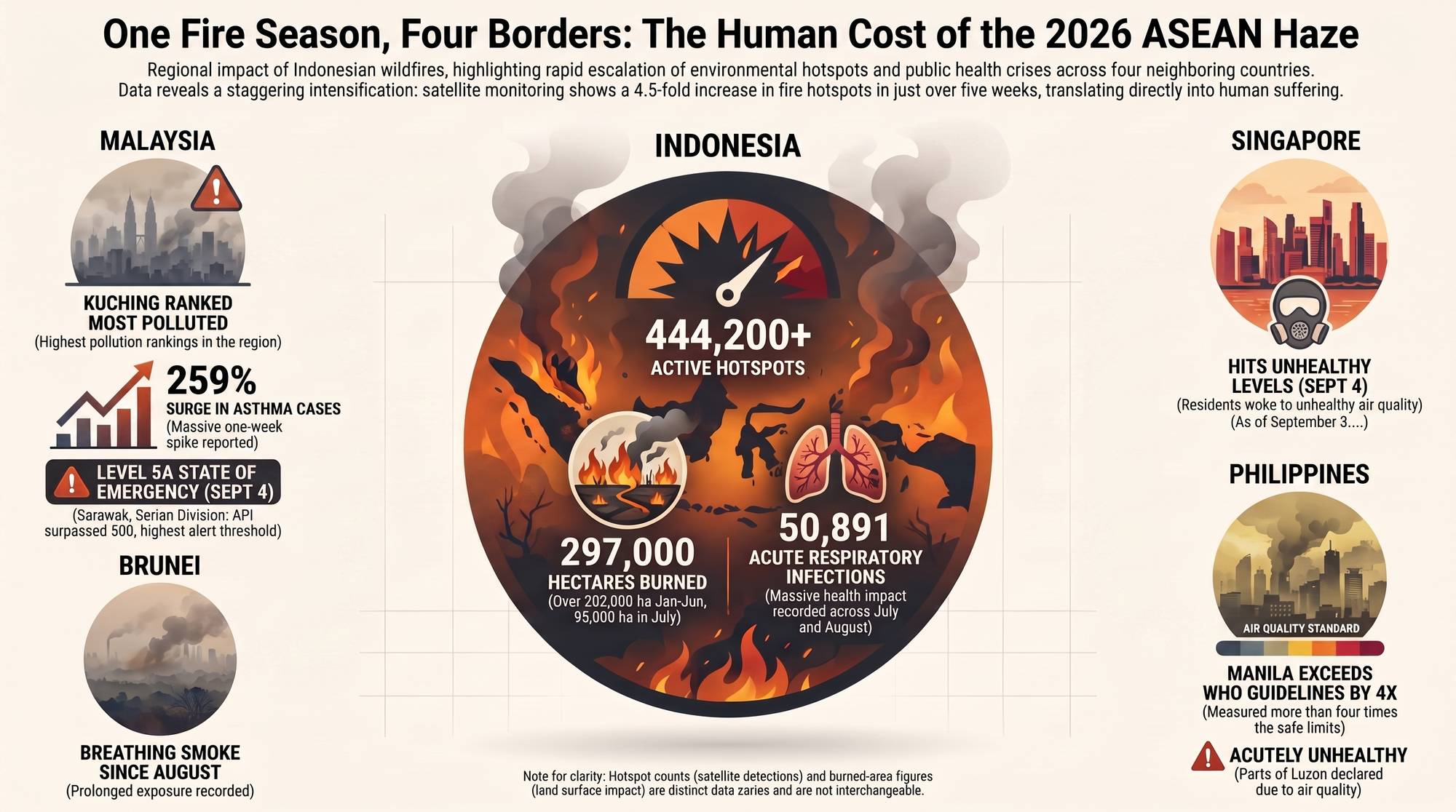
Indonesia’s haze spread farther this week. Malaysia and Brunei have been breathing smoke since August, as No. 14 recorded; in-window developments include Singapore waking to unhealthy air on 4 September; Philippine authorities declaring parts of Luzon acutely unhealthy, with Manila more than four times above WHO guideline levels; and, on 4 September, a state of emergency across Serian Division, Sarawak, declared with the King’s consent after the Air Pollutant Index passed 500, the National Haze Action Plan’s top-alert threshold. [16] [17] [18]
Government figures put more than 202,000 hectares burned from January to June and almost 95,000 hectares in July; Mongabay reports 50,891 acute respiratory infection cases across July and August, and, per the Firewatch satellite platform, more than 444,200 hotspots as of 3 September, 4.5 times the 27 July count; Malaysian asthma presentations rose 259% in one late-August week. [16] [17] Indonesia’s Ministry of Forestry attributes most fires to deliberate burning, with 72 arrests; WALHI points to recurring hotspots in peatland, plantation, and timber concessions. [17] No. 13 documented the peat-maintenance liability behind such seasons; that liability remains context, not established cause.
The procedural counterpoint is the VM0033 revision: for proponents of tidal-wetland restoration projects under the VCS in the region, the consultation to 5 October is the moment to shape the methodology their projects would use, and the ICVCM’s approved list, which VM0033 has not joined, is the label question behind the revision. [7] [6]
What This Means
This week’s nature finance came with terms, and the terms come first.
For program designers and government leads, the TFFF pledge is the template to study: sovereign loan capital serviced by the facility from portfolio returns, performance-based payments that forest countries do not repay, conditions precedent on due diligence and oversight, and an ODA question that turns on classification and final terms; delivery and monitoring systems need to precede the money.
For Verified Carbon Standard proponents, two things are open: the VM0033 consultation, open until 5 October for anyone whose projects would use the methodology, and the label logic itself, under which a CCP-eligible program version confers nothing on a credit unless its methodology is separately CCP-approved.
For adaptation practitioners, the Global EbA Fund’s two calls, announced on 24 August and totaling USD 7.5 million, open on 28 September for small grants and on 12 October for medium grants. [19] And for ASEAN institutions, the haze season restates the maintenance-finance question in population-scale terms, while the reef report turns the interval between bleaching events into a stress-testing parameter for coastal EbA design, set by local monitoring, not the global average.
Worth Watching Through Year-End
Climate Week NYC takes place in New York, United States, from September 20 to 27, 2026, coinciding with the release of the Taskforce on Nature-related Financial Disclosures' second global status report. (Climate Week NYC; TNFD status-report page.) Source | Source
CBD COP17 convenes in Yerevan, Armenia, from October 19 to 30, 2026, for the first global review of the Kunming-Montreal Global Biodiversity Framework. (Convention on Biological Diversity.) Source
The Green Climate Fund Board holds its 46th meeting in Songdo, the Republic of Korea, from October 26 to 29, 2026. (Green Climate Fund, Board decision B.43/15.) Source
The Nature-based Solutions International Congress convenes in Paris, France, from 2 to 6 November 2026 (scientific conference, 3 to 6 November); UNFCCC COP31 follows in Antalya, Türkiye, from 9 to 20 November 2026. (NbS International Congress organizers; UNFCCC COP31 page.) Source | Source
Endnotes
[1] NbS Praxis. (2026, August 29). The portfolio arrives before the protocol (The Climate-Nature Nexus in Practice, Weekly Briefing No. 14). Prior issue, cited for series continuity; not an external primary source.
[2] UK Government. (2026, September 3). Investment boost for climate action and forest protection [Press release]. https://www.argusmedia.com/en/news-and-insights/latest-market-news/2873302-uk-to-loan-541mn-to-tropical-forest-preservation-fund. Primary release: a GBP 400 million loan pledge subject to final due diligence, including a review of the facility’s final size, crediting arrangements, structure, and loan terms, with the UK seeking participation in fund oversight; states verbatim that forest countries will not be expected to repay the funding and that the facility is designed to repay investors and reward countries. A conditional commitment, not a disbursement; the release states sterling only.
[3] Reuters (O’Boyle, B., & Paraguassu, L.). (2026, September 3). UK pledges $541 million to Brazil’s tropical forest fund. https://www.gov.uk/government/news/investment-boost-for-climate-action-and-forest-protection. Wire report read via a syndicated copy; supplies the conversion (USD 1 = GBP 0.7388), the USD 10 billion first-year public-money ambition with almost three-quarters secured, and the USD 125 billion overall design including USD 25 billion from governments and public institutions. Wire coverage, not a primary release.
[4] Tropical Forest Forever Facility. (2025, November 22). COP30 ends with over US$6.7 billion for the TFFF. https://tfff.earth/tfff-at-cop30/ The Facility’s own statement that COP30 concluded with more than USD 6.7 billion in announced contributions, naming Norway (USD 3 billion), Germany (EUR 1 billion over ten years), Brazil (USD 1 billion), and the Minderoo Foundation (USD 10 million) among contributors. Announced contributions, not paid-in capital.
[5] Tropical Forest Forever Facility. (2026). How the TFFF works, and TFFF Concept Note 3.1 (October 2025). https://tfff.earth/ Facility’s self-description: sponsor and market capital invested in a diversified fixed-income portfolio; sponsor capital leveraged three to four times through blended finance and public-market debt; payments to tropical forest countries as a fixed amount per hectare of conserved or restored forest while seeking to maintain the capital base; targets of USD 25 billion in sponsor capital and USD 125 billion in total. The concept note (https://tfff.earth/wp-content/uploads/2025/10/TFFF-Concept-Note-3.1.pdf) is the fuller design document.
[6] Verra. (2026, September 2). Verra announces CCP-eligible status of VCS Version 5 [Announcement]. https://verra.org/verra-announces-ccp-eligible-status-of-vcs-version-5/ Primary standard-setter announcement: program-level CCP eligibility for Version 5, which the announcement states follows the ICVCM’s approval of Version 4.7 in May 2024; the 13 methodologies (VM0042, VM0044, VM0045, VM0047, VM0048, VM0050, VM0051, VMR0016, VMR0017, ACM0008, ACM0001, AM0023, AMS-III.G) and the JNR Framework are described as also approved, separately; VM0033 is not among them. The ICVCM has published no release on Version 5 as of 5 September, and its public assessment register (https://icvcm.org/assessment-status/, last updated 4 September 2026) lists the VCS Program as CCP-Eligible on the May 2024 decision without a Version 5 entry; the recognition is carried out under Verra’s authority.
[7] Verra. (2026, September 3). Consultation: Revision to Tidal Wetland and Seagrass Restoration Methodology (VM0033). https://verra.org/consultation-revision-to-tidal-wetland-and-seagrass-restoration-methodology-vm0033/ Primary announcement; a proposed revision under public consultation to 5 October 2026, not a final methodology, and not itself CCP-approved.
[8] UN Environment Programme. (2026, September 2). UNEP: World set to cross 1.5°C global warming, but can still limit, adapt to and return from higher temperatures [Press release]. https://www.unep.org/news-and-stories/press-release/unep-world-set-cross-15degc-global-warming-can-still-limit-adapt-and Primary release for the report Limiting Overshoot: Navigating Exceedance; modelled scenario findings, with figures taken from the release rather than re-derived from the underlying report.
[9] Global Coral Reef Monitoring Network. (2026, August 31). Marine heatwaves are closing the window for coral reef recovery, landmark global report warns; UN Environment Programme. (2026, September 4). This new report paints a worrying picture about the future of coral reefs. https://gcrmn.net/2026/08/31/gcrmn-2025-report/ Primary release for Status of Coral Reefs of the World: 2025, with ICRI; a long-term monitoring compilation (21.1 million observations, 36,886 sites, 124 countries and territories); the 9.5% figure is a relative decline from the 1980–2009 average (30.2% to 27.3%) that the authors call likely conservative, and the report records regional divergence, with recovery observed in South Asia and the Western Indian Ocean (UNEP story, https://www.unep.org/news-and-stories/story/new-report-paints-worrying-picture-about-future-coral-reefs). The five-to-six-year interval is a global finding, not a design rule for any single site.
[10] Climate Change News. (2026, September 3). UK’s budget juggling trick with rainforest loan for bus-fare cap needs transparency. https://www.climatechangenews.com/2026/09/03/uks-budget-juggling-trick-with-rainforest-loan-for-bus-fare-cap-needs-transparency/ Analytical commentary, not a government position, raising the ODA-eligibility question; its interest-rate shorthand is not used here, and a modelled sponsor return is not evidence of the final UK loan coupon.
[11] OECD Development Assistance Committee. (2024, November). Monitoring ODA grant equivalents (DCD/DAC/STAT(2024)21). https://one.oecd.org/document/DCD/DAC/STAT(2024)21/en/pdf. Primary OECD statistical document: grant-element thresholds and discount rates agreed at the December 2014 High-Level Meeting, in force from 2018 ODA; for loans to multilateral institutions, a 10% threshold at a 5% discount rate for global institutions and regional development banks and 6% for sub-regional organizations. Eligibility depends on the institution’s classification and the full financing terms.
[12] Integrity Council for the Voluntary Carbon Market. (2026, May 11). ICVCM approves new carbon standards and methodologies. https://icvcm.org/integrity-council-announces-new-batch-of-assessment-decisions/ Primary ICVCM release: CCP-Eligible status for the Global Carbon Council standard and CCP-Approved status for, among others, the Isometric Mangrove Restoration Protocol v1.0.
[13] Integrity Council for the Voluntary Carbon Market. (2026, August 4). Integrity Council announces CCP-eligible program decisions for BioCarbon Standard, Cercarbono and Plan Vivo (PV Climate). https://icvcm.org/integrity-council-announces-ccp-eligible-program-decisions-for-biocarbon-standard-cercarbono-and-plan-vivo-pv-climate/ Primary ICVCM release; program-level decisions only, no methodology decisions.
[14] UNFCCC. (2026). Article 6.4 mechanism (PACM): Methodologies [Web page, checked 5 September 2026]. https://unfccc.int/process-and-meetings/the-paris-agreement/article-6/article-64-pacm/methodologies. Primary UNFCCC inventory: three approved mechanism methodologies (landfill gas, nitric-acid N2O abatement, renewable electricity), none nature-based; an afforestation and reforestation methodology submitted 8 May 2026 is at the proposal stage. Inventory as displayed on the check date.
[15] UNFCCC. (2026, February 26). UN carbon market approves first-ever issuance of credits under the Paris Agreement [News]. https://unfccc.int/news/un-carbon-market-approves-first-ever-issuance-of-credits-under-the-paris-agreement. Primary UNFCCC news item on the first PACM issuance, a clean-cooking project in Myanmar.
[16] Mongabay. (2026, September 4). As Indonesia’s wildfires rage, haze spreads farther across Southeast Asia. https://news.mongabay.com/short-article/2026/09/as-indonesias-wildfires-rage-haze-spreads-farther-across-southeast-asia/ Environmental-news reporting: the hotspot count (more than 444,200 as of 3 September, 4.5 times the 27 July count) is attributed to the Firewatch satellite monitoring platform and was not reproduced from the underlying dataset; respiratory-case and air-ranking figures are attributed to official and IQAir data; Brunei is reported hazy since mid-August. Hotspot and burned-area series are methodologically distinct and not reconciled here.
[17] ABC News (Australia). (2026, September 4). What is causing Indonesia’s wildfires and how is the government tackling them? https://www.abc.net.au/news/2026-09-04/causes-of-indonesian-wildfires-and-how-the-government-tackling/107113456 Reporting carrying government-attributed figures: 202,000+ hectares burned January to June, almost 95,000 hectares in July, 72 arrests, 39,000+ personnel; Ministry of Forestry attribution of deliberate burning. Official figures, not independently verified.
[18] The Star (Malaysia). (2026, September 4). Haze: State of emergency declared at Serian, says PMO; and DayakDaily. (2026, September 4). State of emergency declared throughout Serian Division as haze reaches hazardous levels. https://www.thestar.com.my/news/nation/2026/09/04/haze-state-of-emergency-declared-at-serian-says-pmo National press carrying the Prime Minister’s Office confirmation that the King consented, on the advice of the Prime Minister and the Sarawak Premier, to an emergency declaration covering Serian Division within a 20-km radius identified by the Department of Environment, on 4 September; outlets report Air Pollutant Index readings between 518 and 521 during the day, all above the 500 threshold for Level 5A under the National Haze Action Plan (DayakDaily, https://dayakdaily.com/state-of-emergency-declared-throughout-serian-division-as-haze-reaches-hazardous-levels/; Malay Mail and New Straits Times corroborate). Serian Division, created in 2015, contains Serian District; Mongabay’s use of " district " refers to the constituent unit, and the declaration is styled as a Division here.
[19] IUCN. (2026, August 24). IUCN and UNEP offering USD 7.5 million in grants for ecosystem-based adaptation projects. https://iucn.org/news/202608/iucn-and-unep-offering-usd75-million-grants-ecosystem-based-adaptation-projects. Primary implementing-agency announcement of the Global EbA Fund calls (IKI/BMUKN-financed): small grants to USD 250,000 (window 28 September to 26 October) and medium grants to USD 500,000 (12 October to 16 November). Announced on 24 August, before this reporting window.