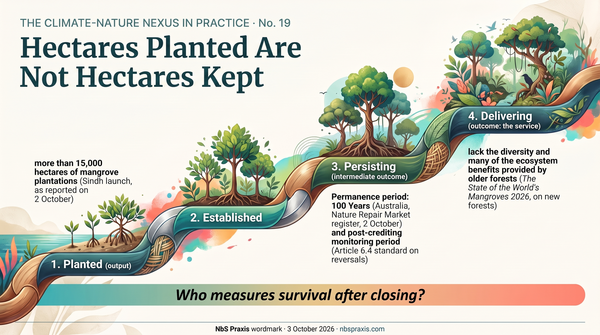
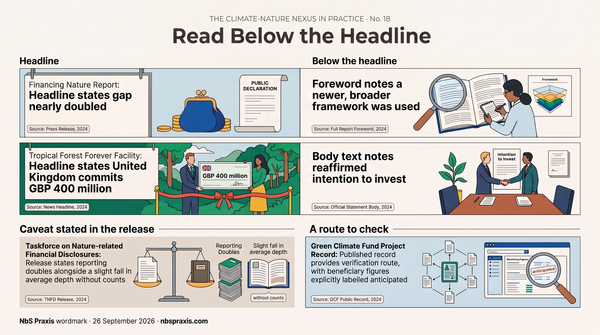
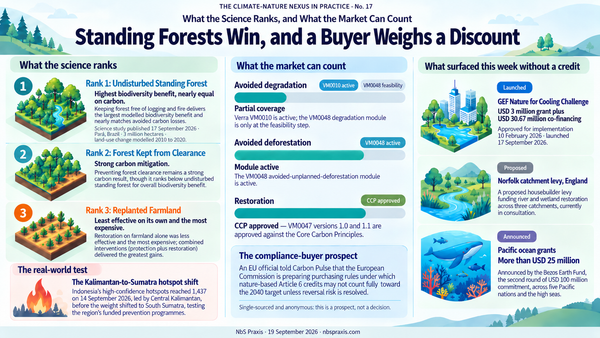
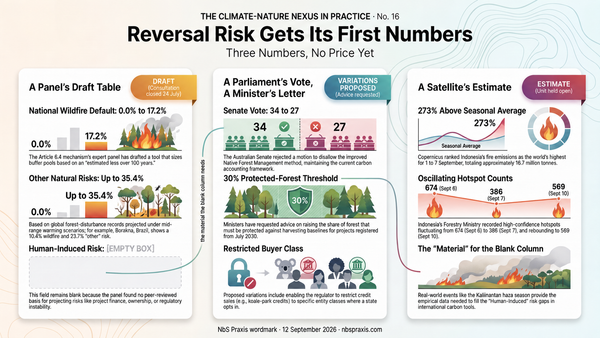
No. 11 — When the Measure Becomes the Market
Canada launched a natural-capital taskforce, Global Witness traced USD 31 billion in sustainability-linked loans to palm-oil firms facing deforestation allegations, and a Caribbean pilot turned a storm index into a payout. The question is not what finance is called, but what its rules capture.

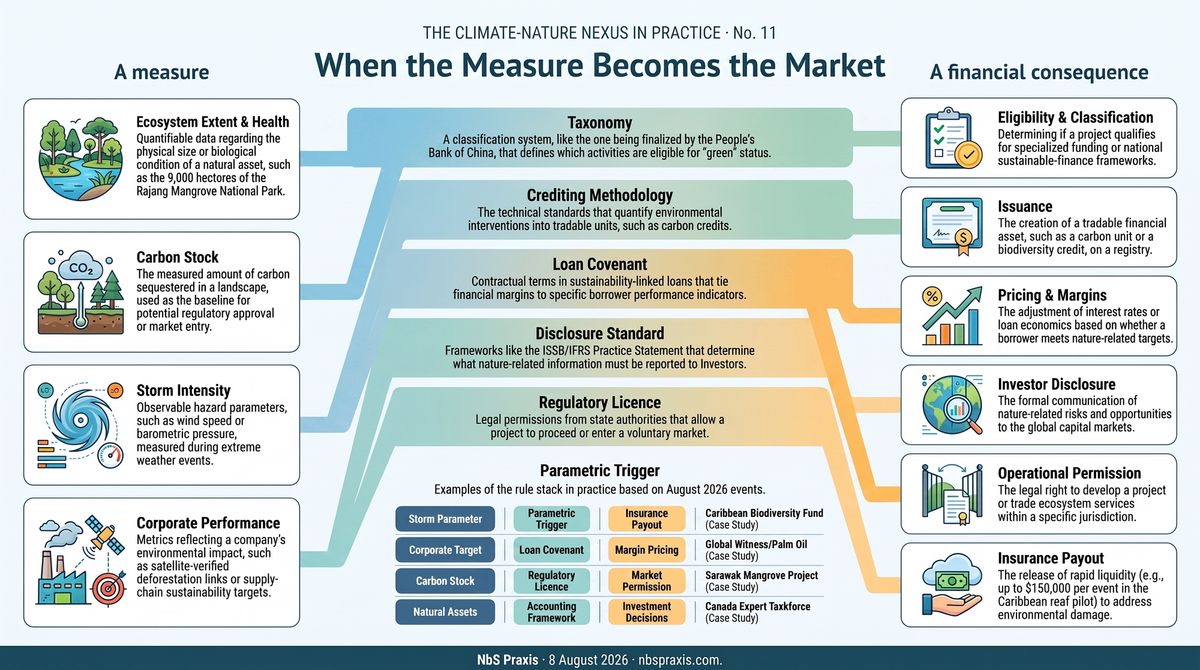
The Climate-Nature Nexus in Practice (Weekly Briefing to 8 August 2026)
Bottom line: Canada launched an advisory Expert Taskforce on Natural Capital Accounting and Nature Financing on 7 August. The same week, Global Witness reported that more than 100 banks arranged USD 31 billion in sustainability-linked loans to Indonesian palm-oil companies facing deforestation allegations. A Caribbean pilot converted a measured storm parameter into an insurance payout trigger. Different rule systems, not a single measurement layer, determine what nature finance recognizes, credits, prices, discloses, or pays for. The practitioner's task is to map that rule stack, then test whether each rule captures what materially matters.
Here is the gateway into the field, and the briefing is the room you walk into: [Podcasts and Video — Gemini Notebook: www.youtube.com/@nbspraxis]
Link to Explainer Video on the risks of sustainability-linked loans (Produced by the author with Gemini Notebook)
Link to Explainer Video on the mechanics of parametric insurance (Produced by the author with Gemini Notebook)
Last week's briefing highlighted a methodological decision that shifted project economics and asked what happens when the method itself becomes the risk. [1] This week widens that question rather than repeating it. A crediting method is one rule system among several, and the week's evidence put four others on the table at once. Canada launched an Expert Taskforce on Natural Capital Accounting and Nature Financing on 7 August, appointing 15 experts to advise on valuing natural assets in public and private decisions and on mobilizing private investment. [2]
Global Witness published an investigation on 5 August, finding that more than 100 banks arranged USD 31 billion in sustainability-linked loans to Indonesian palm-oil companies facing deforestation allegations. [3]
A Caribbean insurance pilot converted a storm index into a contractual payout.
Green Central Banking reported, citing an unnamed source, that the People's Bank of China aims to finalize a biodiversity-focused taxonomy, though no official issuance was identified. [4]
These instruments share a theme rather than a function:
- Accounting framework organizes information for decisions;
- Taxonomy defines eligibility for a classification;
- Crediting methodology quantifies a unit;
- Disclosure standard sets what investors see;
- Loan contract ties pricing to selected indicators;
- Insurance trigger releases cash on an index.
Environmental information acquires financial consequences only when an institution attaches a rule. For senior practitioners, the operational reading follows directly: identify which rule controls at each stage of a project, and test whether that rule captures the impacts that matter.
Who Holds the Definition
The week did not reveal a single measurement layer that decides what nature is worth. The week revealed a stack of different rule systems, each attaching a different consequence to environmental information.
Who holds the definition depends on the transaction:
- A government taxonomy can determine whether an activity qualifies under a national sustainable-finance classification.
- A carbon standard determines whether a quantified intervention can generate units on its registry.
- A lender defines the indicators that move a sustainability-linked loan's margin.
- A disclosure standard determines what nature-related information reaches investors.
- A regulator determines whether a forest-carbon activity may proceed at all.
- An insurer determines which observable hazard parameter triggers a payout.
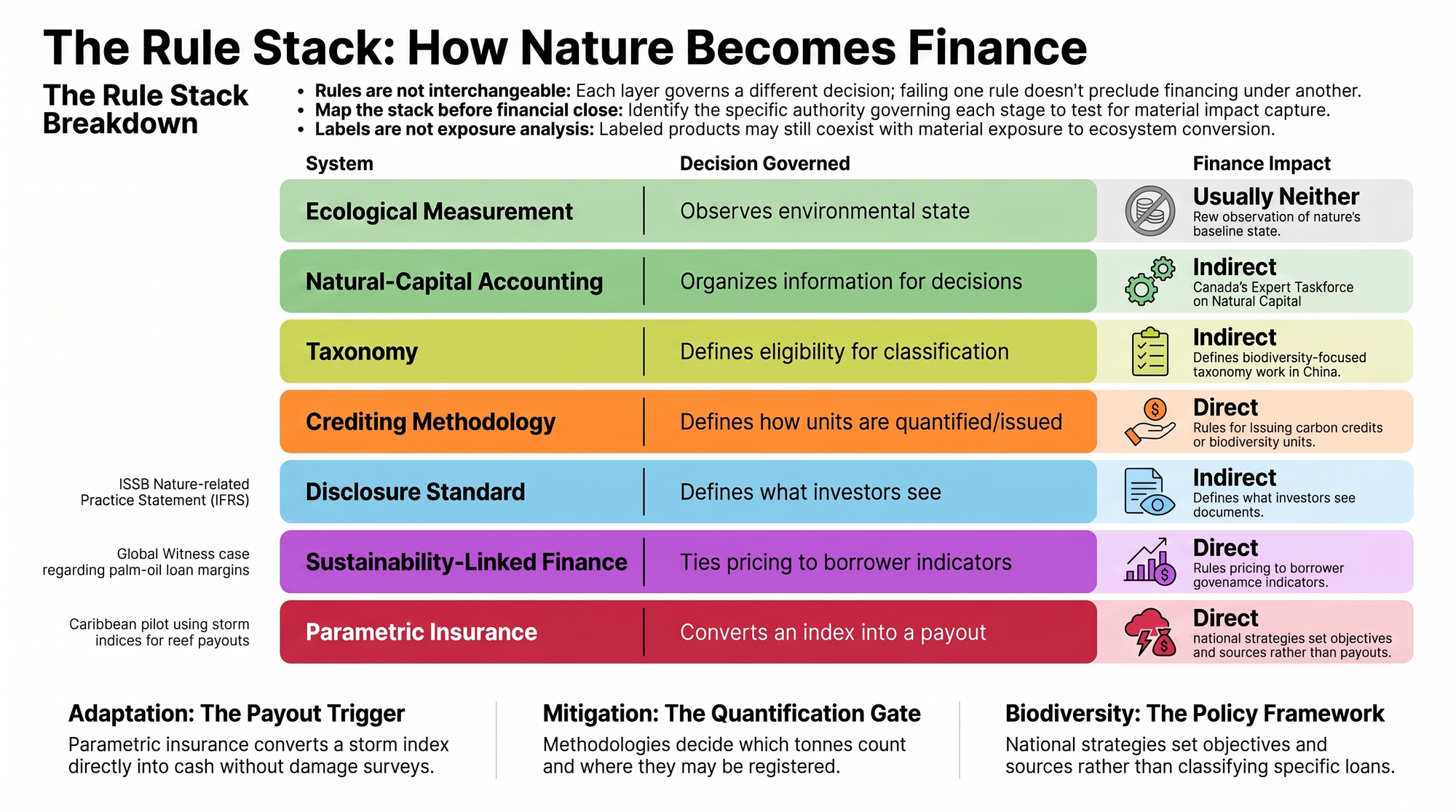
These systems overlap and are not interchangeable. Canada's taskforce matters not because it has defined nature-positive finance, but because a government has asked an advisory body how natural capital should enter public and private decisions; the CAD 3.8 billion in the March 2026 strategy belongs to that strategy rather than to the taskforce. [2] The reported Chinese work points toward an explicit eligibility framework and remains anonymously sourced. [4] Taxonomies, accounting frameworks, and disclosure standards are not neutral plumbing, but neither do they decide financeability outright. Each influences what an institution can recognize, report, label, incentivize, or count toward a nature objective, and in some jurisdictions that materially affects terms and eligibility. A project failing one taxonomy may still be financed conventionally by another lender under another mandate.
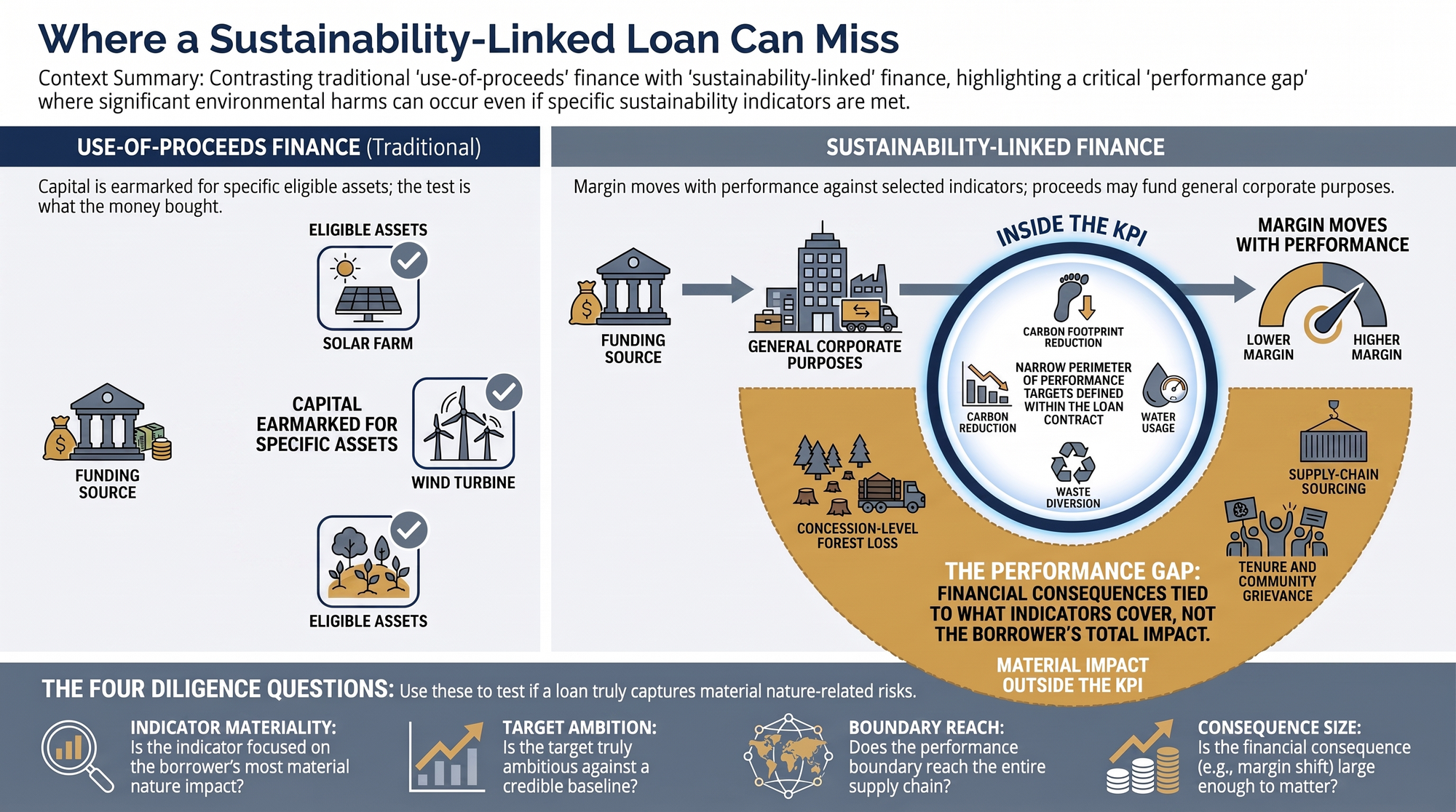
The Global Witness investigation is the week's sharpest case, and the mechanism warrants precision. A sustainability-linked loan is not a use-of-proceeds instrument. Under the market's own definition, the loan's economics, typically the margin, vary with the borrower's performance against selected indicators and targets, and the proceeds may fund general corporate purposes. Global Witness notes that borrowers and lenders set those targets themselves, without a statutory benchmark. [3] The finding is not that banks classified deforestation as nature-positive. Rather, it is that a sustainability-linked financing structure coexisted with serious nature-related allegations, pointing to the perimeter of the indicators rather than to a false label. Global Witness reports that a company received USD 950 million in such commitments between 2018 and 2024, while satellite analysis linked its concessions to roughly 4,200 hectares of primary forest loss from 2016 to 2024, a finding the company firmly refutes. [3] The practitioner question is therefore whether the chosen indicators capture the borrower's most material nature impacts, whether targets are ambitious relative to a credible baseline, whether the performance boundary reaches the supply chain, and whether the financial consequence is meaningful.
The week's three outcomes divide cleanly:
- For mitigation, methodologies and taxonomies determine which tonnes count and where they may be counted.
- For biodiversity, national plans and disclosure architecture decide what registers: Romania's Senate advanced a national biodiversity strategy through Parliament, an instrument that sets objectives, indicators, institutions, and financing sources rather than classifying a loan or issuing a unit. [7] The International Sustainability Standards (IFRS) Board agreed in April 2026 to propose nature-related requirements as an IFRS Practice Statement complementing IFRS S1 and S2 rather than as a standalone standard, targeting an exposure draft in October. [6]
- For adaptation, the Caribbean pilot offers the week's most direct conversion of a measure into a financial mechanism. Willis, a Willis Towers Watson (WTW) company, and the Caribbean Biodiversity Fund insured roughly 1,800 square kilometers of reef across four states, and the contract pays out based on predefined storm parameters rather than on a post-event survey of reef damage. [5]
Index design is therefore financially consequential, because the instrument delivers fast liquidity only insofar as the trigger tracks the loss meant to address, and basis risk is accepted by design. Whose stewardship these systems can see is a governance question, not a data question: Pacific Small Island Developing States warned this week that global reporting undercounts customary and community conservation. [8] The Executive Secretary of the Convention on Biological Diversity, Astrid Schomaker, said separately that companies are not assessing biodiversity impacts fast enough. [9]
The Record
Canada launched an advisory taskforce on natural-capital and nature-financing. The federal government appointed 15 experts to advise on measuring and valuing natural assets in decision-making and on mobilizing private investment for nature-positive outcomes. The taskforce is advisory and will develop recommendations; the CAD 3.8 billion belongs to the March 2026 A Force of Nature strategy, not to this body. This week — in-window institutional launch, advisory mandate, no capital deployed. (Environment and Climate Change Canada, 7 August 2026, Ottawa, Canada.) Source
Global Witness reported USD 31 billion in sustainability-linked loans to palm-oil firms facing deforestation allegations. More than 100 banks, including Barclays, HSBC, Crédit Agricole, Rabobank, Standard Chartered, and Bank of China, arranged the lending to Indonesian palm-oil companies between 2018 and 2025. Investors held USD 46 million in company's shares through 35 funds using “ESG,” “responsible,” or “sustainable” in their names. This week — in-window investigation, published 5 August; figures aggregate loan commitments, and the deforestation links are satellite-based inferences the companies dispute. (Global Witness, 5 August 2026, London.) Source
Willis and the Caribbean Biodiversity Fund launched a coral-reef parametric insurance pilot. The policy covers roughly 1,800 square kilometers of reef across the Dominican Republic, Jamaica, Saint Lucia, and Saint Vincent and the Grenadines, releasing up to USD 150,000 per event on predefined storm parameters, with a USD 1 million program limit for the 2026–2027 hurricane season. This week — in-window instrument launch; a pilot, and the trigger is an index rather than measured reef damage. (InsuResilience Solutions Fund, 5 August 2026; Artemis, 6 August 2026.) Source
The African Development Fund approved a USD 4.23 million natural-capital grant. The grant funds the second phase of a program embedding natural capital in development planning across 13 African countries from October 2026 to September 2029, with in-kind support from WWF, GIZ, and the UN Environment Programme (UNEP). This week — in-window board approval; a grant commitment, not a disbursement, and the Bank's own release rounds the figure to USD 4.3 million. (African Development Bank Group, 4 August 2026.) Source
Romania's Senate advanced the national biodiversity strategy through Parliament. The Senate adopted the National Strategy and Action Plan for Biodiversity Conservation 2026–2030 as first chamber on 4 August by 82 votes to 33, with 9 abstentions, after the government adopted the same strategy on 23 July and then withdrew the decision following a party complaint. The Chamber of Deputies decides. This week — in-window parliamentary vote; a national policy framework, not a financial taxonomy, and not yet in force. (AGERPRES, 4 August 2026 and 23 July 2026, Bucharest, Romania.) Source
ASEAN in Focus
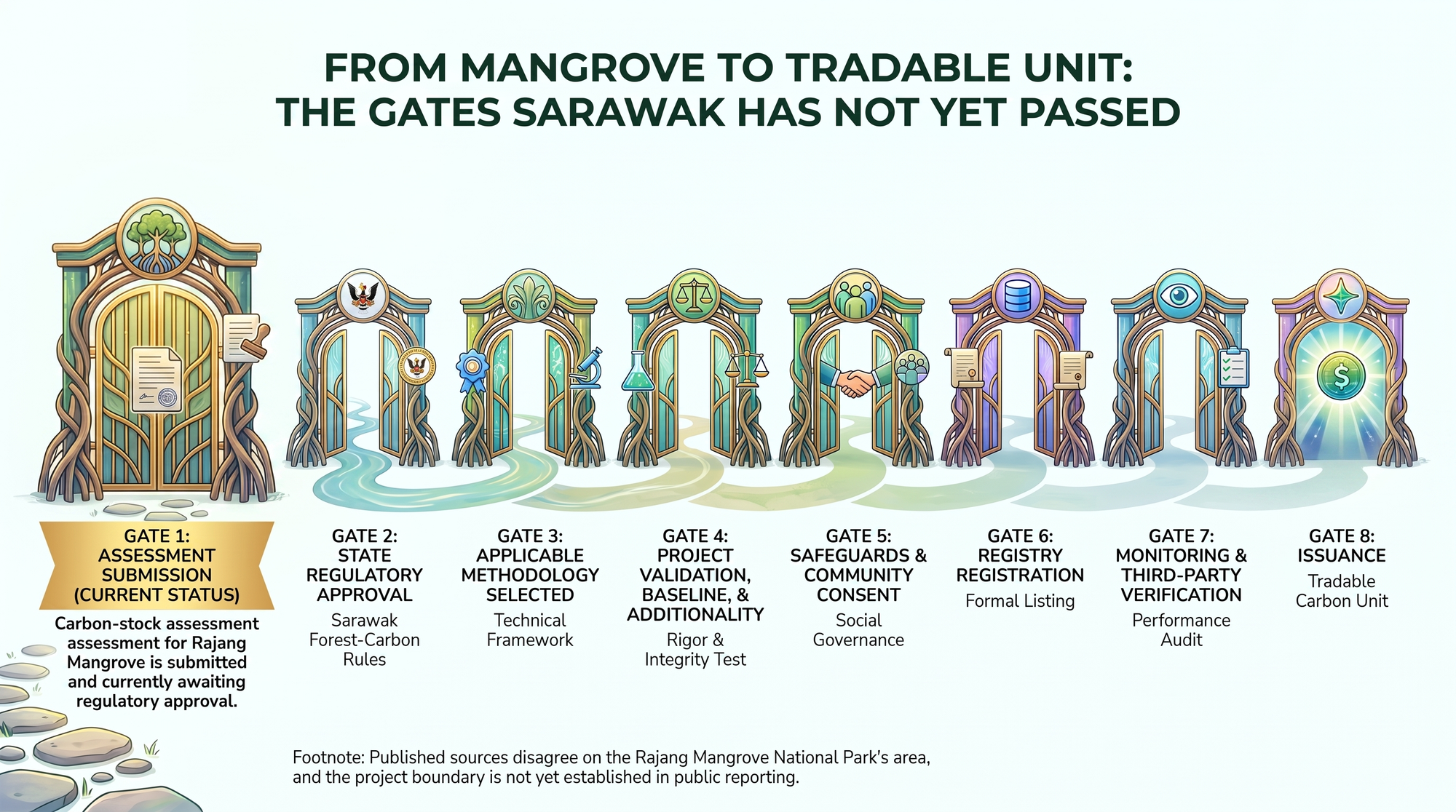
Malaysia supplied the region's most concrete step, and the sequence matters more than the announcement. The Sarawak state government submitted a carbon-stock assessment covering the Rajang Mangrove National Park to the state forestry department, seeking regulatory approval before any entry to the voluntary carbon market under the state's existing forest-carbon rules; reporting puts the area at more than 9,000 hectares, and the park sits inside a far larger Rajang mangrove complex, so the project boundary is not yet established in public reporting. [11] Regulatory permission is one gate among several. A carbon-stock estimate may support state approval, and a tradable unit still depends on an applicable methodology, validation, baseline and additionality, safeguards, registry registration, monitoring, third-party verification, and issuance.
The Global Witness finding lands hardest in the same region, and the portfolio reading is the useful one: a bank can hold explicitly nature-aligned instruments while retaining material exposure to borrowers and supply chains associated with ecosystem conversion, so portfolio nature risk cannot be inferred from the presence or absence of labeled products. [3]
What This Means
For project developers, the task is to map the rule stack before financial close. Identify which:
- authority governs legal permission,
- taxonomy or lender framework governs eligibility,
- methodology quantifies the outcome,
- standard governs disclosure,
- verification and registry process ultimately supports the claim, then stress-test the model against a change in each.
For banks and investors, a sustainability-linked or nature-related label is not a substitute for exposure analysis: examine whether the indicators reach the borrower's most material impacts, whether the boundary includes the supply chain, and whether missing a target carries a consequence worth pricing.
For governments and standard-setters, classification distributes attention and money, so the treatment of customary tenure, Indigenous and local knowledge, and community conservation belongs inside the integrity architecture.
Worth Watching Through Year-End
The Convention on Biological Diversity Subsidiary Body on Implementation (SBI-7) meets in Nairobi, Kenya, through 12 August 2026, reviewing implementation and means of implementation ahead of COP17; SBSTTA-28 concluded on 1 August. (Convention on Biological Diversity notification, meetings held at UNEP headquarters.) Source
The Taskforce on Nature-related Financial Disclosures 2026 Status Report survey closes on 14 August 2026, informing the second global stocktake of nature-related assessment and reporting, due during Climate Week NYC. (TNFD.) Source
The International Sustainability Standards Board targets October 2026 for an exposure draft of a proposed IFRS Practice Statement on nature-related disclosures, drawing on the TNFD framework and supporting application of IFRS S1. Agreed April 2026; a proposed Practice Statement is guidance complementing IFRS S1 and S2, not a new mandatory standard. (IFRS Foundation.) Source
CBD COP17 convenes in Yerevan, Armenia, from 19 to 30 October 2026, for the first global review of collective progress on the Kunming-Montreal Global Biodiversity Framework. (Convention on Biological Diversity.) Source
UNFCCC COP31 runs in Antalya, Türkiye, from 9 to 20 November 2026, with Australia serving as President of Negotiations. (UNFCCC.) Source
Endnotes
[1] NbS Praxis, Weekly Briefing No. 10, “When the Method Becomes the Risk,” week to 1 August 2026. Prior issue, cited for continuity; not an external primary source.
[2] Environment and Climate Change Canada, “Canada launches new Expert Taskforce on Natural Capital Accounting and Nature Financing,” 7 August 2026, canada.ca. Primary government release; the taskforce is advisory. The CAD 3.8 billion belongs to the March 2026 strategy announced at pm.gc.ca, not to the taskforce.
[3] Global Witness, “Major banks providing billions in ‘sustainable’ loans to deforestation-linked companies,” 5 August 2026, London, globalwitness.org. Non-profit investigation using Refinitiv Eikon loan data and palmoil.io analysis of Hansen Global Forest Change satellite data; the USD 31 billion aggregates sustainability-linked loan commitments 2018–2025 and includes refinancing of revolving facilities. Global Witness states the hectare figures are inferences from satellite imagery rather than ground evidence, and records that the company “firmly refute[s] any suggestion that deforestation has been carried out by the company as alleged.” The market definition of a sustainability-linked loan as a borrower-performance instrument, distinct from use-of-proceeds finance, is stated in the release itself.
[4] Green Central Banking, “China set to finalise biodiversity taxonomy,” 5 August 2026, greencentralbanking.com. Reporting attributed to an unnamed source; no official People's Bank of China issuance was identified, so the item is carried as a reported signal and is deliberately absent from The Record.
[5] InsuResilience Solutions Fund, “Willis and Caribbean Biodiversity Fund pilot first-of-its-kind coral reef parametric insurance programme,” 5 August 2026, insuresilience-solutions-fund.org; Artemis, 6 August 2026. Program announcement; a pilot with a USD 1 million limit, capacity from Liberty Mutual, premiums co-funded. Parametric cover pays on index conditions rather than assessed damage, so basis risk is inherent to the design.
[6] IFRS Foundation, “ISSB agrees on the proposed way forward for nature-related disclosures,” May 2026, ifrs.org. The ISSB agreed at its April 2026 meeting to propose an IFRS Practice Statement complementing IFRS S1 and S2 rather than a standalone standard, targeting an October 2026 exposure draft.
[7] AGERPRES, “Senate adopts Biodiversity Strategy,” 4 August 2026, agerpres.ro; and “Strategia privind conservarea biodiversității, adoptată de Guvern,” 23 July 2026, agerpres.ro. Both events occurred: the government adopted the strategy on 23 July as a national recovery-plan milestone, subsequently withdrew the government decision from publication after a party complaint, and the Senate then adopted the strategy as first chamber on 4 August, 82 to 33 with 9 abstentions, sending to the Chamber of Deputies as the decision-making chamber. A strategy sets objectives, indicators, institutions, and financing sources; a strategy does not classify a loan or issue a unit.
[8] National Indigenous Times, “Pacific calls for fairer global biodiversity reporting ahead of COP17,” 4 August 2026, nit.com.au. Reported advocacy position of the Pacific Small Island Developing States group; not an adopted change to reporting methods.
[9] Reuters, “Companies failing to act quickly enough on nature loss, UN says,” 4 August 2026, reuters.com. Attributed interview with the CBD Executive Secretary; a position statement, not a policy instrument.
[10] African Development Bank Group, “African Development Fund Grants $4.3 Million to Strengthen Integration of Natural Capital into Decision-Making in 13 African Countries,” 4 August 2026, afdb.africa-newsroom.com. Primary institutional release, obtained in this pass and replacing the compiled secondary source carried in v1. Board approval of a grant commitment for phase two; the release headline rounds to USD 4.3 million against USD 4.23 million in the detail. This is the African Development Fund, the concessional window of the African Development Bank (and not the Asian Development Bank).
[11] DayakDaily, “Sarawak eyes Rajang mangroves as carbon credit hub with ‘koyong’ farming potential,” reported week of 3 August 2026, dayakdaily.com. Local-outlet report; the carbon-stock assessment has been submitted and is awaiting regulatory approval, and no credits have been issued. Published sources variously list the national park as about 9,374 hectares and about 107 square kilometers, and the wider Rajang-Belawai-Paloh mangrove complex as substantially larger, so the exact project boundary, proponent, and permit class are not established in public reporting and are not asserted here.