No. 12 — The Delivery Gap is Now Documented
A global biodiversity progress report, an audit of India’s flagship restoration mission, Canada’s stalled 30% target, and UN verification of Costa Rica’s forest results all landed in one week: the system is now publishing the gap between commitment and delivery.

The Climate-Nature Nexus in Practice (Weekly Briefing to 15 August 2026)
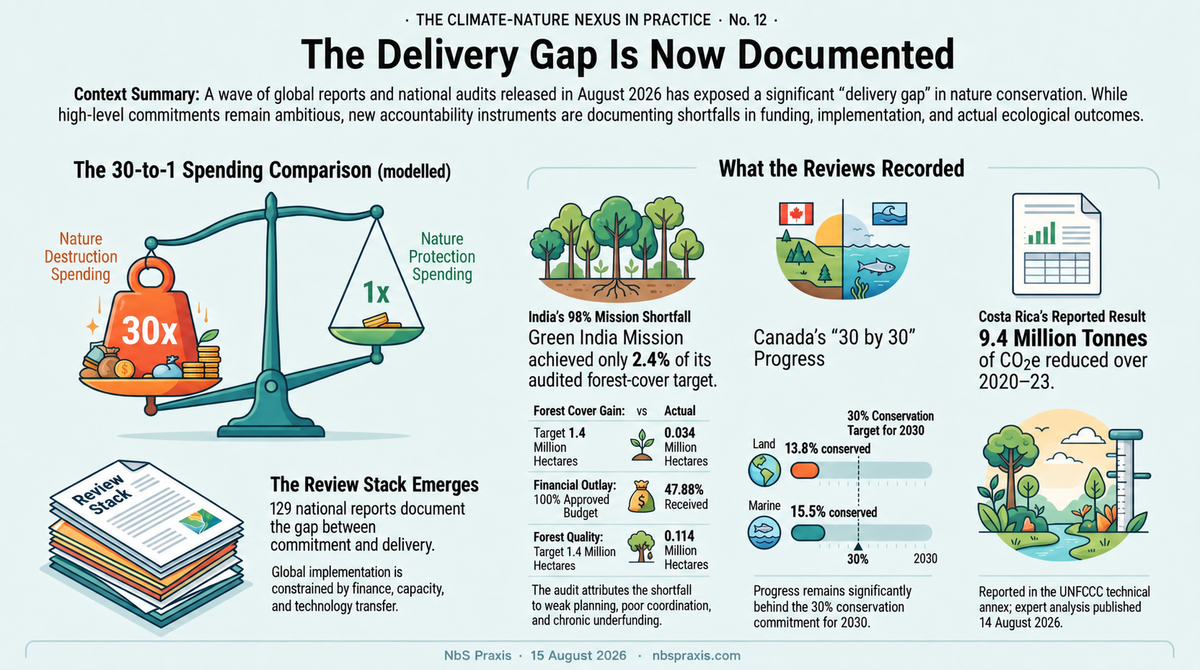
Bottom line: The Convention on Biological Diversity’s implementation body concluded in Nairobi, Kenya, on 12 August after reviewing the revised global progress report on the Kunming-Montreal framework, compiled from 129 national reports. India’s Comptroller and Auditor General tabled a performance audit in Parliament on 13 August, finding the Green India Mission roughly 98% short of the audited forest-cover target. Canada’s indicators show 13.8% of land and 15.5% of marine territory conserved against the 30% commitment. This week’s cases suggest an emerging asymmetry: accountability instruments are documenting delivery gaps faster than finance and implementation are closing them.
Here is the gateway into the field, and the briefing is the room you walk into: [Podcasts and Video — Gemini Notebook: www.youtube.com/@nbspraxis]
Link to Explainer Video on the Carbon Accounting Protocol, among other things
Last week’s briefing mapped the rule stack: the taxonomies, methodologies, covenants, and triggers that determine what nature finance recognizes and pays for. [1] This week, the reviews arrived: the instruments that report what those rules delivered. The seventh meeting of the Convention on Biological Diversity’s Subsidiary Body on Implementation (SBI-7) closed in Nairobi, Kenya, on 12 August after considering the revised global report on collective progress under the Kunming-Montreal Global Biodiversity Framework (KMGBF), which draws on 129 national reports. Recommendations to COP17 remain heavily bracketed. [2] [3] [4] India’s Comptroller and Auditor General (CAG) tabled a Green India Mission performance audit on 13 August; press accounts record a 97.57% shortfall against the audited forest-cover target, with less than half the approved outlay. [5] Canada’s 2026 National Adaptation Strategy Progress Report landed on 13 August, while the national indicator shows 13.8% of terrestrial area and 15.5% of marine territory conserved against the 30% commitment. [6]
On the delivery side of the ledger, the United Nations Framework Convention on Climate Change (UNFCCC) secretariat published the expert analysis of the annex, in which Costa Rica reports roughly 9.4 million tonnes of carbon dioxide equivalent (MtCO2e) in forest emission reductions over 2020–23. [7]
The lesson for senior practitioners is uncomfortable and useful in equal measure: commitments no longer stand in for delivery, because the reviews publish the difference. Design against the documented gap, not the stated ambition.
Delivery, Audited
Review instruments matured across the system this week: a global collective review, a national performance audit, government monitoring, technical verification, and market-rule assurance. Together, they turned the delivery gap from assertion to documentation, and each can say something different.
The review layer did not arrive as a single instrument; a stack of functionally distinct ones thickened in the same week. Nairobi brought the KMGBF’s emerging accounting system into the formal implementation process: the global report, released in draft in June and revised in Nairobi, assembles the first global picture of progress across the 23 targets. [3] The Convention’s Executive Secretary, Astrid Schomaker, restated that the world spends roughly 30 times more on destroying nature than on protecting it, a modeled UN Environment Programme (UNEP) comparison rather than an audited flow. [2] The recommendations traveling to COP17 in Yerevan, Armenia, remain heavily bracketed, so the resource-mobilization fight was deferred rather than resolved: the framework now has a progress report before a finance strategy. [4]
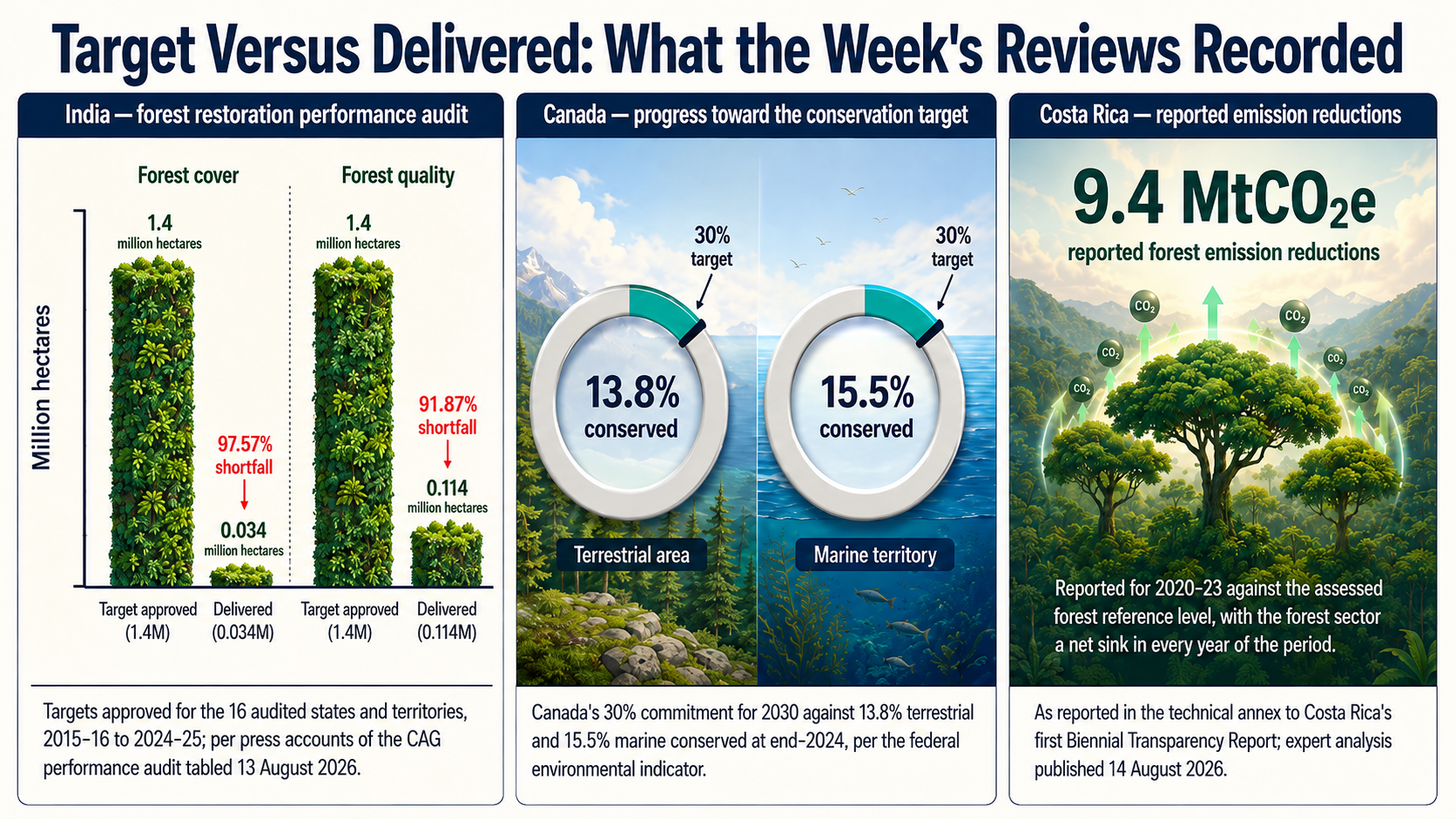
National instruments supply what a collective review cannot. India’s CAG exercise is an independent performance audit that names causes: press accounts record forest-cover gains of 0.034 million hectares against a 1.4 million hectare target, and quality gains of 0.114 million against the same target, shortfalls of roughly 98% and 92%, on 47.88% of the approved outlay. [5] The audit attributes the shortfall to planning, coordination, and chronic underfunding, converting a delivery gap into an accountability chain. Canada’s progress report is a different instrument, government self-monitoring rather than an external audit, and the national indicator records 13.8% of terrestrial area and 15.5% of marine territory conserved at end-2024, a category spanning protected areas (12.8% and 11.4% respectively) and other effective area-based conservation measures. [6] A funding gap and an absorption gap are different failure modes, and the review stack is beginning to distinguish them.
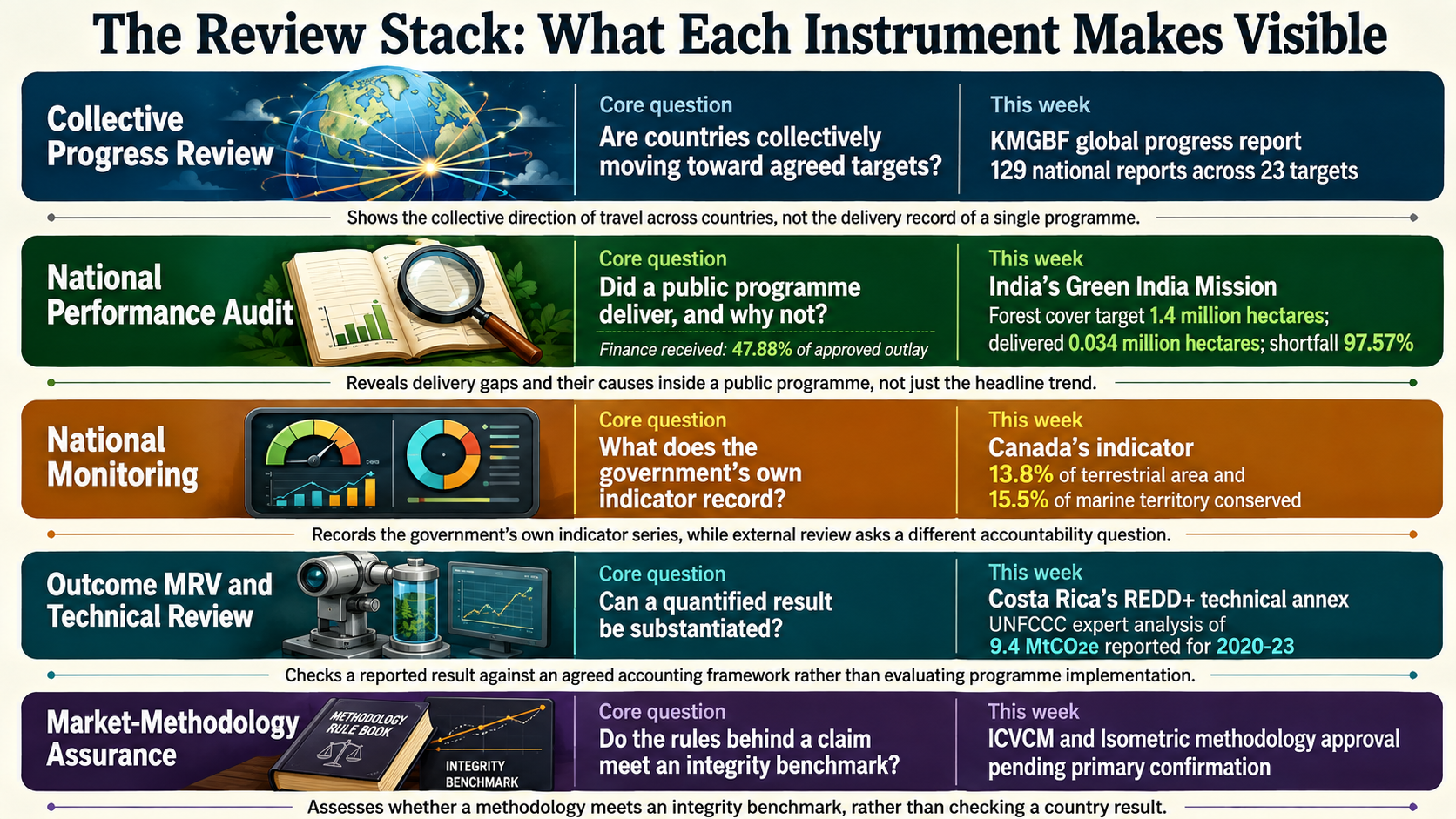
Delivery arrived with its own gradations of assurance. Costa Rica’s result is national measurement, reporting, and verification (MRV) under the UNFCCC framework for reducing emissions from deforestation and forest degradation (REDD+): the technical annex to the country’s first Biennial Transparency Report reports emission reductions of roughly 9.4 MtCO2e for 2020–23 against the assessed reference level, shows the forest sector as a net sink each year, and was published on 14 August, an outcome of a forest-policy system built over decades around forest law, payments for ecosystem services, and results-based finance. [7] BTG Pactual Timberland Investment Group and Conservation International reported more than 20,000 hectares of Brazil’s Cerrado under restoration within a strategy that closed USD 1.24 billion in equity commitments in April: corporate self-reporting, tracked against an independent national restoration observatory. [8] Trade reporting indicated that the Integrity Council for the Voluntary Carbon Market (ICVCM) extended its Core Carbon Principles (CCP) label to Isometric’s agroforestry methodology; the Council’s own announcement was not yet available, and a methodology approval is an integrity designation, not an issued credit. [9] Documented is not a binary category. Assurance has grades, and the grade belongs in the sentence.
A review is itself a rule, the rule that makes delivery legible. Legibility is not bankability: verification alone does not finance an outcome, but a measurement and assurance rule close to the work is increasingly a prerequisite for finance. Taken together, this week’s cases suggest an emerging asymmetry rather than a demonstrated trend: accountability instruments are documenting gaps faster than financing and implementation systems close them. India audited a mission that received less than half its approved budget. Brazil issued a countercurrent and a caution in one week. The National Institute for Space Research (INPE) reported deforestation alerts in the Amazon down 36% in the cycle to July 2026, with 2,874 square kilometers, the lowest reading in the alert series, while federal prosecutors asked the state of Pará to address alleged irregularities in Indigenous consultations under its jurisdictional REDD+ system. [10] [11] The volume of delivery does not settle the legitimacy of delivery, and the review stack now tests both.
The Record
The CBD implementation body concluded with the framework’s revised global progress report and bracketed finance recommendations.
Delegates considered the revised global report on collective progress under the Kunming-Montreal framework, compiled from 129 national reports, national targets, and updated biodiversity strategies, noting broad engagement and implementation constrained by finance, capacity, and technology transfer; the report anchors the first global review at COP17.
This week — in-window close of a UN negotiating session on 12 August; the report aggregates self-reported national submissions. (United Nations Information Service Nairobi and Convention on Biological Diversity, Nairobi, Kenya, 12 August 2026.) Source
India’s national auditor documented a roughly 98% shortfall in the flagship Green India Mission.
The audit, tabled in Parliament on 13 August, records, per press accounts, forest-cover gains of 0.034 million hectares against a 1.4 million hectare target; forest-quality improvement roughly 92% short; 47.88% of the approved outlay received; missing annual accounts in eight states and territories; and no discernible change at roughly 70% of satellite-sampled sites.
This week — in-window parliamentary tabling of a state audit; figures are the auditor’s own, read here through consistent press coverage rather than the CAG document directly. (The Wire and Scroll.in, 13–14 August 2026, New Delhi, India.) Source
The UNFCCC published the technical analysis of Costa Rica’s REDD+ results for 2020–23.
The expert report analyzes the technical annex to Costa Rica’s first Biennial Transparency Report, in which the country reports emission reductions of roughly 9.4 MtCO2e for 2020–23 against its assessed reference level, and the forest sector is a net sink every year: national-scale verified results from the same review machinery that elsewhere documented a shortfall.
This week — in-window publication of report FCCC/ETF/TATR.1/2025/CRI on 14 August; figures are the annex’s own, and a trade-reported total above 10 MtCO2e could not be reconciled with the annex in this pass. (UNFCCC secretariat, 14 August 2026.) Source
BTG Pactual’s timberland arm reported more than 20,000 hectares of Brazil’s Cerrado under active restoration.
The company and Conservation International announced that native-ecosystem restoration is underway on more than 20,000 hectares as part of a Latin American reforestation strategy that secured USD 1.24 billion in equity commitments in April 2026, citing the independent Brazilian Restoration and Reforestation Observatory and calling the effort the region’s largest tracked restoration undertaking.
This week — in-window company announcement on 13 August; hectare figures are self-reported, with third-party tracking cited but not independently verified here, and the superlative is the company’s. (BTG Pactual Timberland Investment Group, 13 August 2026, Atlanta, United States.) Source
Trade reporting indicated the voluntary carbon market’s benchmark quality label extended to agroforestry.
Carbon Pulse reported that Isometric’s agroforestry methodology received Core Carbon Principles approval from the Integrity Council, extending the benchmark quality rule to trees on working farmland. A methodology approval is an integrity designation, not an issuance or a transaction.
This week — trade coverage dated 13 August; the Integrity Council’s own announcement was not located in this pass, so the item is carried as attributed reporting pending primary confirmation. (Carbon Pulse, 13 August 2026.) Source
ASEAN in Focus
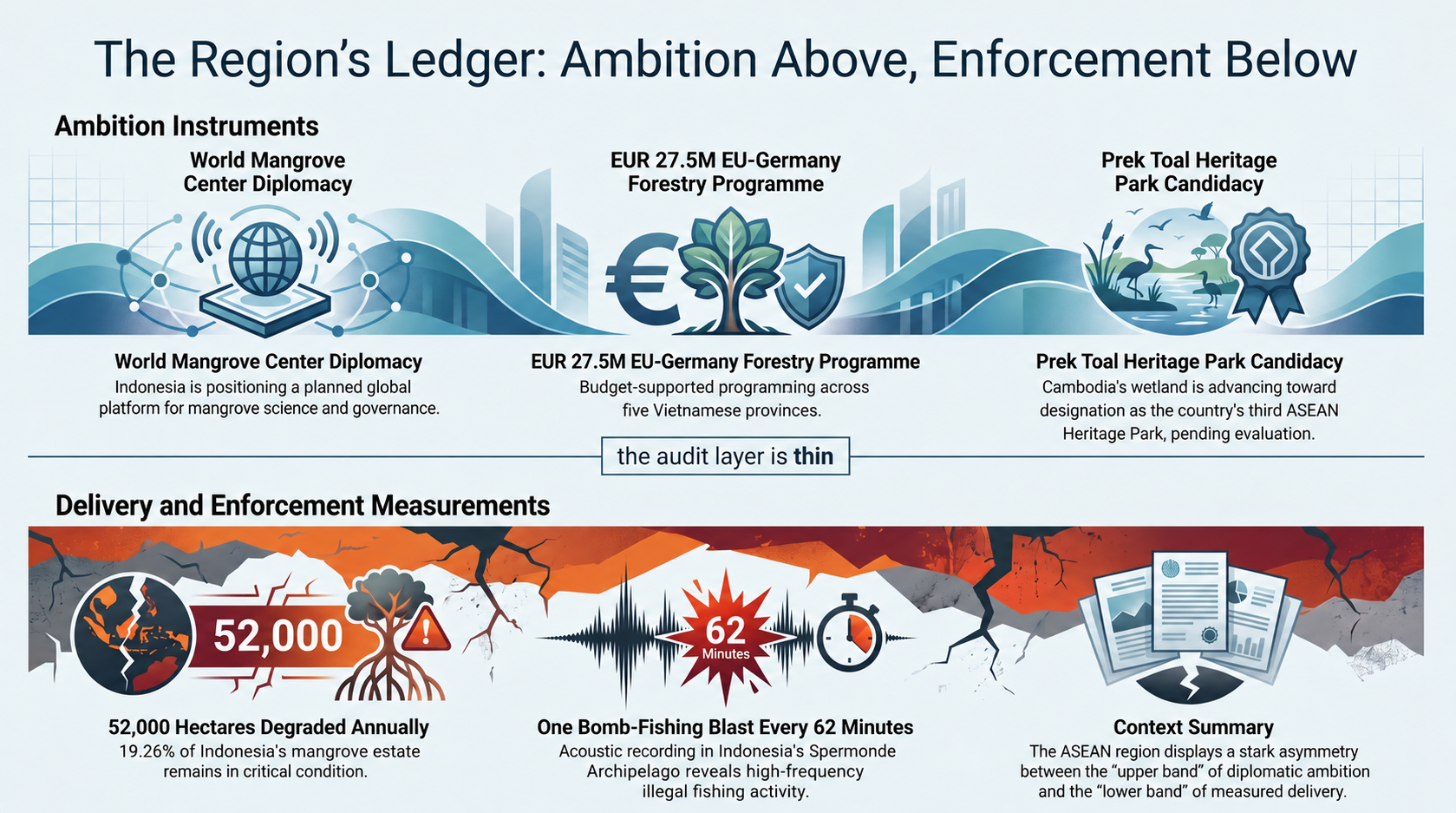
Indonesia’s World Mangrove Center diplomacy remained visible in regional coverage this week. The Ministry of Forestry positioned the planned center as a global platform for mangrove science and governance, citing Indonesia’s share of nearly a quarter of the world’s mangroves and building on positions Indonesia tabled at the ASEAN forestry working group in Siem Reap, Cambodia, in late July. The Ministry of Marine Affairs and Fisheries reports degradation at roughly 52,000 hectares per year, with 19.26% of the mangrove estate in critical condition, so ambition and the delivery gap sit in adjacent ministry files. [12]
Finance moved just ahead of the window: the European Union and Germany announced on 7 August a EUR 27.5 million forestry program with Vietnam’s forest administration and the German agency GIZ across five provinces, with budget-supported programming rather than credits. [13]
The enforcement edge surfaced in an acoustic study published this week, recording one bomb-fishing blast every 62 minutes over 16 months in Indonesia’s Spermonde Archipelago. [14]
Cambodia’s Prek Toal wetland advanced toward designation as the country’s third ASEAN Heritage Park, pending the ASEAN Centre for Biodiversity’s evaluation. [15] The regional reading matches the global: ambition documents are abundant, and the audit layer is thin.
What This Means
For program designers, an audited delivery gap is a stronger problem statement than restated ambition: a proposal anchored in an independently audited shortfall argues from evidence produced by the country’s own accountability system, and an audit that names causes tells the designer which intervention fits: a financing gap calls for different machinery than an absorptive-capacity or governance gap.
For finance officers, verified outcomes make performance more contractible and comparable, but verification alone does not create bankability; the advantage lies in programs that connect credible measurement, institutional accountability, and a financing mechanism able to respond to what the review reveals.
For governments traveling to Ulaanbaatar, Mongolia, on Monday and to Yerevan in October, the reviews travel too: partial but documented delivery now reads better than complete but undocumented commitments.
Worth Watching Through Year-End
UNCCD COP17 convenes in Ulaanbaatar, Mongolia, from 17 to 28 August 2026 under the theme “Restoring Land. Restoring Hope.”, opening Monday. (United Nations Convention to Combat Desertification.) Source
The Taskforce on Nature-related Financial Disclosures releases its second global status report on nature-related assessment and reporting during Climate Week NYC in September; the survey that informed the report closed on 14 August. (TNFD.) Source
CBD COP17 convenes in Yerevan, Armenia, from 19 to 30 October 2026 for the first global review of collective progress under the Kunming-Montreal framework, carrying the revised progress report and its bracketed finance text. (Convention on Biological Diversity.) Source
The Green Climate Fund Board holds its 46th meeting (B.46) in Songdo, Incheon, Republic of Korea, from 26 to 29 October 2026. (Green Climate Fund, Board decision B.43/15.) Source
UNFCCC COP31 runs in Antalya, Türkiye, from 9 to 20 November 2026, with Türkiye holding the Presidency and Australia serving as President of Negotiations under the Türkiye–Australia Partnership Modalities. (UNFCCC; Türkiye–Australia Partnership Modalities, 21 November 2025.) Source
Endnotes
[1] NbS Praxis, Weekly Briefing No. 11, “When the Measure Becomes the Market,” week to 8 August 2026. Prior issue, cited for series continuity; not an external primary source.
[2] United Nations Information Service Nairobi, “From Nairobi to Yerevan: Convention on Biological Diversity (CBD) Talks Wrap Up With Eyes on COP17 and a 30-to-1 Warning,” August 2026, un.org. Primary UN communication on the session’s close and the COP17 handoff; the 30-to-1 spending comparison is attributed to the CBD Executive Secretary and derives from UN Environment Programme State of Finance for Nature estimates, which are modeled aggregates rather than measured flows. https://www.un.org/en/unis-nairobi/nairobi-yerevan-cbd-talks-wrap-eyes-cop17-and-30-1-warning
[3] Convention on Biological Diversity, “What you need to know about the first draft global report of progress under the KMGBF,” 12 June 2026, cbd.int. Primary institutional article: the report draws on 129 national reports, more than 160 sets of national targets, and over 80 updated national biodiversity strategies and action plans, underwent peer review from 2 to 29 June, and forms the primary basis of the Global Review at COP17; the final version follows the Nairobi meetings. https://www.cbd.int/article/2026-06-16-how-the-world-measures-progress-for-nature
[4] Down To Earth, “Nairobi Meetings 2026: CBD’s crucial discussions end with heavily bracketed recommendations for COP17,” August 2026. Secondary specialist coverage of the session’s close on 12 August; the characterization of recommendations as heavily bracketed is the outlet’s, consistent with the UN release’s account of unresolved resource mobilization. https://www.downtoearth.org.in/wildlife-biodiversity/nairobi-meetings-2026-cbds-crucial-discussionsend-with-heavily-bracketed-recommendations-for-cop17
[5] Comptroller and Auditor General of India, performance audit of the National Mission for a Green India, Union Government (Ministry of Environment, Forest and Climate Change), tabled in Parliament 13 August 2026; report number pending publication. Figures here are drawn from press coverage (The Wire and The New Indian Express, Scroll.in and Hindustan Times, The Print, and PNI News, 13–14 August 2026), because the audit document was not yet indexed on cag.gov.in at the time of writing; the figures are consistent across those outlets apart from rounding, and all carry the press-mediated caveat until the primary text is archived. The 1.4 million hectare denominator is the physical target the ministry approved for the 16 audited states and territories over 2015–16 to 2024–25, and is narrower than the mission’s original 2014 design ambition of additional forest and tree cover on 5 million hectares plus quality improvement on a further 5 million; the shortfall reported here therefore measures performance against the audited target, not against the original design. https://m.thewire.in/article/environment/green-india-mission-falls-short-of-its-target-by-97-57
[6] Environment and Climate Change Canada, “Canada’s conserved areas,” canada.ca environmental indicators. Primary government indicator: at the end of 2024, 13.8% of terrestrial area (12.8% in protected areas) and 15.5% of marine territory (11.4% in protected areas) were conserved; “conserved” spans protected areas and other effective area-based conservation measures and is the category of the 30% by 2030 commitment. The 13 August 2026 release of the 2026 National Adaptation Strategy Progress Report is confirmed through same-day third-party statements (Insurance Bureau of Canada; Climate Proof Canada); the indicator figures are government self-reported. https://www.canada.ca/en/environment-climate-change/services/environmental-indicators/conserved-areas.html
[7] Government of Costa Rica, “Technical Annex of the Republic of Costa Rica,” submitted with the first Biennial Transparency Report on 5 September 2025, Table 6: emission reductions of 9,364,369 tCO2e over 2020–23 against the assessed reference level of 76,938 tCO2e per year, with actual net removals in every year of the period; and UNFCCC secretariat, “Technical report on the technical analysis of the technical annex to the first biennial transparency report of Costa Rica,” FCCC/ETF/TATR.1/2025/CRI, published 14 August 2026. Primary submission and review documents; the figures are reported and technically analyzed quantities under UNFCCC REDD+ arrangements, not credits issued or payments disbursed, and a trade-reported total above 10 MtCO2e (Carbon Pulse, 14 August 2026) could not be reconciled with the annex. https://unfccc.int/sites/default/files/resource/2023-anexotecnicoredd.pdf
[8] BTG Pactual Timberland Investment Group, “BTG Pactual TIG and Conservation International reach 20,000 hectares of Cerrado under restoration,” 13 August 2026, read with the company’s April 2026 announcement of the strategy’s close at USD 1.24 billion in equity commitments. Company releases: hectare figures are self-reported, citing the independent Brazilian Restoration and Reforestation Observatory as tracker; USD 1.24 billion is commitments to the strategy, not restoration disbursement; the largest-effort characterization is the company’s. https://timberlandinvestmentgroup.com/btg-pactual-tig-and-conservation-international-reach-20000-hectares-of-cerrado-under-restoration-accelerating-latin-american-reforestation-strategy-increasing-biodiversity-and-social-impacts/
[9] Carbon Pulse, “Isometric agroforestry methodology secures CCP approval,” 13 August 2026. Trade report; the Integrity Council’s most recent located primary announcement (February 2026) covered Isometric’s reforestation protocol as its first CCP-approved nature-based methodology, so the approval is carried as attributed reporting; label eligibility is a quality designation, not an issuance or a transaction. https://carbon-pulse.com/541377/
[10] Agência Gov (Government of Brazil) and the National Institute for Space Research (INPE), DETER alert data presented 7 August 2026: alerts in the Amazon fell 36% in the August 2025–July 2026 cycle to 2,874.38 square kilometers, the lowest in the alert series and 55.6% below the ten-cycle average, against 4,495 square kilometers in the prior cycle. Background anchor released two days before this reporting window; alerts are a leading enforcement indicator, not confirmed deforestation area, for which PRODES provides the official annual rate. https://agenciagov.ebc.com.br/noticias/202608/brasil-tem-reducao-dos-alertas-de-desmatamento-na-amazonia-e-no-cerrado
[11] Carbon Pulse, “Brazil prosecutors question Para over alleged irregularities in J-REDD+ consultations,” 13 August 2026; the Federal Public Prosecutor’s Office had recommended suspension of certification and credit sales in April 2026 pending review. Trade report of a prosecutorial request; allegations under inquiry, not findings. https://carbon-pulse.com/541595/
[12] Antara News, “Indonesia seeks global leadership through mangrove diplomacy,” 11 August 2026, and “Indonesia promotes World Mangrove Center at ASEAN forestry forum,” 30 July 2026, reporting the 21st ASEAN Working Group on Forest Management in Siem Reap, Cambodia. Current signal: the week’s coverage advances an ongoing Ministry of Forestry initiative, while the working-group meeting is late-July background; the degradation figures, roughly 52,000 hectares a year and 19.26% in critical condition, are the Ministry of Marine Affairs and Fisheries’ own. https://en.antaranews.com/news/426501/indonesia-seeks-global-leadership-through-mangrove-diplomacy
[13] Bao Chinh Phu (Government of Vietnam news portal), “EU, Germany back Viet Nam’s natural forest conservation,” 7 August 2026, with the German Embassy in Hanoi as source. Background anchor announced one day before this reporting window: EUR 20 million from the EU alongside Germany’s EUR 7.5 million MEPA project, implemented by VNFOREST and GIZ; commitments, not disbursements. https://en.baochinhphu.vn/eu-germany-back-viet-nams-natural-forest-conservation-111260807121944326.htm
[14] Remote Sensing in Ecology and Conservation (Zoological Society of London), acoustic study of bomb fishing in the Spermonde Archipelago, Indonesia, published week of 10 August 2026: roughly 3,570 blasts recorded over 16 months, one every 62 minutes. Peer-reviewed primary study from a single recorder; counts and degradation-area figures are the study’s own estimates. https://zslpublications.onlinelibrary.wiley.com/doi/10.1002/rse2.70093
[15] CamNess, “Prek Toal conservation area to be ASEAN Heritage Park,” reported week of 10 August 2026. Local-outlet report; formal approval remains pending the ASEAN Centre for Biodiversity’s evaluation, so the designation is prospective, not made. https://cambodianess.com/article/prek-toal-conservation-area-to-be-asean-heritage-park