No. 26 — One Pledge Total, Several Kinds of Money
COP31’s second week produced pledge totals for the GEF funds, coral reefs, and tropical forests, combining contributions across different statuses. A financing plan can use a single contribution—including its donor, window, and conditions—rather than the total.
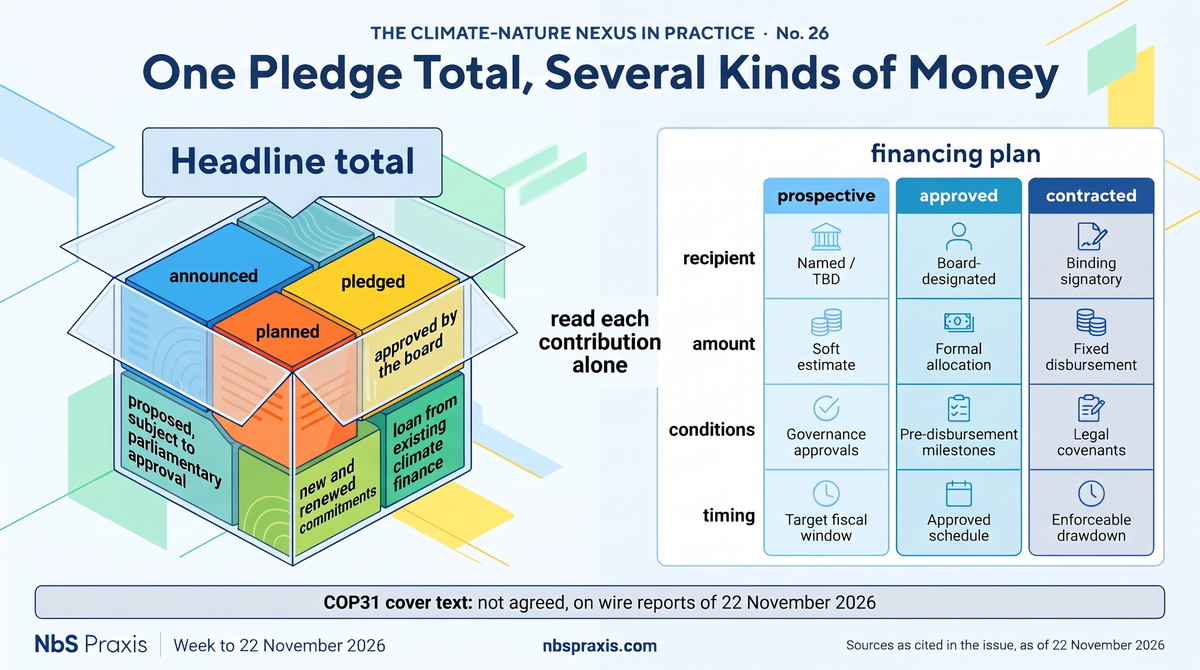
Bottom line: Two headline pledge totals at COP31 each combined money at different stages. The Global Environment Facility reported USD 200 million pledged by four governments, including Germany’s contribution proposed to the German parliament. The Global Fund for Coral Reefs announced more than USD 30 million, joining board-approved investments with new and renewed commitments from state partners. Canada announced up to CAD 560 million for the Tropical Forest Forever Facility, as a loan from existing climate finance. Wire agencies report that COP31 ended without an overarching agreement. A financing plan should cite the single contribution, not the total.
Here is the gateway into the field, and the briefing is the room you walk into: [Podcasts and Videos — Gemini Notebook: www.youtube.com/@nbspraxis]
Link to Explainer Video (Playlist of 1 Podcast and 4 Videos for Week 26, available at https://www.youtube.com/playlist?list=PLSdRhtNllyAs
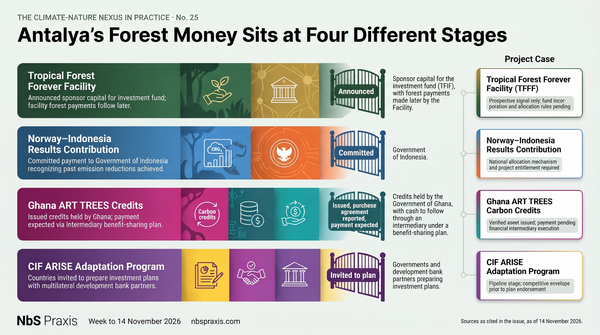
Last week’s briefing argued that the forest money announced in Antalya was at four different stages. During the second week of the United Nations climate conference (COP31) in Antalya, Türkiye, the same question was pushed one level down, from the flow to the headline number. The Global Environment Facility (GEF) reported a pledged total, which the same release describes using different status terms. [1] The Global Fund for Coral Reefs (GFCR) announced a total that combines investments approved by the fund’s board with government commitments. [2] The Tropical Forest Forever Facility (TFFF) restated a running total of pledged sponsor capital following Canada’s announcement, and the Adaptation Fund published new pledges as a dated count. [3] [4]
The negotiated track is a different kind of item. COP31 was due to close on 20 November. On 22 November, Reuters and the Associated Press reported that the talks ended without an overarching agreement after the European Union and others rejected the proposed text. [5] That evening, the UNFCCC news page carried no closing statement, and the cover text remains a draft.
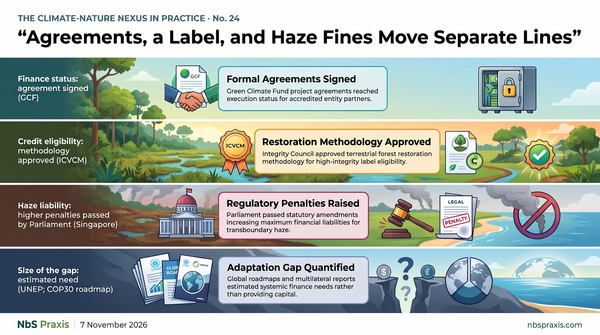
Of the three signals named in last week’s issue, one arrived. The Green Climate Fund’s decisions list now includes the forty-sixth Board meeting’s decisions, including approval of 21 funding proposals subject to annexed conditions. The biodiversity convention’s adopted text on climate change was not found on the convention’s decisions page on 21 November. [6]
For senior practitioners, the implication is that a pledging total is a headline. The unit a financing plan can use is the single contribution, with the donor, the window, the status word, and the conditions attached.
Reading Inside the Total
A pledging total adds contributions across different rungs. The week’s releases supply the words needed to take each total apart.
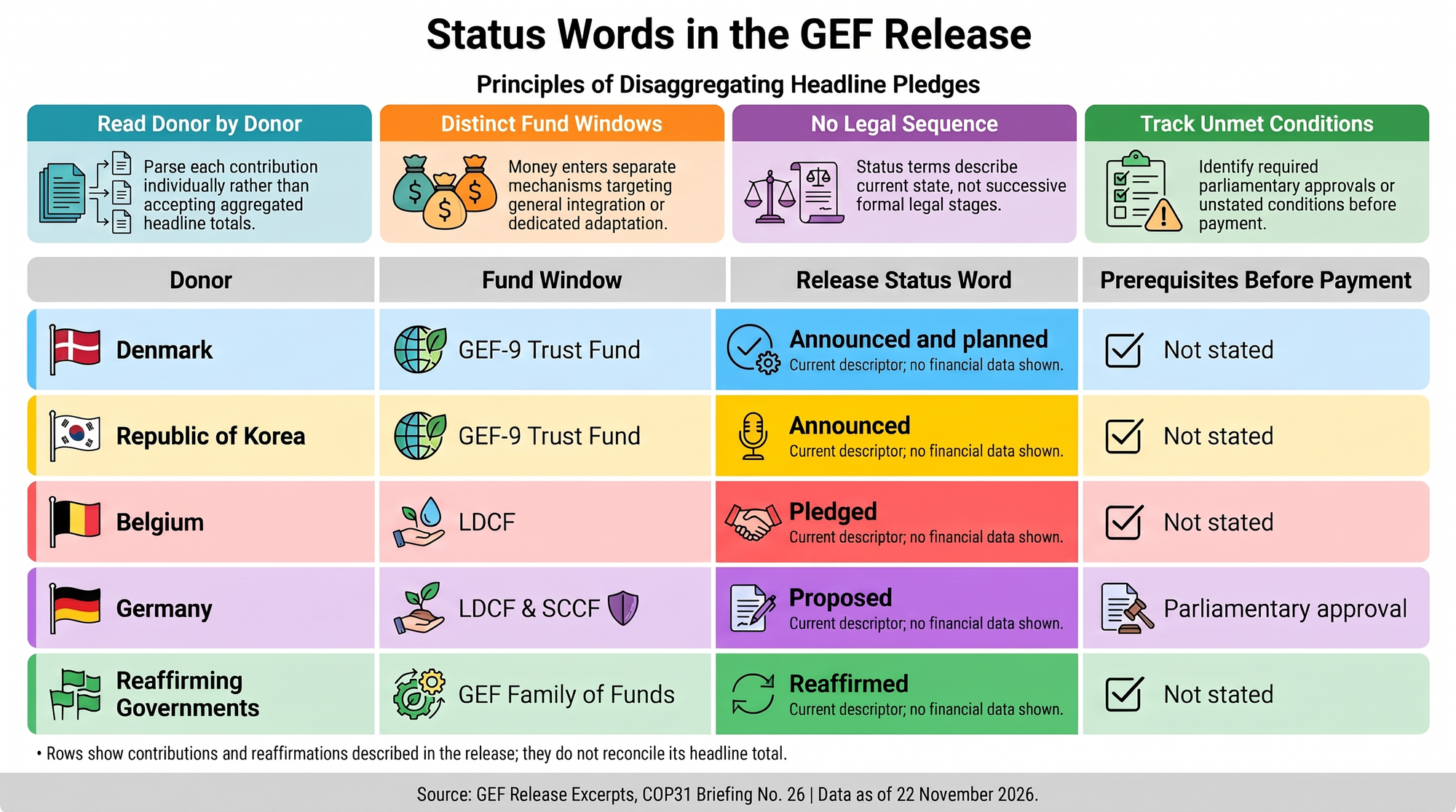
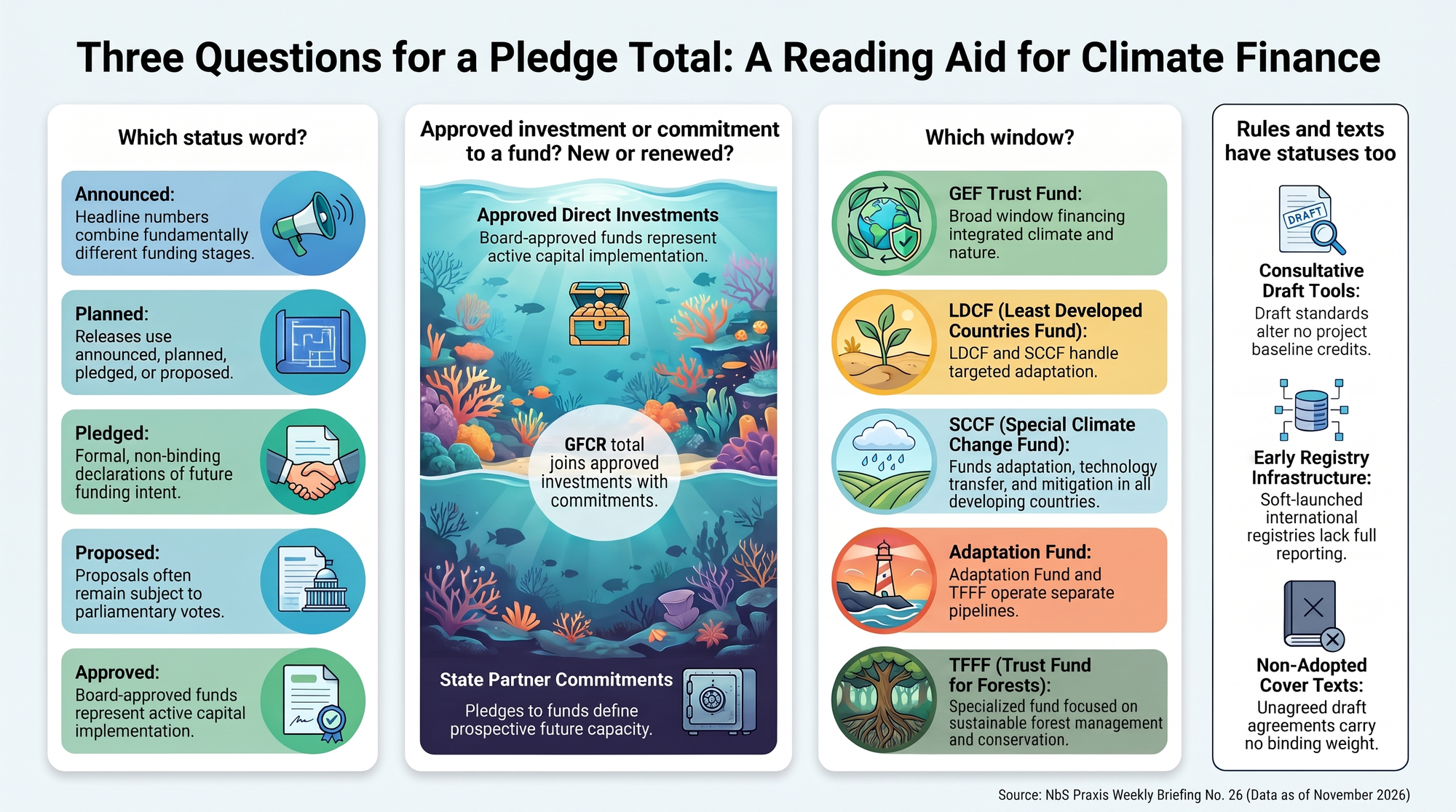
First, read the status word by donor. The GEF’s release uses one verb for the total and several for the parts: contributions are announced, planned, pledged, or proposed to a parliament and subject to approval, and other governments reaffirm support. [1] The total is stated in US dollars and the parts in kroner, won, and euros, so readers must read the parts one by one. The same reading applies to the TFFF, whose running total sums sponsor announcements; the Canadian government’s release qualifies Canada’s contribution with the words “up to,” and a linked backgrounder identifies a loan from existing climate finance. [3]
The second move separates approved investments from fund commitments, and new money from renewed money. The coral reef announcement contains both pairs. [2] Investments approved by the fund’s Executive Board are the part closest to a reef. Commitments from state partners are contributions to the fund, and the release describes those commitments together as new and renewed. For biodiversity and coastal adaptation, the two parts answer different questions: what the fund has decided to finance, and what the fund may be able to finance later.
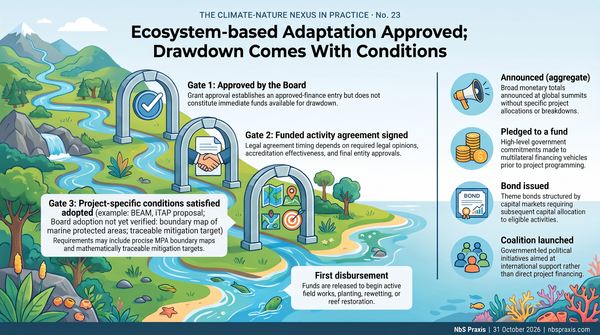
The third move asks which window the money enters. Within the GEF family, the Trust Fund finances what the release calls integrated action on climate, nature, and pollution, while the Least Developed Countries Fund (LDCF) and the Special Climate Change Fund (SCCF) provide dedicated adaptation finance. [1] The Adaptation Fund is a separate institution with separate pledges, a separate pipeline, and a separate mobilization target, whose figures The Record sets out below. [4] Among this week’s dedicated adaptation-fund announcements, the totals that matter for ecosystem-based adaptation (EbA) are those of the LDCF, the SCCF, and the Adaptation Fund, each read on its own.
On mitigation, the week’s movement focused on rules and infrastructure, with each item having its own status. Verra, which operates the Verified Carbon Standard, opened consultations on two draft tools for forest projects: one to estimate leakage from improved forest management and another to set the maximum credits a harvesting project can generate based on a long-term average of carbon storage. [7] The secretariat of the United Nations Framework Convention on Climate Change (UNFCCC) presented a first version of the international registry for cooperative approaches under Article 6.2 of the Paris Agreement, with reporting support to follow in future releases. [8] A draft tool does not change a project’s credits until a final version is published.
The negotiated text sits apart: the COP31 cover drafts show what parties were weighing, and on the wire reports none was adopted. [5]
The Record
GEF reports a pledged total for the GEF family of funds
The GEF’s 17 November release from Antalya states that four governments pledged USD 200 million to the GEF family of funds. Denmark and the Republic of Korea announced contributions of DKK 800 million and KRW 10 billion to the ninth replenishment of the Trust Fund (GEF-9). Denmark’s statement describes the Danish sum as a planned contribution. Belgium pledged EUR 50 million to the LDCF. Germany’s statement says the government proposed EUR 10 million for the LDCF and EUR 8 million for the SCCF to the Bundestag, both subject to parliamentary approval. The release puts total GEF-9 pledges at more than USD 4.5 billion for 2026–2030.
This week: contributions announced, planned, pledged, and proposed, by donor; the release reports no payment. [1]
Global Fund for Coral Reefs announces investments and commitments
On 17 November, the GFCR announced more than USD 30 million in new investments and donor contributions across 22 developing countries. The total comprises two parts: more than USD 10 million in new investments approved by the fund’s Executive Board, and new and renewed commitments from state partners totaling more than USD 20 million. Indonesia and the Philippines are among the countries with named recipients.
This week: board-approved investments and state-partner commitments, new and renewed; self-reported. [2]
Canada announces a loan to the TFFF
On 15 November in Manila, the Philippines, Prime Minister Mark Carney announced an initial contribution of up to CAD 560 million over four years to the TFFF. A Global Affairs Canada backgrounder linked from the release says the contribution is made through a loan financed from Canada’s international climate finance envelope and represents existing funding under Canada’s climate finance commitment. The release on 16 November puts total sponsor capital pledges at USD 8.3 billion.
This week: announced; a loan from existing climate finance, terms not stated in either government document. [3]
Adaptation Fund lists new pledges announced at COP31
The Adaptation Fund’s page, with data as of 17 November at 20.00 Türkiye time, lists new pledges totaling USD 50 million from six contributors: Spain, Germany, Ireland, the Brussels Region, Portugal, and Estonia. The same page reports an active project pipeline at a record nearly USD 2.4 billion and a 2026–2029 target to mobilize at least USD 1.2 billion.
This week: pledges announced; the page says the list will be updated as new pledges are announced. [4]
COP31 ends without an agreed cover text, on wire reports
Reuters and the Associated Press reported on 22 November that COP31 ended without an overarching agreement after the European Union and others rejected the Presidency’s proposed text. The adaptation finance amount of at least USD 120 billion, set out in a paragraph of the 16 November draft, was absent from the third draft of 22 November, which underscored the call to at least triple adaptation finance by 2035 and would have launched an Antalya–Addis Ababa road map on adaptation and resilience finance. The third draft also recognized nature-based solutions (NbS) and encouraged efforts to halt and reverse deforestation and forest degradation by 2030.
This week: outcome reported by wire agencies; no closing statement or adopted decision on the UNFCCC news page on 22 November, and it is unclear whether the session closed or was suspended. [5]
ASEAN in Focus
At the 49th Summit of the Association of Southeast Asian Nations (ASEAN) in Manila, Indonesia’s President Prabowo Subianto apologized to Malaysia and Singapore during the plenary session for haze caused by the season’s forest fires, while saying the fires were not Indonesia’s fault. [9] On 17 November, President Ferdinand Marcos Jr. of the Philippines said leaders had called for measures to prevent the recurrence of forest fires. [10] On 22 November, the depositary’s register for the agreement establishing the regional haze center listed three instruments, those of Viet Nam, Singapore, and Malaysia, unchanged from 14 November, and entry into force still awaits the sixth instrument. [11]
Leaders adopted a Declaration on the One Billion Trees Growing Initiative on 15 November. The operative text encourages restoration of mangroves, peatlands, and watersheds; the use of native and climate-resilient species; and sustainable financing, and sets no numeric target or deadline. [12]
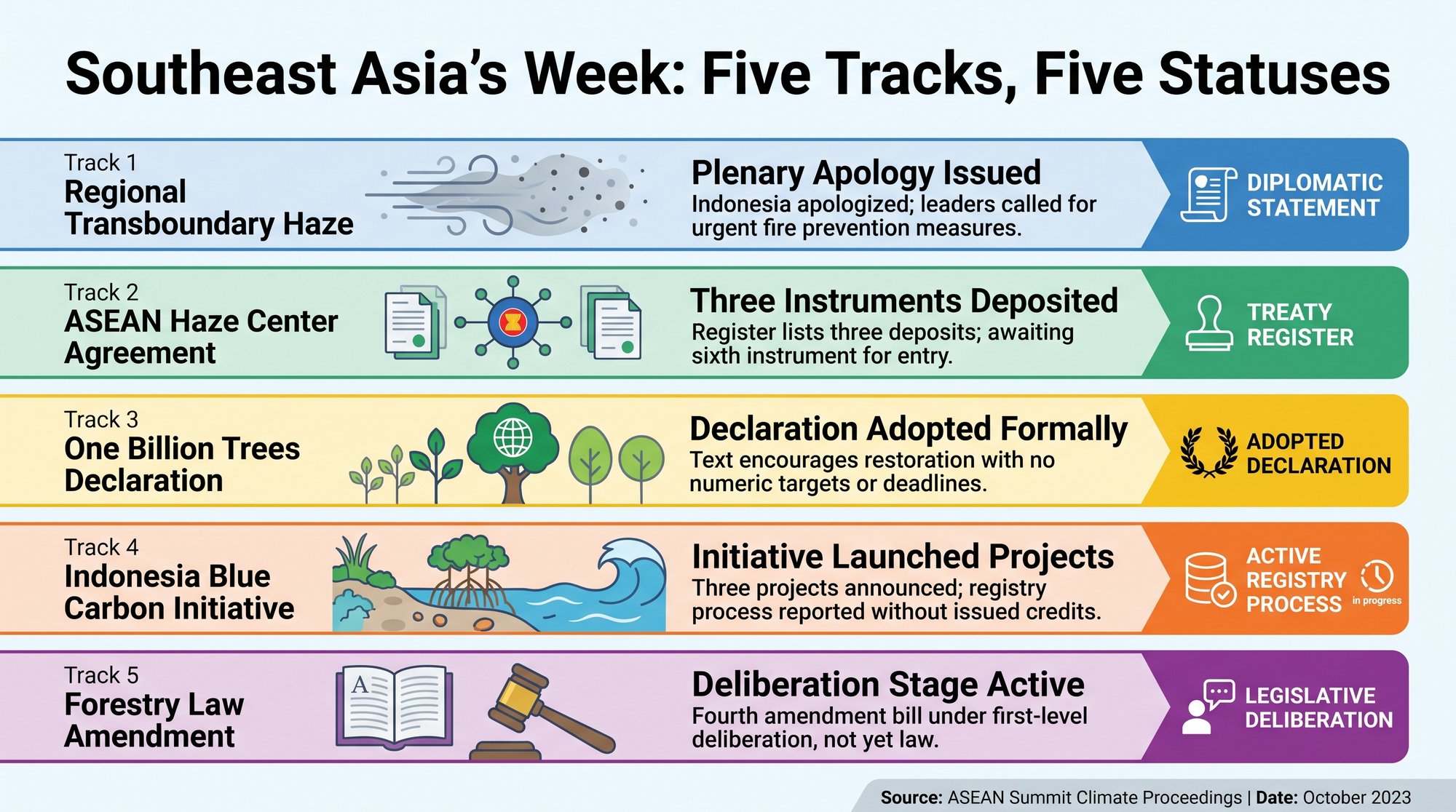
On 17 November in Antalya, Indonesia’s Deputy Environment Minister Diaz Hendropriyono launched a Blue Carbon Initiative with three projects: Mangrove for Coastal Resilience in North Kalimantan, a mangrove restoration initiative on Java’s north coast, and a mangrove and seagrass initiative in East Belitung. [13] The national news agency Antara reported that officials said the North Kalimantan project covers about 43,000 hectares, began about three and a half years ago, and is in the process of entering the national carbon unit registry, and that nearly 50% of the economic value from blue carbon would return to communities. The two sources describe a registry process and report no credits issued or sold.
In Antalya on 18 November, a forestry ministry release cautioned that not all peat conservation automatically generates carbon credits. In Jakarta on 19 November, the government and the parliament’s Commission IV opened first-level deliberation of a fourth amendment to the Forestry Law; the ministry’s release says the bill would set a minimum forest area of 30% of a watershed or island and heavier sanctions for corporations that burn forests. [14] A bill under deliberation is not law.
What This Means
For a programme designer who cites this week’s totals, a pledged total signals where to pitch and not to finance a named project. In a financing plan, money from the GEF Trust Fund, the LDCF, the SCCF, or the Adaptation Fund remains prospective until the fund approves the project. Approved and contracted finance are then recorded separately, each with the recipient, amount, conditions, and drawdown timing. Due-diligence questions include which window and replenishment period a contribution falls into, and which contributions still await a donor’s approval.
For coastal and reef programmes in the countries the Coral Reef Fund names, the question to ask the fund is which investments the board approved, for what amounts, and under what disbursement conditions.
For developers of forest projects with harvesting under Verra's methodologies, the draft tools serve as a monitoring signal and a prompt for comment. The condition for changing a credit forecast is the final published tool, along with the transition provisions that apply to the project. Until then, the drafts serve as a sensitivity case alongside the base case. No design decision should be based on the COP31 drafts.
Worth Watching Through Year-End
2026 UN Water Conference: Abu Dhabi, United Arab Emirates, 8 to 10 December.
Verra consultations on two forest tools: comments close on 18 December for the long-term average tool and on 21 December for the improved forest management leakage tool.
Spatial planning and connectivity assessment of the Intergovernmental Science-Policy Platform on Biodiversity and Ecosystem Services: additional government review of the draft summary for policymakers, 14 December to 22 January 2027.
EU Deforestation Regulation: application date of 30 December for large and medium-sized operators and traders.
Endnotes
[1] Global Environment Facility. (2026, November 17). Governments announce additional $200 million to GEF family of funds at COP31. Primary and self-reported; pledges and proposals, not payments. The release does not name the four governments as a group; Belgium’s statement also refers to EUR 80 million for the GEF, and Japan, the Netherlands, Nigeria, Norway, and Spain are recorded as reaffirming support, with Norway’s NOK 780 million restated.
[2] United Nations Environment Programme and Global Fund for Coral Reefs. (2026, November 17). Over US$30 million announced to strengthen coral reef resilience. Primary and self-reported. A United Kingdom minister’s statement in the release refers to GBP 11.8 million; the release adds that the Mesoamerican Reef Fund investments, in Mexico, Belize, Guatemala, and Honduras, are positioned to mobilize a further USD 12 million in blended finance.
[3] Prime Minister of Canada. (2026, November 15). Prime Minister Carney announces Canada’s landmark contribution to protect tropical forests; Global Affairs Canada. (2026, November 14). Backgrounder: Prime Minister Carney announces Canada’s landmark contribution to protect the world’s tropical forests; and Tropical Forest Forever Facility. (2026, November 16). Canada announces CAD 560 million initial contribution to TFFF. Primary; announced, not paid in. The backgrounder: “through a loan financed from Canada’s international climate finance envelope”; “represents existing funding under Canada’s international climate finance commitment.” The four-year period appears only in the release; the government’s documents list the amount as “up to $560 million” and the facility’s release as CAD 560 million without the qualifier. The running total is the facility’s own.
[4] Adaptation Fund. (2026, November 17). Adaptation Fund Mobilizes $50 Million. Primary and self-reported; pledges announced. The total appears only in the headline; the six listed pledges are Spain EUR 25 million, Germany EUR 10 million, Ireland EUR 6 million, the Brussels Region EUR 2.9 million, Portugal EUR 1 million, and Estonia EUR 300,000.
[5] UNFCCC. Draft text prepared under COP31 Presidency consultations on a Presidency-led, Party-driven cover decision: version of 16 November and version of 22 November, 02.00; UNFCCC news; Reuters. (2026, November 22). COP31 climate talks collapse as EU and others reject deal; Associated Press. (2026, November 22). UN climate talks break down without an overarching agreement. Primary drafts, nothing adopted. The outcome rests on wire agency reports read in syndicated copies; no official closing statement was available on 22 November. Reuters: the conference “ended in collapse on Sunday”; COP31 President Murat Kurum: “There will be no new text from now on.” The adaptation amount is paragraph 73 of the earlier draft; in the third draft, the tripling call is paragraph 45, the road map paragraph 53, NbS paragraph 34, and deforestation paragraph 40(g). Paragraph 64 of the third draft notes USD 120 billion a year from multilateral development banks, a different quantity. A second draft, dated 19 November, sits between the two.
[6] Green Climate Fund. Board decisions listing and Decision B.46/04; and Secretariat of the Convention on Biological Diversity. COP decisions. Primary. The listing carries decisions B.46/01 to B.46/20; the convention’s page listed decisions through COP16 on 21 November.
[7] Verra. (2026, November 19). Consultation: New Improved Forest Management Leakage Tool; and (2026, November 18). Consultation on Long-Term Average Tool for ARR and IFM Projects. Primary; drafts under consultation. The leakage tool would be required for projects under VM0003, VM0005, VM0010, VM0011, VM0012, VM0034, and VM0045 once a final version is published; the long-term average is taken over at least 40 years, or over whole harvesting cycles where those are longer.
[8] UNFCCC. (2026, November 17). COP31 sees launch of first version of Article 6.2 international registry. Primary and self-reported; described as a soft launch, with onboarding to begin with a workshop in early 2027.
[9] Antara. (2026, November 18). Round up: Indonesia gaungkan persatuan kawasan di KTT ke-49 ASEAN. National wire. “Saya ingin meminta maaf kepada negara tetangga, Malaysia dan Singapura … Ini bukan kesalahan kami, tapi sekali lagi kami mohon maaf.” The report does not date the plenary statement.
[10] Philippine News Agency. (2026, November 17). Indonesia doubling down on effort vs. transboundary haze: Marcos. National wire. “We called on measures to prevent the recurrence of forest fires.”
[11] ASEAN Secretariat. ASEAN legal instruments register, Agreement on the Establishment of the ASEAN Co-ordinating Centre for Transboundary Haze Pollution Control. Primary; depositary record. The register dates are 26 June 2026 for Viet Nam’s instrument of approval and 13 and 14 November for Singapore’s and Malaysia’s instruments of ratification; these are the Secretariat’s record dates, not the dates on the instruments.
[12] ASEAN Secretariat. (2026, November 15). ASEAN Leaders’ Declaration on the One Billion Trees Growing Initiative. Primary. The date is the adoption line; the preamble refers to leaders gathering on 10–12 November. Restoration is operative paragraph 3 and financing is operative paragraph 7.
[13] Ministry of Environment, Republic of Indonesia. (2026, November 18). Indonesia Luncurkan Tiga Proyek Pemulihan Mangrove dan Padang Lamun di COP31; and Antara. (2026, November 18). Indonesia luncurkan tiga proyek karbon biru di COP31. Primary for the launch; national wire, reporting officials, for the area, the start, the registry process, and the community share. “dengan luas lahan mencapai 43 ribu hektare”; “hampir 50 persen dari nilai ekonomi yang diperoleh dari karbon biru, akan kembali kepada masyarakat.” Antara also reports an offset estimate for the project without a period, which is not carried.
[14] Ministry of Forestry, Republic of Indonesia. (2026, November 18). Indonesia Dorong Pendanaan Berkelanjutan untuk Perlindungan Gambut dan Pemberdayaan Masyarakat; and (2026, November 19). Pemerintah dan DPR Mulai Bahas Perubahan Keempat UU Kehutanan. Primary, self-reported; a bill at first-level deliberation (Pembicaraan Tingkat I). “tidak semua kegiatan konservasi gambut secara otomatis dapat menghasilkan kredit karbon”; “mengatur kecukupan luas kawasan hutan minimal 30 persen dari luas daerah aliran sungai dan/atau pulau.”