No. 9 — Capital Arrives Link by Link
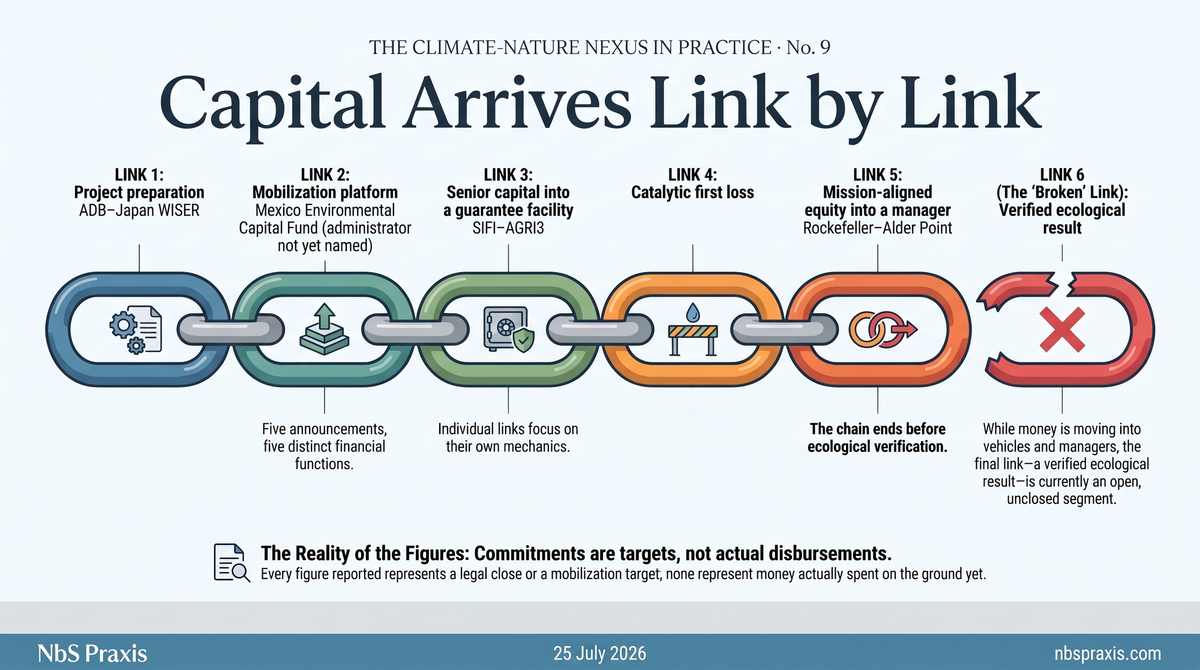
Five announcements placed capital at five different points in the chain from project preparation to verified outcome, and each disclosed only its own link.
The Climate-Nature Nexus in Practice (Weekly Briefing to 25 July 2026)
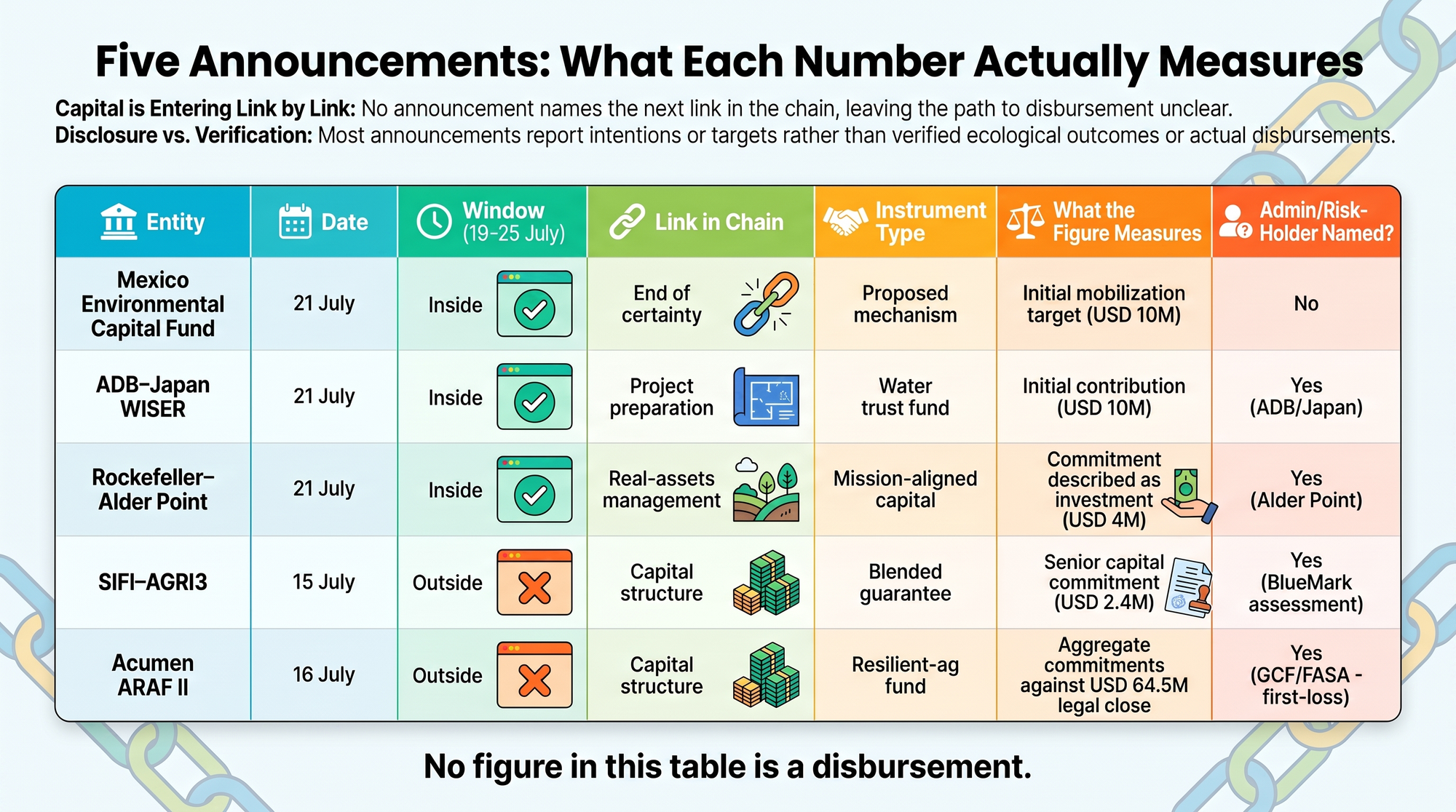
Bottom line: Three announcements landed inside the reporting week, and two from 15 and 16 July drew coverage on those same days. Mexico's environment ministry proposed an environmental capital fund with an initial mobilization target of up to USD 10 million; the Rockefeller Foundation committed USD 4 million in mission-aligned capital to a United States real-assets manager; and the Asian Development Bank and Japan established a water trust fund seeded with USD 10 million from Japan. Each sits at a different point in the financing chain, and none of the five names links to the next.
Here is the gateway into the field, and the briefing is the room you walk into: [Podcast and Video — Gemini Notebook]
Link to Explainer Video (Produced by the author with Gemini Notebook)
Last week's briefing described a growing pool and a narrow pipe: record multilateral commitments that address the volume question and leave access, terms, and delivery governance unresolved. [1] This week offers the next distinction. Five announcements reached the climate-and-nature nexus, and reading them as one class — new funds, new money, new vehicles — obscures what makes them useful. They sit at five distinct points along the chain running from project preparation, through capital structure, to a verified ecological result.
Three landed inside the window. In Mexico City, Mexico, the environment ministry proposed an Environmental Capital Fund with an initial mobilization target of up to USD 10 million. [2] In Tokyo, Japan, the Asian Development Bank and the Government of Japan established a water trust fund that prepares projects rather than investing in them. [3] The Rockefeller Foundation placed USD 4 million of mission-aligned capital with a United States farmland and timberland manager. [4] Two more, announced on 15 and 16 July and covered during the week, illustrate the capital structure: a Swiss initiative's senior-capital commitment to a blended guarantee facility and Acumen's report of USD 90 million in committed capital for a second resilient-agriculture fund. [5][6]
Read as a sequence rather than a pile, the week offers something a practitioner can act on. Capital is entering the chain at every link, and no announcement carries the link that follows. The reader's task is to ask who holds that one.
Five Announcements, Five Links
The week's capital entered the financing chain at five different points, and each announcement disclosed only its own.
The chain begins at project preparation, where the ADB–Japan fund sits. The Water Initiative for Security, Efficiency and Resilience Fund, established on 21 July with an initial USD 10 million from Japan, supports project preparation, policy reform, technical training, and water governance across the bank's developing members. [3] A trust fund of that design does not invest; the fund makes projects investable. Its announcement specifies no nature-based solutions or biodiversity content, so the item belongs here as adjacent climate and water finance with nature relevance to be settled project by project.
Mexico's fund sits at the opposite end of certainty. Presented on 21 July by the Secretariat of Environment and Natural Resources, which proposed the mechanism, alongside the Secretariat of Finance and Public Credit and CAF (the Development Bank of Latin America and the Caribbean), the Environmental Capital Fund is framed as a long-term platform to mobilize up to USD 10 million initially. [2] The purpose is explicit. What the joint announcement does not state is who will administer the fund, under what fiduciary mandate, or what counts as an eligible expenditure. A mobilization target announced before an administrator is named is the week's clearest illustration of the general point.
Two signals from the previous week highlight the capital structure. The SDG Impact Finance Initiative, a Swiss public-private partnership, committed USD 2.4 million to the AGRI3 Fund on 15 July. AGRI3 describes the money as a stable, senior layer of capital that strengthens creditworthiness and attracts further investors. [5] Senior sits opposite first-loss in a capital stack, and the distinction matters: catalytic effects can come from the top of the stack as well as the bottom. In Acumen's second Resilient Agriculture Fund, by contrast, the Green Climate Fund and FASA, Financing for Agricultural SMEs in Africa, hold the catalytic first-loss position, and the Green Climate Fund returns as an anchor, increasing an existing commitment. [6]
The Acumen figures reflect the same care. Acumen announced USD 90 million in committed capital against a USD 120 million target, while FMO reports the fund reached first close at USD 64.5 million. [6] Both are correct and measure different things: first close is capital legally admitted, while the larger figure is aggregate commitments, including those admitted at later closes. Quoting one without the other implies a precision the transaction does not yet have.
One announcement carried something scarcer than money. As a condition of the SDG Impact Finance Initiative's investment window, AGRI3 underwent an independent BlueMark assessment of its impact-management practice and received a Platinum rating. [5] An investor who makes an external check of the intermediary's practice a condition of entry is closer to the discipline these pages have argued for than any disclosure standard now in progress. Disclosure guidance is not verification: the International Sustainability Standards Board targets October 2026 for an exposure draft proposing an IFRS Practice Statement on reporting material nature information, rather than a test of whether an ecological result occurred. [7] The distance between reporting and testing is where the chain still breaks.
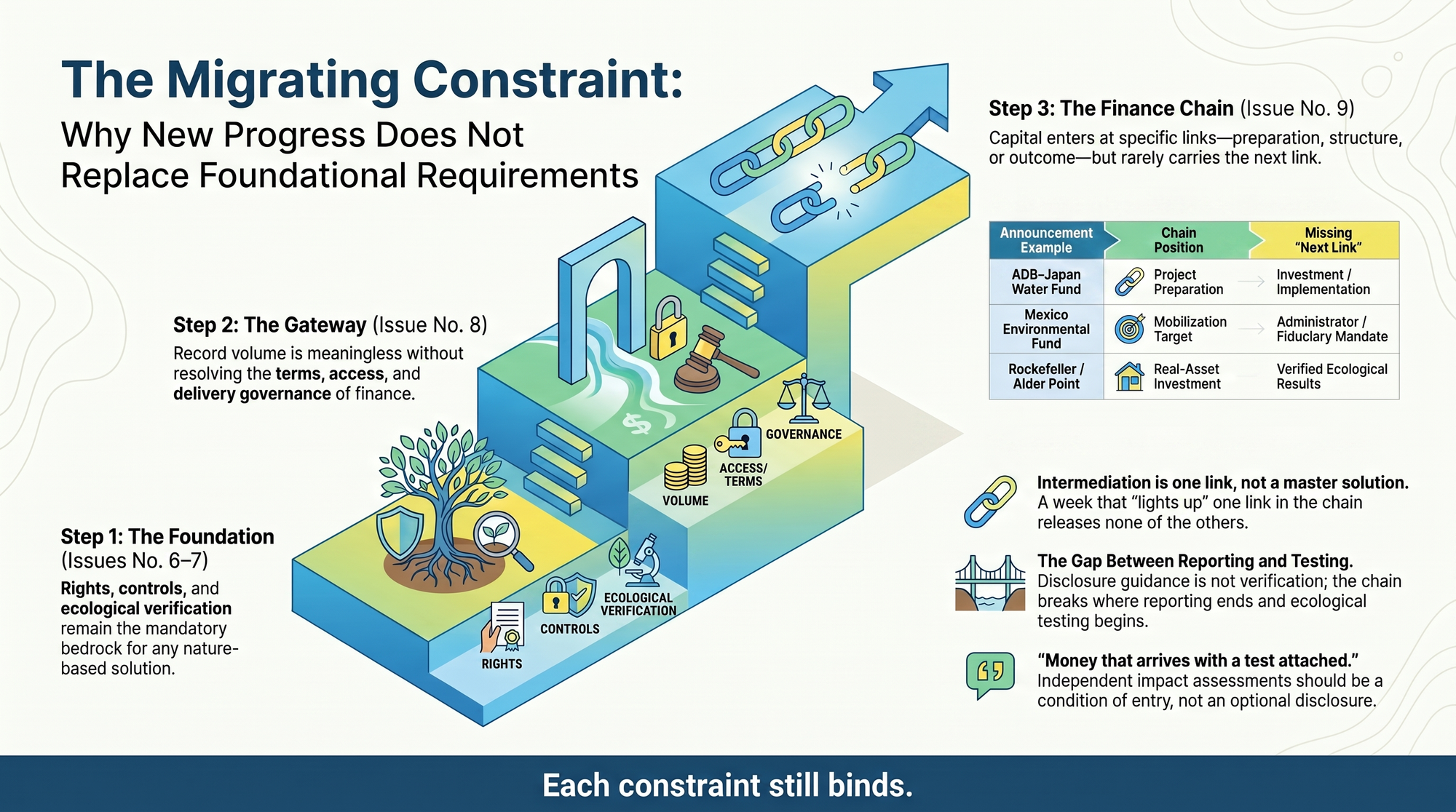
Read across four issues, the binding constraint keeps shifting. Issues No. 6 and No. 7 set out rights, controls, and verification; No. 8 separates the volume of finance from its access, terms, and governance. [1][8] No. 9 adds the chain, cautioning against the obvious overstatement: intermediation is one link among several, not a new master constraint displacing the rest. Project preparation, access, terms, rights, fiduciary capacity, and ecological verification still bind, and a week that lights up one link releases none of the others.
The Record
Three developments within the 19–25 July window and two current signals from the previous week.
This week — Mexico presented an environmental capital fund without naming the administrator.
The Secretariat of Environment and Natural Resources, which proposed the mechanism, presented the Environmental Capital Fund for Mexico on 21 July, alongside the Secretariat of Finance and Public Credit and CAF, the Development Bank of Latin America and the Caribbean. The fund targets an initial USD 10 million for ecosystem restoration and conservation, natural-capital protection, sustainable water and soil management, circular economy, bioeconomy, air quality, and climate action, aligned with the National Development Plan 2025–2030. That figure is a mobilization target, not committed or disbursed capital, and the joint communiqué identifies no administrator or fiduciary mandate.
Source: Government of Mexico, joint communiqué of the Secretariat of Finance and Public Credit and the Secretariat of Environment and Natural Resources, Mexico City, 21 July 2026, corroborated by CAF (primary; announcement; mobilization target). gob.mx
This week — A sovereign donor seeded a water trust fund for project preparation, not for investment.
The Asian Development Bank and the Government of Japan established the Water Initiative for Security, Efficiency and Resilience Fund in Tokyo, Japan, on July 21, with an initial USD 10 million from Japan. The fund supports project preparation, policy reform, technical training, knowledge sharing, and water governance across the bank's developing members, including ASEAN states. The announcement specifies no expenditure on nature-based solutions or biodiversity, so the item is recorded as adjacent climate and water finance.
Source: Asian Development Bank, “ADB, Japan Establish New Water Security Fund,” Tokyo, 21 July 2026 (primary; announcement; initial contribution; nature content not stated). adb.org
This week — A foundation placed mission-aligned capital with a real-asset manager.
The Rockefeller Foundation announced on 21 July a USD 4 million commitment to Alder Point Capital Management, a real-assets manager that acquires undermanaged United States farmland and timberland and partners with local farmers, foresters, and operators to restore soil, water, and forest health. The Foundation describes the funds as long-term, mission-aligned capital and as an investment rather than a grant, targeting measurable climate, biodiversity, and rural-community outcomes. The commitment is United States-focused.
Source: The Rockefeller Foundation, “Rockefeller Foundation Commits USD 4 Million to America's Working Lands and Rural Prosperity in Partnership with Alder Point,” New York, 21 July 2026 (primary; commitment described by the issuer as an investment). rockefellerfoundation.org
Current signal (15 July) — Senior capital entered a blended-guarantee facility, with an independent assessment attached.
The SDG Impact Finance Initiative, a Swiss public-private partnership, committed USD 2.4 million to the Amsterdam-based AGRI3 Fund, which provides partial risk guarantees and credit enhancement to banks financing sustainable agriculture and avoided deforestation across Africa, Asia, and Latin America. AGRI3 describes the commitment as a stable, senior layer of capital, not as concessional or first-loss capital. As part of the investment window, AGRI3 underwent an independent BlueMark fund assessment and earned a Platinum rating. The transaction was announced on 15 July, ahead of the reporting window, and drew coverage during the week.
Source: AGRI3 Fund, “AGRI3 Fund Announces Participation of the SDG Impact Finance Initiative (SIFI),” Amsterdam, 15 July 2026, published 16 July (primary; commitment to a guarantee facility; senior capital; outside the reporting window). agri3.com
Current signal (16 July) — A resilient-agriculture fund reported commitments well ahead of its legal first close.
Acumen announced USD 90 million in committed capital for the Acumen Resilient Agriculture Fund II, against a USD 120 million target. Returning anchor investors include the Green Climate Fund, FMO, and Proparco, joined by new investors Swedfund, BIO, and FASA, Financing for Agricultural SMEs in Africa, alongside a family office. The Green Climate Fund and FASA invested as catalytic first-loss investors, with the Green Climate Fund increasing a commitment held since the first fund. FMO, which committed USD 12.5 million, reports a first close at USD 64.5 million: the first close measures capital legally admitted, while the USD 90 million measures aggregate commitments. The fund expands from East and West Africa into North Africa.
Source: Acumen, “Acumen's ARAF announces USD 90 million in committed capital,” New York, 16 July 2026; FMO investment announcement (USD 12.5 million; first close at USD 64.5 million) (both primary; commitments and legal close, not disbursement; outside the reporting window). acumen.org
ASEAN in Focus
No ASEAN intermediary vehicle launched within the reporting window; the week's fundraising was concentrated in Latin America, Africa, and multi-region facilities. Two developments nonetheless bear on the region. The ADB–Japan water fund covers the bank's developing members, including ASEAN states. Because the fund prepares projects rather than investing in them, its regional significance will depend on which projects the fund prepares and whether nature is included in those projects at design or not at all. [3]
The nearer opportunity is already open. Blue Action Fund's call on mangroves, blue carbon markets, and 30x30 closes on 16 October 2026, offering individual grants of EUR 2 million to 4 million over implementation periods of up to five years to national and international non-governmental organizations working in Indonesia, the Philippines, Vietnam, and India. [9]
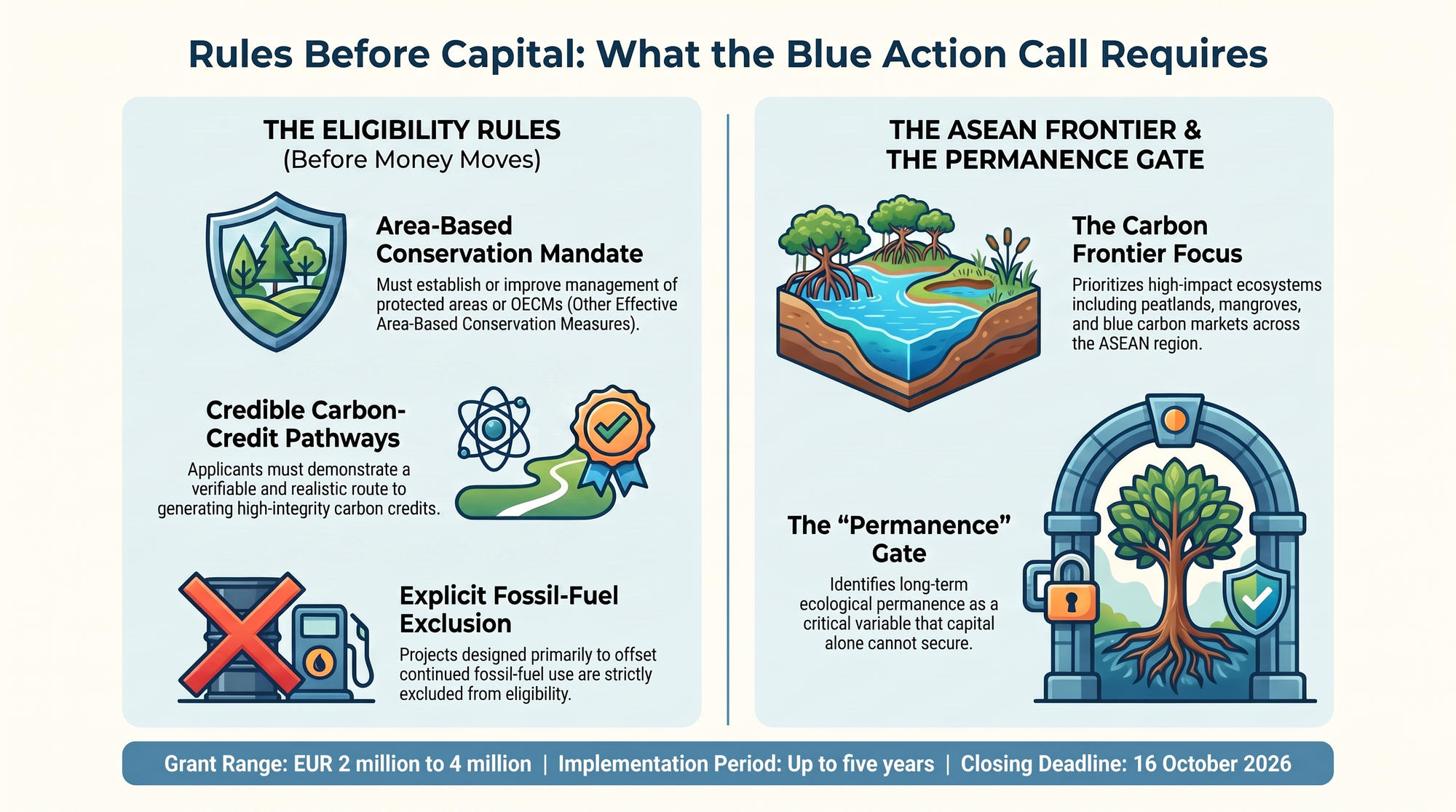
The call's structure is what matters here. An applicant must pair the establishment or improved management of protected areas or other effective area-based conservation measures with a credible pathway to carbon-credit generation. Projects designed primarily to offset continued fossil-fuel use fall outside its scope. [9] A funder writing eligibility and integrity rules before capital moves is a discipline the region's peatland and mangrove work has generally lacked, and permanence remains the variable no capital structure alone secures.
What This Means
The week speaks to whoever holds the next link. For governments and development banks announcing platforms, the discipline is to name the administrator, the fiduciary mandate, and the definition of an eligible expenditure in the same breath as the target; a mobilization figure without those three states an intention rather than a design. For investors entering a capital structure, the question is which layer the money occupies and what that layer is paid to do; senior capital and first-loss capital can both be catalytic, and collapsing the two hides the risk each partner accepted. For anyone quoting a number, first close, aggregate commitments, and disbursement measure three different things. And the week's most useful precedent is its smallest: an investor that made an independent assessment of impact-management practice a condition of entry. Money that arrives with a test attached is the version of this news worth wanting.
Worth Watching Through Year-End
Watchpoints on policy, standards, and capital.
CBD COP17, 19–30 October 2026, Yerevan, Armenia. Parties undertake the first global review of collective progress on the Kunming-Montreal Global Biodiversity Framework, alongside resource mobilization. Source: Convention on Biological Diversity, seventeenth Conference of the Parties (primary; scheduled meeting). cbd.int
Climate Week NYC, 20–27 September 2026, New York. Watch whether corporate and financial nature commitments move from targets to disclosed transaction criteria. Source: Climate Group, Climate Week NYC 2026 (primary; convening announcement; dates carried from the drafting run, not re-verified in this pass). climateweeknyc.org
Nature-based Solutions International Congress, 2–6 November 2026, Paris, France. The test is whether monitoring, equity, and financing methods converge into usable project architecture. Source: Biodiversa+ and partners, Sorbonne University. nbscongress.sciencesconf.org
Blue Action Fund call on mangroves, blue carbon markets, and 30x30, closes 16 October 2026. Grants of EUR 2 million to 4 million, requiring area-based conservation paired with a credible carbon-credit pathway. Source: Blue Action Fund, Call for Proposals: Mangroves, Blue Carbon Markets, and 30x30 in Asia. blueactionfund.org
ISSB nature-related disclosure exposure draft, targeted for October 2026. The Board aims to publish an exposure draft proposing an IFRS Practice Statement, a non-mandatory instrument complementing IFRS S1 and S2. A target, not a guaranteed date. Source: IFRS Foundation, “ISSB agrees on the proposed way forward for nature-related disclosures”. ifrs.org
Endnotes
[1] NbS Praxis, The Climate-Nature Nexus in Practice, Weekly Briefing No. 8 (week to 18 July 2026), analyzing the 2025 Joint Report on Multilateral Development Banks' Climate Finance (record USD 163 billion committed, released 13 July 2026). Prior-issue thesis carried forward as series continuity; the underlying figures are committed finance under the banks' joint tracking methodology, not disbursements or verified outcomes. https://www.adb.org/news/multilateral-development-banks-increase-climate-finance-record-163-billion-2025
[2] Government of Mexico, joint communiqué of the Secretariat of Finance and Public Credit (SHCP) and the Secretariat of Environment and Natural Resources (Semarnat), Mexico City, 21 July 2026; corroborated by CAF's own release of the same date. The mechanism was proposed by Semarnat with the participation of SHCP and CAF. The USD 10 million is an initial mobilization target, not committed or disbursed capital. Neither release names an administrator or a fiduciary mandate. https://www.gob.mx/shcp/prensa/mexico-presenta-el-fondo-de-capital-ambiental-430815 · https://www.caf.com/es/actualidad/noticias/mexico-lanza-el-fondo-de-capital-ambiental-para-proteger-su-capital-natural/
[3] Asian Development Bank, “ADB, Japan Establish New Water Security Fund,” Tokyo, 21 July 2026. Primary. The WISER Fund was established with an initial USD 10 million from Japan and supports project preparation, policy reform, technical training, knowledge sharing, and water governance. The announcement states no nature-based-solutions or biodiversity content; the fund's nexus relevance is therefore prospective and project-dependent, not demonstrated. https://www.adb.org/news/adb-japan-establish-new-water-security-fund
[4] The Rockefeller Foundation, “Rockefeller Foundation Commits USD 4 Million to America's Working Lands and Rural Prosperity in Partnership with Alder Point,” New York, 21 July 2026. Primary. The issuer describes the USD 4 million as both a commitment and an investment, providing long-term, mission-aligned capital to a real-assets manager; United States-focused. https://www.rockefellerfoundation.org/news/rockefeller-foundation-commits-4m-americas-working-lands-rural-prosperity-partnership-alder-point/
[5] AGRI3 Fund, “AGRI3 Fund Announces Participation of the SDG Impact Finance Initiative (SIFI),” datelined Amsterdam, 15 July 2026 and published 16 July 2026. Primary. The release describes SIFI's USD 2.4 million as a stable, senior layer of capital and records AGRI3's Platinum rating under an independent BlueMark fund assessment conducted as part of SIFI's investment window. Announced ahead of the 19–25 July window and cited as a current signal, not current-week news. Trade coverage during the window: ImpactAlpha, 20 July 2026. https://agri3.com/agri3-fund-announces-participation-of-the-sdg-impact-finance-initiative-sifi/ · https://impactalpha.com/sdg-impact-finance-initiative-backs-agri3s-blended-finance-fund/
[6] Acumen, “Acumen's ARAF announces USD 90 million in committed capital to continue scaling climate-resilient agriculture across Africa,” New York, 16 July 2026; FMO, announcement of a USD 12.5 million commitment to Acumen Resilient Agriculture Fund II recording first close at USD 64.5 million; ImpactAlpha, 20 July 2026, reporting a USD 120 million target from an SEC Form D filing and identifying the Green Climate Fund and FASA as catalytic first-loss investors. Primary sources for the transaction; secondary for the target and the first-loss characterization. Committed capital and legal first close are distinct measures, and neither is disbursement. FASA is Financing for Agricultural SMEs in Africa, a multi-donor fund-of-funds managed by Investisseurs & Partenaires providing subordinated capital, mainly junior equity. https://acumen.org/news/acumen-araf-climate-resilient-agriculture-africa/ · https://www.fasafund.com/about/
[7] IFRS Foundation, “ISSB agrees on the proposed way forward for nature-related disclosures,” following the Board's April 2026 meeting. Primary. The ISSB aims to publish an exposure draft in October 2026 proposing an IFRS Practice Statement, a non-mandatory guidance instrument that complements IFRS S1 and IFRS S2 without amending them; the form of standard-setting is itself open to consultation. Cited to distinguish disclosure guidance from ecological verification. https://www.ifrs.org/news-and-events/news/2026/05/issb-agrees-proposed-way-forward-nature-related-disclosures/
[8] NbS Praxis, Weekly Briefings No. 6 and No. 7 (the rights, controls, and verification sequence). Continuity references to the series' own prior analysis, not external primary sources.
[9] Blue Action Fund, Call for Proposals: Mangroves, Blue Carbon Markets, and 30x30 in Asia, launched June 2026, closing 16 October 2026. Primary. Individual grants of EUR 2 million to 4 million, implementation up to five years, open to national and international non-governmental organizations working in Indonesia, the Philippines, Vietnam, and India. Background to the reporting window, cited as an open opportunity rather than as news. https://www.blueactionfund.org/funding-opportunities/