No. 7 - Distribution Moves from Principles to Plumbing
The distributional question shifted this week from principle to plumbing, as the Philippines incorporated a national nature-based solutions framework into an administrative order and the evidence hardened on whether capital labeled for nature, public or private, conserves anything at all.

The Climate-Nature Nexus in Practice (Weekly Briefing to 11 July 2026)
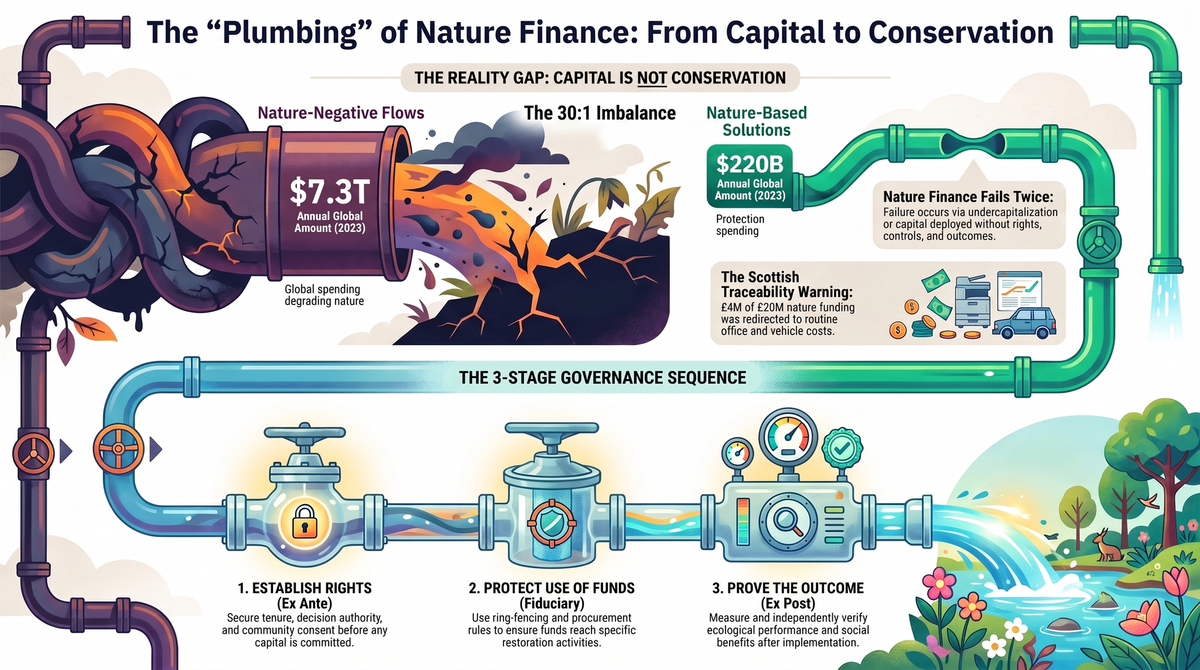
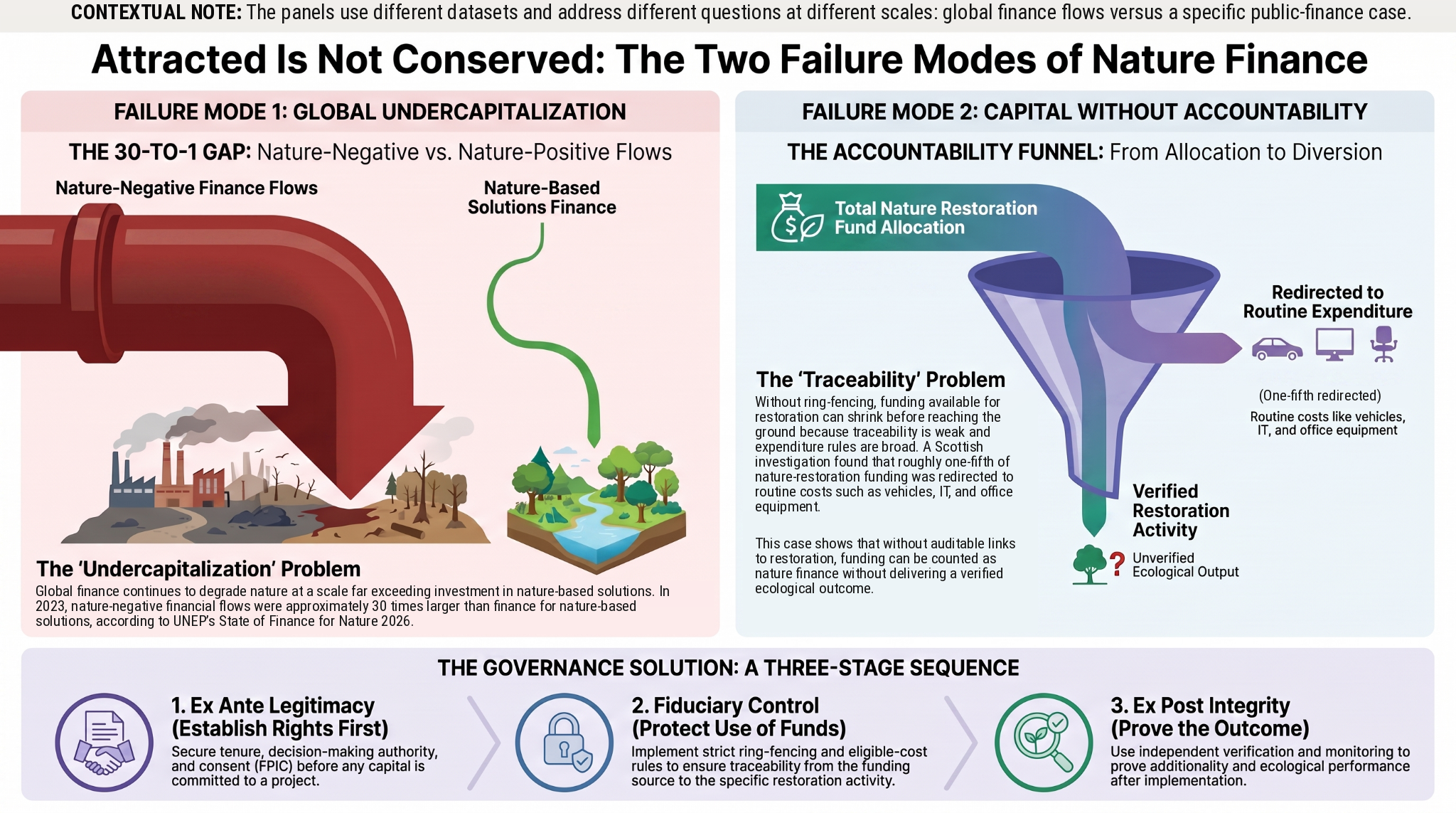
Bottom line: Last week's question, who benefits, who decides, who pays, shifted this week from principle to plumbing. The Philippines formalized its first national nature-based solutions policy through a DENR administrative order, establishing an institutional platform to mainstream, finance, register, and monitor NbS. Public accounts describe the framework as people-centered and rights-anchored, though the order's text has not yet been shown to mandate consent or benefit-sharing. Two warnings arrived in the same week. A biodiversity-finance review and a Scottish spending investigation confirmed that capital labeled for nature, public or private, is not conservation. Nature finance can fail twice: through undercapitalization and through capital deployed without rights, controls, or verified outcomes.
Here is the gateway into the field, and the briefing is the room you walk into: [Podcasts and Video — NotebookLM]
Link to Explainer Video (Produced by the author with NotebookLM)
Last week ended with three distributional questions and no binding answer: who benefits, who decides, and who pays when integrated nature finance arrives. This week produced one institutional response and two warnings, and the three belong together. The Philippine Department of Environment and Natural Resources moved nature-based solutions from scattered practice into a national administrative framework. [1] A review of return-seeking biodiversity finance, backed by the field's own specialists, restated that capital-market access is not a conservation outcome. [2][3] An investigation into Scottish council spending showed that public money labeled as nature can lose its connection to delivery when expenditure rules and traceability are weak. [4]
The scale that framed last week has not shifted. The United Nations Environment Programme's stocktake still finds roughly USD 30 spent degrading nature for every USD 1 spent protecting it, with nature-based solutions drawing about USD 220 billion in 2023 against USD 7.3 trillion moving the other way. [5] The gap now has a shape. Closing it takes more capital, but not only more capital. The closing move requires capital that can show who authorized the intervention, where the money went, and what the ground did in response.
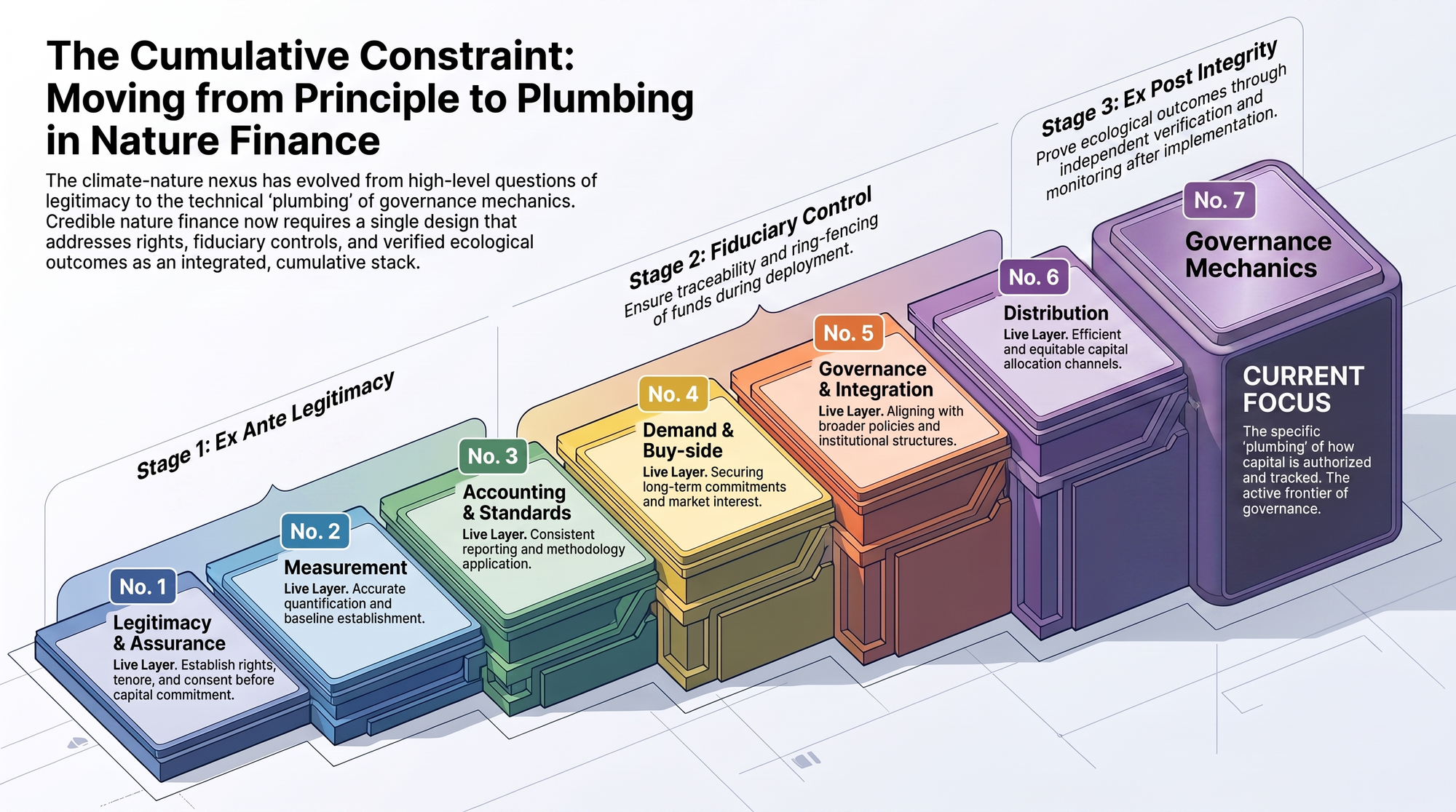
For senior practitioners, the design sequence is paramount. Establish rights and decision-making authority before capital is committed. Keep eligible expenditures, procurement, and claims traceable while capital is deployed. Measure and independently verify the ecological outcome afterward. These are three distinct governance functions — ex ante legitimacy, fiduciary control, and ex post integrity — and none substitutes for the others.
From Whose to How
Last week, the distributional questions were named; this week, they were turned into an implementation problem: which rights, controls, and evidence must be included in the instrument before capital is committed. The answer is a governance design, not a slogan.
Across seven issues, the binding constraint has shifted from legitimacy and assurance to measurement, accounting, demand, integration, distribution, and now the mechanics of governance. That sequence is not a completed progression. The earlier constraints do not retire as the argument advances; they accumulate. The nexus bottleneck is cumulative, and a credible instrument must now, in a single design, answer not only whether a project is financeable but also who holds rights, who can authorize it, which expenditures are eligible, how benefits and claims are allocated, and how the outcome will be verified.
Mitigation continues to expand faster than the ledger that would price it. The scientific case for nature's mitigation value keeps hardening, from the animal-mediated carbon processes flagged at the Bonn session in Germany last month to the standing evidence that high-integrity nature-based solutions could deliver a meaningful share of the mitigation the Paris Agreement needs. [6] A wider frontier without a wider or better-governed ledger is the two-speeds problem in a third register. The asset grows more legible each week; the machinery to fund it justly does not keep pace.
Adaptation is where the constructive move landed, and it landed in administrative law. The Philippine order places ecosystem-based adaptation at the center of a national framework, directing the government to restore forests and watersheds, rehabilitate mangroves and coral reefs, protect seagrass beds, and expand urban green space, with funding drawn from appropriations, development partners, payments for ecosystem services, and carbon and blue-carbon finance. [1] The design choice that matters for the nexus thesis is not the list of ecosystems. The choice is the insistence that these approaches be people-centered, integrate gender equality and social inclusion, and recognize Indigenous Peoples and local communities as stewards. Public summaries do not yet show the order mandating a specific consent or benefit-sharing regime, and that limitation should be stated plainly rather than assumed away. What the order does establish is a platform on which those project-level rules can be built and applied.
Biodiversity remains the most exposed strand, and this week sharpened the warning against mistaking capital for conservation. A review of return-seeking biodiversity finance concluded that conservation does not happen in a vacuum: commercial, ecological, and social risks are interdependent, and scaling investor returns while maintaining robust ecological and social oversight may not be feasible. [2] The point is not new to the field's specialists, who put it more bluntly three years ago: heavy reliance on private finance alone will not deliver conservation goals. [3] Providing routes for private money to flow, through credits, bonds, or ecotourism, is necessary but insufficient. The governance that verifies the outcome and shares the benefit is what turns a flow into a result.
The Record
Three current-week developments and one ongoing process showed where the operating system is advancing and where it remains incomplete. Each item is weighed by how far it moves integration from a legitimate intention toward a legitimate, governed instrument.
THIS WEEK — The region's physical case found its clearest institutional answer. The Philippines formalized its first national-level nature-based solutions policy through DENR Administrative Order No. 2026-30, signed on 29 June and launched on 30 June, moving NbS from local and sectoral practice into a national administrative framework backed by a national registry, capacity building, monitoring, and diversified financing. The order recognizes local and Indigenous stewardship and is anchored in existing environmental and rights legislation. Public summaries do not yet show that the order itself prescribes a detailed consent or benefit-sharing mechanism; those requirements must be confirmed in the full text and, where relevant, provided through applicable law and project-level agreements.
Source: Philippine News Agency, "DENR adopts global nature-based solutions to cut disaster risks," 30 June 2026; Forest Foundation Philippines, "The Philippines takes Nature-based Solutions from local practice to national policy," 7 July 2026. https://www.pna.gov.ph/articles/1278647
THIS WEEK — Scottish reporting revealed a traceability problem in non-ring-fenced nature funding. An investigation by The Ferret found that almost GBP 4 million of the GBP 20 million allocated directly to Scottish councils from the Nature Restoration Fund over its first four years had been redirected to routine or general expenditure, including vehicles, information technology, and office equipment. Because the allocations were not ring-fenced, the spending did not necessarily breach the fund's terms. The finding is therefore not evidence of unlawful diversion or a formal audit failure. It is a warning about design: when eligible expenditure is broad and reporting does not link allocations to ecological outputs, money can count as nature finance without leaving an auditable line to restoration.
Source: The Ferret, "Environmental funding misspent by councils," July 2026 (journalistic investigation based on council accounts obtained under freedom-of-information requests; figures as reported).* https://www.theferret.scot/
CONTINUING PROCESS — TNFD advanced the assessment and disclosure layer. The Taskforce on Nature-related Financial Disclosures opened a consultation on methods and practices for nature-related risk assessment and continued its 2026 Status Report survey of report preparers, users, investors, and enablers. The consultation targets a persistent implementation challenge: translating dependencies and impacts into comparable risk assessments and financial effects. This is not yet an assurance regime, but it is part of the assessment and disclosure infrastructure on which any credible assurance will depend.
Source: Taskforce on Nature-related Financial Disclosures, discussion paper on nature-related risk assessment and 2026 Status Report survey, July 2026 (primary; consultation and survey).* https://tnfd.global/
ASEAN in Focus
Southeast Asia has appeared in this briefing for weeks as the place where the integrated asset is a physical fact, the region's peat swamp forests and mangroves, a small share of its land carrying roughly half its land-use emissions, examined at length in No. 6 and traceable to the same 2025 modeling. This week, the region moved past that established case. The question is no longer whether the asset exists but how its benefits are governed, and the Philippines gave a partial answer. That shift is the point, because tenure and resource rights decide who can authorize a project, claim its ecosystem services, and negotiate its benefits, and a blue-carbon design that treats consent and benefit-sharing as administrative annexes fails on exactly the ground the region's asset sits. The Philippine framework matters here because it provides the platform for integrating mitigation, adaptation, and biodiversity into a single planning, financing, and monitoring architecture. The latter framework should be distinguished from a separate 2026 Philippine instrument for forest carbon credit projects, DENR Administrative Order No. 2026-05, which carries the more explicit transaction-level safeguards: legally enforceable community protections, benefit-sharing and grievance mechanisms, and free, prior, and informed consent (FPIC) for externally led projects in ancestral domains. [7] One order builds a general NbS platform; the other supplies specific rules for a defined class of carbon transactions.
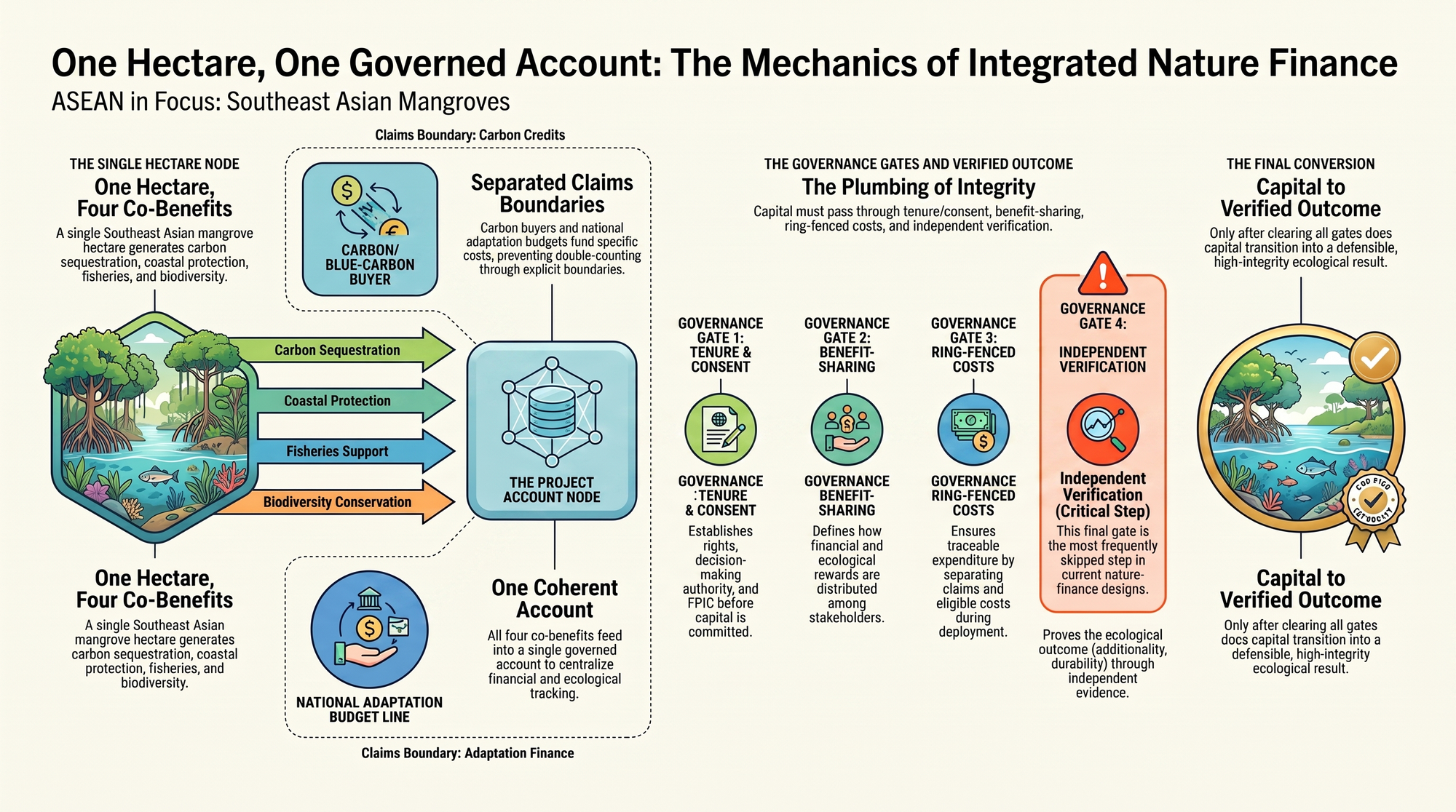
For ASEAN practitioners, that distinction is the design standard. Anchor NbS and ecosystem- based adaptation in NDCs, NAPs, land- use plans, and sector programs, but do not stop at policy alignment: identify tenure and rights, establish lawful authority and consent where applicable, agree on benefit- sharing, ring- fence eligible expenditure, separate financing sources and claims to prevent double counting, and verify the ecological and social outcome. The instrument becomes integrated not because one hectare yields several benefits, but because those benefits, rights, costs, and claims are governed by a single coherent account.
What This Means
The week points to a three-stage operating sequence, and the discipline is to build all three, not to bank one and hope the rest follow. First, establish rights before commitment: tenure, decision authority, participation, consent where required, benefit allocation, safeguards, and grievance channels. Second, protect the use of funds during deployment: eligible-cost rules, ring-fencing, procurement, disbursement conditions, financial reporting, and traceability from source to activity. Third, prove the outcome after implementation: baselines, additionality, leakage, durability, monitoring, attribution, and independent verification. A national registry can connect these functions; it cannot replace project agreements, fiduciary controls, or evidence of ecological performance.
The Philippine order shows the first stage being implemented in policy. The Scottish investigation shows the cost of the second stage when it is missing. The biodiversity-finance review shows why the third stage cannot be assumed. The central question is no longer whether capital can be attracted. The question is whether the instrument can demonstrate that the authorized capital reached eligible activities and produced a defensible result. Design governance before capital and prove the outcome afterward.
Worth Watching Through Year-End
The calendar now turns to the meetings where resource mobilization, disclosure, and implementation rules will be tested.
Climate Week NYC, 20–27 September 2026, New York. Monitor whether corporate and financial-sector nature commitments shift from target-setting to transaction criteria, portfolio decisions, and disclosed evidence of implementation.
Source: Climate Group, Climate Week NYC 2026, 20–27 September 2026.* https://www.climateweeknyc.org/
CBD COP17, 19–30 October 2026, Yerevan, Armenia. Resource mobilization and implementation of the Kunming-Montreal Global Biodiversity Framework will put financing adequacy, access, benefit distribution, and accountability on the treaty agenda — the multilateral form of the question the Philippines just answered nationally.
Source: Convention on Biological Diversity, seventeenth Conference of the Parties, Yerevan, 19–30 October 2026.* https://www.cbd.int/cop/
Nature-based Solutions International Congress 2026, 2–6 November 2026, Paris. The congress brings together NetworkNature Week and the scientific conference at Sorbonne University. The test will be whether monitoring, equity, standards, and financing methods converge into usable project architecture.
Source: Biodiversa+ and partners, Nature-based Solutions International Congress 2026, Sorbonne University, Paris, 2–6 November 2026.* https://nbscongress.sciencesconf.org
Endnotes
[1] Philippine News Agency, "DENR adopts global nature-based solutions to cut disaster risks," 30 June 2026; and Forest Foundation Philippines, "The Philippines takes Nature-based Solutions from local practice to national policy," 7 July 2026. Primary and near-primary (government announcement and implementing-partner account); current-week policy launch. These sources confirm DENR Administrative Order No. 2026-30, its national-level policy function, the national registry, diversified financing, capacity building, and recognition of local and Indigenous stewardship. They do not establish a detailed consent or benefit-sharing regime within the order itself, which remains to be verified in the full text. https://www.pna.gov.ph/articles/1278647
[2] Carter, H., Thompson, B.S., Bull, J.W. et al., "Demystifying biodiversity finance," Nature Reviews Biodiversity, volume 2, pages 388–401, published 18 May 2026. Peer-reviewed review of return-seeking biodiversity-finance mechanisms; published in May and receiving renewed attention in current-week reporting, so cited as an established review, not fresh research. The review states that the conservation contribution of these mechanisms remains contested and that scaling depends on reconciling investor returns with robust ecological and social oversight, whose feasibility is unclear. https://www.nature.com/articles/s44358-026-00155-z
[3] Kedward, K., zu Ermgassen, S.O.S.E., Ryan-Collins, J. and Wunder, S., "Heavy reliance on private finance alone will not deliver conservation goals," Nature Ecology & Evolution, volume 7, pages 1339–1342, 2023. Peer-reviewed perspective by specialists in the field; cited as the primary, foundational statement of the thesis that private capital alone does not secure conservation outcomes. Background, not current-week. https://www.nature.com/articles/s41559-023-02098-6
[4] The Ferret, "Environmental funding misspent by councils," July 2026. Journalistic investigation based on council accounts obtained under freedom-of-information requests; not an official audit. It reports that almost GBP 4 million of GBP 20 million allocated directly to Scottish councils from the Nature Restoration Fund was redirected to routine or general expenditure. The allocations were not ring-fenced and the spending was not presented as unlawful; figures are as reported. https://www.theferret.scot/
[5] United Nations Environment Programme, State of Finance for Nature 2026: Nature in the Red — Powering the Trillion-Dollar Nature Transition Economy, published 22 January 2026. Primary source, UNEP flagship report; the roughly 30-to-1 ratio, USD 220 billion in nature-based solutions finance, and USD 7.3 trillion nature-negative flows are 2023 flow data. Background scale anchor, not current-week news. https://www.unep.org/resources/state-finance-nature-2026
[6] International Fund for Animal Welfare and partners, "Scientific Consensus on Wildlife and Climate," announced at the UNFCCC Subsidiary Bodies session (SB64), Bonn, 11 June 2026; and United Nations Environment Programme Finance Initiative material on the mitigation potential of high-integrity nature-based solutions. Primary and advocacy; mid-June background cited for the widening mitigation frontier, not current-week. The "meaningful share" phrasing is deliberately non-numeric here; the specific up-to-30%-by-2030 estimate carried by UNEP FI would require its own defined source and timeframe before use as a figure. https://www.ifaw.org/press-releases/280-global-scientists-unite-urgent-need-wildlife-protection-climate
[7] Department of Environment and Natural Resources, Republic of the Philippines, DENR Administrative Order No. 2026-05, Guidelines on the Establishment, Registration, and Monitoring of Forest Carbon Credit Projects in the Philippines. Primary (government issuance); cited to distinguish the general NbS policy (AO 2026-30) from this separate forest-carbon instrument, which carries the more explicit transaction-level safeguards, including legally enforceable community protections, benefit-sharing and grievance mechanisms, and FPIC for externally led projects in ancestral domains. https://apidb.denr.gov.ph/infores/uploads/DAO-2026-05.pdf