No. 8 - Record Commitments, Unfinished Delivery
Multilateral development banks reported record 2025 climate-finance commitments, yet developments in the Pacific and Vietnam underscored why access, financing terms, and delivery governance still determine whether capital translates into resilience and conservation.

The Climate-Nature Nexus in Practice (Weekly Briefing to 18 July 2026)
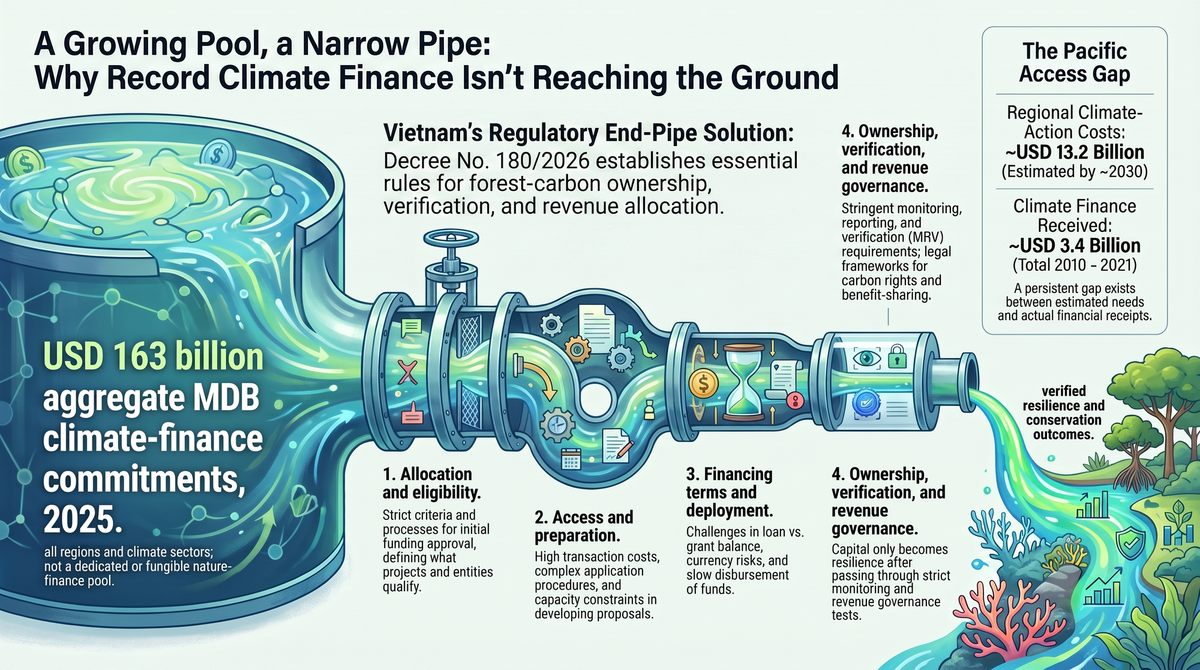
Bottom line: Multilateral development banks reported a record USD 163 billion in climate-finance commitments for 2025, including USD 35 billion in adaptation finance for low- and middle-income economies, up 31%. Yet the aggregate is neither a dedicated nature-finance pool nor proof that vulnerable states can access finance on workable terms. In Nadi, Fiji, Pacific governments worked to address access barriers behind a gap between an estimated USD 13.2 billion in climate-action costs by around 2030 and roughly USD 3.4 billion received from 2010 to 2021. Vietnam's forest-carbon decree, effective July 15, set rules for ownership, verification, and revenue allocation.
Here is the gateway into the field, and the briefing is the room you walk into: [Podcast and Video - Gemini Notebook]
Link to Explainer Video (Produced by the author with Gemini Notebook)
Last week's briefing followed the nexus argument from principle into plumbing, setting out a governance sequence: establish rights before capital is committed, keep expenditure traceable while capital is deployed, and verify the ecological outcome afterward. This week added the finance-volume dimension and a caution against reading volume as a measure of sufficiency. The multilateral development banks reported that their climate-finance commitments reached a record USD 163 billion in 2025, a 19% rise. Commitments to low- and middle-income economies rose 21% to USD 103 billion, and adaptation finance in those economies rose 31% to USD 35 billion. [1] The figures are reported under the banks' joint tracking methodology and represent committed finance rather than disbursements or verified outcomes. The report does not identify how much supports nature-based solutions, ecosystem-based adaptation, or any single region is receiving. [1] A record aggregate is not a dedicated pool that vulnerable countries can draw on at will. The week's two most instructive developments sat at the narrow points capital must pass through. In Nadi, Fiji, Pacific governments and partners worked on the eligibility rules, accreditation, project preparation, and transaction costs that stand between small states and the funds meant for them. [2] In Vietnam, a forest-carbon decree took effect, setting rules for who owns a credit, how a credit is verified, and how revenue is allocated. [4] Finance volume, access, financing terms, and delivery governance are simultaneous constraints, and the record total addresses only the first. For senior practitioners, the task is to design all four together.
A Growing Pool, a Narrow Pipe
Record commitments addressed the volume of finance, not its accessibility, its terms, or the governance that turns finance into outcomes.
The banks' 2025 accounting put mitigation commitments to low- and middle-income economies at USD 68 billion, up 16%. [1] That total measures climate finance, not nature: the report does not disaggregate how much reached nature-based solutions or ecosystem-based adaptation, so the total is context for the nexus rather than direct evidence that capital for nature is now abundant. [1] Growth in a climate-finance aggregate does not, on its own, tell a mangrove project that funding has arrived on usable terms.
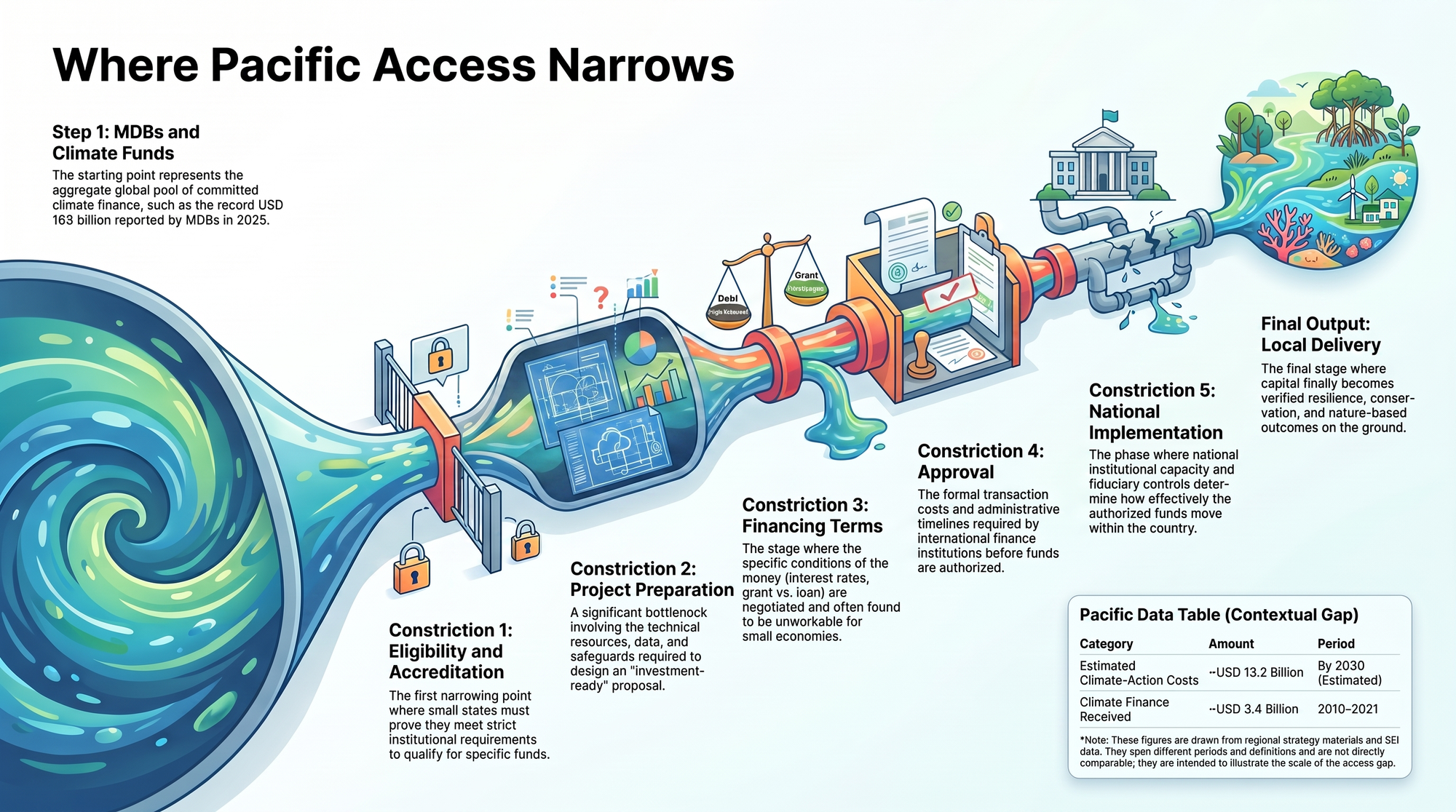
Adaptation is where the week's numbers and its governance signals converge. The 31% rise in adaptation commitments for low- and middle-income economies to USD 35 billion is the headline; the Pacific workshop is the counterpoint. [1][2] For a region facing some of the world's most acute adaptation needs, the binding problem is not the size of any fund but the interplay of fund design, national institutional capacity, project-preparation resources, and the transaction costs that international finance imposes on small and vulnerable states. [2] Regional estimates put Pacific climate-action costs near USD 13.2 billion by around 2030, based on costed plans for only part of the region, while roughly USD 3.4 billion in climate finance was received between 2010 and 2021, about a quarter of that estimate. [2] The periods and definitions are not directly comparable, but together the figures describe a persistent access gap that a larger global pool alone does not close.
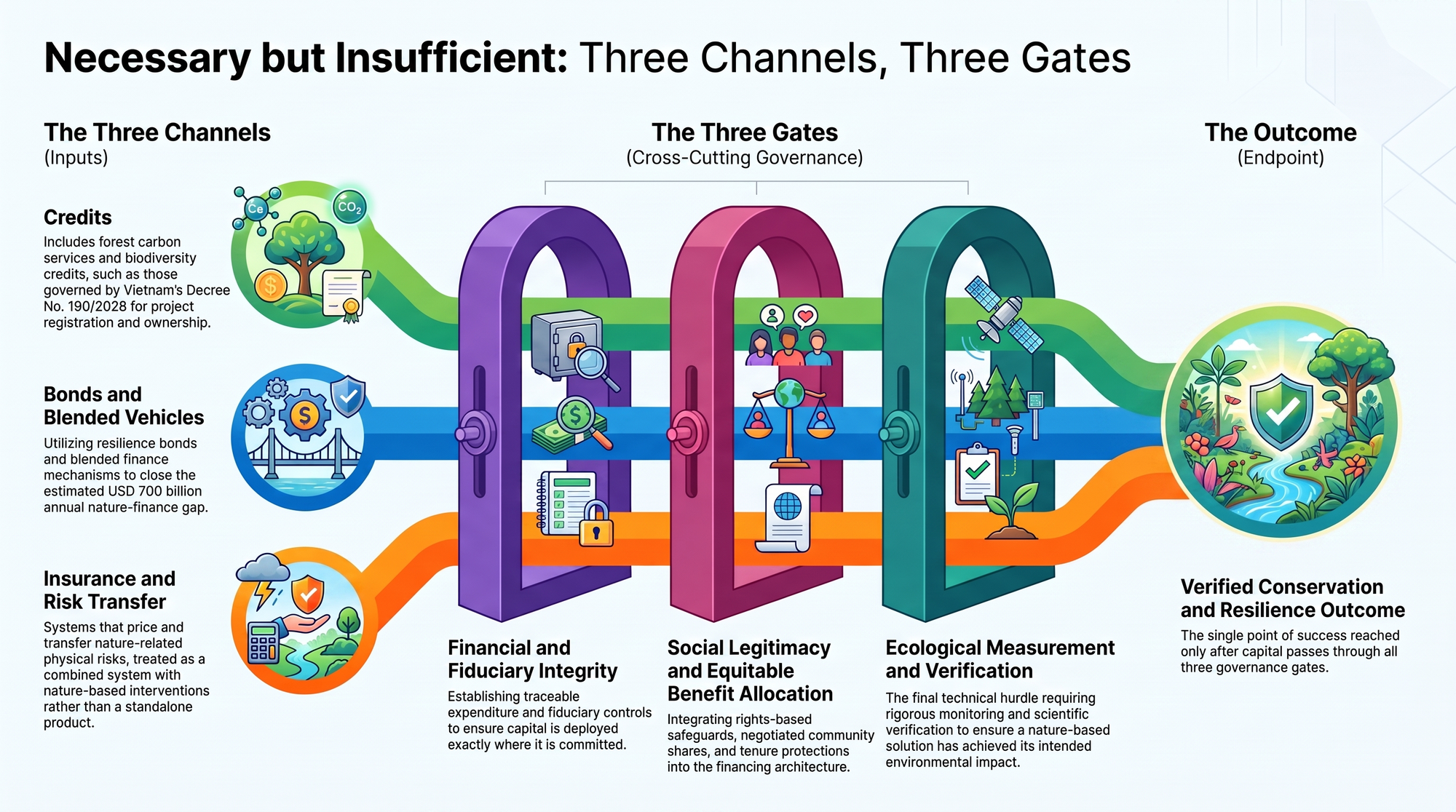
The week's third design signal came from insurance. At the Insurance for Nature-Positive Leadership Forum in Tokyo, Japan, on 17 July, convened by the United Nations Environment Programme Finance Initiative (UNEP FI) and hosted by an insurance group, the discussion paired insurance mechanisms that price or transfer nature-related and physical risks with nature-based interventions that reduce those risks, treating the two as parts of one system rather than a standalone product. [3] The forum added insurance and risk transfer to the week's design agenda without, on its own, establishing insurance as a mature third instrument. Read alongside UNEP FI's 2026 nature agenda, which names insurance-linked solutions, resilience bonds, and blended vehicles as mechanisms to help close an estimated USD 700 billion annual nature-finance gap in an economy where more than half of value generation depends on nature, the analytical reading is that no single instrument scales without the governance that verifies outcomes and allocates benefits. [5] That is the lesson the biodiversity-finance review drew last week.
The Record
THIS WEEK - Multilateral development banks reported a record year in climate finance. The 2025 Joint Report on Multilateral Development Banks' Climate Finance, coordinated by the European Investment Bank and released on 13 July, reports that they are on track to meet the 2030 collective projections announced at COP29 in Baku, Azerbaijan. The report reports committed finance under a joint tracking methodology but not disbursements, verified outcomes, or the share reaching nature-based solutions. Any nexus or regional read is an inference by this briefing, not a figure in the report.
Source: Asian Development Bank and partner MDBs, "Multilateral Development Banks Increase Climate Finance to Record USD 163 Billion in 2025," 13 July 2026 (primary; joint MDB tracking methodology; committed finance). https://www.adb.org/news/multilateral-development-banks-increase-climate-finance-record-163-billion-2025
THIS WEEK - The Pacific worked on the access end of the system. Senior officials from Pacific Islands Forum members, regional bodies, and development partners met in Nadi, Fiji, from 15 to 17 July for the Climate Finance Access and Mobilisation Strategy prioritization workshop, building an investment-ready pipeline ahead of an inaugural Pacific Climate Finance Investment Forum in 2027. The workshop focused on eligibility rules, accreditation, and project preparation. The often-quoted figures come from regional strategy materials rather than the workshop itself: an estimated climate-action cost near USD 13.2 billion by around 2030, based on the costed plans of only part of the region, and roughly USD 3.4 billion in finance received from 2010 to 2021, about a quarter of that estimate. The two figures span different periods and definitions and should be read as an illustration of the access gap, not a precise ratio.
Source: Pacific Islands News Association and Pacific Islands Forum Secretariat, 13–16 July 2026 (workshop and self-reported regional figures); underlying 2010–2021 flow data from Stockholm Environment Institute, "Climate finance in the Pacific." https://pina.com.fj/2026/07/13/pacific-strategy-targets-bigger-share-of-climate-finance-by-2030/
THIS WEEK - Nature insurance was framed as a system, not a product. The Insurance for Nature-Positive Leadership Forum in Tokyo, Japan, on 17 July, convened by UNEP FI and hosted by MS&AD Insurance Group, examined how nature-based solutions reduce physical risk, how insurance prices, transfers, and pools risk, and how policy, data, and partnership conditions would enable the pairing to scale across the Asia-Pacific. The event directly reports its systems framing and agenda; the inference that insurance "cannot scale alone" is this briefing's analytical reading, not a demonstrated market outcome.
Source: United Nations Environment Programme Finance Initiative, "Insurance for Nature-Positive Leadership Forum," Tokyo, 17 July 2026 (primary; convening announcement). https://www.unepfi.org/industries/insurance/insurance-for-naturepositive-leadership-forum/
ASEAN in Focus
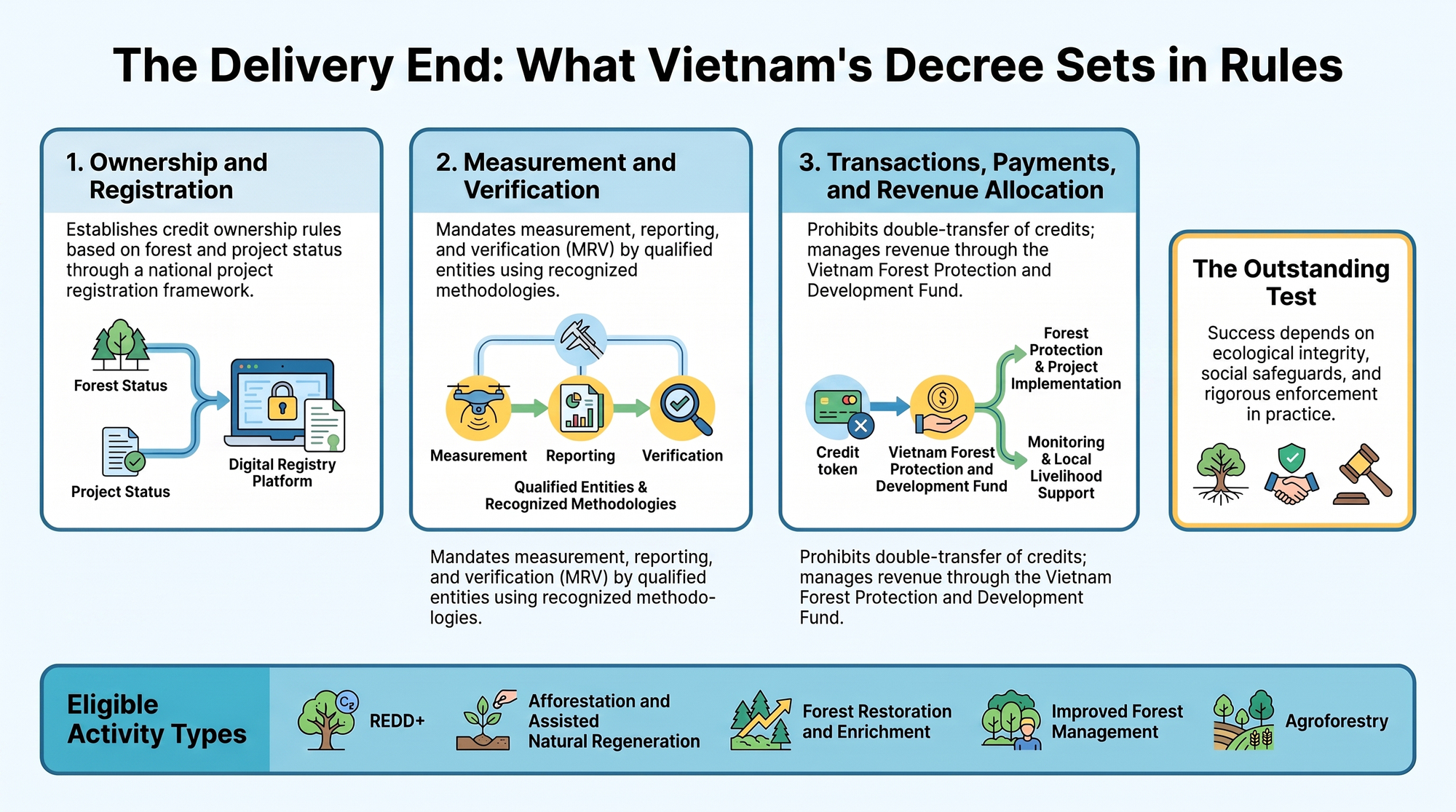
This week, Southeast Asia provided the delivery-end counterpart to the Pacific's access problem, and did so through regulation. Vietnam's Decree No. 180/2026/ND-CP on forest carbon services, issued on 21 May and effective from 15 July, sets a national framework for forest carbon: rules for project registration, credit ownership that varies with forest and project status, measurement and reporting, verification by qualified entities, a prohibition on transferring the same credit twice, and revenue management that can flow through the Vietnam Forest Protection and Development Fund toward forest protection, project implementation, monitoring, and local livelihoods. [4] These are the rules governing ownership, verification, payment, and revenue allocation set out in subordinate legislation. They are not, by themselves, a full benefit-sharing regime: negotiated community shares, tenure safeguards, grievance mechanisms, and free, prior, and informed consent are the broader design principles against which the decree's implementation should be judged, and the decree's significance will ultimately rest on the crediting methodologies, safeguards, verification practice, and enforcement developed under the decree and under Vietnam's wider carbon-market regulations, from which a recognized-methodology requirement is expected to gain force from 2028. [4] Eligible activity types include REDD+, afforestation and assisted natural regeneration, forest restoration and enrichment, improved forest management, and agroforestry. [4] The regional reason this matters is that it is established ground rather than this week's news: Southeast Asia's peatlands and mangroves hold an outsized share of the region's land-use carbon, as examined in No. 6, so the credibility of the rules governing their financing is the variable to watch. [6] The delivery end is being built regulation by regulation and project by project, and will be judged on ownership, verification, and revenue governance in practice, not on frameworks announced.
What This Means
The week resolves into a four-stage test that connects this issue to last week's sequence. Capital must clear allocation and eligibility (who qualifies, which activities are recognized, and whether sufficient grant and concessional finance exists), then access and preparation (accreditation, project preparation, data, safeguards, and the transaction costs borne by small states), then financing and deployment (terms, procurement, fiduciary controls, and traceable expenditure), and finally outcome governance (rights, ownership, monitoring, verification, and revenue allocation). The record multilateral total speaks mainly to the first stage. For development finance institutions, the implication is not to choose between more money and better access, but to do both: expand appropriately structured and concessional finance while investing far more in access, project preparation, simplified procedures, and delivery systems for small and vulnerable states. For program designers and executing entities, Vietnam's decree is a framework for assessment, not a template to copy, because its arrangements reflect Vietnam's legal system, state-forest ownership, and carbon-market architecture; the transferable question is whether an instrument fixes ownership, verification, and revenue governance before transactions scale. As aggregate commitments grow, the case for repairing the access and delivery architecture becomes stronger, and additional, appropriately structured capital remains necessary.
Worth Watching Through Year-End
The calendar now turns to the convenings where allocation, access, disclosure, and delivery rules will be tested against capital, banks have reported.
CBD COP17, 19–30 October 2026, Yerevan, Armenia. Resource mobilization and implementation of the Kunming-Montreal Global Biodiversity Framework are on the treaty agenda. Separately, the International Sustainability Standards Board expects to publish its nature-related disclosure exposure draft in October 2026, a parallel disclosure milestone in the same month rather than part of the COP agenda.
Source: Convention on Biological Diversity, seventeenth Conference of the Parties (primary; scheduled meeting); and IFRS Foundation / ISSB work plan (primary; expected exposure draft). https://www.cbd.int/cop/
Climate Week NYC, 20–27 September 2026, New York, United States. Watch whether corporate and financial nature commitments move from target-setting to transaction criteria and disclosed evidence of implementation.
Source: Climate Group, Climate Week NYC 2026 (primary; convening announcement). https://www.climateweeknyc.org/
Nature-based Solutions International Congress 2026, 2–6 November 2026, Paris, France. The test is whether monitoring, equity, standards, and financing methods converge into usable project architecture.
Source: Biodiversa+ and partners, Nature-based Solutions International Congress 2026, Sorbonne University, Paris (primary; convening announcement). https://nbscongress.sciencesconf.org
Blue Action Fund call for mangrove and blue-carbon proposals, deadline 16 October 2026. The call funds mangrove and blue-carbon work in Asia; the precise list of eligible countries should be confirmed against the full call documentation rather than a summary page.
Source: Blue Action Fund, Call for Proposals: Mangroves, Blue Carbon Markets, and 30x30 in Asia (primary; open call). https://www.blueactionfund.org/
Endnotes
[1] Asian Development Bank and partner multilateral development banks, "Multilateral Development Banks Increase Climate Finance to Record USD 163 Billion in 2025," 13 July 2026, reporting the 2025 Joint Report on Multilateral Development Banks' Climate Finance coordinated by the European Investment Bank. Primary figures are committed climate finance reported under the MDBs' joint tracking methodology, not disbursements or independently verified outcomes. USD 163 billion total (up 19%), USD 103 billion for low- and middle-income economies (up 21%), USD 35 billion adaptation finance in those economies (up 31%), USD 68 billion mitigation finance in those economies (up 16%). The report does not disaggregate nature-based solutions or ecosystem-based adaptation, so any nexus or regional read is inferential. https://www.adb.org/news/multilateral-development-banks-increase-climate-finance-record-163-billion-2025
[2] Pacific Islands News Association, "Pacific strategy targets bigger share of climate finance by 2030," 13 July 2026, and Pacific Islands Forum Secretariat materials, covering the Climate Finance Access and Mobilization Strategy prioritization workshop, Nadi, Fiji, 15–17 July 2026. The estimated climate-action cost of about USD 13.2 billion by around 2030 is an aggregate drawn from the costed plans of only part of the region, not an annual requirement; roughly USD 3.4 billion in climate finance was received over 2010–2021 (about a quarter of the estimate), per Stockholm Environment Institute data on Pacific climate finance. The two figures span different periods and definitions and are cited to illustrate the access gap, not as a precise ratio; all are self-reported or compiled, not independently verified here. https://pina.com.fj/2026/07/13/pacific-strategy-targets-bigger-share-of-climate-finance-by-2030/
[3] United Nations Environment Programme Finance Initiative, "Insurance for Nature-Positive Leadership Forum," Tokyo, Japan, 17 July 2026, convened by UNEP FI and hosted by MS&AD Insurance Group. Primary (convening announcement). The forum's systems framing, pairing nature-based risk reduction with insurance-based risk pricing and transfer, is directly reported; the reading that insurance cannot scale on its own is this briefing's analytical interpretation, not a demonstrated market outcome. https://www.unepfi.org/industries/insurance/insurance-for-naturepositive-leadership-forum/
[4] Socialist Republic of Vietnam, Decree No. 180/2026/ND-CP on forest carbon services, issued 21 May 2026, effective 15 July 2026, as reported by Viet Nam News and Nhan Dan and summarized by legal trackers. Primary government issuance reported through secondary sources; establishes rules for project registration, credit ownership (varying with forest and project status), measurement and reporting, verification, a prohibition on double transfer, and revenue management via the Vietnam Forest Protection and Development Fund. It sets payment and revenue-allocation rules rather than a full benefit-sharing regime. The expectation that recognized methodologies and a national standard gain force from 2028 relates to Vietnam's broader carbon market regulations (including Decree No. 119/2025), not solely to Decree 180/2026, and is flagged for confirmation against the consolidated legal texts. National instrument, not a regional first. https://vietnamnews.vn/environment/1784683/new-decree-lays-legal-foundation-for-viet-nam-s-forest-carbon-market.html
[5] United Nations Environment Programme Finance Initiative, "Action on nature: what can financial institutions expect in 2026?" 27 January 2026. Supplies the estimated USD 700 billion annual nature-finance gap and the estimate that more than half of global economic value generation is moderately or highly dependent on nature, and names insurance-linked nature-based solutions, resilience bonds, and blended vehicles among mechanisms to scale nature finance. Cited to corroborate the biodiversity-finance-architecture reading. https://www.unepfi.org/themes/ecosystems/action-on-nature-what-can-financial-institutions-expect-in-2026/
[6] Sasmito, S.D. et al., "Half of land use carbon emissions in Southeast Asia can be mitigated through peat swamp forest and mangrove conservation and restoration," Nature Communications, 2025 (PubMed 39875368). https://www.nature.com/articles/s41467-025-55892-0