No. 10 — When the Method Becomes the Risk
Australia's carbon-crediting regulator kept the soil-carbon method but recommended withholding credits above a conservatism ceiling. The week's evidence turned on a practitioner question: how a methodology decision affects project economics.

The Climate-Nature Nexus in Practice (Weekly Briefing to 1 August 2026)
Bottom line: Australia's Emissions Reduction Assurance Committee cleared the 2021 soil-carbon method against five of six integrity standards and recommended withholding credits for accruals above 3 tonnes of soil organic carbon per hectare per year, after finding that reported accrual rates are not supported by the scientific literature. The government opened consultation on 28 July. Verra launched its next-generation registry alongside digital-monitoring testing and durability pilots, and Global Mangrove Watch released version 4.1. The practitioner lesson is narrower than a market verdict: a methodology decision moves project economics.
Here is the gateway into the field, and the briefing is the room you walk into: [Podcasts and Video — Gemini Notebook: www.youtube.com/@nbspraxis]
Link to Explainer Video on the Methodology Risk (Produced by the author with Gemini Notebook)
Link to Explainer Video on the Financial Risk (Produced by the author with Gemini Notebook)
Last week's briefing framed the week's capital as a chain entering at five points, from project preparation to a verified ecological result, and closed by asking who holds the link that comes next. [1] This week's evidence answers that question and something more useful. The reviewed material carried few major new capital announcements and several prominent developments in the methods, registries, and monitoring systems that turn ecological change into a financeable claim. One of those developments was a hard regulatory action.
Australia's Emissions Reduction Assurance Committee (ERAC), the statutory integrity body for the country's carbon-crediting scheme, completed its review of the 2021 soil organic carbon method, found reported accrual inconsistent with the peer-reviewed literature, and recommended a conservatism ceiling; the federal government opened consultation on the change on 28 July. [2] Read carefully, that action does not say the method failed. The committee found the method met five of the six Offsets Integrity Standards and recommended withholding units above the ceiling rather than canceling them. [2] The distinction matters, because the practitioner consequence runs through cash flow and valuation rather than through wholesale write-off.
For senior practitioners, the operational reading is this. Verification is not the last administrative step after capital arrives. Method selection, baselines, sampling design, permanence, and leakage treatment are design conditions that must be credible before commitment and remain credible for the life of the claim, and a methodology decision taken years later can still move the model.
When the Method Moves, the Model Moves
The week's evidence did not show capital ceasing to be a constraint; it showed methodology risk becoming legible as project-finance risk, and the assurance machinery around it being built at different speeds.
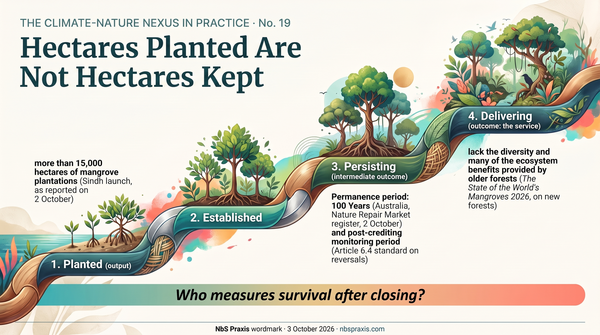
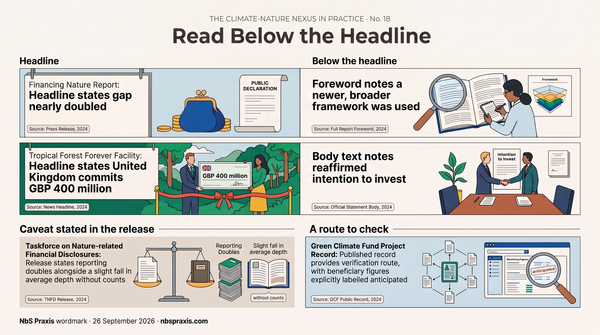
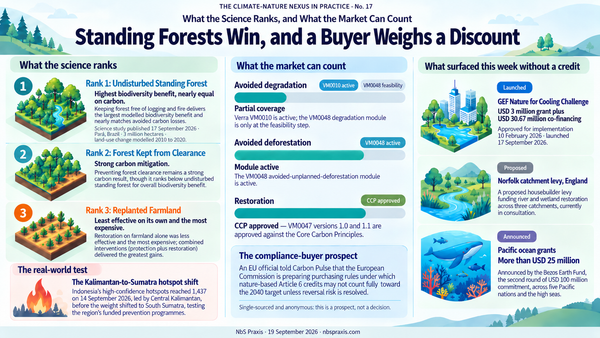
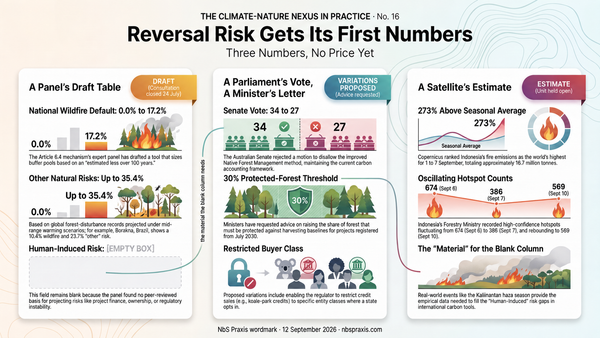
Across four issues, the binding question has evolved. No. 7 set out a governance sequence: establish rights before capital, keep expenditure traceable during deployment, and verify the outcome afterward. No. 8 separated the volume of finance from its access, terms, and delivery governance. No. 9 showed capital entering the financing chain at five points and asked who holds the verified-outcome link. [1] This week offers a partial answer and a correction to the question. The verified-outcome link is not held only at the end.
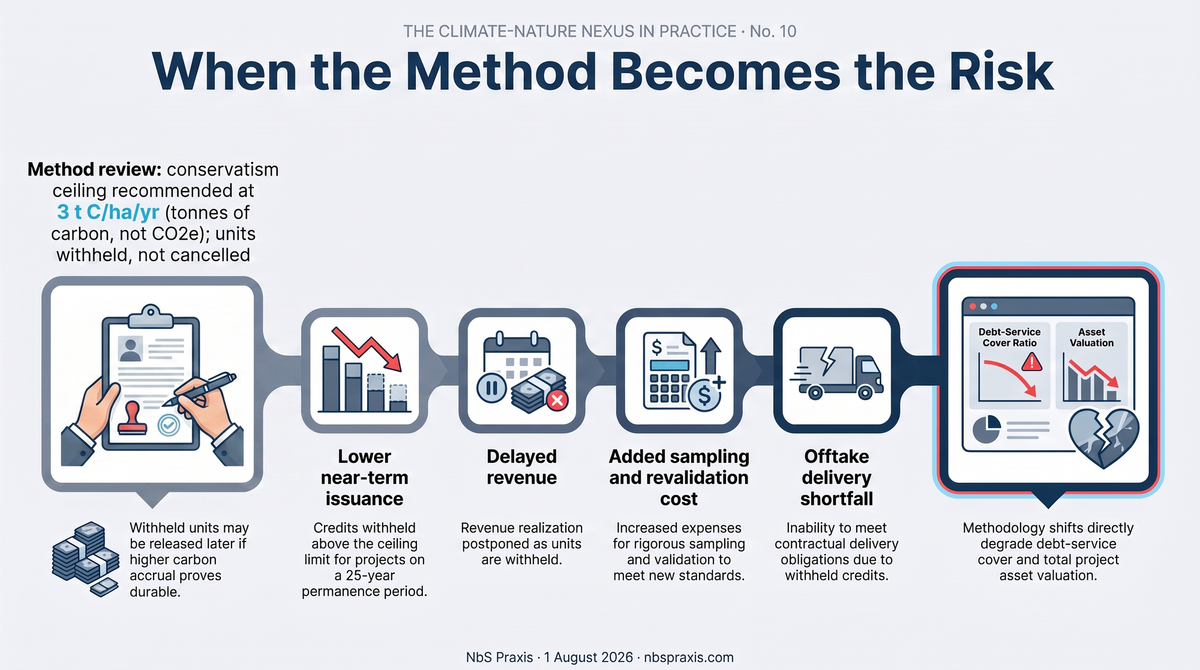
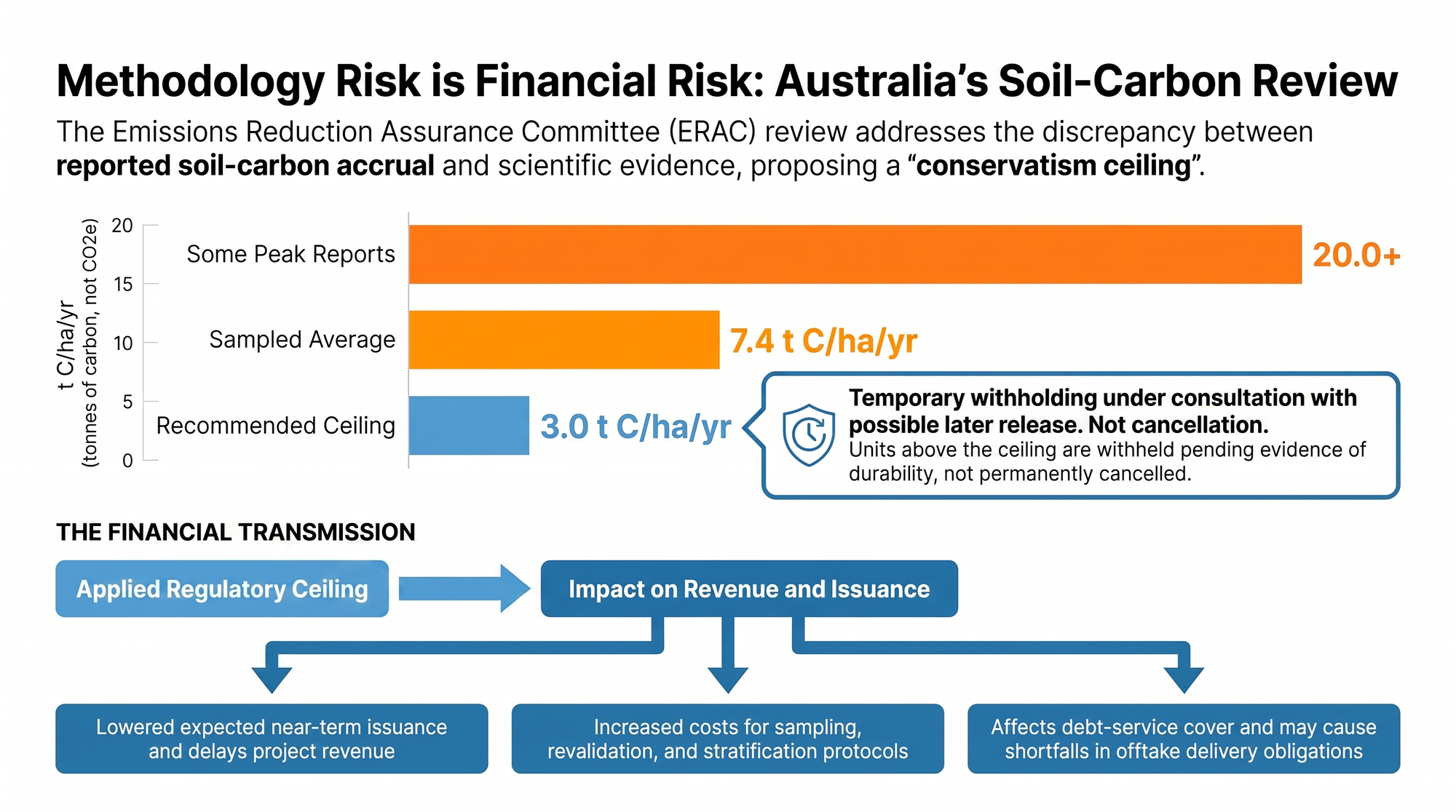
The soil-carbon review is the week's one hard methodology action, and its mechanics merit attention. The committee sampled project reports and found an average undiscounted accrual of 7.4 tonnes of soil organic carbon per hectare per year, with some reports above 20 tonnes, levels the literature does not support. [2] Its recommendation was a temporary withholding of units above 3 tonnes of carbon per hectare per year for projects on a 25-year permanence period, with withheld units potentially released later if higher accrual proves durable, alongside tighter sampling and stratification protocols and limits on registering multiple projects on one landholding. [2] Note the unit: tonnes of carbon, not carbon dioxide equivalent, and the two differ by a factor of roughly 3.7. The financial transmission is specific rather than dramatic. A ceiling of this kind lowers expected near-term issuance, delays revenue, raises sampling and revalidation costs, and can put an offtake delivery obligation out of reach, which affects debt-service cover and asset valuation without a single credit being canceled.
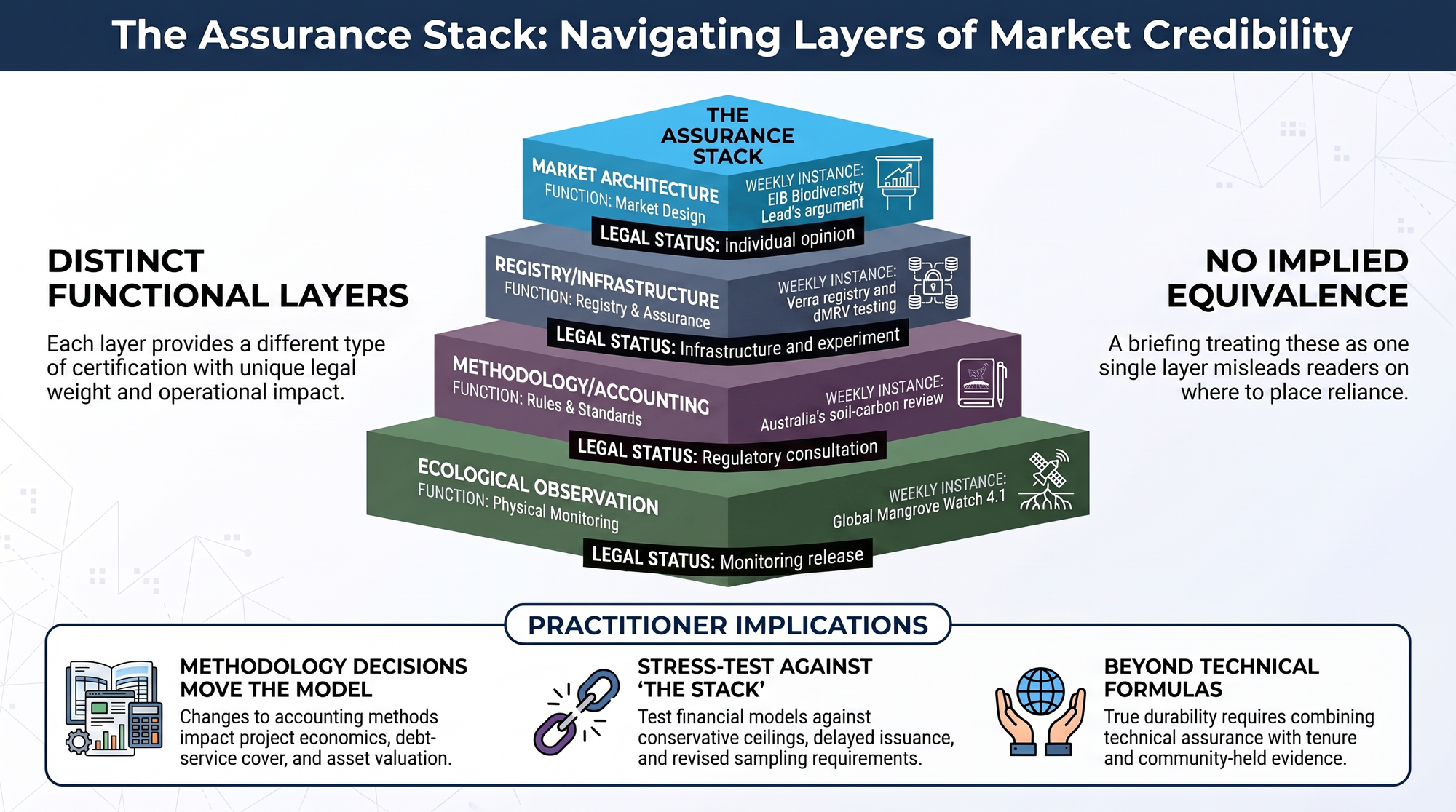
The assurance machinery around that action advanced unevenly, and the differences matter more than the common direction. Verra launched its next-generation registry and announced testing of digital monitoring, reporting, and verification (MRV) approaches and pilots on durability, which is infrastructure and experimentation rather than an adopted rule. [3] Global Mangrove Watch released version 4.1, extending annual loss-and-recovery mapping from 1985 to 2025 and adding regions, which improves ecological observation rather than project-level crediting. [4] A European Investment Bank biodiversity lead argued in an interview that voluntary nature-credit markets are unlikely to reach scale and that a compliance framework may eventually be needed, which is a market-design opinion rather than institutional policy. [5] Observation, accounting, registry infrastructure, and market architecture are separate functions with separate legal standing, and a briefing that treats them as one layer will mislead a reader deciding where to place reliance.
What the week does not establish deserves to be said plainly. A curated weekly scan cannot show that capital supply has stopped binding; the SIDS blue-economy fund below exists precisely because island adaptation finance remains scarce. The honest claim is narrower and still useful. In the evidence reviewed, methodology and assurance risk were the dominant signal, and that risk now has a visible price.
The Record
Australia opened consultation on a soil-carbon conservatism ceiling. ERAC found that the 2021 soil organic carbon method met five of six integrity standards but not the Conservative standard. ERAC recommended temporarily withholding units exceeding 3 tonnes of carbon per hectare per year. This week — in-window regulatory consultation. (Australian Government Department of Climate Change, Energy, the Environment and Water, 28 July 2026, Australia.) [2]
Verra launched its next-generation registry. The standard also outlined digital-MRV testing and durability pilots, along with an update on its jurisdictional forestry program. This week — infrastructure launch plus pilots, not adopted safeguards. (Verra stakeholder update, 29 July 2026.) [3]
Global Mangrove Watch released version 4.1. The platform's official launch on World Mangrove Day extended annual loss-and-recovery mapping from 1985 to 2025 and added additional mangrove regions. This week — monitoring release. (Global Mangrove Watch and Wetlands International, 26 July 2026.) [4]
Germany's International Climate Initiative launched seven new projects. Five focus on mitigation and two on biodiversity, including an Indonesian project establishing two corridors linking three forest areas; no cohort funding figure was disclosed. This week — projects entering implementation, not a new capital package. (International Climate Initiative, 28 July 2026, Berlin, Germany.) [6]
A blended blue-economy fund for small island developing states reported first close. Outrigger Impact Fund I targets USD 100 million with final close expected in 2027; the first-close amount was not disclosed. This week — reported first close; target is not raised capital. (Carbon Pulse, 29 July 2026; European Investment Bank project record.) [7]
ASEAN in Focus
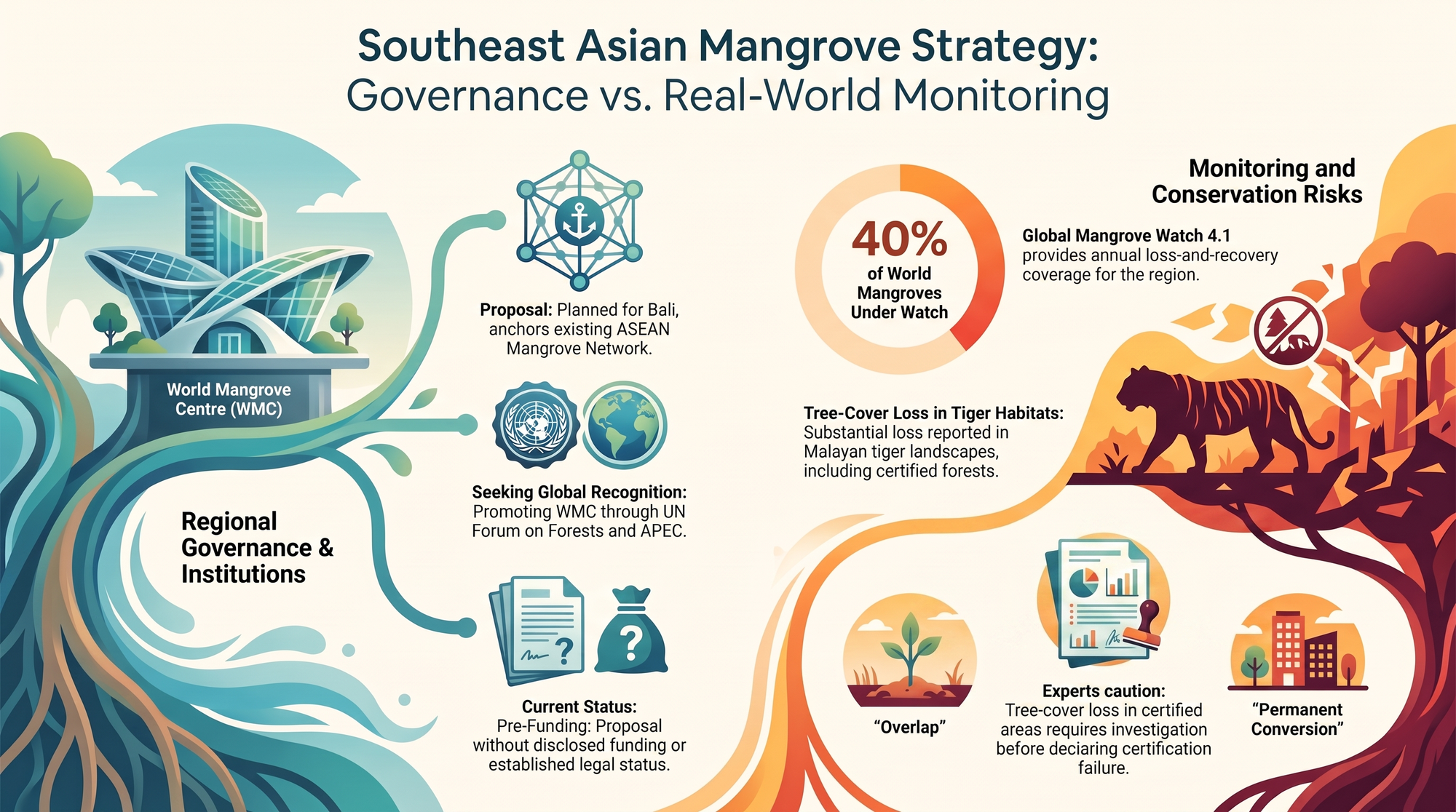
Indonesia's forestry ministry spent the week arguing for regional mangrove governance rather than announcing capital for it. At the 21st ASEAN Working Group on Forest Management in Siem Reap, Cambodia, the ministry promoted a proposed World Mangrove Centre, built on the Bali-based Mangrove Information Centre and anchored in the ASEAN Mangrove Network, and said it would seek wider recognition through the UN Forum on Forests and APEC. [8] The center remains a proposal, with no disclosed funding or legal form.
The measurement sharpened the same week, with Global Mangrove Watch 4.1 extending annual loss-and-recovery coverage across a region holding roughly 40% of the world's mangroves. [4] A counter-signal arrived from Malaysia, where secondary reporting on a new study described substantial tree-cover loss in Malayan tiger landscapes, including reported overlap with certified forest. [9] That overlap is the item to watch rather than to conclude from: tree-cover loss is not automatically permanent conversion, and the primary study and its certification overlay need examination before anyone calls it a certification failure.
What This Means
The practical response for project designers and financiers is not more verification in the abstract but method-risk diligence conducted before commitment and written into contracts. Financial models should be stress-tested against a conservative crediting ceiling, delayed issuance, revised sampling requirements, and changes to leakage or eligibility treatment, because Australia's soil-carbon review shows that a regulator can impose all four on a method already in service.
Financing and offtake agreements should specify who bears methodology-change risk and what follows if expected units are withheld rather than canceled. For nature projects specifically, assurance that stops at satellites, registries, and accounting formulas is incomplete: tenure, free, prior, and informed consent, benefit sharing, grievance mechanisms, and community-held evidence determine whether a technically sound instrument is also durable.
Worth Watching Through Year-End
The Taskforce on Nature-related Financial Disclosures (TNFD) 2026 Status Report survey closes on 14 August 2026, informing a global stocktake of how organizations are implementing nature-related assessment, reporting, and decision-making, with the stocktake to be released during Climate Week NYC in September. (TNFD.) [10]
CBD COP17 convenes in Yerevan, Armenia, from 19 to 30 October 2026 and will undertake the first global review of collective progress in implementing the Kunming-Montreal Global Biodiversity Framework. (Convention on Biological Diversity.) [11]
UNFCCC COP31 runs in Antalya, Türkiye, from 9 to 20 November 2026, with Türkiye hosting and Australia serving as President of Negotiations. (UNFCCC.) [12]
The Tropical Forests Forever Facility continues assembling sponsor capital under Brazil's COP presidency through the end of 2026, with Luxembourg committing EUR 50 million for 2026 to 2030 in June and hosting the facility's financial arm. Announced contributions, signed capital, and deployable funds remain distinct. (COP30 Presidency.) [13]
Endnotes
[1] NbS Praxis, Weekly Briefing No. 9, "Capital Arrives Link by Link," week to 25 July 2026. Prior issue, cited for continuity; not an external primary source. https://www.nbspraxis.com/no-9-capital-arrives-link-by-link/
[2] Australian Government, DCCEEW, "Estimation of soil organic carbon sequestration using measurement and models method" and "Have your say on the ACCU Scheme's Soil Organic Carbon 2021 method," consultation opened 28 July 2026, https://www.dcceew.gov.au/climate-change/emissions-reduction/accu-scheme/methods/estimation-of-soil-organic-carbon-sequestration-using-measurement-and-models; reported by Argus Media, The Land, and Carbon Pulse, https://carbon-pulse.com/536015/. ERAC review completed April 2026, released late July; the ceiling is a recommendation under consultation, not a final rule, and the mechanism is temporary withholding rather than cancellation. Unit is tonnes of soil organic carbon, not CO2 equivalent.
[3] Verra stakeholder update webinar, 29 July 2026, https://verra.org/events/stakeholder-update-webinar-july-2026/; reported by Carbon Pulse, https://carbon-pulse.com/536786/. Registry launch plus dMRV testing and durability pilots; safeguards governing projects not finalized.
[4] Global Mangrove Watch v4.1 (Wetlands International, The Nature Conservancy, Aberystwyth University, soloEO), official launch World Mangrove Day, 26 July 2026, https://www.globalmangrovewatch.org/. Modeled remote-sensing estimates of mapped cover change, not ground verification. The sixfold improvement to 10-meter baseline mapping is a version 4 series characteristic rather than a 4.1 addition, so no resolution claim is attributed to this release; the platform cautions that global net figures mask large regional losses.
[5] Carbon Pulse interview, "Compliance market for nature credits could emerge to scale finance, says EIB," 29 July 2026, https://carbon-pulse.com/536624/. One EIB biodiversity lead's interview position, not EIB or EU policy.
[6] International Climate Initiative, 28 July 2026, https://www.international-climate-initiative.com/en/iki-media/news/new-iki-projects-launched-to-reduce-emissions-and-boost-biodiversity/. Primary source; projects entering implementation. No cohort funding figure disclosed and none inferred.
[7] Carbon Pulse, 29 July 2026, https://carbon-pulse.com/536518/; EIB project record, https://www.eib.org/en/projects/all/20240355. First-close amount undisclosed; USD 100 million is the target, not capital raised; impact figures are intended targets.
[8] ANTARA News, 30 July 2026, https://en.antaranews.com/amp/news/424635/indonesia-promotes-world-mangrove-center-at-asean-forestry-forum. Primary state-news report; the World Mangrove Centre is a proposal, not a funded or constituted institution. Regional share given as roughly 40% following the ASEAN Centre for Biodiversity.
[9] Carbon Pulse, 29 July 2026, https://carbon-pulse.com/536523/; also Free Malaysia Today. Secondary reporting of a study whose primary text, tree-cover definitions, canopy threshold, and certification overlay were not obtained. Hectare figures and any inference of certification non-compliance withheld pending the primary report.
[10] TNFD 2026 Status Report survey, closing 14 August 2026, https://tnfd.global/. The date is the survey deadline informing the Status Report, not a consultation on revising nature-risk guidance.
[11] Convention on Biological Diversity, COP17, Yerevan, 19–30 October 2026, https://www.cbd.int/cop.
[12] UNFCCC, COP31, Antalya, 9–20 November 2026, https://unfccc.int/cop31. No agenda priority claimed; published material does not yet establish one.
[13] COP30 Presidency, Luxembourg EUR 50 million pledge, June 2026, https://cop30.br/en/news-about-cop30/luxembourg-joins-the-tropical-forests-forever-facility-tfff-and-pledges-euro50-million. Pledged sponsor capital; announcements are not signed or deployable capital.
[14] Background, outside the reporting window, cited as context not current-week news: UNEP FI "Conceptual Framework for Sustainability Risk Integration," launched 22 July 2026, https://www.unepfi.org/industries/banking/conceptual-framework-for-sustainability-risk-integration/ (sustainability risks broadly, not climate and nature alone); the coral-reef biodiversity-credit perspective published online 10 June 2026; and Forestry Australia's 26 June 2026 criticism of the improved native forest management method, which ERAC had assessed as suitable to be made after amendments.