The Reconciliation Burden: What One Mangrove Hectare Must Prove and to Whom
Nature finance did not fail to write its rules. Nature finance wrote several sets of them, each for a different purpose, none designed to be reconciled with the next, and left the reconciliation to the project, which pays in time and depends on institutions no proponent can direct.

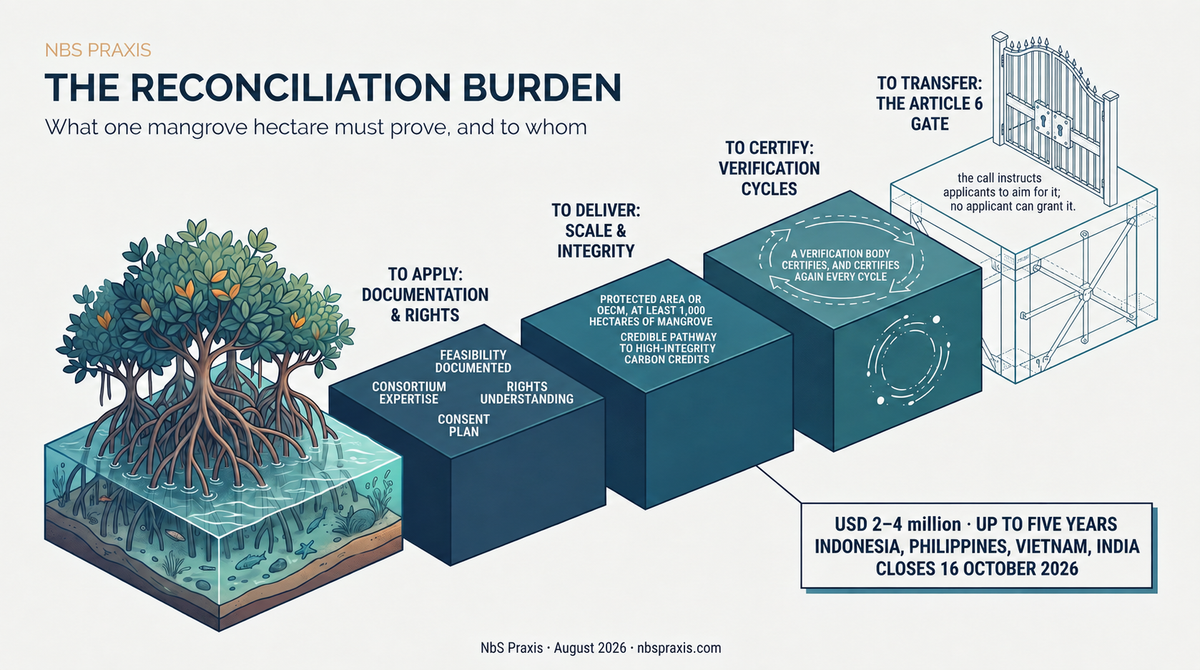
This paper argues that the codification layer of climate-and-nature finance, the arena where taxonomies, crediting rules, disclosure regimes, and conservation targets are written, did not merely run ahead of capital: the layer produced the shape in which capital now arrives. Composition works inside each family of rules and stops at the family boundary, and nothing, binding or voluntary, carries a single project from taxonomy through Article 6 authorization to accounting standard to conservation target. A live Blue Action Fund call, closing 16 October 2026, shows a publicly funded foundation writing that bridge privately because no public standard exists to write it. The record then shows what the reconciling costs: less in invoices than in waiting, and in gates held by ministries, registries, and legislatures. A deliberate search of the public record for the counterexample returned nothing that qualified. The paper closes with the reconciliation test, six questions, three for the project team and three for the funder, to ask before design closes.
An hectare of mangrove on the Indonesian coast, put forward under a call for proposals that closes this October, must prove a great deal, and keep proving long after the first grant money arrives.
To qualify at all, the project behind the hectare must include a documented feasibility study, a consortium with carbon-accounting, measurement, methodology, and project-design expertise, an understanding of carbon and land rights, and a plan for free, prior and informed consent that meets international standards and the funder's own safeguard system. To deliver, the project must establish or improve a protected area or another effective area-based conservation measure that meets criteria set by the International Union for Conservation of Nature (IUCN) and the Convention on Biological Diversity (CBD), and must have a credible pathway to high-integrity carbon credits under a standard aligned with the Core Carbon Principles of the Integrity Council for the Voluntary Carbon Market (ICVCM). A validation and verification body (VVB) must later certify the amount sequestered per hectare and recertify at every cycle. And if the credits are to count toward another country's climate pledge, the host government must authorize that use under Article 6 of the Paris Agreement, an authorization the call instructs applicants to seek and that no applicant can grant themselves.[1]
Each requirement is reasonable on its own terms. Each was written by a different institution for a different purpose on a different timetable. None was written with the others in view. The grant, when awarded, finances part of the reconciliation. The gates the funder cannot open remain.
That reads as a compliance story. The story is about authorship.
What the codification layer produced
The codification layer did not merely run ahead of capital deployment. The codification layer produced the shape in which capital now arrives.
The symptom was visible in one week of July 2026, when five announcements placed capital at five distinct points along a chain running from project preparation through capital structure to verified ecological result, and not one carried the link that follows.[2] Capital arriving link by link looked like a coordination failure among funders. The explanation lies upstream. Capital arrives in disconnected pieces because the rules governing each piece were written by different bodies, for different purposes, on different timetables, none designed to compose with the next.
Two qualifications limit the claim:
- Project preparation, access to finance, financing terms, rights and tenure, fiduciary capacity, and ecological verification each bind independently, and adding an additional constraint dissolves none of them. This paper proposes no new master constraint.
- Not every hectare falls under all of the regimes listed above. A sustainable-finance taxonomy applies where the financing entity is subject to it, and the ASEAN Taxonomy for Sustainable Finance, at Version 4 since November 2025, remains voluntary at the regional level.[3] An Article 6 corresponding adjustment applies when a credit's use is authorized toward another country's pledge or for other international mitigation purposes; a cross-border sale alone triggers nothing.
A disclosure regime binds the buyer, not the hectare. The narrower claim is the one worth defending: there are now projects where these regimes converge on a single site by design, the convergence is documented in a public document, and reconciliation falls entirely on the applicant.
And in the record this paper reviews, reconciliation is paid less in invoices than in schedules, and depends on institutions the proponent does not control.
Where composition works, and where composition stops
The field is not standing still, and any argument about fragmentation must first withstand the counterevidence.
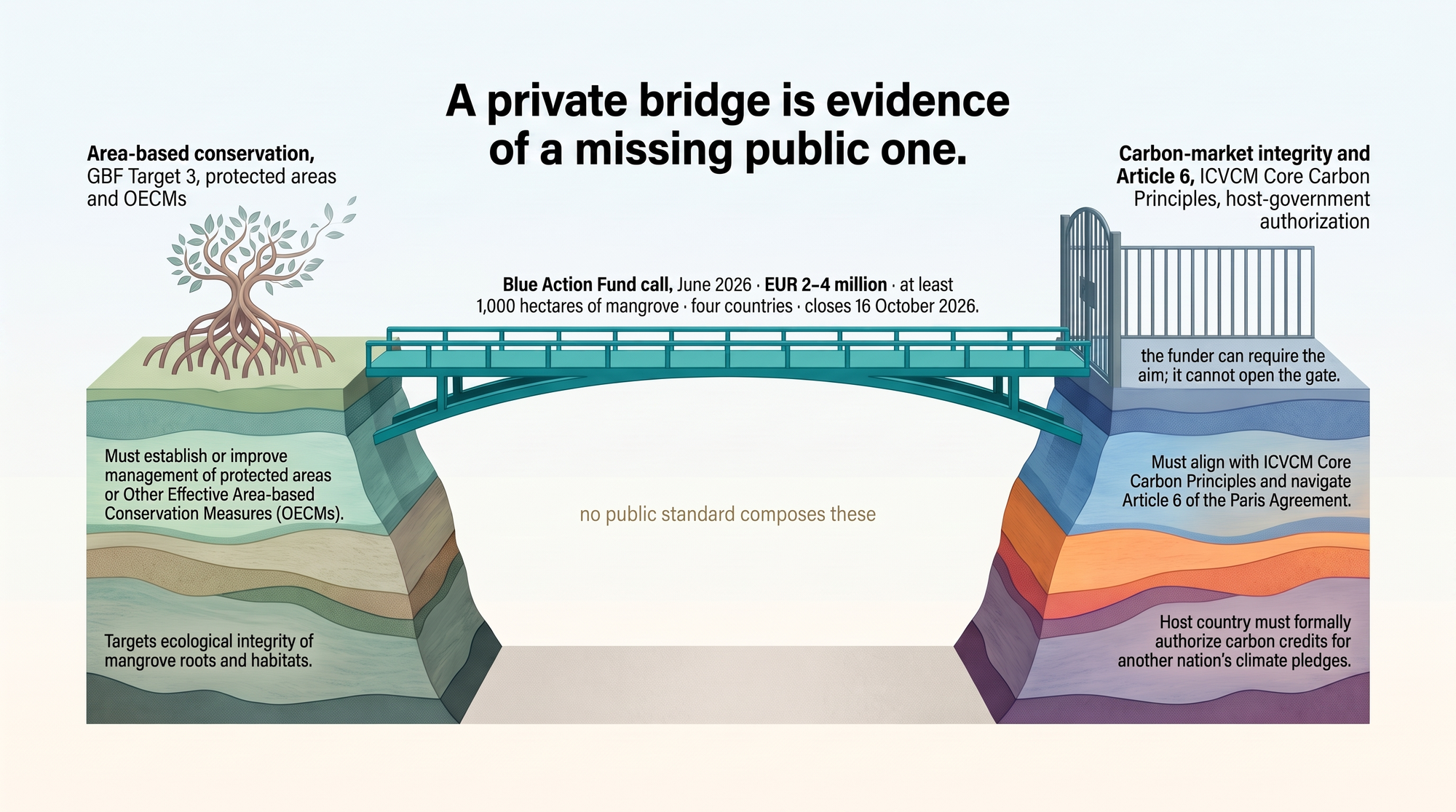
Within the disclosure family, convergence is real and carefully staged. The International Sustainability Standards Board (ISSB) decided in November 2025 to build its nature-related work on the framework of the Taskforce on Nature-related Financial Disclosures (TNFD); chose in April 2026 to propose the instrument as an IFRS Practice Statement, guidance with a standard's full effect only for entities claiming compliance; and in July 2026 moved toward balloting an exposure draft targeted for October 2026.[4] The Global Reporting Initiative and TNFD have published interoperability mapping confirming strong alignment.[5]
Within the taxonomy family, the International Platform on Sustainable Finance presented the Multi-Jurisdiction Common Ground Taxonomy in Baku, Azerbaijan, on 14 November 2024, mapping the Chinese, European Union, and Singapore taxonomies against one another.[6]
Both efforts acknowledge limits. The Common Ground Taxonomy is a technical reference document and is expressly not legally binding. In the Asian Development Bank's Asia Bond Monitor, the Sustainable Finance Institute Asia's chief executive concedes that equivalence, rather than interoperability alone, will eventually be needed.[7] The ISSB will permit TNFD metrics, through conditional adoption rather than absorption, where they serve the objectives of IFRS S1 and do not conflict with existing standards; choosing a Practice Statement rather than a standard keeps a door open without walking through.
The European Union has gone further than any other jurisdiction in addressing regime overlap, taking three steps over time. The Omnibus proposals of 26 February 2025 were justified by administrative burden, with estimated annual savings of around EUR 6.3 billion, roughly EUR 4.5 billion of which came from the sustainability measures.[8] A quick-fix amendment of 11 July 2025 gave the first wave of reporters relief, including permission to omit biodiversity data points for financial years 2025 and 2026.[9] Revised reporting standards followed on 3 July 2026, projected to cut reporting costs per company by roughly 30%.[8] Simplifying duplicated obligations is the correct response to proliferation, and no other rule-writer has mounted one at this scale.
Read closely, the three steps show how much more could have been accomplished at the junction that mattered most for nature. Biodiversity is the one place where corporate disclosure meets the regimes governing the hectare, where reconciliation across families would have paid the most. Faced with that junction, the relief deferred the biodiversity data points, and the revision simplified within the disclosure family. The deferral is legitimate, and the relief is real. The opportunity was to make biodiversity reporting align with the crediting and conservation regimes already governing the same ground, and that opportunity stayed on the table. Regimes move apart under pressure as readily as they converge under design.
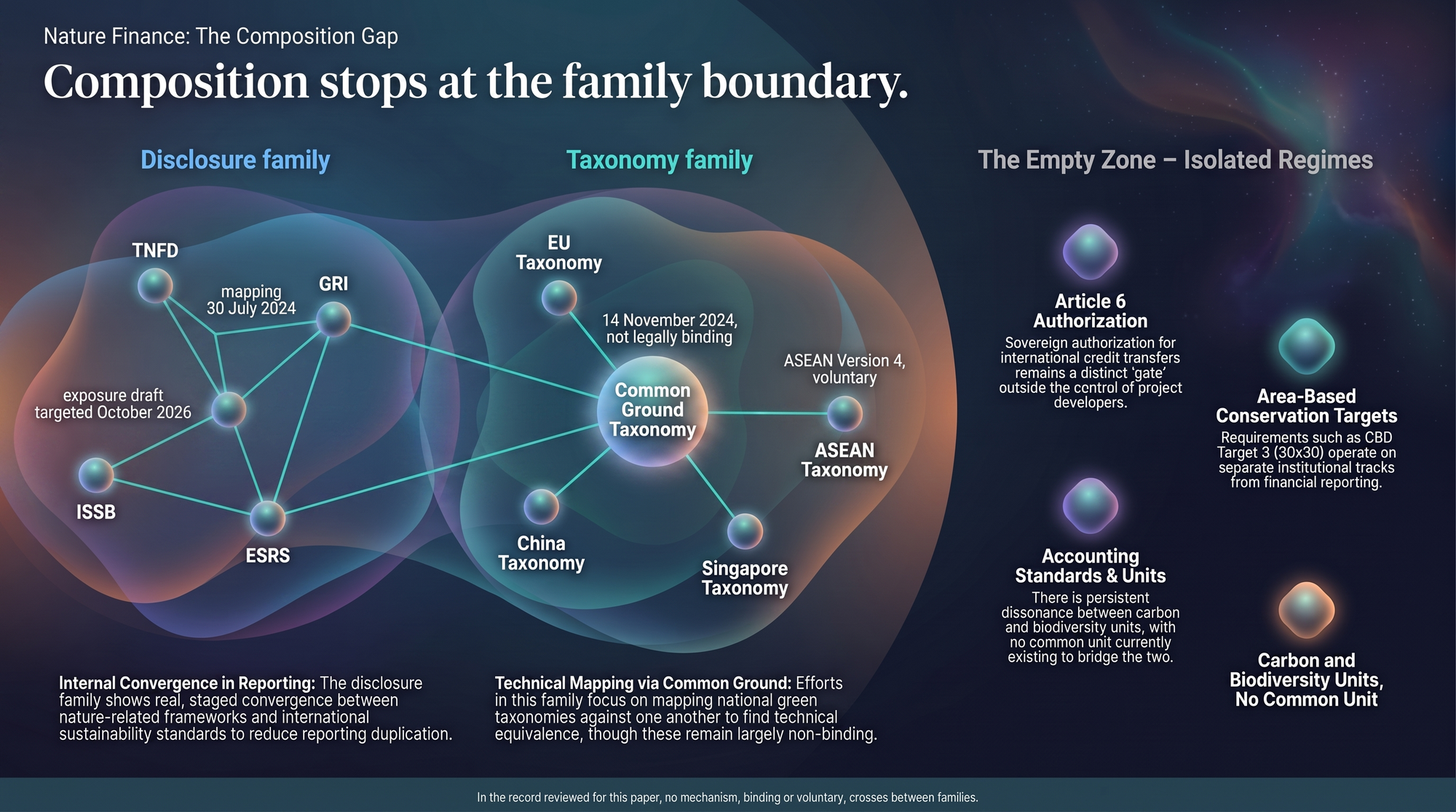
The pattern is consistent. Composition operates within a family of rules that share an author community, a vocabulary, and a purpose. Composition ends at the family boundary. In the record reviewed for this paper, no mechanism, binding or voluntary, runs from a taxonomy through an Article 6 authorization to an accounting standard to an area-based conservation target. Nor does a common unit exist between carbon and biodiversity: a study published in August 2025 traced the persistent dissonance over a biodiversity unit to a framing borrowed from the carbon credit.[10]
A funder writes the bridge
Blue Action Fund is a nonprofit foundation under German civil law, established in December 2016 by Germany's Federal Ministry for Economic Cooperation and Development through KfW Development Bank, and since then funded by the Swedish Ministry for Foreign Affairs, Agence Française de Développement, the Norwegian Agency for Development Cooperation, and Irish Aid, alongside the Green Climate Fund for one regional program. The portfolio stood at EUR 199.3 million on the fund's grant-program pages in May 2026. Blue Action makes grants to non-governmental organizations through competitive calls and implements nothing itself.[11]
A philanthropy writing an idiosyncratic funding rule exercises private discretion. A foundation funded by five European governments writing one is public money composing rules the public rule-writing system has not composed.
The call opened in June 2026 and closes on 16 October 2026, offering grants of EUR 2 to 4 million over up to five years to organizations working in Indonesia, the Philippines, Vietnam, or India. Each project must combine the establishment or improved management of a protected area or other effective area-based conservation measure covering at least 1,000 hectares of mangrove with what the call terms a credible pathway toward high-integrity carbon credits. Applicants must explain the route to market and the buyer landscape, ensure no double claiming, aim for national authorization under Article 6, and submit to a standard aligned with the ICVCM Core Carbon Principles and the High-Quality Blue Carbon Principles and Guidance. Blue Action states that projects designed primarily to offset continued fossil fuel expansion or mining will not be supported.[1]
No public standard combines CBD Target 3 with Article 6 and voluntary carbon market integrity. A publicly funded foundation therefore composed them privately, in one call, for four countries, with a deadline in October. A private bridge suggests a missing public one.
Blue Action can require an applicant to seek Article 6 authorization; Blue Action cannot require a host government to grant one.
Blue Ventures holds a Blue Action grant of EUR 1,778,602, co-financed by EUR 830,398, a five-year grant running from August 2021 to September 2026, to safeguard blue forests in Indonesia.[12]
The grant predates the current call and its explicit carbon pairing requirement, making the project a useful reference point: mangrove protection at scale within a national jurisdiction that suspended international transfers of carbon credits for much of the grant period. Figures are institution-reported; no independent evaluation of the Blue Action portfolio has been published.
What the burden is denominated in
Ask what reconciliation costs, and the field can answer precisely for one regime.
Under the Verified Carbon Standard, the issuance levy has been USD 0.23 per credit since the fee schedule took effect on 1 January 2025, with an upfront charge of USD 5,000 for each verification review, half of which is creditable against later issuance levies.[13] Program and registry fees are one column of the ledger; the validation and verification body's charges are a second, recurring each cycle at levels that do not decrease with project size, as this series established in the Medellin paper.[14] The project's own monitoring, studies, and legal work are a third. The prices are public because a market cannot transact without a fee schedule.
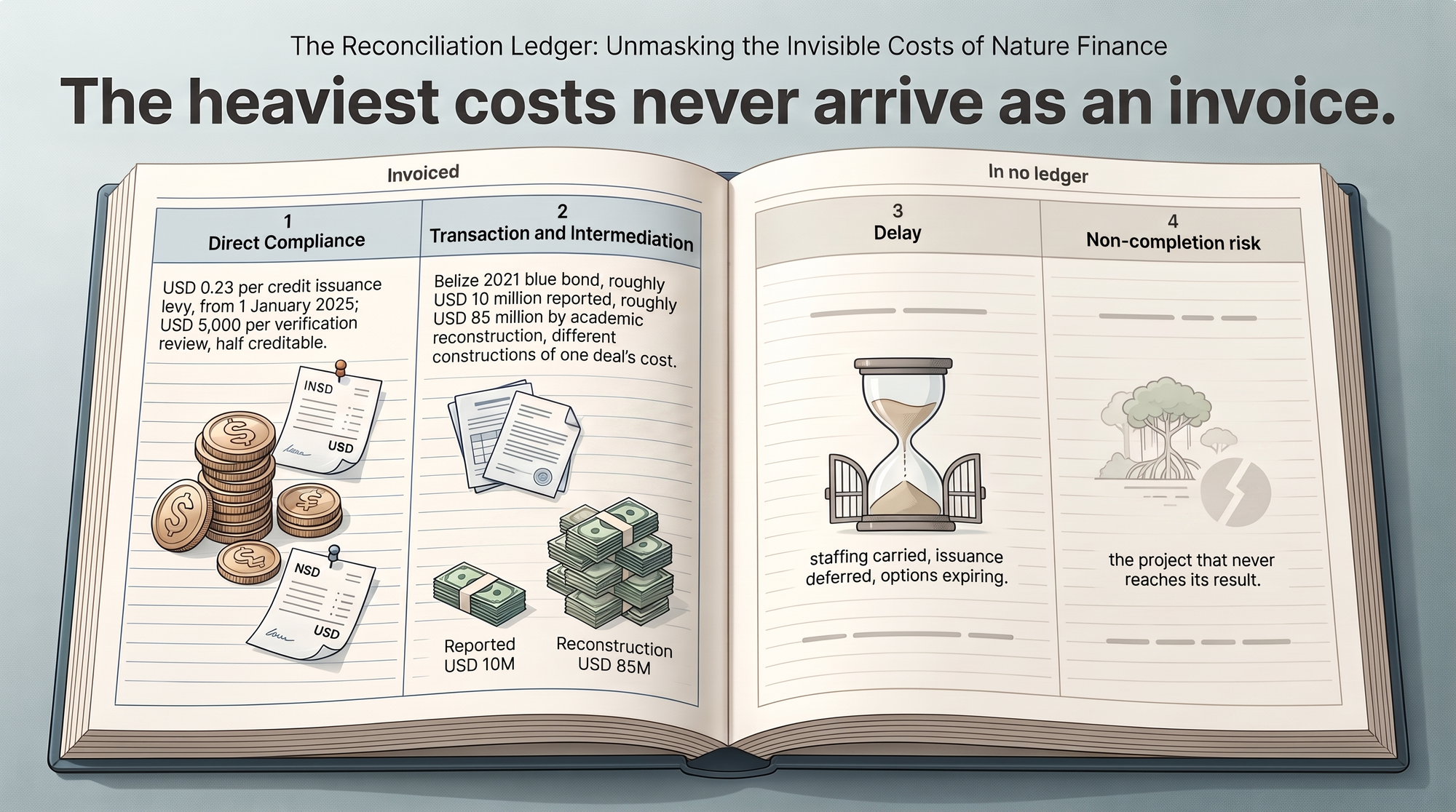
Reconciliation carries four kinds of cost:
- Direct compliance expenditure:fees and studies above;
- Transaction and intermediation costs, including the structuring, insurance, and arranger margins of assembled deals;
- Economic cost of delay, including staffing carried, issuance deferred, and options expiring; and
- Non-completion risk, the project that never reaches its result.
The first two arrive as invoices, sometimes published. The last two arrive as time and probability and do not appear in any ledger.
Now ask what the stacked regimes cost. Corporate disclosure has estimates because the European Commission modeled them: around EUR 287,000 one-off and EUR 320,000 recurring for a large company.[15] But corporate disclosure binds the buyer. For the regimes binding the hectare, no citable primary source prices the per-transaction host-country cost of Article 6 authorization, and none prices taxonomy alignment or an area-based designation. Those gaps are stated, not filled by inference. The stack is unpriced because its heaviest components, the delay and the risk of never completing, never arrive as an invoice.
Regimes do not stack additively in money. Regimes stack multiplicatively in risk. Each regime introduces a gate, and most are held by an institution outside the proponent's control: a ministry that must authorize, a legislature that must legislate, a registry that must register, or a cabinet that must sign a designation decree. Six regimes are not six times the paperwork. Six regimes are a chain in which any stalled link stalls everything downstream.
The claim survived a deliberate search of the public record for its counterexample, a documented case in which money, at a material scale rather than time, was the binding constraint. Nothing qualified, and absence from the reviewed record is not proof of absence.
The nearest case in nature finance is Belize's 2021 blue bond. The transaction retired USD 553 million of sovereign debt through USD 364 million in new financing, backed by USD 610 million in political-risk insurance from the United States International Development Finance Corporation. Reported transaction costs totaled roughly USD 10 million. An academic reconstruction, which counted arranger margin, insurance premiums, and reinsurance, put the full cost of intermediation closer to USD 85 million. The Nature Conservancy's own case study reports an all-in financing cost of 6.1%, with USD 39 million directed to reserves, transaction costs, and original issue discount.[16] The three figures are different construction costs, not competing measurements of one number, and the criticism the transaction drew was denominated in money. Yet the structure was conditioned on the passage of a Blue Bonds Loan Act, on marine spatial planning, and on protected-area commitments, none of which the arrangers could deliver and all of which the sovereign held. The fees priced the assembly. The gates set the shape and the schedule.
The two currencies convert at the margin. In May 2026, Singapore committed USD 15 million to the Global Green Growth Institute's Carbon Transaction Facility, including USD 5 million for an Article 6 readiness facility addressing host-country institutional capacity and transaction costs.[17] Switzerland's KliK Foundation, with facilitation from the United Nations Development Programme, financed the cookstove activity behind Ghana's first issued transfers, completed in July 2025.[18] Money can shorten a gate and lower the probability of a gate closing. Money cannot open a gate a sovereign holds shut.
Where reconciliation fails
The record of failure is unusually legible, because regulatory gates close in public.
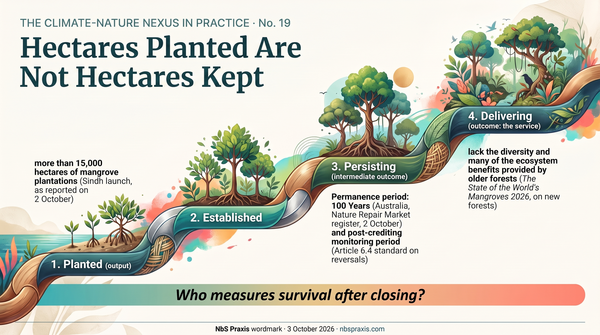
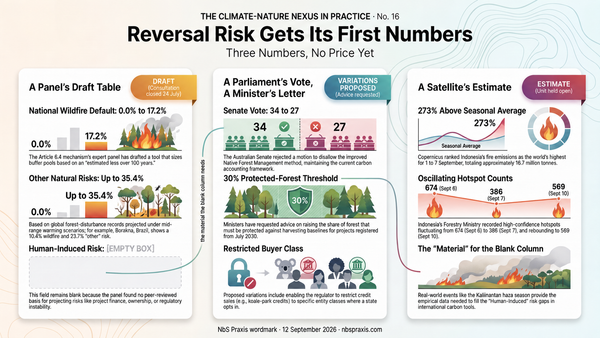
Papua New Guinea imposed a moratorium on voluntary carbon market REDD+ projects in March 2022 while national rules were being drafted, and lifted the moratorium on 10 April 2025, three years later, citing carbon market regulations now in place.[19] Indonesia suspended international transfers of carbon credits in 2022 and reopened them in stages: international trading launched on the national exchange on 20 January 2025, initially carrying energy-sector units; the forestry sector received its own pathway in April 2026 under Minister of Forestry Regulation No. 6 of 2026, with first approvals that July.[20] For an applicant responding to the Blue Action call from Indonesia, the rules governing their credits are younger than the call itself. Zimbabwe declared all existing carbon agreements null and void on 16 May 2023 and claimed half of project revenue; Statutory Instrument 150 of 2023 revised the split that August so developers retained up to 70%; and Statutory Instrument 48 of 2025, gazetted on 2 May 2025, repealed the 2023 framework and established a new carbon markets authority and registry. Three sets of rules in three years, each binding while current.[21]
The multilateral gates run more slowly. Accreditation to the Green Climate Fund historically took about 30 months; a revised framework, whose first application window opens in January 2026, provides a nine-month review period that excludes applicant response time. Funding-proposal approval is a separate process, and the Fund's own evaluation office found a median of 21 months for least-developed-country proposals, with the longest at 58.[22]
None of those was a financing failure. Each was a decision or a non-decision by an institution the project proponent could not direct.
The pattern achieves conservation outcomes directly. A Blue Action grant to the Wildlife Conservation Society across Kenya, Madagascar, and Tanzania closed in January 2024, having exceeded its beneficiary target more than fourfold, at 21,915 people against 5,000, while recording nothing toward its 2,950 square kilometer objective for new protected areas. The enabling gazettement decree in Madagascar was still pending when the grant closed, after leadership changes, election cycles, and pandemic disruption had each slowed the file.[23] Community engagement, where the grantee held the greater share of influence, overperformed. Legal designation, which only a government could complete, did not arrive within the grant's five years.
The Wildlife Conservation Society received EUR 2,905,754 in Blue Action funding and EUR 959,250 in co-financing from May 2019 to January 2024 to create a network of resilient marine protected areas across Kenya, Madagascar, and Tanzania.
Blue Action's own recorded lesson concerns administrative burden: multi-country projects involve large implementing teams, require additional coordination, and carry a higher administrative load. Figures are institution-reported.[23]
The Work Ahead
If the burden is scheduled and dependent on others, the response belongs in project preparation and takes the form of questions asked before design closes, not clauses negotiated after. Call it the reconciliation test: six questions, three for the project team and three for the funder.
To the project team:
- Which approvals on this project are held by institutions we do not control, and who, by name, holds each one?
- Which regime is load-bearing: the one whose failure kills the project rather than merely delays it?
- What must start in month one because nothing can compress it afterward?
To the funder:
- Who set the requirements for this call, and which of them lacks a public standard?
- If the host government never grants the authorization we are instructed to seek, what in this grant survives?
- Where a gate reflects capacity rather than intent, whose readiness money can move it now, as Singapore's and Switzerland's readiness money has?
The third question addresses the safeguard that schedules usually break. Free, prior, and informed consent, grievance access, and community deliberation are not preparatory steps to accelerate: consent takes the time adequacy requires, and a plan that counts on recovering that time later is designed to fail its own safeguards. Gates held by a ministry, a registry, or a legislature cannot be compressed either; those can only be started earlier, a design decision made at inception or not at all.
A project team that can answer the first three questions has found its gates.
A funder that can answer the second three has earned the application.
And when the answers come only from the funder's template, remember what a template is: the funder's set of rules, not the project's.
The rule set has not paused for the argument. The IUCN Global Standard for Nature-based Solutions reached a second edition on 10 October 2025,[24] the Paris Agreement Crediting Mechanism became fully operational with its first approved methodology on 30 October 2025, and COP30 followed with decisions on transition and financing,[25] and IPSAS 51, the first accounting standard for natural resources held for conservation, was issued on 22 January 2026 and takes effect on 1 January 2028.[26]
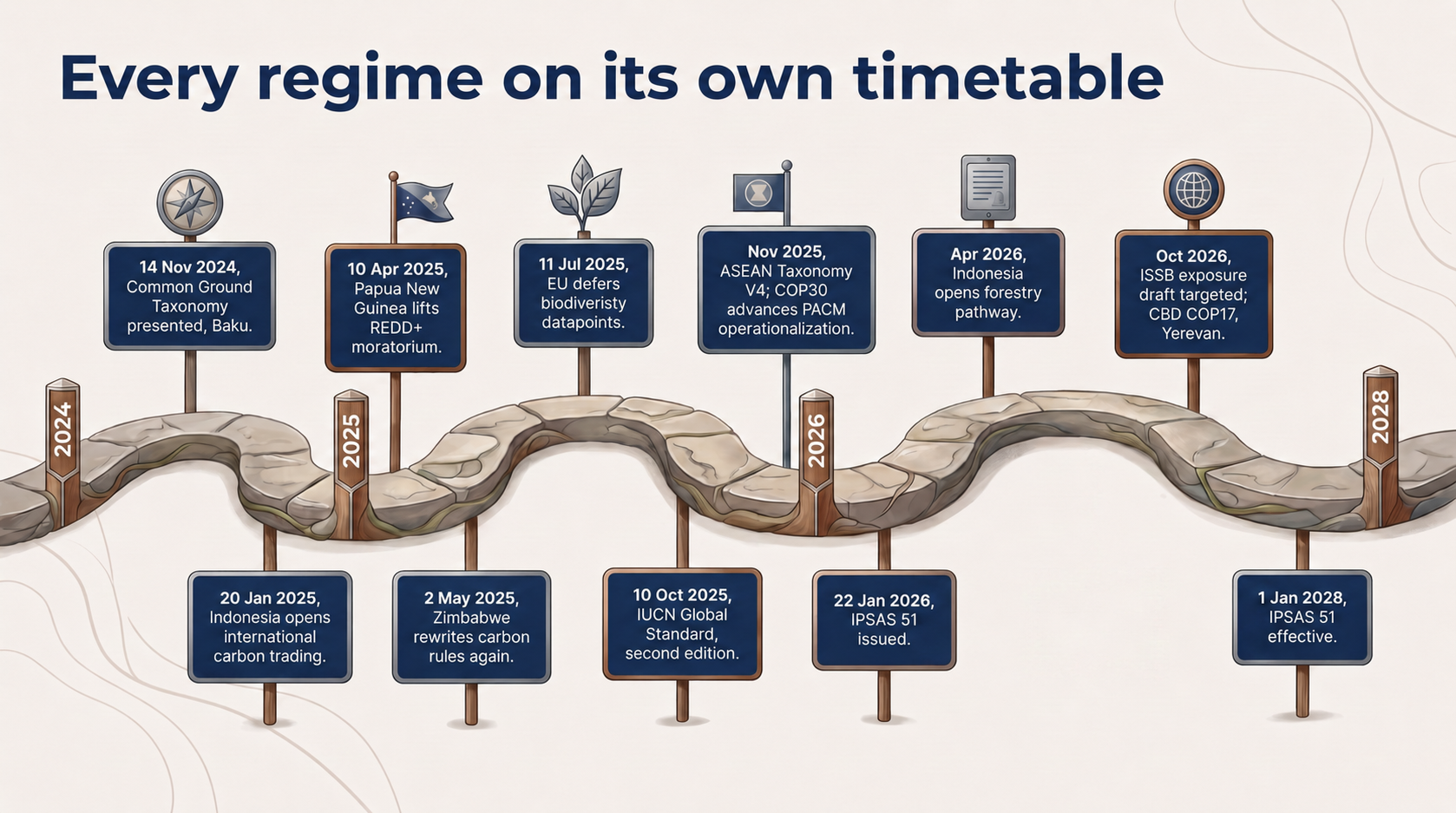
One condition dissolves this argument, and that condition belongs in the text. A binding cross-family composition mechanism, whether a CBD instrument with legal force or an ISSB standard that absorbs taxonomy and carbon-accounting logic into a single reporting obligation, would move the reconciliation upstream to the rule-writers. Watch the exposure draft due in October 2026 and the first global review of the Global Biodiversity Framework at CBD COP17 in Yerevan, Armenia, the same month. Until one of those produces a bridge, the bridge is built project by project, by the applicants least equipped to build one, and paid for in a currency nobody is counting.
Note: All frameworks cited were verified as of Mid August 2026; several are mid-revision.
Several short explainer videos are uploaded on the NbS Praxis YouTube channel. The written analysis above is the definitive version.
Explainer Podcast produced by the author using Gemini Notebook:
Endnotes
[1] Blue Action Fund. (2026, June). Call for proposals: Mangroves, blue carbon markets, and 30x30 in Asia. Closing date: 16 October 2026. Requirements stated in the call include documented pre-feasibility or feasibility assessments, consortium expertise, minimum 25% match funding, and free, prior, and informed consent consistent with international standards and the fund's environmental and social management system.
[2] NbS Praxis. (2026, July 26). No. 9 - Capital arrives link by link. Weekly briefing for the week ending 25 July 2026. The five institutional announcements are individually sourced in that issue's endnotes.
[3] ASEAN Taxonomy Board. (2025, November 6). ASEAN taxonomy for sustainable finance (Version 4). ASEAN. Version 4 supersedes Version 3, released on 27 March 2024 and effective on 20 December 2024. The taxonomy is voluntary at the regional level, with national adoption and regulatory use varying among ASEAN Member States.
[4] IFRS Foundation. (2025, November 7). ISSB welcomes TNFD's support as it advances nature-related disclosures.
IFRS Foundation. (2026, May). ISSB agrees on the proposed way forward for nature-related disclosures. News release reporting the Board's April 2026 decision, taken in Beijing, to propose an IFRS Practice Statement.
IFRS Foundation. (2026, June). ISSB Update: June 2026.
IFRS Foundation. (2026, July). Nature-related disclosures [work plan].
The ISSB began work in November 2025 on nature-related disclosures informed by TNFD recommendations. The July 2026 meeting initiated balloting, with an exposure draft targeted for October 2026. A Practice Statement is not an IFRS Sustainability Disclosure Standard; application would be voluntary, whereas entities claiming compliance with IFRS Sustainability Disclosure Standards must comply with applicable standards.
[5] Global Reporting Initiative & Taskforce on Nature-related Financial Disclosures. (2024, July 30). Interoperability mapping between the GRI Standards and the TNFD recommended disclosures and metrics. The mapping identifies commonalities and linkages between GRI's impact-reporting standards and TNFD's nature-related disclosure recommendations and metrics.
[6] International Platform on Sustainable Finance. (2024, November). Multi-jurisdiction common ground taxonomy: Methodology and activity tables. European Commission. Presented in Baku, Azerbaijan, on 14 November 2024. It maps the Chinese, European Union, and Singapore taxonomies and is a technical comparison, not a legally binding instrument for participating jurisdictions.
[7] Wong, E. (2024, June). Taxonomies in action: The ASEAN taxonomy for sustainable finance. Asia Bond Monitor. Asian Development Bank. The equivalence formulation is verbatim in the source: "Eventually, taxonomy equivalence, not just interoperability, will be needed."
[8] European Commission. (2025, February 26). Commission proposes to cut red tape and simplify business environment [Press release]. European Commission; European Financial Reporting Advisory Group. (2026, July). European Commission publishes delegated act on revised ESRS and voluntary sustainability reporting. The Commission estimated annual administrative savings of about EUR 6.3 billion overall, including about EUR 4.5 billion associated with sustainability-reporting measures; prospective estimates, not realized savings.
[9] European Commission. (2025). Commission Delegated Regulation (EU) 2025/1416 of 11 July 2025 amending Delegated Regulation (EU) 2023/2772 as regards the postponement of the date of application of the disclosure requirements for certain undertakings. Official Journal of the European Union, L, 2025/1416, 10 November 2025. In force from 13 November 2025. The regulation extends selected ESRS phase-in reliefs for first-wave CSRD reporters, including specified ESRS E4 biodiversity-and-ecosystems disclosure requirements, for financial years 2025 and 2026.
[10] Kim, E. H., Dellecker, A., Field, R., Stephenson, P. J., & Schrodt, F. (2025). Towards high-integrity biodiversity credits: Balancing commensurability, ecological complexity and governance. Proceedings of the Royal Society B: Biological Sciences, 292(2053), Article 20250990. Electronic publication: 20 August 2025.
[11] Blue Action Fund. (n.d.). Grant program. Blue Action Fund describes itself as a non-profit foundation under German civil law, established in December 2016 by Germany's Federal Ministry for Economic Cooperation and Development through KfW Development Bank. The cited live record reports support from the Swedish Ministry for Foreign Affairs, Agence Française de Développement, the Norwegian Agency for Development Cooperation, and Irish Aid; it also identifies Green Climate Fund financing for the Western Indian Ocean program. The reported portfolio total of EUR 199.3 million comprises EUR 145.2 million in Blue Action Fund funding and EUR 54.1 million in match funding, as stated on the page in May 2026; figures are institution-reported.
[12] Blue Action Fund. (n.d.). Safeguarding blue forests in Indonesia. In Grant program. Blue Ventures is identified as the implementing organization. The live page, verified 16 August 2026, records an August 2021 to September 2026 grant period and an open status. Institution-reported. A peer-review record showed a July 2026 end date; the live source carries September 2026.
[13] Verra. (2024, October 16). Verra program fee schedule (Version 1.0); Verra. (2024, October 16). New Verra program fee schedule: Frequently asked questions. Effective 1 January 2025, the schedule specified an issuance levy of USD 0.23 per Verified Carbon Unit and USD 5,000 per verification-review request, of which USD 2,500 could be credited against future issuance levies. The transitional USD 0.20 invoice adjustment was limited to projects with verification review requested on or before 16 October 2024, and issuance requested within 30 days of approval; least-developed-country projects were exempt from the new levy until 1 July 2025.
[14] NbS Praxis. (2026, June 19). Resilient equity: What Medellin's green corridors reveal about financing nature. The article characterizes validation and verification fees as largely fixed per project cycle and therefore relatively more burdensome for smaller projects.
[15] European Commission. (2021). Impact assessment accompanying the proposal for a directive as regards corporate sustainability reporting (SWD(2021) 150 final). Adopted 21 April 2021. Annex 17 contains modeled estimates of approximately EUR 287,000 in one-off costs and EUR 320,000 in recurring annual costs for large companies previously reporting under the Non-Financial Reporting Directive; these are modeled figures, not observed compliance costs.
[16] United States International Development Finance Corporation. (2021, November 5). DFC provides $610 million in political risk insurance for innovative debt conversion in support of marine conservation in Belize.
Warner, J. (2023, February 28). Do debt-for-nature swaps work? Learning from Belize. London School of Economics and Political Science, International Development Blog.
The Nature Conservancy. (2021). Belize debt conversion case study. DFC records USD 364 million in Blue Bond financing, USD 610 million in political-risk insurance, and repurchase of USD 553 million in sovereign debt.
Warner's reconstruction estimates intermediation between Belize's debt-service payments and investor returns at approximately USD 85 million. TNC reports a 6.1% all-in Blue Loan cost measure and identifies USD 39 million allocated among the conservation endowment, debt-service reserve, original issue discount, and closing costs. These figures are distinct construction costs and should not be averaged.
[17] Ministry of Trade and Industry, Singapore. (2026, May 19). Singapore enhances Article 6 carbon markets by committing US$15 million to GGGI's Carbon Transaction Facility and establishes Singapore Article 6 Carbon Facility [Press release].
Global Green Growth Institute. (2026, May 19). Singapore joins GGGI's Carbon Transaction Facility as fifth contributor, anchoring new Singapore Article 6 Carbon Facility [Press release].
Singapore committed USD 15 million across two pillars: USD 5 million to the Article 6 Readiness Facility and USD 10 million to anchor the Singapore Article 6 Carbon Facility, joining New Zealand, Norway, Sweden, and the United Kingdom as the facility's fifth contributor.
[18] KliK Foundation. (2025, July 7). Ghana and Switzerland pioneer Africa's first ITMO issuance under Paris Agreement Article 6.2 for NDC use.
United Nations Development Programme. (2022, November 12). Ghana, Vanuatu, and Switzerland launch world's first projects under new carbon market mechanism set out in Article 6.2 of the Paris Agreement [Press release].
UNDP facilitated the Ghana-Switzerland bilateral framework, whose first authorized activity, presented at COP27, was the climate-smart rice project.
The Transformative Cookstove Activity in Rural Ghana, financed by the KliK Foundation, later produced the first ITMO issuance for NDC use from an African activity, in the Swiss Emissions Trading Registry, with a corresponding adjustment commitment by Ghana.
[19] Government of Papua New Guinea. (2022, March). Moratorium on PNG REDD+ voluntary carbon market projects. Agence France-Presse. (2025, April 10). Papua New Guinea lifts forest carbon-credit moratorium. The 2025 report states that the Minister for Environment, Conservation and Climate Change lifted the moratorium on 10 April 2025, citing the implementation of carbon-market regulations.
[20] Otoritas Jasa Keuangan, & Ministry of Environment. (2025, January 20). Inauguration of Indonesia international carbon trading [Joint press release]. The release documents the inauguration of international trading of Indonesian carbon units on IDXCarbon.
[21] Government of Zimbabwe. (2023, May 16). Government statement on carbon-credit agreements; Zimbabwe. (2023, August 18). Carbon Credits Trading (General) Regulations, 2023 (Statutory Instrument 150 of 2023); Zimbabwe. (2025, May 2). Carbon Trading (General) Regulations, 2025 (Statutory Instrument 48 of 2025). The 2025 regulations repeal the prior framework and establish the Zimbabwe Carbon Markets Authority and a national registry.
[22] Green Climate Fund. (2025). Accreditation framework of the Green Climate Fund (Board Decision B.42/13). Green Climate Fund. (2026, January 19).
GCF new accreditation framework: First window opens for accreditation applications. Green Climate Fund Independent Evaluation Unit. (2022, January).
Independent evaluation of the Green Climate Fund's approach to the least developed countries. The Board adopted the framework by decision B.42/13, and it took effect on 31 October 2025; the first accreditation window opened in January 2026, with a nine-month Secretariat and Accreditation Panel review period excluding applicant response time, as stated in the Fund's framework materials and announcement. The 2022 evaluation reported a median funding-proposal approval duration of 21 months and a maximum of 58 months.
[23] Blue Action Fund. (2024, December). Grant report: Wildlife Conservation Society - Western Indian Ocean, May 2019 to January 2024. This institution-reported grant report records leadership changes, election cycles, pandemic disruption, and coordination complexity alongside the pending gazettement decree.
[24] International Union for Conservation of Nature. (2025, October 10). IUCN launches the second edition of the IUCN Global Standard for Nature-based Solutions. The second edition was launched at the IUCN World Conservation Congress in Abu Dhabi, United Arab Emirates, and supersedes the 2020 first edition.
[25] United Nations Framework Convention on Climate Change. (2025, October 30). UN Body agrees first methodology under Paris Agreement carbon market [Press release].
Article 6.4 Supervisory Body. (2025). Annual report to the CMA at its seventh session, covering 10 October 2024 to 30 October 2025. The Supervisory Body's approval of the first methodology on 30 October 2025 made the market, in the UNFCCC's words, fully operational; the foundational methodological standards had been adopted in October 2024. COP30, Belem, Brazil, November 2025, took decisions on Clean Development Mechanism transition and mechanism financing.
[26] International Public Sector Accounting Standards Board. (2026, January 22). IPSAS 51: Tangible natural resources held for conservation. IPSAS 51 is effective for annual periods beginning on or after 1 January 2028, with earlier application permitted.